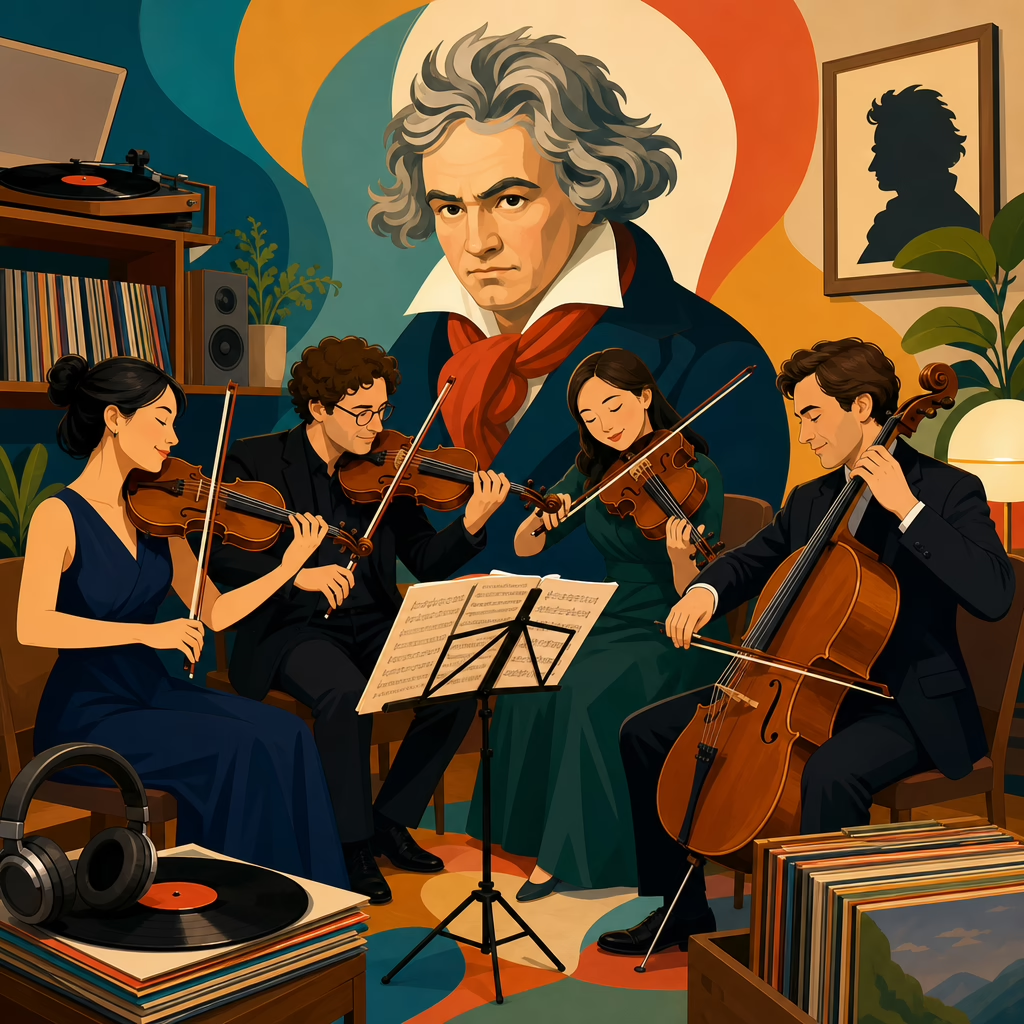
The Best Beethoven String Quartet Recordings
Beethoven’s string quartets are the summit of the chamber music repertory, and choosing the best Beethoven string quartet recordings matters because performances can differ radically in tempo, articulation, tone, repeats, and emotional stance. By “best,” experienced listeners usually mean recordings that combine technical command, structural clarity, stylistic conviction, and replay value rather than mere prestige. By “miscellaneous,” in the context of a Performance and Recordings hub, I mean the essential surrounding questions serious listeners actually have: whether to start with a complete cycle or individual discs, how modern instruments differ from period instruments, which ensembles illuminate the early, middle, and late quartets most persuasively, and which sets are best for beginners, collectors, and audiophiles. I have spent years comparing classic LP-era cycles, first-generation digital sets, and newer historically informed recordings, and one lesson stands out: no single quartet owns Beethoven. The music is too varied. Op. 18 demands elegance and proportion; the “Razumovsky” quartets require symphonic breadth; the late quartets ask for philosophical depth, rhythmic flexibility, and absolute ensemble trust. This guide identifies the standout Beethoven string quartet recordings, explains why they matter, and helps you build a listening path across the complete quartets, selected masterpieces, and overlooked alternatives. Whether you want one authoritative cycle or a shelf of complementary versions, the goal is the same: hear how interpretation changes the meaning of Beethoven’s most searching music.
What makes a Beethoven quartet recording great
A great Beethoven quartet recording balances fidelity to the score with persuasive interpretive character. In practice, I listen for four things first: intonation under pressure, unanimity of rhythm, the quality of inner-voice projection, and a convincing sense of long-range architecture. Beethoven’s writing exposes weakness instantly. In Op. 59 No. 1, for example, a group can shape the expansive first movement either as a dramatic argument or as a sequence of attractive episodes; only the finest ensembles sustain tension across its large spans. In the late quartets, especially Op. 131 and Op. 132, the issue is not simply beauty of tone but whether the players can make abrupt contrasts sound inevitable.
Recorded sound also matters more than many listeners expect. Dry, close engineering can sharpen contrapuntal detail in the Grosse Fuge, while warmer acoustics help the hymnlike pages of Op. 132 breathe. Editions and performance practice are another factor. Some quartets observe all repeats; some trim them. Some use vibrato continuously; others reserve it more strategically. On period instruments or modern setups with reduced vibrato, dance rhythms often emerge with greater bite, though some listeners may miss the plush blend of twentieth-century ensembles. The best recordings make these decisions feel musically necessary rather than doctrinaire.
The benchmark complete cycles
If you want a complete Beethoven string quartets set, three cycles consistently prove their worth. The Alban Berg Quartet’s studio cycle remains one of the safest recommendations because it combines polished ensemble, Viennese tonal warmth, and disciplined structure. Their Op. 18 quartets sing without sounding lightweight, the middle quartets have tensile strength, and the late works avoid exaggeration. The ensemble’s hallmark is cultivated legato paired with excellent balance, which lets secondary lines register naturally. For many listeners, this is the modern-instrument cycle that best bridges lyricism and rigor.
The Takács Quartet offers a more sharply profiled modern perspective. Across their cycle, accents bite harder, dynamic contrasts are more vivid, and phrase endings often carry an extra expressive charge. In Op. 95, that volatility pays off immediately; in Op. 127 and Op. 130, it creates a heightened sense of drama without sacrificing coherence. I often recommend Takács to listeners who want Beethoven to sound urgent, not monumental. Their engineering is generally close enough to capture grain and attack, which suits the music’s argumentative character.
For listeners curious about historically informed performance, the Quatuor Mosaïques cycle is indispensable. Using gut strings and classical bows, they reveal transparent textures, springier rhythms, and startling color contrasts. The result is not antiquarian. Instead, familiar pages feel newly conversational. In Op. 18, the dance elements come alive; in the “Harp” Quartet, pizzicato textures become more percussive and strange. The set is incomplete in practical reach compared with some mainstream cycles for casual buyers, but artistically it changed how many musicians hear Beethoven quartet style.
The finest recordings of the early quartets
The six Op. 18 quartets are often treated as preparation for Beethoven’s later breakthroughs, but that view undersells their originality. These works already stretch Haydn and Mozart models through sharper contrasts, denser motivic working, and emotionally ambiguous slow movements. For the early quartets, I favor ensembles that preserve grace while emphasizing edge. The Tokyo Quartet, especially in their later recordings, finds a poised middle path: elegant phrasing, clean textures, and enough tensile energy to remind you that this is Beethoven, not salon classicism.
The Quatuor Mosaïques is even more revelatory here. Their light articulation and transparent sonority clarify Beethoven’s wit in Op. 18 No. 2 and the theatrical rhetoric of Op. 18 No. 1. The slow movement of No. 1, inspired by the tomb scene from Romeo and Juliet, benefits enormously from their refusal to over-romanticize the line. Every accent sounds motivated. The result is expressive but unsentimental.
Among older classic readings, the Italiano Quartet deserves more attention than it often gets in current recommendation lists. Their blend is beautiful, but the real strength is proportion. They phrase long lines with patience, avoid pushing transitions, and let harmonic tension do the work. If you value refinement over overt intensity, their early Beethoven remains deeply satisfying.
Middle-period power: Razumovsky, Harp, and Serioso
The middle quartets are where many listeners decide which ensemble speaks Beethoven most convincingly. Op. 59 Nos. 1–3, Op. 74, and Op. 95 demand a larger scale, more public rhetoric, and almost orchestral force. For the “Razumovsky” quartets, the Emerson String Quartet brings uncommon brilliance. Their precision in passagework, especially fugato textures and rapid exchanges, is extraordinary. Some hear them as slightly cool, but in Op. 59 No. 3 that steeliness enhances the music’s drive.
The Takács Quartet is my preferred choice for Op. 95 “Serioso.” This compact, volatile quartet can sound merely abrupt if under-characterized. Takács shapes its nervous energy into a coherent psychological arc, and the ensemble’s explosive attacks make Beethoven’s dynamic shocks land viscerally. By contrast, the Alban Berg Quartet broadens the work slightly and gives it a more classical profile, which some listeners may prefer.
For Op. 74 “Harp,” the Végh Quartet offers a special lesson in warmth and narrative pacing. Their recorded sound is older and less analytically detailed than modern releases, but the humanity of the playing is unmistakable. The variation movement unfolds with deep affection, and the finale has rustic lift rather than generic brilliance. These older performances remind us that expressive authority is not reducible to perfect polish.
The late quartets: where legends are made
No repertoire tests a quartet more severely than Beethoven’s late quartets. Op. 127, 130, 131, 132, 135, and the Grosse Fuge require mastery of fugue, variation, recitative, dance, hymn, and rupture within single works. The Busch Quartet’s historic recordings remain essential because they capture interpretive daring at white heat. You do not turn to Busch for modern engineering or immaculate tuning by current studio standards. You turn to them because phrasing feels discovered in the moment, climaxes carry existential weight, and transitions speak with unmatched conviction.
For a more modern sonority, the Takács recordings of Op. 131 and Op. 132 are exceptional. In Op. 132, the “Heiliger Dankgesang” unfolds with grave simplicity rather than inflated solemnity; the contrast between modal stillness and the “Neue Kraft fühlend” episodes is perfectly judged. In Op. 131, their handling of the continuous seven-movement span is both analytical and deeply human. You always know where you are structurally, yet nothing sounds diagrammatic.
The Budapest Quartet also remains central in the late works, especially for listeners drawn to patrician balance and long-breathed line. Their Beethoven can sound less interventionist than Busch, but the seriousness of purpose is unmistakable. For many collectors, the ideal library includes both: Busch for dangerous immediacy, Budapest for architectural wisdom.
Best Beethoven quartet recordings by listener type
Different listeners need different recommendations, and this is where a hub article should be practical. If you are buying your first complete cycle, start with Alban Berg or Takács. If you are sensitive to historically informed style and want to hear Beethoven’s textures with less romantic smoothing, add Quatuor Mosaïques. If you love archival recordings and can listen past dated sound, Busch and Budapest are non-negotiable. For audiophile-friendly engineering with modern virtuosity, Emerson remains attractive, especially in the middle quartets.
| Listener need | Best choice | Why it works |
|---|---|---|
| First complete set | Alban Berg Quartet | Balanced interpretations, warm tone, reliable excellence across all periods |
| More dramatic modern cycle | Takács Quartet | Sharper contrasts, vivid characterization, strong late quartets |
| Historically informed sound | Quatuor Mosaïques | Transparent textures, rhythmic lift, persuasive classical style |
| Historic essential | Busch Quartet | Unmatched urgency and interpretive intensity in late Beethoven |
| Analytical precision | Emerson String Quartet | Brilliant ensemble, clean detail, strong middle-period focus |
If your goal is selective collecting rather than one-box convenience, I would mix sets. Choose Quatuor Mosaïques for Op. 18, Emerson or Takács for the “Razumovsky” quartets, Végh for Op. 74, Takács for Op. 95, and Busch or Takács for the late masterpieces. That approach reflects the reality that Beethoven interpretation is repertoire specific.
Underrated and miscellaneous recommendations
A serious Beethoven recordings guide should also cover worthy alternatives that do not always dominate the standard lists. The Belcea Quartet brings tensile rhythm and dramatic profile, often with a darker tonal palette than Takács. In live Beethoven, they can be electrifying. The Pavel Haas Quartet, though not identified with a complete Beethoven cycle in the same way, offers individual performances of high voltage and striking color. The Hagen Quartet can be intellectually formidable, with clear textures and fearless tempo relationships, though some listeners find them emotionally cooler than Alban Berg or Végh.
Do not overlook single-work recommendations. For the Grosse Fuge, the Juilliard Quartet in its classic incarnation remains a thrilling demonstration of control within chaos. For Op. 130 with the original finale restored, several modern ensembles make a strong case, but the interpretive question matters more than brand loyalty: do the players integrate the fugue as the culmination of the whole work, or does it arrive as an appended monument? The finest recordings answer that structural challenge persuasively.
There is also the issue of live versus studio. Live cycles, including festival Beethoven, often communicate higher risk, stronger momentum, and more spontaneous transitions. Studio cycles usually deliver cleaner balances and fewer blemishes. I rarely treat that as a simple hierarchy. Beethoven’s quartets can benefit from danger.
How to listen and build your own Beethoven quartet library
The smartest way to explore the best Beethoven string quartet recordings is not to stream randomly but to compare the same work across contrasting traditions. Start with Op. 18 No. 1, Op. 59 No. 3, Op. 95, Op. 132, and Op. 131. Those five quartets give you a compressed view of Beethoven’s evolution. Listen first for tempo and articulation, then for voicing. Ask which ensemble lets the viola and second violin matter, because in Beethoven they often carry the argument. Next, compare slow movements. This is where sentimentality, patience, and harmonic awareness are easiest to judge.
Over time, build a library with complementary strengths rather than chasing consensus alone. A balanced shelf might include one modern complete cycle, one historically informed set, one historic mono cycle, and a handful of handpicked late-quartet alternatives. Read booklet notes, check whether repeats are observed, and note recording venues. Labels such as Decca, Deutsche Grammophon, Hyperion, ECM, and Harmonia Mundi often signal different engineering philosophies, and those choices affect how Beethoven’s textures register in your room or headphones.
The best Beethoven string quartet recordings are the ones that keep revealing new relationships: motive to motive, movement to movement, instrument to instrument. Start with Alban Berg or Takács if you need one dependable gateway, add Quatuor Mosaïques to hear a different sound world, and make time for Busch and Budapest to understand why historic Beethoven playing still shapes modern standards. No single cycle settles every question, because Beethoven’s quartets are not a museum object but a living argument about form, feeling, and freedom. Use this Miscellaneous hub as your starting point within Performance and Recordings, then explore composer-specific guides, ensemble comparisons, late-quartet deep dives, and format-based recommendations for vinyl, CD, and streaming. The reward is not merely owning acclaimed discs. It is learning to hear how interpretation transforms masterpieces from familiar monuments into urgent conversations. Pick one quartet today, compare two recordings, and let Beethoven prove why these works remain the ultimate test of chamber music art.
Frequently Asked Questions
What makes one Beethoven string quartet recording better than another?
The biggest difference is not prestige, label, or even reputation alone, but how convincingly an ensemble solves Beethoven’s musical problems. His quartets demand technical precision, rhythmic unanimity, tonal control, and a deep grasp of structure. A top-tier recording lets you hear how the players shape long spans of music rather than merely delivering beautiful moments. In the best performances, tempi feel purposeful, transitions are clearly understood, inner voices matter, and climaxes sound earned rather than exaggerated.
Interpretive choices also matter enormously. Beethoven quartets can sound radically different depending on articulation, use of vibrato, dynamic contrast, pacing of slow movements, observance of repeats, and the degree of expressive risk an ensemble is willing to take. Some groups emphasize classical balance and transparency, especially in the early quartets; others lean into the late quartets’ spiritual intensity, fragmentation, and volatility. Neither approach is automatically “best.” What matters is whether the performance sounds internally coherent, stylistically convincing, and emotionally alive.
For experienced listeners, replay value is often the deciding factor. The finest Beethoven string quartet recordings reveal new details over time: a viola line emerging in the texture, a perfectly judged accelerando, a scherzo that suddenly feels dangerous rather than polite, or a slow movement that unfolds with inevitable logic. A great cycle or individual recording should stand up to repeated listening and continue to feel fresh long after first impressions fade.
Should I start with a complete Beethoven string quartet cycle or with individual standout recordings?
That depends on how you listen. If you want a broad, reliable introduction to Beethoven’s development from the Op. 18 quartets through the middle-period “Razumovsky” set and on to the late quartets, a complete cycle is often the best place to begin. A strong cycle gives you consistency of ensemble sound, interpretive philosophy, recording quality, and personnel. It also helps you hear Beethoven’s artistic evolution as a continuous journey rather than as a set of isolated masterpieces.
On the other hand, individual recordings can be a smarter choice if your goal is to hear the strongest possible performance of a particular work. Many collectors prefer a mixed library because some ensembles are especially compelling in the early quartets, while others excel in the middle or late works. For example, a quartet that brings classical poise and elegance to Op. 18 may not necessarily deliver the same authority in the Grosse Fuge or the C-sharp minor Quartet, where the music demands a different kind of intensity and structural daring.
In practice, many listeners do both. They begin with a respected complete set for orientation, then gradually supplement it with favorite versions of individual quartets. That approach makes sense because Beethoven interpretation is not one-size-fits-all. If your article discusses “best recordings,” it is helpful to frame the answer this way: a complete cycle is ideal for immersion and comparative listening, while standout single recordings are often where collectors find the most distinctive, unforgettable performances.
Why do Beethoven quartet recordings sound so different from one another?
They sound different because Beethoven leaves room for major interpretive decisions, and every ensemble brings its own aesthetic priorities. Tempo is the most obvious variable. Some quartets choose brisk, sharply profiled pacing that emphasizes energy, wit, and classical discipline. Others prefer broader tempos that highlight weight, lyricism, and architectural grandeur. The same movement can feel urgent, noble, tragic, playful, or visionary depending on tempo relationships alone.
Articulation and tone are equally important. An ensemble influenced by historically informed performance may use lighter bow strokes, leaner vibrato, and stronger rhythmic definition, producing a texture that sounds transparent and speech-like. A more traditional modern quartet may favor a richer blend, longer lines, and warmer sonority. Neither is inherently superior, but they create very different listening experiences. In Beethoven, where accents, sforzandos, and sudden dynamic shifts carry expressive meaning, these choices can transform the character of the music.
Then there is the question of emotional stance. Some groups present Beethoven as a revolutionary dramatist, emphasizing turbulence, surprise, and confrontation. Others focus on lyric continuity, formal balance, and spiritual inwardness. Repeats also matter more than casual listeners sometimes realize, because they can change a movement’s proportions and deepen its rhetorical impact. Recording style plays a role as well: close, analytical sound highlights detail and attack, while more resonant engineering can make the ensemble feel broader and more blended. All of these factors explain why comparing Beethoven string quartet recordings is so fascinating—and why informed recommendations need to address more than reputation alone.
Which Beethoven quartets are the most important to compare across recordings?
If you are trying to judge ensembles seriously, a few quartets tend to reveal their strengths and limitations very quickly. Among the middle quartets, the “Razumovsky” works, especially Op. 59 No. 1 and Op. 59 No. 3, are essential. They test an ensemble’s command of scale, rhythmic discipline, tonal breadth, and ability to sustain large structures. These quartets can expose whether a group truly understands Beethoven’s long-range architecture or is simply playing attractively from moment to moment.
For the late quartets, Op. 131, Op. 132, and Op. 130 are especially important touchstones. Op. 131 requires extraordinary structural insight because its seven connected movements must feel inevitable as a whole. Op. 132 asks for both metaphysical depth and strict control, particularly in the “Heiliger Dankgesang,” where pacing and sonority are everything. Op. 130 is central because it exists in relation to two endings: the lighter replacement finale and the monumental Grosse Fuge, which has become a major interpretive test in its own right. How an ensemble handles these works tells you a great deal about its sense of risk, intellect, and expressive range.
The early quartets should not be overlooked either. Op. 18 No. 1 and Op. 18 No. 4, for example, reveal whether a quartet can play Beethoven with elegance, wit, and classical proportion rather than treating everything as proto-late Beethoven. The best Beethoven string quartet recordings usually show stylistic flexibility across all three periods. A quartet that can illuminate the grace of the early works, the muscular logic of the middle works, and the visionary intensity of the late works is usually the one listeners return to most often.
How should I choose the best Beethoven string quartet recordings for my own taste?
Start by deciding what kind of Beethoven speaks to you. If you want clarity, drive, and strong rhythmic definition, you may prefer ensembles known for taut textures and forward momentum. If you value warmth, tonal richness, and lyrical phrasing, you may respond more strongly to quartets with a broader, more blended sound. Some listeners want maximum dramatic contrast and interpretive boldness; others want structural steadiness and classical poise. Knowing your own priorities makes recommendations far more useful.
It also helps to listen comparatively rather than searching for a single “correct” version. Try one early quartet, one middle quartet, and one late quartet from different ensembles. Pay attention to how each group handles transitions, balances the four instruments, shapes accents, and sustains slow movements. Ask yourself whether the performance feels merely polished or truly inevitable. The best recordings often create the impression that every phrase belongs exactly where it is, even when the music is at its most unpredictable.
Finally, remember that “best” in Beethoven usually means a combination of technical command, stylistic conviction, structural clarity, and long-term replay value. A famous cycle may impress immediately yet wear thin if it feels generalized. A less celebrated recording may become indispensable because it keeps revealing new insights. For most collectors, the ideal solution is not one definitive set but a core cycle plus a handful of individual favorites. That gives you both consistency and variety, which is exactly what Beethoven’s quartets reward.