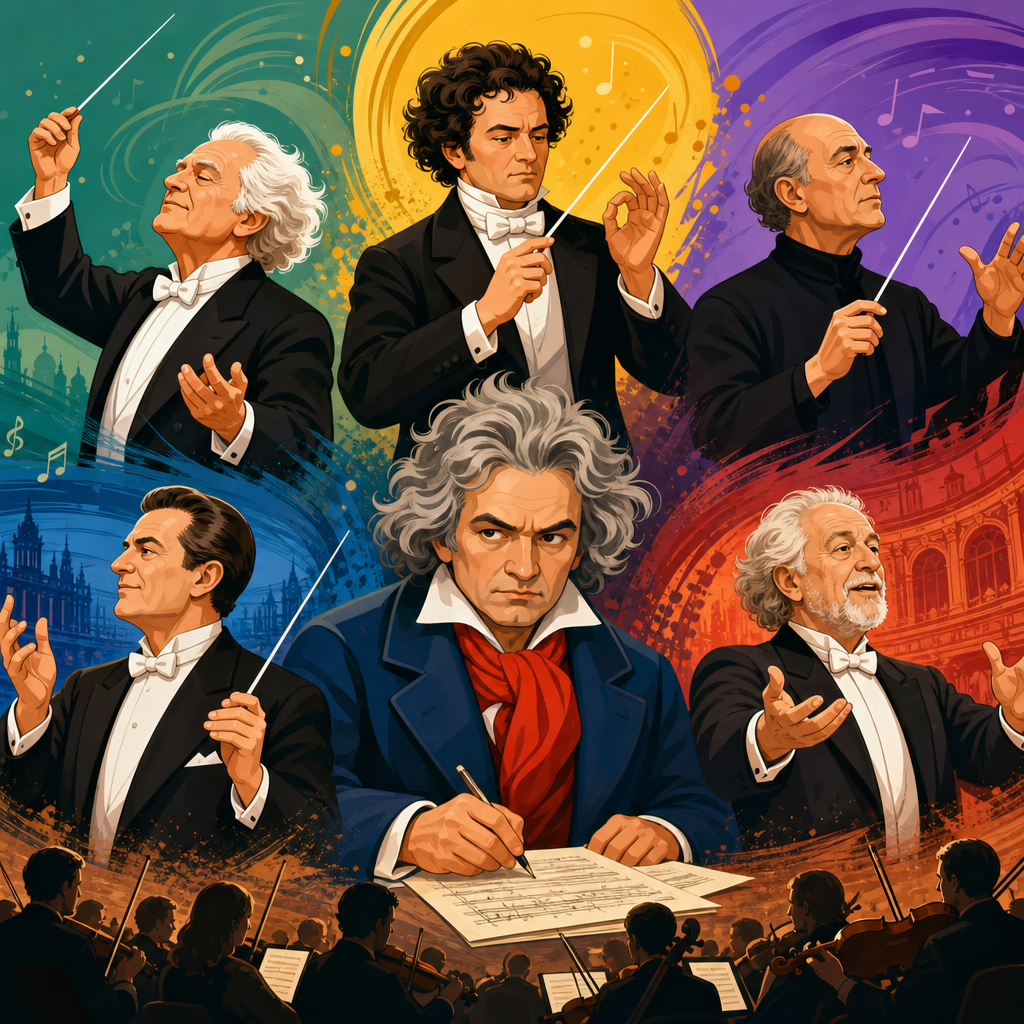
Famous Conductors and Their Signature Beethoven Styles
Beethoven interpretation has always revealed as much about the conductor as it does about the score, and that is why famous conductors and their signature Beethoven styles remain central to any serious discussion of performance and recordings. In practical terms, a conductor’s “style” means recurring choices in tempo, phrasing, articulation, orchestral balance, repeat observance, string vibrato, brass prominence, and the degree to which the performance leans toward monumentality or kinetic drama. In Beethoven, those choices matter more than usual because the music sits at a crossroads: it grows from Haydn and Mozart, yet it points directly toward Berlioz, Wagner, Brahms, and Mahler. A conductor handling the Eroica, the Fifth, the Seventh, or the Ninth must therefore decide whether to emphasize Classical architecture, revolutionary force, rhetorical tension, or emotional breadth.
I have spent years comparing Beethoven cycles, score markings, rehearsal reports, and remastered recordings, and one lesson returns constantly: there is no single “correct” Beethoven style. There are informed traditions, strong textual arguments, and performance practices supported by scholarship, but the greatest conductors make coherent cases rather than merely following fashion. Some drive the music hard with sharp accents and lean sonorities. Others build vast paragraph structures, using weight and patience to reveal the symphonic span. Still others mix historical awareness with modern orchestral resources, creating performances that sound both disciplined and newly alive. For listeners exploring the performance and recordings landscape, this subject matters because Beethoven is often the testing ground by which conductors are judged. Their choices in these scores shape reputations, define orchestral identities, and influence how audiences understand the music itself.
This hub article surveys the major interpretive types and the conductors most associated with them, while also pointing toward the wider “Miscellaneous” territory within Beethoven performance and recordings. That wider territory includes recording technology, orchestral tradition, editorial questions, period instruments, venue acoustics, and the different expectations of radio, studio, and live audiences. If you want a reliable framework for hearing why Carlos Kleiber feels electrifying, why Wilhelm Furtwängler sounds uniquely elastic, why Herbert von Karajan can seem seamless and saturated, or why John Eliot Gardiner brings out rhythmic bite, the key is not hero worship. The key is learning to connect audible details to interpretive philosophy. Once you hear those details clearly, Beethoven recordings stop sounding like interchangeable documents and start sounding like sharply argued performances.
What Defines a Signature Beethoven Style
A signature Beethoven style is not a vague personality trait; it is a set of repeatable musical decisions. The first variable is tempo. Beethoven often supplied metronome markings, especially in later publication history, and conductors have long debated whether to follow them strictly. A faster Allegro con brio in the Fifth Symphony changes the character from heavy fate-knocking to volatile propulsion. The second variable is rhythm. Beethoven’s sforzandi, syncopations, and offbeat accents lose their force if smoothed over. Conductors who stress rhythmic attack often make the music sound more radical. The third variable is balance. If timpani and lower brass are audible as structural agents rather than background color, Beethoven’s orchestration suddenly sounds daring rather than merely noble.
Phrasing and architecture are equally decisive. Some conductors shape Beethoven in long spans, preserving tension across entire movements. Others prioritize local contrast, making every transition, crescendo, and fermata feel dramatic in the moment. In rehearsal, this often comes down to bow distribution in the strings, wind breathing points, and whether transitions are driven through or broadened. Recording conditions also matter. A close-miked studio production can spotlight inner voices and tighten ensemble, while a live concert capture may preserve risk, momentum, and larger acoustic bloom. These factors explain why one conductor’s Beethoven cycle can feel completely different from another’s even when both claim fidelity to the same Urtext edition.
Listeners can evaluate these styles with a practical checklist. Ask: Are repeats observed? How much portamento do the strings use? Are timpani hard-stick and prominent or blended and soft-edged? Do scherzos dance or pound? Does the finale of the Ninth build through cumulative rhythm or through sheer mass? Those questions produce clearer listening than broad labels like traditional or modern.
The Monumental Germanic Tradition: Furtwängler, Klemperer, Karajan
The monumental Germanic approach treats Beethoven as a composer of philosophical scale, weight, and spiritual struggle. Wilhelm Furtwängler is the indispensable figure here. His wartime and postwar performances, especially the 1943 Berlin Ninth and the 1951 Bayreuth Ninth, are famous for tempo flexibility, elastic transitions, and enormous accumulative power. Furtwängler did not conduct to a metronomic grid. He shaped Beethoven through organic pulse, allowing climaxes to grow from tension rather than from surface precision. Critics sometimes call this subjective, but in the best performances the rubato serves structure. The first movement of the Eroica under Furtwängler can feel as though it is discovering its own form in real time.
Otto Klemperer represents another branch of monumentality. Where Furtwängler bends time, Klemperer often steadies it. His Philharmonia recordings, especially the Third, Fifth, and Missa solemnis, project granite strength, broad tempos, and extraordinary contrapuntal clarity. Slow does not mean inert in Klemperer’s best Beethoven. Instead, the listener hears harmonic pressure, inner-line logic, and the architecture of the movement laid bare. This approach can be revelatory in the late works, but it can also feel severe to listeners who want more volatility or dance impulse.
Herbert von Karajan stands between inherited German breadth and modern orchestral polish. Across his Beethoven cycles from the 1960s, 1970s, and 1980s, he cultivated legato string sound, blended orchestral sheen, and near-flawless ensemble with the Berlin Philharmonic. Karajan’s Beethoven often emphasizes continuity over fracture. The line flows, climaxes are engineered with control, and the orchestral image is luxurious. Admirers hear inevitability and grandeur; skeptics hear over-smoothing and too little roughness in a composer built on accent and conflict. Both views have evidence, which is why Karajan remains essential rather than settled.
Precision, Drive, and Classical Tension: Toscanini, Szell, Reiner
If the monumental school seeks breadth, the precision school seeks definition. Arturo Toscanini’s Beethoven, preserved in NBC Symphony broadcasts and studio recordings, is built on taut rhythm, exact ensemble, and refusal to sentimentalize. He favored brisk tempos, hard rhythmic profiles, and clean textures that cut through Romantic padding. In the Seventh Symphony, for example, the outer movements can sound almost dangerous because the rhythmic engine never slackens. Toscanini’s detractors have called this impatient, yet his approach restored a sense of Beethoven as a disruptive, high-voltage composer rather than a bronze monument.
George Szell extended this discipline with the Cleveland Orchestra. Szell’s Beethoven is notable for transparent textures, unanimity of articulation, and classical proportion. He could make the Pastoral sound lucid rather than cozy and the Fifth sound structural rather than rhetorical. In practical listening terms, you hear wind lines clearly, transitions aligned precisely, and climaxes prepared rather than simply expanded. Szell’s recordings are particularly valuable for listeners who want to understand Beethoven’s construction without interpretive fog.
Fritz Reiner belongs in the same conversation because his control over orchestral attack and balance brought out the steel in Beethoven’s writing. Although more often associated with Strauss and Bartók, Reiner’s Beethoven shows how much drama can emerge from exact execution. This style proves an important point for the broader performance-and-recordings discussion: fidelity to the text is not the absence of personality. In Beethoven, exactness can itself be a signature.
Historically Informed Beethoven: Norrington, Gardiner, Harnoncourt
The historically informed movement changed Beethoven listening by challenging assumptions that had hardened during the twentieth century. Instead of treating large modern-orchestra Beethoven as the unquestioned norm, conductors such as Roger Norrington, John Eliot Gardiner, and Nikolaus Harnoncourt reexamined sources, instrument design, vibrato practice, articulation, and Beethoven’s own metronome marks. The result was not a single style but a spectrum of historically aware approaches that made familiar works sound newly risky and sharply profiled.
Norrington became known for lean sonority, reduced vibrato, fast tempos, and pointed articulation. His London Classical Players cycle startled many listeners because it stripped away plushness and brought rhythmic spring to the forefront. Gardiner, with the Orchestre Révolutionnaire et Romantique, combined period instruments with fierce dramatic intelligence. His Beethoven has edge, transparency, and exceptional timpani presence, but it also sings. Harnoncourt, especially with the Chamber Orchestra of Europe, often pursued rhetorical contrast more than doctrinal purity. He highlighted Beethoven’s abrupt accents, strange silences, and disruptive gestures, reminding listeners that this music was once unsettlingly new.
| Conductor | Typical Tempo Profile | Orchestral Sound | Defining Beethoven Effect |
|---|---|---|---|
| Furtwängler | Flexible, expansive | Dark, blended, surging | Organic growth and existential drama |
| Karajan | Controlled, flowing | Polished, saturated, seamless | Grand continuity and orchestral sheen |
| Toscanini | Brisk, disciplined | Lean, direct, incisive | Urgency through precision |
| Gardiner | Energetic, text-led | Period color, vivid timpani | Rhythmic bite and revolutionary freshness |
| Kleiber | Spring-loaded, alive | Transparent yet full | Electric momentum with lyrical lift |
These conductors also influenced mainstream orchestras. Today it is common to hear modern ensembles adopt harder sticks, lighter articulation, antiphonal violins, and stricter observance of repeats. That hybrid practice is one of the most important miscellaneous developments in Beethoven performance history because it shows scholarship affecting the center of the repertoire, not just specialist ensembles.
Modern Synthesis and Charismatic Individualists: Bernstein, Abbado, Kleiber, Chailly
Many late twentieth-century conductors moved beyond the old binary between heavyweight tradition and historical correction. Leonard Bernstein’s Beethoven could be wildly personal, especially in live performance. He often favored heightened rhetorical emphasis, strong emotional projection, and broad climactic shaping. In the Ninth and the Missa solemnis, that could generate overwhelming conviction; in some symphonies, it could also tip toward overstatement. Yet Bernstein made Beethoven feel urgent for modern audiences, and that communicative force should not be underestimated.
Claudio Abbado brought a different synthesis: transparency, flexibility, and chamber-like listening within major orchestras. His Beethoven, particularly with the Berlin Philharmonic and later ensembles, tends to avoid both heaviness and cool detachment. Inner parts speak, transitions breathe, and the music advances with natural momentum. Riccardo Chailly pushed further toward text-based modern Beethoven, incorporating informed tempos and articulation while retaining the resources of a contemporary symphony orchestra. His Leipzig Gewandhaus cycle is often cited for its clarity, energy, and serious engagement with sources.
Carlos Kleiber occupies a category almost of his own because his recorded Beethoven output is comparatively small but extraordinarily influential. His Fifth and Seventh Symphonies with the Vienna Philharmonic remain touchstones for listeners who want intensity without heaviness and precision without rigidity. What makes Kleiber distinctive is the sense of airborne rhythm. The music seems to spring from the beat rather than sit on it. Crescendos accumulate naturally, dance rhythms lift, and details register without pedantry. When people ask what “electrifying Beethoven” sounds like, these recordings are usually the answer.
How to Listen Across Recordings and Build Your Own Beethoven Map
For anyone using this miscellaneous hub as a guide to further exploration, the smartest approach is comparative listening. Start with one symphony, ideally the Fifth, Seventh, or Eroica, and hear three sharply different conductors back to back. Compare opening tempos, treatment of repeats, string articulation, and how the conductor handles transitions into codas. You will quickly hear that Beethoven interpretation is not an abstract academic issue but an audible set of commitments. Streaming platforms make this easier than ever, but serious comparison still benefits from good editions, remaster notes, and awareness of recording dates and orchestras.
It also helps to match conductors to works. Furtwängler may illuminate the Ninth’s metaphysical scale, while Szell may reveal the Fourth’s classical balance. Gardiner can make the First and Second sound explosively modern, while Klemperer may suit listeners wanting the Missa solemnis or late overtures with unshakeable gravity. No single cycle wins every work. That is one of the healthiest conclusions a listener can reach, because it encourages repertoire-specific judgment instead of brand loyalty.
The broader benefit of studying famous conductors and their signature Beethoven styles is that your listening becomes active and informed. You stop asking only whether a performance is good and start asking what argument it makes, what traditions it inherits, and what details justify its choices. That approach opens the door to every related article in the performance and recordings sphere, from period instruments to remastering quality, from live versus studio tradeoffs to orchestra-specific traditions. Use this hub as a starting point: choose a symphony, compare three conductors, take notes on tempo, balance, and phrasing, and let Beethoven teach you how interpretation works.
Frequently Asked Questions
What makes one conductor’s Beethoven style different from another’s?
A conductor’s Beethoven style is usually defined by a consistent set of interpretive decisions rather than by a single dramatic trait. Those decisions include tempo choices, the shaping of phrases, the sharpness or smoothness of articulation, the way inner orchestral lines are balanced, whether written repeats are observed, how much string vibrato is used, how prominently brass and timpani are projected, and whether the overall character feels monumental, lyrical, urgent, or volatile. Two conductors can use the same score and produce performances that sound strikingly different because Beethoven’s notation leaves room for judgment in pacing, accentuation, dynamic contrast, and structural emphasis.
For example, some conductors present Beethoven as a heroic architect of massive symphonic structures, favoring broad tempos, weighty sonorities, and long-breathed phrasing that emphasize grandeur and inevitability. Others highlight rhythmic propulsion, sharper attacks, leaner orchestral textures, and a stronger sense of danger or theatrical tension. Historically informed interpreters may reduce vibrato, clarify articulation, bring out winds and brass more vividly, and follow Beethoven’s often controversial metronome markings more closely, creating a more agile, transparent, and combustible sound. More traditional conductors may prioritize blended string tone, warmth, and cumulative power. In that sense, a conductor’s “signature Beethoven” emerges from repeated habits of musical thinking: how they hear form, drama, balance, and the relationship between classical discipline and romantic intensity.
Which famous conductors are most often associated with distinctive Beethoven interpretations?
Several major conductors are regularly cited because their Beethoven cycles or concert performances established highly recognizable approaches. Wilhelm Furtwängler is often associated with flexible tempo, expansive phrasing, and a deeply organic sense of structure, where the music seems to grow and surge from within rather than unfold in strictly controlled time. Arturo Toscanini, by contrast, is frequently linked to discipline, propulsion, rhythmic exactness, and a leaner, more driven intensity. Herbert von Karajan is commonly identified with polished orchestral sonority, architectural control, and a powerful blend of seamless line and symphonic weight.
Among later interpreters, Carlos Kleiber is admired for combining precision with electricity, producing Beethoven performances that feel both rigorously shaped and unpredictably alive. Leonard Bernstein often brought expressive breadth, emotional projection, and rhetorical intensity, sometimes favoring a more humanly dramatic than classically restrained Beethoven. Nikolaus Harnoncourt and John Eliot Gardiner helped shift the conversation by applying historically informed principles to Beethoven, stressing clarity, rhythmic bite, antiphonal textures, lighter articulation, and a rethinking of inherited performance traditions. Claudio Abbado is often praised for transparency, refinement, and a singing line, while conductors such as Bernard Haitink, Daniel Barenboim, and Christian Thielemann are associated with varying blends of structural seriousness, warmth, and central-European weight. What makes these names important is not simply fame, but the fact that each presents Beethoven through a coherent and immediately recognizable interpretive lens.
How do tempo and phrasing shape a conductor’s signature Beethoven sound?
Tempo and phrasing are among the most revealing markers of Beethoven interpretation because they determine both the emotional temperature of the performance and the listener’s sense of the music’s architecture. A fast tempo can make Beethoven sound urgent, defiant, and rhythmically combustible, but if pushed too hard it can reduce grandeur or obscure harmonic weight. A broader tempo can underline solemnity, nobility, and structural depth, yet if it becomes too heavy the music may lose its tensile energy. Beethoven’s scores depend on a careful equilibrium between momentum and mass, and conductors distinguish themselves by where they place that balance.
Phrasing adds another layer of identity. Some conductors shape Beethoven in long spans, connecting phrases into large arches that emphasize inevitability and symphonic logic. Others articulate more sharply at cadences, accents, and motivic turns, making the drama feel more immediate and speech-like. In a famous symphonic movement, one conductor may smooth transitions to preserve continuity, while another may spotlight contrast, making silences more suspenseful and rhythmic cells more confrontational. This is especially important in Beethoven because his music often derives huge emotional force from tiny motivic units. Conductors who stress those units can make the music feel restless and revolutionary; conductors who prioritize line can make the same passage sound noble and cumulative. In short, tempo sets the basic pulse of Beethoven’s world, while phrasing determines how that world breathes, speaks, and advances.
Why do orchestral balance, articulation, and vibrato matter so much in Beethoven performances?
These elements matter because Beethoven’s music is built not only on melody and harmony, but on attack, contrast, texture, and instrumental dialogue. Orchestral balance affects what the listener actually hears as structurally important. A conductor who brings winds and brass to the foreground may reveal harmonic tension, rhythmic counterweight, or military brilliance that can disappear in string-dominated performances. A more blended, string-rich balance can produce grandeur and warmth, but it may also soften the raw edge and dramatic opposition that are central to Beethoven’s style. Timpani placement, brass prominence, and the clarity of lower strings can radically alter the character of climaxes and transitions.
Articulation is equally crucial. Crisp, detached strokes and sharply profiled accents can make Beethoven sound volatile, athletic, and modern; smoother articulation can make him seem more lyrical, noble, and integrated into a broader romantic tradition. String vibrato is often a major dividing line between styles. Continuous, lush vibrato tends to enrich the sound and contribute to a monumental symphonic blend, whereas restrained vibrato can expose harmonic friction, sharpen vertical sonority, and increase textural transparency. That is one reason historically informed Beethoven often sounds more angular and rhetorically vivid to modern ears. None of these choices is merely cosmetic. They influence how Beethoven’s drama is perceived: whether the listener experiences the music as sculpted mass, urgent action, rhetorical debate, or explosive contrast.
Is there a single “correct” Beethoven style, or do multiple approaches have legitimacy?
There is no universally accepted single correct Beethoven style, and that is precisely why debates about famous conductors remain so lively. Beethoven’s scores are rich enough to sustain different, intellectually serious interpretations. Some conductors seek fidelity through modern orchestral power and continuity of tradition; others pursue fidelity by reexamining period instruments, articulation practices, and Beethoven’s metronome indications. Both camps can make strong claims, and both can fail if their performances become dogmatic. A convincing Beethoven interpretation usually depends less on ideological purity than on internal coherence, stylistic awareness, and the ability to project the music’s structure and emotional stakes persuasively.
That said, not every approach is equally persuasive in every work. The Beethoven of the First or Second Symphony may benefit from classical lightness and clarity, while the Ninth or the Missa solemnis can support broader and more monumental conceptions. Even within a single piece, different conductors may illuminate different truths: one may clarify formal logic, another may intensify drama, and another may recover instrumental detail that changes how the work is understood. For listeners, the most useful question is often not “Which style is correct?” but “What does this conductor reveal about Beethoven, and at what artistic cost or benefit?” That perspective allows for a more mature understanding of interpretation. Beethoven’s greatness is large enough to survive, and often thrive under, multiple signature styles, provided they are musically informed, technically convincing, and dramatically compelling.