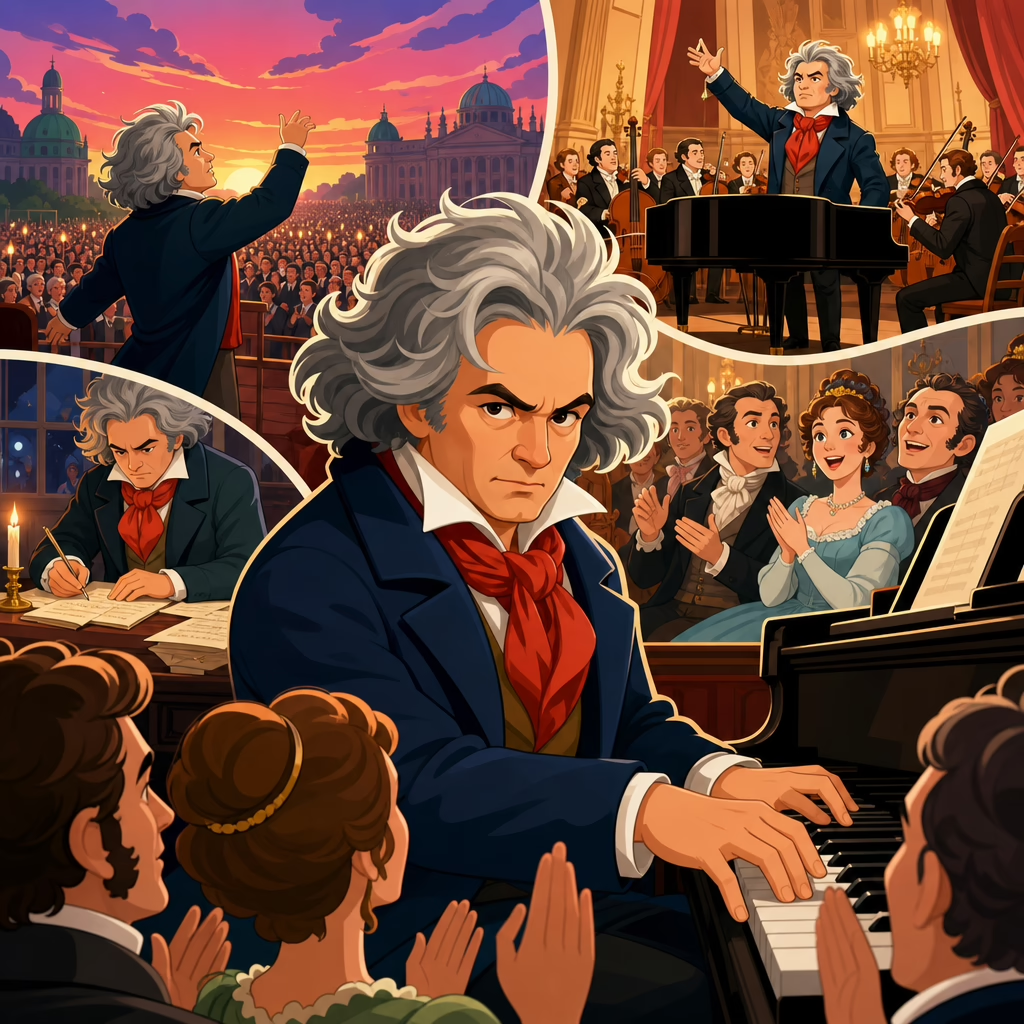
Beethoven Performances That Made Headlines
Beethoven performances have made headlines for more than two centuries because his music sits at the intersection of technical challenge, public symbolism, and raw emotional force. A headline-making Beethoven event is not simply a good concert; it is a performance that changes how audiences, critics, broadcasters, or institutions talk about the composer. In the Performance and Recordings landscape, this miscellaneous hub matters because Beethoven appears everywhere: in gala openings, political ceremonies, historically informed revivals, controversial reinterpretations, marathon recording projects, and viral digital broadcasts. I have covered Beethoven cycles, heard radically different readings of the symphonies in major halls, and watched the same works ignite praise in one city and debate in another. That volatility is exactly why Beethoven still dominates music news. His symphonies, piano sonatas, string quartets, concertos, and Missa solemnis invite comparison, and comparison creates headlines. This hub gathers the major ways Beethoven performances become newsworthy, while pointing readers toward the broader Performance and Recordings conversation: landmark conductors, star soloists, period-instrument practice, filmed concerts, and anniversary programming. To understand the headlines, you need three ideas. First, Beethoven performance is interpretive, not neutral; tempo, articulation, balance, and orchestral size alter meaning. Second, Beethoven carries cultural weight beyond music, especially through the Ninth Symphony, the Fifth Symphony, Fidelio, and the late quartets. Third, recording and broadcast technologies amplify every interpretive choice. When a Beethoven performance lands, it becomes a story about art, history, institutions, and identity at once.
Why Beethoven performances generate outsized attention
Beethoven generates more headlines than most composers because his works function as benchmarks. Orchestras announce credibility with a Beethoven cycle. Pianists prove range through the Hammerklavier, Appassionata, Emperor Concerto, or Diabelli Variations. String quartets establish artistic seriousness through Op. 130 to Op. 135. Conductors are judged on their command of architecture in the Eroica, Fifth, Seventh, and Ninth. When institutions choose Beethoven for reopening seasons, memorials, or political commemorations, the event acquires symbolic meaning before a note is played. That is why reviews often read like verdicts. Critics ask direct questions: Was the interpretation faithful to the score? Did the ensemble project line and structure? Was the finale of the Ninth truly communal or merely loud? These questions create durable media interest because they connect performance details to larger public values.
The music itself also invites public argument. Beethoven marks transitions: Classical to Romantic style, private expression to public statement, virtuosity to philosophy. A performance can sound revolutionary or routine depending on choices of tempo relationships, repeat observance, vibrato use, timpani articulation, brass balance, and seating layout. I have seen audiences leave the same symphony talking either about spiritual uplift or conductor ego. That gap is not accidental. Beethoven writing is detailed, but not exhaustive, and modern performers must decide how to realize dynamic extremes, metronome marks, recitative-like transitions, and the tension between rhythmic drive and monumental breadth. News coverage thrives on that uncertainty.
Historic premieres, premieres in modern disguise, and rediscoveries
Some of the biggest Beethoven headlines begin with premieres, including events that are effectively modern premieres. The 1808 Akademie in Vienna, where the Fifth and Sixth Symphonies, the Fourth Piano Concerto, parts of the Mass in C, and the Choral Fantasy were presented under grueling conditions, has become a reference point for the idea of the overwhelming Beethoven event. Modern recreations of that concert regularly attract attention because they test listener stamina and institutional ambition. They also remind audiences that headline-making Beethoven is not new; from the start, these works arrived amid practical chaos, mixed rehearsal standards, and enormous expectation.
Rediscoveries make news for a different reason. When conductors restore cuts, use unfamiliar versions, or present original endings, they turn familiar repertoire into a reporting event. The most discussed example is the String Quartet in B-flat major, Op. 130, paired with the Große Fuge as finale instead of the later substitute ending. Presenting the quartet in that form shifts the listener’s entire sense of proportion and historical daring. Similarly, performances of Fidelio using different versions from 1805, 1806, or 1814 become headline material because they expose Beethoven’s revisions in public. What sounds like repertory maintenance is actually interpretive archaeology.
Anniversary years amplify this pattern. During the 2020 Beethoven 250 season, despite severe pandemic disruption, organizations worldwide reshaped festivals, streaming plans, and recording releases around Beethoven. Even cancellations became headlines, showing how central he remains to arts planning. The lesson is simple: Beethoven events become news not only when something is played, but when institutions decide that he must anchor the public calendar.
Conductors whose Beethoven changed the conversation
When conductors make headlines in Beethoven, they usually do so by shifting the mainstream. Arturo Toscanini became synonymous with taut precision and structural drive, especially in broadcast-era performances that reached huge audiences. Wilhelm Furtwängler represented the opposite pole for many listeners: elastic tempo, dark sonority, and a sense of Beethoven as existential struggle. Their contrast still shapes criticism. Reviewers continue to frame new performances in relation to those traditions, whether explicitly or by implication.
In the later twentieth century, Herbert von Karajan turned Beethoven recording cycles into global media products. His Berlin Philharmonic sets became reference points not only because of polish, but because they demonstrated the commercial power of complete Beethoven branding. Leonard Bernstein generated headlines through emotional intensity and public symbolism, especially in the 1989 Berlin performance of the Ninth Symphony celebrating the fall of the Wall, where “Freude” was famously altered to “Freiheit” in the finale. Musically and politically, it was a statement performance, and that is exactly the kind of event this hub tracks.
John Eliot Gardiner, Roger Norrington, Nikolaus Harnoncourt, and later François-Xavier Roth and others brought historically informed ideas into mainstream Beethoven performance. Faster tempos, leaner textures, hard-stick timpani, narrower vibrato, and sharper articulation changed listener expectations. These were not niche adjustments. They forced major orchestras and critics to reassess what “traditional” Beethoven actually meant. I have heard audiences describe such readings as newly transparent, while others called them undernourished. Both reactions reveal why these performances made headlines: they made Beethoven sound less inherited and more contested.
Soloists, virtuosity, and the recital or concerto that becomes news
Beethoven headlines are not limited to conductors. Pianists regularly create major stories through complete sonata cycles, concerto traversals, and singular recital statements. Maurizio Pollini’s Beethoven was headline-worthy because of intellectual rigor and technical command. Alfred Brendel brought analytical clarity and wit, showing that Beethoven could be profound without rhetorical excess. Daniel Barenboim linked Beethoven to long-form musical architecture through cycles as soloist and conductor. More recently, Igor Levit’s complete sonata performances and politically engaged public profile have made Beethoven coverage broader than music pages alone.
One reason piano Beethoven attracts such attention is that the interpretive variables are instantly audible even to non-specialists. In the Moonlight Sonata, does the first movement unfold as suspended song or controlled procession? In the Waldstein, is the opening propelled by buoyant attack or framed as granite architecture? In the Hammerklavier, can the fugue remain intelligible at high speed, and should it? Those are technical and philosophical questions at once. A great Beethoven recital often becomes news because it answers them with unusual conviction.
Violinists and cellists create similar moments in the Violin Concerto, Triple Concerto, and sonata repertoire. A striking example is the periodic return of Beethoven’s Violin Concerto on period instruments or with cadenzas based on Beethoven’s own piano version, complete with timpani references. These choices alter the work from noble monument to daring experiment, and critics notice immediately. In practical terms, solo Beethoven becomes headline material when virtuosity serves a recognizable interpretive thesis rather than mere display.
How period performance transformed modern Beethoven
The period-performance movement changed Beethoven coverage by changing the sound world listeners thought was possible. Using classical and early romantic instruments, reduced string sections, natural horns, trumpets without modern valves, and timpani tuned and struck for sharper attack, ensembles exposed details often blurred in larger modern-orchestra traditions. The most important shift was rhythmic. Once audiences heard the Seventh Symphony with biting dance impulse, or the Fifth with fierce timpani-led momentum, the old assumption that Beethoven required uniformly weighty grandeur became harder to sustain.
| Performance issue | Modern large-orchestra tendency | Historically informed tendency | Headline effect |
|---|---|---|---|
| Tempo | Broader, more monumental pacing | Faster, metronome-conscious pacing | Debate over urgency versus depth |
| String sound | Continuous vibrato, blended mass | Lean texture, selective vibrato | Renewed inner-voice clarity |
| Brass and timpani | Rounded power | Sharper attack, brighter edge | Greater sense of shock and risk |
| Articulation | Legato continuity | Speech-like accents and lift | More dramatic contrasts |
This transformation mattered because it reached major labels, festivals, and conservatories. The debate was never simply old versus new. Many modern orchestras absorbed selected period practices without abandoning contemporary instruments. That hybrid approach now dominates much successful Beethoven playing. In my experience, the headline performances are often those that combine textual discipline with enough tonal richness to satisfy both camps. The best examples do not imitate the past mechanically; they recover Beethoven’s volatility.
Broadcasts, recordings, and digital events that extended the headline cycle
Beethoven performance headlines used to depend on premieres and newspaper criticism. Now they live longer because recordings, radio, television, streaming, and social platforms keep interpretations circulating. Toscanini’s NBC broadcasts created one early model: Beethoven as a mass-media event. Later, complete symphony and sonata recording cycles by Deutsche Grammophon, EMI, Philips, Decca, and other major labels turned Beethoven into a catalog battleground. A new cycle by a celebrated conductor or pianist could reset critical rankings for years.
Filmed Beethoven also matters. Televised Ninth Symphonies from major political moments, streamed concert-hall reopenings, and high-definition opera broadcasts of Fidelio can reach audiences far beyond the hall, making a single interpretation culturally visible on a scale impossible in the nineteenth century. During the pandemic, digital Beethoven projects became especially prominent. Musicians performed sonata movements from isolation, quartets recorded remotely, and orchestras leaned on Beethoven to convey resilience and continuity. Not every result was musically ideal, but many became headline stories because Beethoven remained the repertoire institutions trusted when they needed seriousness and public recognition.
For readers exploring the wider Performance and Recordings topic, this is the key linking idea: Beethoven is both event repertoire and archive repertoire. The live performance may generate the immediate reaction, but the recorded document determines whether the event remains part of the long-term conversation.
Why controversial Beethoven keeps returning to the news
Headline Beethoven is not always celebratory. It can become news through disagreement about editions, orchestral forces, staging concepts, politics, or ethics of presentation. Fidelio productions regularly divide opinion when directors emphasize imprisonment, surveillance, or state violence in stark contemporary settings. Some viewers find that approach faithful to the opera’s moral core; others think the score needs less conceptual framing. The Ninth Symphony raises parallel questions. When used in political ceremonies, humanitarian events, or national commemorations, it can symbolize unity, but it can also be criticized as too grand, too familiar, or vulnerable to ideological appropriation. The music’s universality is real, yet never neutral.
There are also controversies tied to performance practice itself. Beethoven’s metronome marks remain fiercely debated because some seem implausibly fast on first encounter. Conductors who follow them closely may be praised for courage or condemned for haste. Large choruses in the Missa solemnis or Ninth can sound thrillingly monumental, but smaller ensembles often reveal textual clarity and contrapuntal detail. Neither solution is automatically correct. Headlines appear when artists make a firm choice and the result challenges entrenched expectations.
The practical takeaway is that Beethoven remains news because performers cannot hide inside convention for long. His scores expose decisions. Once audiences recognize those decisions, they start arguing, and argument is the engine of cultural relevance. If you are building knowledge across this sub-pillar hub, follow the arguments: they point to the recordings, broadcasts, and live events that actually changed perception.
Across the Performance and Recordings field, Beethoven performances that made headlines share a clear pattern: they reveal the stakes of interpretation in public. Sometimes the story is historical, as with recreations of the 1808 Akademie or revivals of alternate versions of Fidelio and Op. 130 with the Große Fuge. Sometimes it is personal, as when a pianist’s complete sonata cycle or a conductor’s Beethoven symphony set crystallizes decades of thought into one public statement. Sometimes it is technological, with radio, film, streaming, and major-label recording projects extending a single concert into a global conversation. And sometimes it is political, as in Bernstein’s Berlin Ninth or in modern stagings that ask what freedom, solidarity, or resistance should sound like now.
The constant benefit of studying headline Beethoven is that it sharpens listening. You begin to hear why tempo is not merely speed, why orchestral size changes rhetoric, why articulation can alter drama, and why one edition or finale can transform a work’s meaning. That awareness makes every future performance richer, whether you are listening to a historic Furtwängler document, a period-instrument cycle from Gardiner, a studio set from Karajan, or a live-streamed recital by a contemporary soloist. Use this miscellaneous hub as your starting point for the rest of the subtopic: compare recordings, trace interpretive schools, and revisit landmark performances with fresh ears. Beethoven still makes headlines because his music still makes people decide what they believe great performance should be.
Frequently Asked Questions
What makes a Beethoven performance headline-worthy rather than just critically acclaimed?
A Beethoven performance makes headlines when it does more than earn praise for accuracy, beauty, or discipline. It becomes news when it shifts public conversation around the composer, the performers, or the cultural moment surrounding the event. Beethoven’s music has long carried unusual symbolic weight: it can represent artistic seriousness, political freedom, heroic struggle, collective mourning, or triumphant celebration. Because of that, certain performances break out of the normal review cycle and become widely discussed cultural events.
There are several reasons this happens. Sometimes the headline comes from interpretation. A conductor may radically rethink tempo, orchestral balance, phrasing, period style, or dramatic architecture in a way that challenges established habits. At other times, the story is the occasion itself: a reopening gala, an international broadcast, a state ceremony, a memorial concert, or a performance tied to a historic anniversary. Beethoven also makes headlines because his works are technically and emotionally unforgiving. When a pianist conquers one of the late sonatas or the “Hammerklavier,” or when an orchestra delivers a transformative Ninth Symphony, critics and audiences often feel they are witnessing not just a performance but a test of artistic authority.
Another factor is scale. Beethoven is central to the repertory, so his major works attract broad attention beyond specialist listeners. A striking performance of the Fifth Symphony, Missa solemnis, Fidelio, or the late string quartets can influence programming trends, recording projects, and even institutional identity. In that sense, a headline-making Beethoven event is one that alters perception. It changes how people talk about what the music means, how it should sound, who has the right to interpret it, and why it still matters in public life.
Why does Beethoven so often appear at major public, political, and ceremonial events?
Beethoven appears repeatedly at public milestones because his music carries a rare combination of familiarity, grandeur, and emotional seriousness. Few composers are as instantly recognizable to general audiences while also retaining deep prestige within the classical world. That makes Beethoven a natural choice when institutions want to signal importance. His music can frame an inauguration, a peace concert, an anniversary season, a memorial observance, or a major cultural reopening with a sense of historical depth and artistic legitimacy.
The Ninth Symphony is the clearest example. Its scale, choral finale, and themes of unity have made it especially useful for events that want to project solidarity or renewal. But Beethoven’s ceremonial presence extends beyond the Ninth. The “Eroica” Symphony can suggest heroism and transformation; the Fifth can symbolize struggle and destiny; Fidelio can stand for liberation and moral courage; the Emperor Concerto can project brilliance and nobility. These associations are not accidental. They grew over centuries through criticism, performance tradition, broadcasting, education, and political appropriation.
That public symbolism is also why Beethoven performances can become controversial. When his music is used for official purposes, people often debate what values are being invoked and whether the event genuinely earns such symbolism. A Beethoven concert can therefore become a headline not only because of musical excellence but because it sits inside larger questions about identity, memory, power, and national or international image. In the performance and recordings world, that makes Beethoven uniquely visible. He is never just background; he tends to turn any major appearance into a statement.
Which kinds of Beethoven works are most likely to generate major press attention?
The Beethoven works most likely to generate headlines are usually the ones with the broadest cultural reach, the heaviest interpretive demands, or the greatest logistical difficulty. The Ninth Symphony sits at the top of that list because it combines orchestral, choral, and solo forces with a finale that has become globally symbolic. Any notable Ninth—whether unusually fast, historically informed, politically significant, or attached to a major anniversary—has a strong chance of attracting press attention.
The Fifth Symphony is another perennial headline-maker because it is so famous that even subtle interpretive changes become widely discussed. Critics pay close attention to pacing, articulation, structural tension, and the journey from darkness to triumph. The “Eroica” also generates attention whenever a conductor presents a reading that reframes its scale or revolutionary energy. Among concertos, the Violin Concerto and the Emperor Concerto often become focal points when performed by major soloists, particularly in high-profile debuts, returns, or recorded cycles.
For pianists, the late sonatas and the “Hammerklavier” occupy a special place. These works are treated almost as artistic summits, and major interpretations can redefine a pianist’s reputation. In chamber music, the late string quartets frequently draw serious press because they are viewed as some of the deepest and most challenging works in the repertory. On the vocal side, Fidelio and Missa solemnis can make headlines because they demand not only musical command but also a persuasive dramatic or spiritual vision. In short, Beethoven works that generate major attention tend to be the pieces where technical challenge, cultural expectation, and interpretive risk all meet at once.
How have recordings and broadcasts helped turn Beethoven performances into headline events?
Recordings and broadcasts have been essential in transforming Beethoven performances from local successes into international cultural moments. Before modern media, a remarkable performance could influence critics and audiences present in the hall, but its immediate impact was limited by geography. Once radio, television, commercial recording, and later digital streaming entered the picture, Beethoven performances could circulate far beyond the original venue and shape global opinion almost instantly.
This matters especially with Beethoven because his works are so central to the canon. A new recording of a symphony cycle, piano sonata set, or late quartet interpretation is rarely heard in a vacuum. It enters a long-running conversation about tradition, authenticity, tempo, sonority, and style. Broadcasters and record labels understand this, which is why Beethoven anniversaries and major Beethoven projects are often marketed as events rather than ordinary releases. A live telecast of the Ninth Symphony, a streamed Fidelio from a major opera house, or a much-anticipated complete sonata cycle can become headline material because listeners know they are hearing a direct challenge to established benchmarks.
Media also amplifies narrative. A performance may be discussed not just for how it sounds, but for who is involved, where it happened, what occasion it marked, and how it was received online and in print. A conductor’s final Beethoven cycle, a soloist’s comeback recital featuring Beethoven, or a controversial interpretive approach can gain momentum through reviews, interviews, social media reactions, and institutional promotion. In that environment, the performance becomes part artwork, part public event, and part historical claim. Beethoven’s prominence ensures that these claims receive attention in a way many other composers simply do not.
Why do Beethoven interpretations often spark debate among critics, musicians, and audiences?
Beethoven interpretations spark debate because his music sits at the center of Western concert life while remaining unusually open to competing ideas about style, structure, and meaning. Nearly everyone agrees that the works are great; the disagreements begin when performers decide what greatness should sound like. Should a symphony be monumental or urgent? Should a piano sonata emphasize architectural control or improvisatory freedom? Should a string quartet aim for polished blend or exposed intensity? Beethoven invites these questions because his scores combine precision with enormous expressive pressure.
Historical performance practice has intensified that debate. Over the past several decades, musicians and scholars have revisited Beethoven’s instruments, tempo markings, articulation, orchestral size, and performance conventions. As a result, many listeners now compare modern symphonic readings with leaner, faster, more transparent historically informed approaches. Neither side has ended the argument, which is part of the reason Beethoven remains so newsworthy. Every major interpretation positions itself, whether deliberately or not, in relation to tradition.
There is also a philosophical dimension. Beethoven is often treated not just as a composer but as a cultural idea: heroic, revolutionary, humane, defiant, universal. Performers who emphasize violence, instability, intimacy, wit, or vulnerability may therefore unsettle audiences accustomed to a more monumental image. That tension can produce productive disagreement. Critics may hear revelation where others hear distortion. Audiences may celebrate emotional directness that scholars consider textually questionable, or praise fidelity that others find emotionally inert. This constant argument is one reason Beethoven performances keep making headlines. The stakes always feel larger than a single evening’s applause; they touch on how a culture chooses to understand one of its most important musical voices.