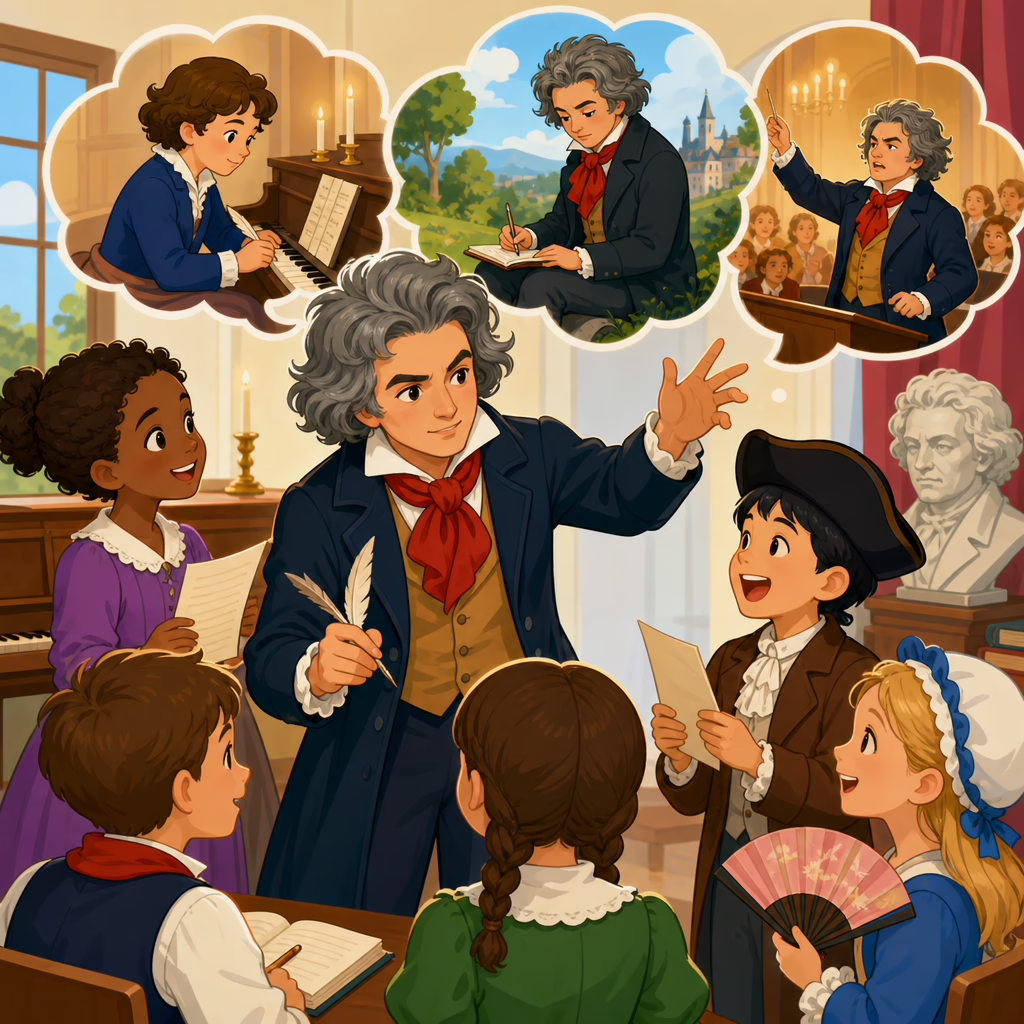
Teaching Beethoven’s Life Through Storytelling and Role-Play
Teaching Beethoven’s life through storytelling and role-play turns a familiar composer into a vivid human being whom students can question, challenge, and remember. In classrooms, museums, homeschool settings, youth orchestras, and community arts programs, I have seen the same pattern repeatedly: students may forget a lecture about dates and catalog numbers, but they remember the moment “Beethoven” storms into Vienna, argues with a patron, or struggles to hear a melody that still exists powerfully in his mind. That is why this approach matters. It connects biography, music history, listening skills, social context, and emotional understanding in a single learning experience.
At its core, storytelling means presenting Beethoven’s life as a sequence of meaningful events rather than as a list of facts. Role-play means students actively inhabit perspectives from that world: Beethoven himself, his father Johann, patrons such as Archduke Rudolph, contemporaries including Haydn, publishers, doctors, family members, or ordinary Viennese listeners. Used together, these methods support comprehension because they give students a narrative structure and a reason to care. Students understand not just what happened, but why it mattered, how it felt, and what changed as a result.
Ludwig van Beethoven was born in Bonn in 1770 and died in Vienna in 1827. He is often introduced simply as the composer who became deaf, but that summary is too thin for serious teaching. His life sits at the intersection of the Enlightenment, the French Revolution, the Napoleonic era, changing patronage systems, disability history, public concerts, print culture, and the transformation from Classical style to early Romantic expression. Teaching Beethoven well means defining these key terms in accessible language. Patronage refers to financial and social support from nobles or institutions. Form means the structural design of a piece, such as sonata form or theme and variations. Role-play in education is guided dramatic participation used to deepen learning, not theatrical performance for its own sake.
This hub article covers miscellaneous teaching angles because educators rarely need only one lesson idea. They need a flexible framework that can link music appreciation, literacy, social studies, drama, and community engagement. The strongest Beethoven lessons answer common questions directly: Who was he? What shaped him? How did hearing loss affect his work? Why do people still perform his music? How can students of different ages connect with him without reducing him to myth? Storytelling and role-play provide those answers in ways that are memorable, historically grounded, and adaptable across settings.
Why storytelling works for Beethoven education
Storytelling works because Beethoven’s life contains clear dramatic arcs: gifted child in Bonn, ambitious young musician in Vienna, student of major masters, independent composer, public celebrity, isolated artist coping with deafness, and late creator of works that stretched musical language. When I plan a unit, I never begin with “Today we will cover Opus numbers.” I begin with tension. A tense father pushing a child to practice. A young artist arriving in Vienna where Mozart had recently died and Haydn still commanded respect. A composer realizing that hearing loss threatens not just his career, but his identity. Students follow tension naturally, and once they are engaged, historical detail lands more securely.
Good storytelling also corrects misconceptions. Beethoven was not only angry, wild-haired, and tragic. He was strategic about publication, deeply aware of social status, politically idealistic yet practically dependent on wealthy supporters, affectionate in some relationships and difficult in others. Presenting those contradictions helps students think critically. Instead of a cartoon genius, they encounter a complicated working musician navigating real constraints. That complexity is especially valuable in community and education contexts, where the goal is not hero worship but understanding how art grows inside society.
Another reason storytelling succeeds is that it supports chronological thinking. Many learners struggle to place Beethoven between Mozart and Schubert, or to connect him with the French Revolution and Napoleon. A well-built narrative solves that. For example, students can trace one through-line: Bonn court musician’s son, move to Vienna in 1792, early fame as a pianist, hearing crisis around 1802 and the Heiligenstadt Testament, middle-period expansion in the “Eroica” Symphony and Fifth Symphony, and late works such as the Ninth Symphony and late string quartets. Once that sequence is secure, listening activities become more meaningful because students can hear stylistic change as part of a life story.
Building role-play activities that are accurate and engaging
Effective role-play needs structure. The best activities are anchored in specific moments, sources, and learning goals. I typically choose one pivotal scene and assign each student a clear task. A scene might involve Beethoven deciding whether to dedicate the Third Symphony to Napoleon, discussing finances with a publisher, confronting his brothers during the family conflict over his nephew Karl, or meeting a doctor about worsening hearing. Students receive short briefing cards containing historical facts, motives, and one or two quotations from letters or conversation books. That prevents improvisation from drifting into fiction.
Accuracy matters because Beethoven’s life is often romanticized. For example, if students reenact the “Eroica” dedication, explain that Beethoven admired the republican ideals associated with Napoleon before later rejecting him as emperor. If students portray deafness, distinguish between partial hearing loss, tinnitus, communication through notebooks, and the uneven timeline of his condition. If they reenact concerts, note that early nineteenth-century concert life did not resemble today’s quiet, standardized recital etiquette. People reacted visibly, programs were mixed, and rehearsal conditions could be inconsistent.
Role-play should also be age-appropriate. Younger students do well with simple first-person prompts: “I am Beethoven in Bonn. My father wants me to practice. How do I feel?” Older students can handle moral and historical ambiguity: “As a patron, why support a difficult composer? As Beethoven, what do you owe supporters if you prize independence?” These questions lead to stronger discussions than simple biography recall.
| Teaching goal | Story or role-play activity | Primary learning outcome |
|---|---|---|
| Understand childhood and training | Family scene in Bonn with Johann, young Ludwig, and court musicians | Students identify early influences and pressures |
| Place Beethoven in Vienna | Arrival interview with Haydn, patrons, and publishers | Students connect biography to musical culture and patronage |
| Explore hearing loss | Diary or doctor consultation based on the Heiligenstadt period | Students understand disability, adaptation, and emotional stakes |
| Explain political ideals | Debate over dedicating the “Eroica” to Napoleon | Students link music history to European politics |
| Interpret late works | Conversation-book role-play with visitors during final years | Students see how communication and creativity coexisted |
Assessment can remain simple and rigorous. Ask students to write a reflection in which they separate documented fact from dramatic interpretation. Have them cite one source, such as the Heiligenstadt Testament, a letter, or a standard biography by Jan Swafford or Lewis Lockwood. This preserves creativity while reinforcing historical discipline.
Key episodes from Beethoven’s life that teach well
Some episodes consistently produce strong results because they contain conflict, evidence, and clear connections to the music. The first is Beethoven’s childhood in Bonn. Teachers should avoid the exaggerated myth of nonstop abuse, but it is accurate to say that Johann van Beethoven pushed his son hard and hoped to market him as a prodigy. This opens discussion about training, family pressure, and the difference between talent and disciplined work. Students can compare Beethoven’s childhood to Mozart’s and ask why their public images developed differently.
The second key episode is Beethoven’s move to Vienna in 1792. Vienna was the center of elite music making in the German-speaking world, and this move positioned him for study, performance, and patronage. Role-play can show what a young musician needed to survive there: recommendations, connections, improvisational skill, and social adaptability. Students learn that Beethoven’s reputation first grew not only from composition but from piano performance and improvisation, a fact often missing from simplified school narratives.
A third essential episode is the hearing crisis culminating in the 1802 Heiligenstadt Testament. This unsent letter to his brothers is one of the most important documents for teaching Beethoven because it is both personal and historically grounded. Students can read selected passages in modern English and identify themes of despair, secrecy, resilience, and artistic duty. The educational value is high because the text invites empathy without sentimentality. It also helps frame disability as lived experience rather than symbolic tragedy.
The fourth episode is the “Eroica” Symphony and Beethoven’s evolving politics. Here students can examine how revolutionary ideals, disappointment in Napoleon, and the growing scale of symphonic writing intersect. The piece itself marked a break in ambition, length, and expressive range. Even students with little formal music background can hear that this is not background entertainment; it demands attention and projects public significance.
Finally, the late years provide powerful material. By the 1824 premiere of the Ninth Symphony, Beethoven was profoundly deaf, yet he remained a central artistic figure. The oft-repeated image of him needing to be turned toward the applauding audience is dramatic, but teachers should note that retellings vary in detail. That nuance is useful. Students learn that history includes evidence, interpretation, and mythmaking. The late quartets, Missa solemnis, and Ninth Symphony show a creator whose imagination kept expanding despite severe communication barriers.
Connecting biography to listening, literacy, and community learning
The strongest Beethoven lessons do not stop at acting. They connect story scenes to actual listening and to reading or writing tasks. After a role-play about Bonn, play an early piano sonata and ask students what sounds disciplined, elegant, or surprising. After the Heiligenstadt scene, listen to the slow movement of the “Pathétique” Sonata or excerpts from the Fifth Symphony and ask how listeners project meaning onto music. Be careful with that language. Music does not literally narrate his life, but biography can shape how audiences interpret musical tension, silence, repetition, and release.
Literacy integration is straightforward. Students can create a newspaper article from Vienna, a letter from a patron, a rehearsal note for the Ninth Symphony, or a museum label for a hearing ear trumpet. These assignments work because they require audience awareness and evidence selection. In community education settings, intergenerational programs are especially effective. Older adults may bring prior knowledge of symphonies or recordings, while younger learners bring curiosity and dramatic energy. A shared role-play or reading circle can turn Beethoven from elite culture into a common civic subject.
Community venues also broaden what counts as Beethoven education. Libraries can host “meet the composer” events with scripted monologues. Local orchestras can pair family concerts with pre-concert scene setting. Museums can use object-based storytelling around manuscripts, pianos, or medical devices associated with hearing loss. Schools can link units to history fairs, disability awareness programming, or creative writing festivals. This miscellaneous hub approach is useful because Beethoven touches more than one discipline, and successful programs often emerge from those intersections.
Use reliable resources. The Beethoven-Haus Bonn offers digitized documents and timelines. Major recordings by conductors such as Carlos Kleiber, John Eliot Gardiner, and Claudio Abbado provide contrasting interpretive approaches worth discussing with older students. Standard biographies and scholarly program notes help teachers avoid recycled myths from popular media. The goal is not to overwhelm learners with scholarship, but to make every story scene rest on something verifiable.
Common mistakes and a practical framework for teachers
The most common mistake is reducing Beethoven to a single theme: deaf genius. That framing is memorable but incomplete. It can erase his humor, business sense, political interests, friendships, and craft. Another mistake is treating role-play as free improvisation without evidence. Students enjoy dramatic freedom, but educational value drops when scenes become historically detached. A third mistake is ignoring the music itself. If Beethoven’s life is taught without listening, students may remember the biography while missing the reason his life still matters.
A practical framework is simple. Start with one essential question, such as “How did Beethoven turn personal struggle into public art?” Choose three life episodes, not ten. Pair each episode with one listening excerpt, one source, and one short role-play. End with reflection that asks students what is known, what is inferred, and what remains uncertain. This sequence works in one extended workshop or over several weeks.
Teaching Beethoven’s life through storytelling and role-play works because it honors both the person and the music. Students gain chronology, empathy, historical context, and a sharper ear. They see how family, politics, disability, labor, and creativity shaped a composer whose influence still reaches classrooms and concert halls. If you are building a Community and Education hub on miscellaneous Beethoven topics, make this article your starting point: use stories, ground them in evidence, connect them to listening, and invite learners to step into the world Beethoven changed. Then expand into your linked lessons, performances, and local programs with confidence.
Frequently Asked Questions
Why is storytelling and role-play so effective for teaching Beethoven’s life?
Storytelling and role-play work especially well because they move Beethoven out of the textbook and into the students’ lived experience. Instead of presenting him as a list of dates, compositions, and historical facts, this approach helps learners encounter him as a complicated person: ambitious, brilliant, stubborn, vulnerable, and deeply shaped by the social world around him. When students see “Beethoven” arrive in Vienna, negotiate with patrons, react to political change, or confront the emotional impact of hearing loss, they build memory through scene, emotion, and action. That kind of learning tends to last far longer than passive listening.
This method also supports deeper historical understanding. Students begin to ask more meaningful questions: What did it mean to be a composer before modern celebrity culture? How did class structures affect artists? Why did Beethoven’s deafness matter artistically and personally? Those questions naturally emerge when students are invited to step into the story rather than merely observe it from a distance. In practical terms, storytelling gives context, and role-play gives ownership. Together, they encourage empathy, critical thinking, and stronger recall of both biographical details and musical significance.
What parts of Beethoven’s life are best suited for classroom storytelling and role-play?
Several moments in Beethoven’s life are especially powerful because they are dramatic, historically rich, and easy for students to visualize. His difficult childhood in Bonn, including the pressure placed on him by his father, can open conversations about talent, discipline, and family expectations. His move to Vienna is another strong entry point because it places him in a city full of musical opportunity, social hierarchy, and artistic competition. Students can immediately understand the tension of a young musician trying to prove himself in a major cultural center.
Other highly effective episodes include Beethoven’s relationships with aristocratic patrons, his growing reputation as a bold and unconventional composer, his response to the political currents of the Napoleonic era, and most importantly, his struggle with hearing loss. The Heiligenstadt Testament, for example, offers an emotionally compelling way to explore despair, perseverance, and artistic purpose. Later-life scenes can show students how Beethoven continued composing despite isolation and physical limitations. These moments are ideal for role-play because they contain conflict, stakes, and emotional complexity. They help students see that Beethoven’s music was not created in a vacuum; it emerged from real pressures, personal decisions, and a changing Europe.
How can teachers make role-play accurate without making it too complicated for students?
The best approach is to aim for historical integrity rather than rigid perfection. Students do not need to memorize every date or speak in overly formal period language to benefit from role-play. What matters most is grounding the activity in a few clear, accurate ideas: where Beethoven was, what challenge he was facing, who the key people were, and why the moment mattered. Teachers can provide short character cards, a timeline, a brief scene setup, and a few historically informed quotes or facts. That structure gives students confidence while still allowing creativity.
It also helps to focus on essential truths rather than overload. For example, if students are reenacting Beethoven’s conflict with patronage systems, they should understand that aristocrats provided support but also held social power over artists. If the scene concerns his deafness, they should know that hearing loss threatened not only his career but also his identity and relationships. With that foundation, students can improvise dialogue and reactions in ways that are engaging and believable. Accuracy improves when learners understand the context, not when they are burdened with too many details. A well-guided role-play should feel lively and accessible while still honoring the historical record.
What age groups and learning environments benefit most from this approach?
This approach is remarkably flexible and can be adapted for a wide range of ages and settings. In elementary and middle grades, storytelling and simple role-play can introduce Beethoven as a memorable historical figure through short scenes, guided questions, and expressive activities. Younger students often respond strongly to clear narrative elements such as struggle, determination, conflict, and triumph. They may not yet grasp every political or musical nuance, but they can understand what it means to work hard, feel isolated, or refuse to give up.
Older students, including high school and college learners, can go much further. They can analyze Beethoven’s social position, debate the “heroic artist” idea, compare primary sources, and examine how biography shapes interpretation of the music. Beyond schools, this method also works extremely well in museums, homeschool programs, youth orchestras, and community arts settings because it invites participation from students with different backgrounds and skill levels. It is especially valuable in mixed-ability groups, where some learners connect through speaking, some through movement, some through music, and others through discussion. The format can be scaled from a five-minute dramatic prompt to a full interdisciplinary lesson, making it useful almost anywhere Beethoven is being taught.
How does teaching Beethoven through storytelling and role-play help students connect with his music?
One of the greatest advantages of this method is that it links biography to listening in a way that feels natural rather than forced. When students understand the human experiences behind the music, they often listen with greater attention and curiosity. A symphony, sonata, or string quartet stops being just an assignment and becomes evidence of a person thinking, struggling, experimenting, and communicating. Students who have imagined Beethoven confronting deafness, wrestling with frustration, or asserting artistic independence are more prepared to hear tension, contrast, intensity, and emotional depth in his works.
This does not mean reducing music to biography alone, but it does mean giving students a meaningful doorway into the repertoire. For example, after a role-play about Beethoven’s growing hearing loss, students may listen differently to a piano sonata or late quartet, asking how inner hearing and imagination shaped the result. After dramatizing his break from conventional expectations, they may better appreciate his reputation for expanding form and expressive range. In educational practice, this kind of connection improves engagement, discussion quality, and retention. Students are more likely to remember both the life and the music because they have experienced them as parts of a single, compelling story.