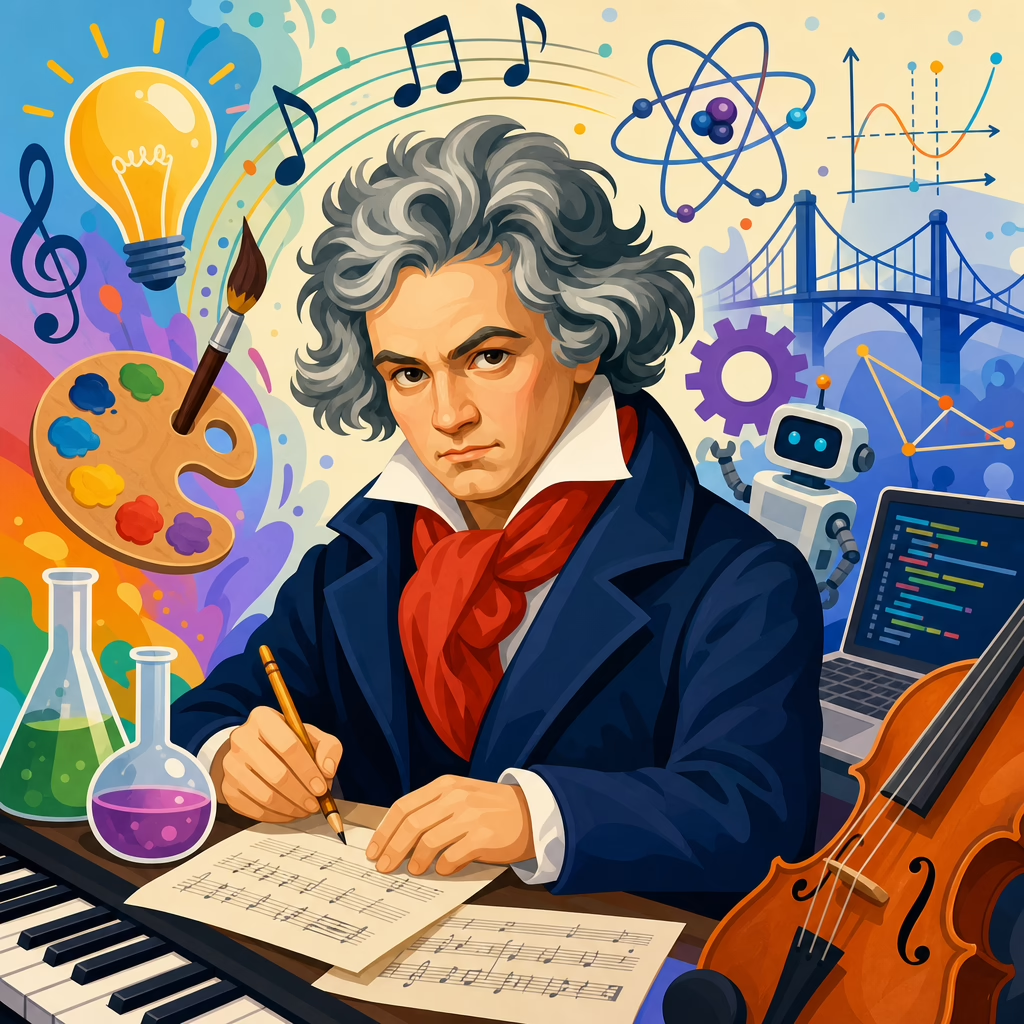
Beethoven and STEAM Education: Creativity in Music and Tech
Beethoven and STEAM education belong in the same conversation because both treat creativity as disciplined problem solving rather than vague inspiration. STEAM education expands STEM by adding the arts, recognizing that innovation depends on imagination, interpretation, communication, and design as much as mathematics and engineering. Ludwig van Beethoven offers a powerful model for this integrated approach. His music shows how constraints can produce originality, how technical mastery supports emotional expression, and how persistence turns experiment into breakthrough. In classrooms, makerspaces, youth orchestras, coding labs, and community arts programs, educators can use Beethoven to connect music, technology, history, and creative inquiry in ways students immediately understand.
When I have worked with interdisciplinary school teams, Beethoven consistently engages both music students and learners who identify more with robotics, computing, or visual design. That happens because his story is not only about genius. It is about process. Students can hear a four-note motif develop into a large-scale structure, compare early sketches with finished works, trace how hearing loss changed his working methods, and then apply the same habits to composing with digital audio workstations, building instruments with sensors, or visualizing sound with code. This article serves as a hub for miscellaneous resources and ideas under community and education, showing how Beethoven supports project-based learning, accessibility, cultural literacy, and practical technology integration.
To define the key terms clearly: creativity is the capacity to generate useful and original ideas; music technology includes tools for recording, editing, synthesis, analysis, and performance; community education refers to learning that happens through schools, libraries, museums, ensembles, after-school programs, and public initiatives. Beethoven matters here because he sits at a productive intersection of artistic heritage and modern relevance. His works are widely performed, heavily documented, and adaptable across age groups. At the same time, his life raises current questions about disability, resilience, authorship, and how tools shape creative output. For an education hub page, that breadth is valuable because it links many kinds of related articles and classroom pathways.
Why Beethoven fits STEAM education so well
Beethoven fits STEAM education because his work illustrates pattern, iteration, structure, emotion, and experimentation at once. In science and engineering classes, teachers often ask students to identify systems, test variables, and refine prototypes. Beethoven composed in similar ways. His surviving sketchbooks show revision as a central habit. He did not simply wait for finished ideas to appear. He drafted motives, altered rhythms, changed harmonies, and rebalanced entire formal plans. That makes him an ideal example for explaining iterative design, a principle students also encounter in coding, electronics, architecture, and product development.
His music also makes abstraction concrete. The opening of Symphony No. 5 is one of the clearest demonstrations of how a simple cell can drive complex outcomes. Teachers can map that motif across movements, discuss repetition and transformation, then connect those ideas to algorithmic thinking. A student writing a loop in Scratch, Python, or Sonic Pi is doing something conceptually related: defining a pattern, testing variation, and controlling development over time. Beethoven therefore helps students see that composition and computation are not opposites. Both involve organized choices under constraints.
Another reason he works in community and education settings is accessibility of materials. Public domain scores, extensive recordings, reputable critical editions, and scholarship from institutions such as the Library of Congress, the Berlin State Library, and major conservatories make lesson design easier. Educators can compare manuscript scans, orchestral interpretations, piano reductions, and software-generated analyses without licensing barriers that often limit contemporary repertoire. For a hub article covering miscellaneous educational uses, Beethoven provides a stable anchor because resources exist for beginners, advanced students, families, and lifelong learners.
Creativity, constraint, and the engineering mindset
A common misconception in arts education is that creativity means unlimited freedom. In practice, the strongest student work usually emerges from boundaries. Beethoven demonstrates this repeatedly. Sonata form, variation form, fugue, instrumental range, tuning systems, and commission requirements all constrained his choices. Yet those boundaries sharpened invention. In STEAM terms, this mirrors engineering design briefs. A bridge must hold load within budget. A robot must navigate a course with limited battery life. A musical work may need to fit a dance pattern, a patron’s request, or a playable keyboard layout.
One effective teaching strategy is to frame Beethoven as a systems thinker. In the “Eroica” Symphony, thematic material, orchestration, scale, and expectation interact as parts of one design challenge. Students can ask: what problem was Beethoven solving? Often the answer is expressive and structural at once. He wanted greater dramatic range, stronger thematic unity, and a different relationship between tension and release. That is not unlike a design team trying to increase performance while maintaining usability. The transfer value is high because students learn that creativity improves when they can name the constraints and work deliberately within them.
This is also a useful entry point for discussing failure. Beethoven’s sketches document dead ends, not just triumphs. In my experience, students relax when they see that an iconic composer revised obsessively. It gives them permission to prototype, test, and discard. Digital composition platforms such as Soundtrap, GarageBand, Ableton Live, and BandLab support the same workflow. Learners can duplicate tracks, alter tempo, invert melodies, automate dynamics, and compare versions. Linking those actions to Beethoven’s manuscript practice helps demystify both classical music and modern tech-based creativity.
Technology tools that bring Beethoven to life
Modern music technology allows Beethoven study to become active rather than purely historical. Notation software such as MuseScore, Dorico, Finale, and Sibelius enables students to reconstruct themes, orchestrate passages, and hear immediate playback. Digital audio workstations let them remix motifs, build sampled arrangements, and layer acoustic and electronic textures. Analysis tools such as Sonic Visualiser and Audacity make tempo, spectrum, waveform, and phrase shape visible. Instead of simply telling students that Beethoven used contrast and development, educators can show those qualities on screen and ask learners to test them in their own work.
Assistive and immersive technologies expand the possibilities further. Because Beethoven’s later life is closely associated with hearing loss, his story opens informed discussions about accessibility and design. Students can explore bone conduction, visual metronomes, haptic feedback systems, captioned performances, and vibrotactile devices used by deaf and hard-of-hearing musicians. This should be handled carefully: Beethoven’s deafness is not a motivational slogan but a concrete case for understanding adaptation. Community education programs can connect this topic to inclusive performance practice, universal design for learning, and the broader history of disability in the arts.
Data and coding projects are especially effective for middle school through undergraduate levels. Learners can convert MIDI files into visualizations, compare dynamic markings across movements, or use Python libraries to analyze pitch frequency and rhythmic recurrence. A small project might ask students to graph the distribution of note lengths in a Beethoven theme, then compare the result with a pop chorus or film cue. That creates a bridge between canonical repertoire and contemporary listening habits. It also supports cross-curricular standards in statistics, computational thinking, and media literacy.
| Educational goal | Beethoven connection | Tool or method | Student outcome |
|---|---|---|---|
| Pattern recognition | Motivic development in Symphony No. 5 | MuseScore plus score annotation | Identify repetition, variation, and structure |
| Sound analysis | Dynamic contrast in piano sonatas | Audacity or Sonic Visualiser | Read waveform, amplitude, and timing data |
| Coding and visualization | Transforming themes into graphic patterns | Python, Scratch, or Processing | Connect music theory to algorithmic logic |
| Inclusive design | Hearing loss and adaptive music making | Haptic tools, captions, accessibility review | Understand disability-aware creative practice |
| Creative production | Recomposing a variation set | BandLab, Soundtrap, or GarageBand | Produce original work from historical material |
Community learning, public programs, and interdisciplinary projects
As a community and education hub topic, Beethoven should not be limited to formal music classrooms. Libraries can host listening clubs that pair recordings with score excerpts and historical context. Museums can combine instrument demonstrations with acoustics exhibits. Public schools can partner with local orchestras for rehearsal visits, then extend learning through podcast creation or student-designed program notes. Senior centers, homeschool cooperatives, and after-school organizations can all use Beethoven-themed projects because the repertoire scales well from simple listening prompts to advanced harmonic analysis.
Interdisciplinary projects work best when they solve a real communication problem. For example, students might design an interactive exhibit titled “How Beethoven Builds Tension.” One team creates short explanatory text, another produces animated notation, another records examples, and another codes a touch-screen interface. In one project I observed, students used Makey Makey boards to trigger motifs from conductive posters, turning a hallway display into a hands-on lesson in thematic transformation. The content was historical, but the learning outcomes included circuitry, user experience design, concise writing, and public presentation.
Beethoven also supports civic and cultural learning. His music has been used in celebrations, memorials, films, political ceremonies, and popular media, which makes it a useful case for discussing how art circulates in public life. The “Ode to Joy” theme, for instance, can launch conversations about translation, idealism, European history, and why some works become symbols beyond their original context. Students should also examine limitations and criticism. Canonical status can overshadow other composers, especially women and non-European traditions, so Beethoven should be taught as a gateway rather than a gatekeeper. Strong hub content acknowledges that balance and points learners outward to broader repertoires.
Practical lesson pathways for teachers and program leaders
Educators often ask a direct question: what can students actually do with Beethoven in a STEAM unit? The most reliable answer is to center making, not memorization. A primary-grade class can draw the shape of loud and soft passages while moving to a recording. Upper elementary students can build simple cardboard or 3D-printed instruments and test resonance against Beethoven themes played on classroom keyboards. Middle school learners can create loop-based compositions inspired by short motifs. High school classes can compare historically informed performances with modern interpretations, then defend choices using evidence from scores and acoustics.
For secondary and postsecondary settings, project sequences should move from listening to analysis to production. Start with one clearly defined excerpt, such as the first movement of Symphony No. 5 or the “Moonlight” Sonata opening. Ask students to identify key musical features in plain language. Next, use notation or audio software to inspect those features more closely. Finally, have students produce something: a recomposition, a coded visualization, a podcast episode, a mini documentary, or an accessible concert guide for community audiences. This sequence works because it converts passive appreciation into demonstrated understanding.
Assessment should reflect interdisciplinary goals. Rubrics can include musical accuracy, originality, technical execution, research quality, accessibility, and audience awareness. If students build a digital exhibit, evaluate whether the interface actually helps a newcomer understand the musical idea. If they compose a response piece, assess whether they manipulated motive, texture, rhythm, or form intentionally rather than randomly. Named frameworks such as project-based learning, Understanding by Design, and Universal Design for Learning are useful here because they keep activities tied to outcomes. The best Beethoven and STEAM projects are not novelty lessons; they are structured inquiries that produce evidence of learning.
Building a strong hub for miscellaneous Beethoven education resources
A hub article on Beethoven and STEAM education should connect many related needs: classroom ideas, family engagement, accessibility, digital tools, listening guides, historical context, and creative extensions. That miscellaneous category is valuable because real users rarely arrive with one narrow question. A teacher may need a quick activity for a general music class, while a parent wants a home project, and a community arts coordinator needs a workshop model for mixed ages. The hub should therefore organize content around use cases, not just topics. Clear internal pathways might include beginner listening resources, technology-based composition projects, disability and inclusion materials, and interdisciplinary lesson plans.
Quality matters more than quantity. Each linked resource should answer a specific question completely: What is Beethoven’s role in STEAM education? How can students use coding to explore classical music? What tools work best for beginner music technology projects? How should educators discuss Beethoven’s deafness responsibly? Hub pages perform well when they reduce friction. Include concise summaries, signal who each resource is for, and make next steps obvious. In my own curriculum planning, the most useful education hubs are the ones that save preparation time by translating big ideas into practical choices.
Beethoven remains relevant because he makes a core educational truth visible: creativity is learnable. Students do not need to become classical specialists to benefit from studying his methods. They need opportunities to observe revision, experiment with structure, use technology thoughtfully, and share work with a real audience. That is the enduring benefit of linking Beethoven and STEAM education. It turns a famous composer into a framework for inquiry across music, design, computing, accessibility, and community learning. If you are building curriculum, programming public workshops, or planning related articles in this subtopic, start with one strong Beethoven project and expand the hub from there.
Frequently Asked Questions
How does Beethoven connect to STEAM education?
Beethoven connects to STEAM education because his work demonstrates that creativity is not separate from rigor, structure, or technical skill. In STEAM, the arts are not added as decoration to science, technology, engineering, and mathematics; they are included because innovation depends on human interpretation, design thinking, communication, and emotional intelligence. Beethoven’s music is a clear example of that integration. He worked within formal musical systems, studied harmony and counterpoint deeply, and understood the technical rules of composition. At the same time, he pushed those systems in original ways, using contrast, motif development, rhythm, and structure to create something new.
That makes him a strong model for students learning in a STEAM environment. His process shows that breakthroughs often come from disciplined experimentation rather than sudden inspiration alone. Just as engineers test solutions within constraints and programmers build elegant systems from limited inputs, Beethoven transformed musical boundaries into opportunities. His compositions reveal how analysis and imagination can operate together. In a classroom, that idea helps students see that artistic thinking strengthens scientific and technical learning by encouraging them to ask better questions, notice patterns, refine ideas, and design with both precision and meaning in mind.
Why is Beethoven a useful example of creativity as disciplined problem solving?
Beethoven is a useful example because he did not treat creativity as a mysterious gift that appeared without effort. He revised extensively, developed tiny musical ideas into large-scale works, and showed remarkable persistence in solving compositional challenges. Many of his pieces begin with a small motif or simple rhythmic figure, and from that limited material he constructs movements of extraordinary depth and power. That is a form of problem solving: taking a set of constraints, identifying possibilities within them, testing variations, and refining the strongest result.
This is exactly the mindset STEAM education aims to cultivate. Students are often encouraged to think of math, coding, engineering, and art as different subjects, but Beethoven’s example shows how similar their core processes can be. Whether someone is composing a sonata, designing a bridge, or developing an app, they must work with patterns, systems, iteration, and trade-offs. Beethoven also modeled resilience. He kept creating under intense personal and physical challenges, including hearing loss, which required adaptation, focus, and internal visualization. For educators, that makes him a compelling case study in how disciplined practice, reflection, and revision drive creativity forward in every field.
What can students learn from Beethoven about the relationship between constraints and innovation?
Students can learn that constraints are often the starting point for originality, not the enemy of it. Beethoven composed within recognizable musical forms such as sonatas, symphonies, quartets, and variations, yet he found ways to reinvent what those forms could do. Rather than seeing structure as limiting, he used it as a framework for exploration. He manipulated timing, tension, thematic development, and emotional contrast to create music that felt surprising and deeply personal while still being technically grounded. That lesson is central to STEAM: rules and limitations can spark ingenuity by forcing clearer thinking and more intentional design.
In practical terms, this is highly relevant to modern learning. Engineers work within budget, materials, and safety requirements. Coders work within logic, platform limitations, and user needs. Designers work within purpose, audience, and usability expectations. Beethoven’s music shows that innovation often happens when creators understand a system so well that they can stretch it meaningfully. For students, this encourages a healthier view of challenge. Instead of assuming that freedom means having no boundaries, they can begin to understand that meaningful invention usually happens inside a set of conditions. That perspective builds both confidence and creative discipline.
How does adding the arts to STEM strengthen education and innovation?
Adding the arts to STEM strengthens education because it expands the definition of intelligence and innovation. STEM disciplines are essential for technical understanding, measurement, and problem solving, but the arts develop equally important capacities: imagination, expression, empathy, narrative thinking, interpretation, and aesthetic judgment. In real-world innovation, these abilities matter. A brilliant technology still has to be understandable, usable, engaging, and relevant to human needs. That is where the arts make a major difference. STEAM recognizes that the best solutions are not only functional but also meaningful, well-designed, and connected to people’s experiences.
Beethoven helps illustrate this point because his work joins formal mastery with emotional communication. His music is highly structured, yet it also speaks powerfully to listeners across time and culture. That balance mirrors what strong STEAM education aims to produce: students who can analyze data and also communicate ideas, build systems and also think about impact, solve technical problems and also shape user experience. When the arts are integrated into education, students often become more flexible thinkers. They learn to prototype, revise, interpret ambiguity, and connect logic with intuition. Those are not secondary skills; they are often what turn technical competence into true innovation.
How can teachers use Beethoven in STEAM lessons?
Teachers can use Beethoven in STEAM lessons by framing his music as a case study in pattern recognition, iteration, design, and creative decision-making. For example, students can listen to a short motif from one of his works and trace how that idea changes over time. This can lead to discussions about algorithms, transformation, variation, and systems thinking. A music lesson might connect to mathematics through rhythm and proportion, to engineering through structure and design, or to technology through digital composition tools and waveform analysis. In each case, Beethoven becomes more than a historical composer; he becomes an example of how complex ideas can be built from simple components.
Teachers can also create project-based assignments inspired by his process. Students might compose using strict limitations, build visual models of musical form, compare Beethoven’s revisions to prototype development, or explore how he adapted to hearing loss and what that reveals about accessibility, resilience, and innovation. These approaches help students understand that STEAM is not about forcing unrelated subjects together. It is about recognizing shared habits of mind across disciplines. Beethoven offers a rich, accessible way to teach that connection because his work combines technical mastery, expressive depth, and bold experimentation. That makes him an ideal figure for showing students that creativity and analytical thinking are strongest when they work together.