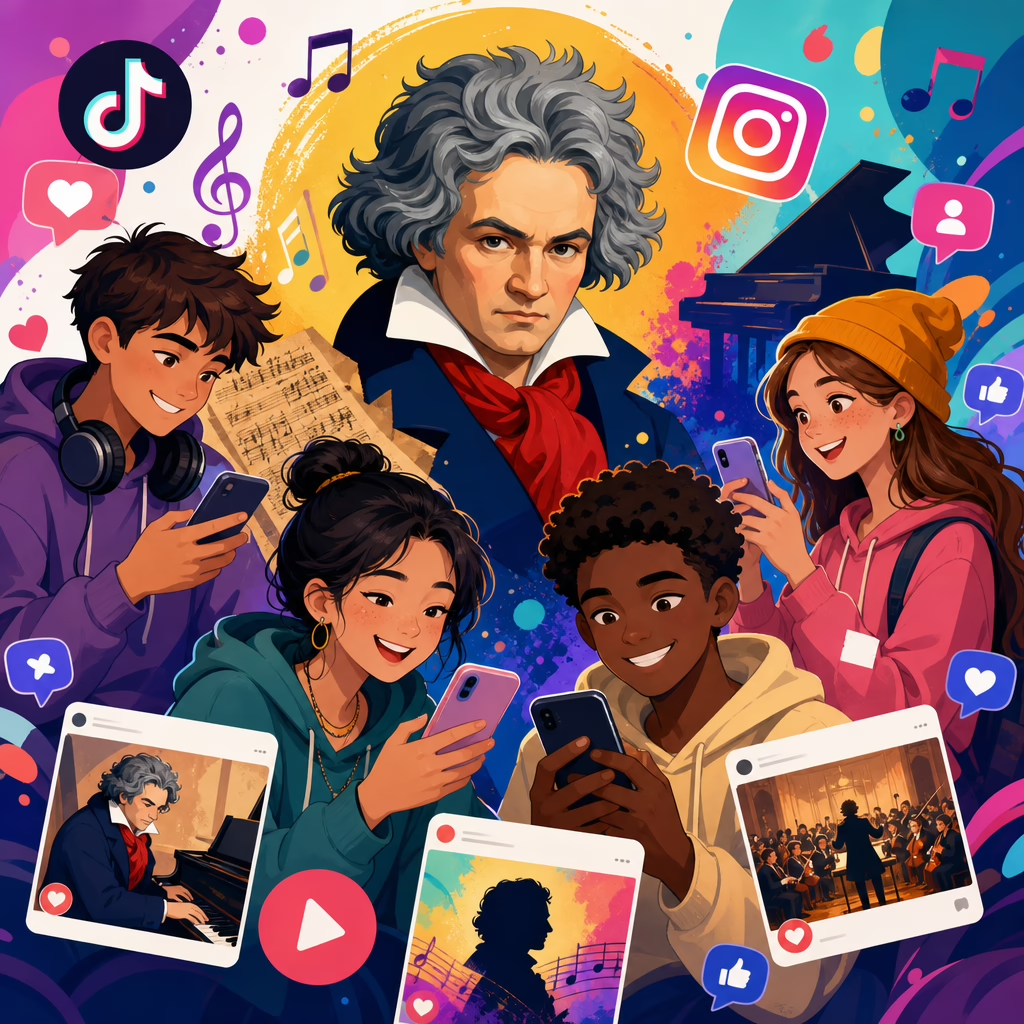
Engaging Teens with Beethoven’s Legacy Through Social Media
Engaging teens with Beethoven’s legacy through social media starts with a simple reality: most young people will not encounter Ludwig van Beethoven first in a concert hall, a music appreciation class, or a dense biography. They will meet him in a short video, a meme, a creator reaction, a gaming soundtrack comparison, or a classroom post shared through Instagram, TikTok, YouTube, or Discord. If educators, arts organizations, libraries, youth ensembles, and community groups want Beethoven to feel relevant, they must present his work where teens already gather, communicate, and build identity.
Beethoven’s legacy includes far more than a handful of famous melodies. It spans symphonies, piano sonatas, chamber music, choral works, political ideals, artistic independence, and a life story marked by hearing loss, personal struggle, and relentless experimentation. His influence reaches film scores, popular music structures, emotional storytelling in games, and modern ideas about the composer as a visionary individual. For teenagers, that makes Beethoven useful not only as a historical figure but also as a gateway into creativity, resilience, culture, and self-expression.
In practice, I have seen the difference between presenting Beethoven as a monument and presenting him as a human being. A static lecture about dates and opus numbers rarely sparks sustained interest. A short reel comparing the opening motif of the Fifth Symphony to the way contemporary producers build instantly recognizable hooks can. A student discussion around hearing loss and identity, connected to Beethoven’s late quartets and modern accessibility advocacy, often produces deeper engagement than a test on chronology. Social media does not have to dilute classical music. Used well, it can create entry points, context, and community.
This hub article explains how to engage teens with Beethoven’s legacy through social media in ways that are accurate, educational, and culturally aware. It covers what content formats work, how different platforms shape attention, which themes resonate with teenage audiences, and how community and education programs can connect this hub to workshops, performances, classroom materials, youth challenges, and local partnerships. It also addresses the practical limits: short-form platforms reward speed, trends can flatten nuance, copyright matters, and outreach must invite participation rather than talk down to young audiences.
Why Beethoven Still Connects with Teen Audiences
Teens respond to Beethoven when the framing matches the questions they already ask: Who was he really? Why is this music still famous? How did he keep creating after losing his hearing? Why do so many movie scenes sound emotionally similar to his dramatic arcs? These are answerable questions, and they matter because teenagers are often drawn to authenticity, challenge, and stories of persistence. Beethoven offers all three.
His biography contains obvious points of connection. He moved from Bonn to Vienna as a young artist, built a career in a competitive environment, challenged expectations, and redefined what musicians could say in public through art. His increasing deafness is not a sentimental detail; it is central to understanding his career and the public mythology around him. For many teens navigating stress, isolation, disability, ambition, or creative uncertainty, Beethoven’s life is a concrete example of adaptation under pressure.
The music also works surprisingly well in social formats because it contains bold contrasts. The rhythmic opening of Symphony No. 5 is instantly identifiable. “Für Elise” is globally recognizable even among listeners with little classical training. The “Ode to Joy” theme from Symphony No. 9 has become a civic and global symbol. These pieces provide familiar anchors that creators can remix, explain, compare, and contextualize. Familiarity lowers the barrier to entry; commentary creates depth.
Just as important, Beethoven stands at the intersection of many teen interests. He connects to mental health conversations, disability history, film music, internet remix culture, piano study, orchestral performance, social justice themes around freedom and citizenship, and debates about what counts as genius. That breadth makes this page a natural hub for miscellaneous community and education articles: teacher guides, youth ensemble projects, local event toolkits, creator collaborations, listening lists, and digital literacy resources can all branch from a strong central strategy.
Choosing the Right Social Media Platforms and Formats
Each platform changes how Beethoven should be introduced. TikTok and Instagram Reels favor compressed storytelling, strong openings, captions, and emotional payoff within seconds. YouTube supports longer explainers, performer interviews, score-following videos, and mini-documentaries. Discord works well for ongoing youth communities, listening clubs, rehearsal groups, and collaborative projects. Snapchat can support event reminders and behind-the-scenes access, while school LMS systems and library newsletters can extend social posts into structured learning.
The mistake I see most often is publishing the same content everywhere. A two-minute educator monologue may underperform badly on TikTok while a fifteen-second hook, followed by comments answering audience questions, performs well. On YouTube, however, teens will often watch seven to ten minutes if the topic is clear, the visuals are dynamic, and the host demonstrates real command. Platform fit matters more than volume.
Successful formats usually include one of five elements: recognition, surprise, participation, identification, or utility. Recognition means starting with a melody teens already know. Surprise means revealing something unexpected, such as Beethoven revising obsessively rather than improvising masterpieces in one burst. Participation means inviting duets, remixes, polls, or response videos. Identification means connecting his life to issues teens feel personally. Utility means giving listeners a playlist, practice tip, classroom prompt, or local event link they can use immediately.
| Platform | Best Beethoven Content | Why It Works for Teens |
|---|---|---|
| TikTok | 15 to 60 second motif breakdowns, duets, trend-based hooks | Fast discovery, strong algorithmic reach, easy remix culture |
| Instagram Reels | Performance clips, quote cards, behind-the-scenes rehearsal edits | Visual identity, shareability, school and arts organization reach |
| YouTube | Mini-documentaries, listening guides, composer comparisons | More depth, search longevity, stronger educational retention |
| Discord | Listening clubs, Q&A sessions, peer discussion channels | Community building, ongoing conversation, teen-led participation |
For a community and education hub, the practical approach is to pair short-form discovery with longer-form explanation. A reel can ask, “Why does Beethoven’s Fifth feel so urgent?” Then a linked video, article, lesson page, or event signup can answer fully. That pathway respects teen attention without assuming teens are incapable of depth.
Content Themes That Make Beethoven Relevant
The strongest social content themes are not random. They connect Beethoven’s work to recognizable teenage concerns and cultural habits. One effective theme is resilience without cliché. Instead of posting generic inspiration, show how hearing loss affected Beethoven’s career, correspondence, social life, and compositional process. Mention the Heiligenstadt Testament as a primary source that reveals despair and determination. Teens respond better when evidence replaces slogans.
A second theme is decoding famous music. Explain why the four-note opening of Symphony No. 5 is memorable: rhythmic economy, repetition, tension, and orchestral development. Compare that musical economy to how modern pop and hip-hop producers rely on identifiable motifs. This does not collapse the genres into each other; it teaches pattern recognition and composition across traditions.
A third theme is “Beethoven in modern media.” Show where his music appears in films, commercials, animation, or games, then ask what emotional function it serves. The “Moonlight” Sonata often signals introspection or melancholy. The Ninth can suggest triumph, collectivity, or irony depending on context. Teens already understand soundtrack language; this framing lets them analyze rather than passively consume.
A fourth theme is myth versus reality. Social audiences love correction content when it is respectful and sourced. For example, clarify that “Für Elise” may not have been intended as a major concert statement, yet it became one of the most recognized piano pieces in history. Explain that Beethoven was revolutionary, but also deeply engaged with forms inherited from Haydn and Mozart. Good historical nuance builds trust.
A fifth theme is participation through creativity. Invite teens to choreograph a passage, draw what a late quartet feels like, create a lo-fi study mix inspired by Beethoven textures, or compare two recordings and explain their preference. Participation turns legacy into lived culture.
Building Programs Around Social Media, Not Just Posts
Social media works best when it supports a larger ecosystem. A community orchestra can run a Beethoven challenge online, then invite participants to an open rehearsal. A public library can post weekly listening prompts, then host an in-person teen discussion. A school district can share short clips from student performers and connect them to curricular materials on history, literature, and sound. Posts alone create awareness; programs create belonging.
One practical model is the three-step ladder. Step one is discovery: a short post introducing a hook, question, or challenge. Step two is engagement: comments, polls, creator responses, live Q&A sessions, or downloadable guides. Step three is participation: workshops, performances, teen advisory boards, remix contests, listening clubs, or student-produced media. When I have helped institutions structure outreach this way, retention improves because teens are given a reason to return.
Partnerships are especially valuable. Music teachers, youth centers, disability advocates, local historians, conservatories, student media clubs, and content creators can each make Beethoven relevant from a different angle. A deaf studies group can contribute informed discussion about hearing, identity, and representation. A film teacher can analyze Beethoven in cinema. A youth orchestra can demonstrate how interpretation changes the same score. This hub should point readers toward all those subtopics because miscellaneous educational engagement is broad by nature.
Measurement should also be concrete. Views alone are not enough. Track saves, shares, comment quality, event registrations, repeat participation, teacher downloads, student submissions, and average watch time. If a post gets fewer views but drives twenty workshop signups, it may be more valuable than a viral clip with no conversion to learning or attendance.
Accuracy, Access, and the Risks of Shallow Engagement
Effective Beethoven social media must be accurate, accessible, and ethically framed. Accuracy matters because misinformation travels quickly, especially around famous figures. Use reliable editions, recognized biographies, museum sources, and established musicological references. When discussing hearing loss, avoid simplistic claims that Beethoven “composed entirely in silence.” His hearing decline was gradual and complex, and scholars continue to debate aspects of his auditory experience.
Accessibility matters just as much. Caption every video. Use readable on-screen text. Provide alt text for images when possible. Avoid assuming all teens have prior classical vocabulary. Define terms such as sonata, motif, quartet, and variation in plain language. If you share score excerpts, explain what viewers are seeing. Inclusive design is not an extra feature; it is part of educational quality.
There are tradeoffs. Trend-driven content can oversimplify. Meme formats can detach music from context. Copyright and licensing must be checked, especially for specific recordings even when the compositions are public domain. Institutions also need moderation policies for teen spaces, particularly on Discord or live streams. Clear community guidelines, staff oversight, and privacy protections are essential.
The solution is not to avoid social media. It is to use it responsibly. Treat each post as an invitation to deeper understanding, not a substitute for it. When organizations balance lively storytelling with factual precision, teens notice the respect. That respect is what makes engagement durable.
Beethoven can feel distant if he is presented only as a marble bust, but social media gives educators and community leaders a practical way to reintroduce him as a living cultural force. The key is to meet teens where they are without flattening the music or the history. Use recognizable works, platform-specific formats, strong storytelling, and direct links to real participation. Connect biography to disability awareness, composition to modern listening habits, and legacy to creative expression. Build pathways from reels and shorts to workshops, performances, discussions, and youth-led projects.
For a community and education hub, that broad approach matters. Miscellaneous engagement is not a weak category; it is where many first encounters happen. A student may arrive through a meme, stay for a listening guide, join a school ensemble event, and eventually explore a sonata or quartet in depth. That progression is realistic and valuable. If you are developing content in this area, start with one clear question teens actually ask about Beethoven, answer it well, and connect it to the next resource they can use today.
Frequently Asked Questions
Why is social media an effective way to introduce teens to Beethoven’s legacy?
Social media works because it meets teens where they already spend time and how they already discover culture. For many young people, interest does not begin with formal instruction. It begins with a short, compelling clip, a joke, a trend, a reaction video, or a comparison that makes an older subject feel current. Beethoven’s music and story fit this environment surprisingly well. His compositions are emotionally vivid, recognizable, dramatic, and often already familiar in indirect ways through film, gaming, advertising, and internet culture. That gives educators and arts organizations a strong entry point.
Just as important, social media allows Beethoven to be presented in formats that feel less intimidating than traditional educational materials. A 30-second video explaining the intensity of the Fifth Symphony, a meme about creative obsession, or a side-by-side comparison of a Beethoven motif and a modern cinematic soundtrack can make teens curious enough to want more. Curiosity is the first goal. Once attention is captured, deeper learning can follow through discussion, playlists, classroom activities, live performances, or interactive projects.
Social platforms also encourage participation instead of passive consumption. Teens can comment, remix, respond, vote, duet, stitch, and share their own interpretations. That matters because engagement is stronger when students are invited to create meaning rather than simply receive facts. In this setting, Beethoven stops being just a distant historical figure and becomes a source of ideas, moods, questions, and creative challenges that teens can connect to their own lives and digital habits.
How can educators and youth organizations make Beethoven feel relevant to teenagers without oversimplifying him?
The key is to connect Beethoven to themes teens already understand while still respecting the complexity of his life and work. Relevance does not mean turning him into a gimmick. It means translating his significance into language, examples, and formats that are accessible. Beethoven’s legacy can be framed through topics that resonate strongly with young audiences: perseverance, identity, creative risk, frustration, independence, innovation, and the pressure to express something meaningful. His personal struggles, especially his hearing loss and determination to continue composing, can open powerful conversations about resilience and artistic purpose.
One effective strategy is to begin with a relatable question instead of a lecture. For example: Why does dramatic music still sound powerful hundreds of years later? How does a composer communicate anger, triumph, or tension without words? Why do so many modern soundtracks echo ideas Beethoven used? Questions like these invite discovery. From there, educators can add historical context, musical detail, and cultural significance in manageable layers. This approach preserves depth while removing unnecessary barriers.
It also helps to present Beethoven as both a human being and a major artistic force. Teens do not need a sanitized version of history. They respond better to authenticity. Acknowledging Beethoven’s flaws, intensity, ambition, and contradictions makes him more real, not less important. Social media content can introduce a hook, but thoughtful follow-up should build understanding of his music, historical environment, and lasting influence. When done well, relevance becomes a bridge to substance, not a replacement for it.
What kinds of social media content are most effective for engaging teens with Beethoven’s music?
The most effective content is short, visually clear, emotionally direct, and designed to spark interaction. Clips that highlight instantly recognizable musical moments often perform well because they create an immediate response. For Beethoven, that might include the opening of Symphony No. 5, energetic passages from Symphony No. 7, dramatic sections from the “Moonlight” Sonata, or excerpts that sound surprisingly modern in mood and intensity. These moments can be paired with captions, animations, reaction formats, or simple explanations that help teens understand what they are hearing.
Comparison content is especially powerful. Posts that connect Beethoven to movie scores, video game music, sports hype tracks, or modern producers can help teens hear influence across time. Reaction videos, “if you like this, try this” playlists, behind-the-scenes rehearsal clips, and creator breakdowns also work well because they feel personal and informal. Memes and humor can be useful too, as long as they lead somewhere meaningful. A funny post can open the door, but a good content strategy should also provide next steps for deeper exploration.
Interactive formats tend to sustain attention better than one-way messaging. Polls, quizzes, “duet this performance,” remix challenges, and short prompts asking students to identify the mood of a piece can turn a scroll into an experience. Consistency matters as much as creativity. A steady stream of varied content—performance snippets, historical facts, creative challenges, student responses, and live Q&A sessions—builds familiarity over time. That repeated exposure helps Beethoven’s music move from being “old and distant” to recognizable, discussable, and worth revisiting.
How can social media support deeper learning about Beethoven instead of just creating momentary attention?
Momentary attention is useful, but it should be treated as the beginning of a learning pathway rather than the end goal. Social media is strongest when it acts as the front door to richer educational experiences. A short post can introduce a musical idea, but deeper learning happens when that post is connected to guided listening, discussion, performance, reflection, and creative response. In practical terms, this means every engaging clip or visual should point somewhere: a classroom activity, a playlist, a live event, a worksheet, a conversation prompt, or a collaborative project.
For example, a short video on Beethoven’s use of tension and release can be followed by a listening exercise where students identify those elements in a longer work. A meme about Beethoven’s dramatic style can lead into a lesson on form, orchestration, or emotional storytelling in music. A comparison between Beethoven and a game soundtrack can become a discussion about influence, musical structure, and why certain patterns still affect listeners today. The social post generates curiosity; the educational design turns curiosity into understanding.
Deeper learning also benefits from student creation. When teens make their own content—such as playlists, visual interpretations, short analyses, remixes, or response videos—they process the material more actively. They move beyond “I saw something interesting” to “I understand this well enough to explain or reinterpret it.” That shift is important. Social media should not replace teaching, but it can extend and reinforce it by making Beethoven visible in the environments where teens already communicate, form opinions, and share ideas.
What should schools, libraries, and arts organizations keep in mind when using social media to share Beethoven with teens?
They should begin with audience awareness, platform awareness, and a clear purpose. Teens on TikTok, Instagram, YouTube, and Discord do not all respond to the same style of content, so successful outreach depends on understanding the habits and expectations of each space. Content should feel native to the platform rather than repurposed without adaptation. A polished concert clip may work on YouTube, while a fast, captioned, personality-driven explanation may work better on TikTok or Instagram Reels. The goal is not to chase trends blindly, but to communicate in ways that feel recognizable and respectful to young audiences.
It is also important to avoid talking down to teens. Young people are highly skilled at detecting forced relevance. Institutions should aim for authenticity, clarity, and curiosity rather than exaggerated attempts to sound trendy. Strong content often comes from real musicians, teachers, librarians, student ambassadors, or creators who can explain why Beethoven matters in a direct and engaging way. Including teen voices in planning and content creation can make outreach more credible and more effective.
Finally, organizations should think beyond visibility and ask what success actually looks like. Is the goal to increase listening? Drive attendance to performances? Support classroom learning? Build community participation? Encourage student creativity? Clear goals make content more intentional. When social media is tied to educational outcomes, youth programs, performance opportunities, and meaningful conversation, it becomes much more than promotion. It becomes a practical tool for cultural access—one that helps teens encounter Beethoven not as a museum figure from the past, but as an artist whose work still carries energy, emotion, and influence in the present.