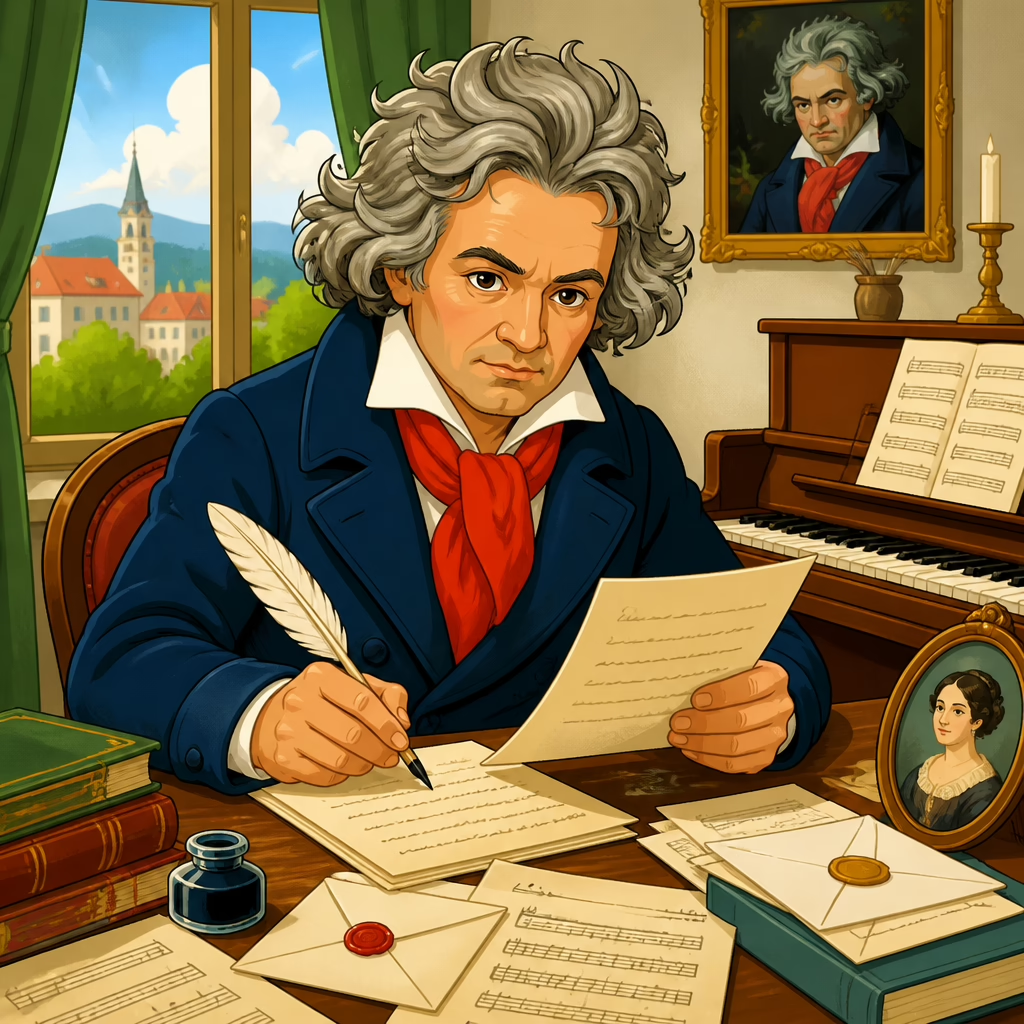
Teaching Beethoven Through Letters and Primary Sources
Teaching Beethoven through letters and primary sources gives students a more accurate, human, and memorable understanding of the composer than a timeline of dates and masterworks alone. In music classrooms, Beethoven is often introduced as the deaf genius behind the Fifth Symphony, the Moonlight Sonata, and the Ninth Symphony. That shorthand is familiar, but it is incomplete. Primary sources, including letters, conversation books, dedications, publication pages, diary-like notes, and contemporary accounts, let students encounter Beethoven as a working musician who negotiated fees, argued with publishers, worried about health, revised scores, depended on patrons, and shaped his public image. When I have taught Beethoven this way, students ask better questions because the evidence feels immediate. Instead of asking only what he composed, they ask why he wrote, for whom, under what pressures, and how historians know what they claim to know.
Primary sources are materials created during the period being studied. For Beethoven, that means autograph manuscripts, correspondence, legal documents, notebooks, and reports by people who knew him. A letter to a publisher is not merely biographical color; it is evidence about professional practice, musical economics, and artistic priorities. A page from the Heiligenstadt Testament is not just a dramatic text about hearing loss; it reveals self-fashioning, family tension, and the gap between private despair and public productivity. Teaching from such sources matters because it strengthens historical thinking and media literacy at the same time. Students learn that every source has a creator, audience, purpose, and bias. They also learn that great music did not emerge from myth, but from choices made by a person in a real social world.
For elementary and middle-grade settings, the goal is not to turn every lesson into archival training. The goal is to select a few carefully framed documents that illuminate one musical idea, one life event, or one misconception. In upper grades, those same documents can support richer work with chronology, translation, authorship, and interpretation. Across levels, letters and primary sources make Beethoven teachable as both a composer and a historical subject. That combination is especially valuable in community and education contexts, where the aim is not only appreciation but also connection, inquiry, and confidence with evidence.
Why letters work so well in Beethoven lessons
Letters are among the most effective entry points because they are direct, readable in excerpt, and naturally dramatic. Students understand the basic form immediately: one person writing to another for a reason. That familiarity lowers the barrier to historical study. Beethoven’s correspondence covers practical matters such as commissions, publication terms, performance plans, housing, family relationships, and health. Those topics create concrete teaching moments. A letter about delayed payment opens discussion about how composers earned money before streaming or recording. A note showing frustration with a copyist reveals that music circulated through labor-intensive processes. A message to a patron illustrates the importance of aristocratic support in Vienna around 1800.
Letters also help correct common myths. Students often hear that Beethoven simply transcended deafness through sheer will. The documents present a harder truth. His hearing loss unfolded over time, affected social interaction and performance, and created shame, anger, and isolation. The Heiligenstadt Testament from 1802, addressed to his brothers Carl and Johann, is central here. It was not a public essay but a private document never sent in its original moment. In age-appropriate excerpts, students can see Beethoven describe withdrawing from society because he could not admit the extent of his hearing problems. That source supports careful discussion: hearing loss shaped his life profoundly, but it did not erase his agency or define his entire identity.
Another strength is that letters naturally connect music to place and network. Beethoven did not work in isolation. He corresponded with publishers such as Breitkopf & Härtel, interacted with patrons including Archduke Rudolph and Prince Lobkowitz, and depended on performers, copyists, instrument makers, and friends. Once students read even one or two documents, the image of the solitary genius starts to give way to a more accurate ecosystem of creation. That shift improves music understanding because compositions begin to look like responses to circumstances, opportunities, and audiences rather than detached monuments.
Which primary sources to choose and what each one teaches
The best classroom sources are short, interpretable, and connected to a clear lesson objective. Start with four high-value categories. First, letters to publishers teach musical labor and commerce. Beethoven frequently negotiated terms, complained about unauthorized editions, and pushed for fair compensation. Those documents show that intellectual property concerns existed long before modern copyright debates. Second, the Heiligenstadt Testament teaches hearing loss, emotional life, and source context. Students can compare the private intensity of the document with the continued ambition of works from the same general era.
Third, conversation books are powerful for advanced students. Because Beethoven’s hearing declined severely, visitors often wrote their side of conversations in notebooks while he replied aloud or in writing. These books, especially from his later years, reveal daily life, practical concerns, and the fragmented nature of evidence, since Beethoven’s spoken replies are often missing. That absence is a superb lesson in historical limitation. Fourth, autograph manuscripts and sketchbooks teach revision. Students are often surprised to learn how extensively Beethoven reworked ideas. Seeing crossings-out and alternative passages makes composition visible as process rather than magic.
| Source type | Best classroom use | What students can learn |
|---|---|---|
| Letters to publishers | Economics of composing | Fees, deadlines, editions, professional identity |
| Heiligenstadt Testament | Hearing loss and self-expression | Private voice, emotional context, historical empathy |
| Conversation books | Later life and evidence gaps | Communication methods, fragmentary records, inference |
| Sketchbooks and manuscripts | Composition process | Revision, persistence, thematic development |
Published source collections and digital archives make these materials accessible, but teachers should preview translations carefully. Some editions modernize wording, omit context, or combine fragments. For younger students, a two- or three-sentence excerpt with a short source note is usually enough. For older students, include date, recipient, location, and a question about reliability. If the lesson focuses on a famous work, pair the source with one identifiable musical excerpt. A manuscript page related to the Eroica Symphony, for example, can support discussion of expansion, revision, and the bold scale that shocked early listeners.
How to build a lesson around one document
A strong primary-source lesson follows a simple sequence: set context, examine the document, connect it to music, and close with a claim supported by evidence. I use this pattern because it keeps the source from becoming decoration. Suppose the document is a letter about publishing difficulties. Begin with two minutes of background on Vienna’s musical marketplace and ask students how musicians today get paid. Then show the excerpt and identify the sender, recipient, and purpose. Have students underline one phrase that signals urgency or frustration. Next, play a short excerpt from the related work, if one is known, and ask what the letter suggests about the conditions under which that music reached the public. Students finish by writing one sentence beginning, “This source shows that Beethoven…”
The same structure works with the Heiligenstadt Testament. After a brief explanation of the date and private nature of the text, students read an excerpt describing Beethoven’s withdrawal from social life. Then they listen to a passage from the Second Symphony or another work near that period and discuss whether the music sounds like the despair they expect. That tension is productive. It teaches that art does not function as a straightforward diary. Sources and compositions illuminate each other, but they are not interchangeable. This is one of the most important historical habits students can learn.
Document study also supports cross-curricular goals. In literacy terms, students identify audience, tone, and point of view. In history terms, they evaluate evidence and distinguish primary from secondary material. In music terms, they connect biography to repertoire without reducing one to the other. Teachers looking for age-appropriate classroom materials can also draw ideas from broader planning resources such as Beethoven lesson plans for elementary music classes, then adapt those activities by adding one source excerpt as the anchor evidence.
Common pitfalls and how to avoid them
The biggest mistake is using letters only to dramatize Beethoven’s suffering. Hearing loss is essential to his story, but if every source points back to anguish, students come away with a flattened portrait. Balance personal documents with professional ones. Show him negotiating, joking, revising, persuading, and managing relationships. A second mistake is treating translated excerpts as transparent. Translation always involves choices. If a phrase sounds unusually modern or excessively polished, tell students they are reading a translator’s version of Beethoven’s meaning, not hearing his voice without mediation. That small clarification builds trust and sophistication.
A third pitfall is overclaiming what a source proves. Conversation books are particularly tricky because they preserve only part of the exchange. Students should know that historians often infer Beethoven’s side from context, but inference is not certainty. Likewise, a passionate statement in one letter should not be taken as his final position on every issue. People write for audiences and moments. A complaint to a publisher may be strategic as well as sincere. Naming that possibility does not weaken the lesson; it strengthens it by showing how evidence works.
Finally, avoid presenting primary sources without enough framing. Students need date, relationship, and reason. A letter excerpt dropped onto a worksheet with no context becomes a puzzle with no payoff. Even one sentence of setup can transform comprehension: “In 1802, as his hearing worsened, Beethoven drafted a private text to his brothers that was never sent.” That framing tells students what kind of evidence they are handling and why it matters.
What students gain from this approach
When Beethoven is taught through letters and primary sources, students gain more than biographical detail. They develop a grounded understanding of how musical history is constructed. They see that famous narratives are assembled from documents, edited by scholars, translated for readers, and interpreted in classrooms. They also gain a stronger connection to the music itself. A sketchbook page can make motivic development less abstract. A publisher letter can make the circulation of a sonata feel real. A private testament can deepen listening without turning music into simple autobiography.
This approach is especially effective in community and education settings because it invites participation from students with different strengths. Strong readers can analyze wording. Visual learners can inspect handwriting and manuscript changes. Curious listeners can connect source context to sound. Students who are less invested in canonical repertoire often respond positively when they realize the lesson is not asking them to revere a monument, but to investigate evidence about a complicated person. That shift from passive admiration to active inquiry is the main educational benefit.
Teach one carefully chosen document, ask answerable questions, and connect the evidence to one musical idea. That is enough to make Beethoven more understandable, more human, and more relevant. Start small: a letter, a short excerpt, a listening passage, and one claim supported by proof. Done consistently, that method builds historical thinking and deeper musical engagement at the same time.
Frequently Asked Questions
Why should teachers use Beethoven’s letters and other primary sources instead of relying only on timelines and famous compositions?
Timelines and lists of major works are useful starting points, but they often reduce Beethoven to a simplified classroom image: the isolated, deaf genius who produced a handful of masterpieces. Primary sources give students something far richer. Letters, conversation books, dedications, title pages, and personal notes reveal Beethoven as a working musician, a complicated individual, and a participant in the political, social, and artistic life of his time. Students can see how he managed professional relationships, negotiated with publishers, expressed frustration, defended his artistic choices, and responded to illness and hearing loss.
Using these materials also strengthens historical thinking. Instead of memorizing facts about Beethoven, students learn to ask evidence-based questions: Who wrote this document? Why was it written? What does it reveal, and what might it leave out? That kind of inquiry helps students understand that history and music history are constructed from surviving evidence, not just textbook summaries. In practical terms, primary sources make Beethoven more memorable because students encounter his own voice and the voices of people around him. That direct connection often leads to stronger engagement, better class discussion, and a more nuanced understanding of both the composer and the world in which he lived.
What kinds of primary sources are most useful for teaching Beethoven in the classroom?
The most effective primary sources are the ones that illuminate both Beethoven’s music and his lived experience. Letters are often the best entry point because they are personal, vivid, and accessible. In them, students can observe Beethoven discussing commissions, money, illness, patrons, artistic goals, and daily frustrations. Conversation books are also especially important for understanding the later years of his life, when hearing loss made spoken communication more difficult. These documents help students move beyond the oversimplified story of deafness by showing how Beethoven and those around him adapted in practical, human ways.
Other valuable materials include dedications and publication pages, which reveal networks of patronage, marketing, and reputation. Sketches and draft materials can show that great compositions were not simply inspired in finished form, but developed through revision and experimentation. Diary-like notes, legal documents, and accounts by contemporaries add still more dimension, especially when students compare perspectives. Even concert announcements or early reviews can be useful because they demonstrate how Beethoven’s music circulated and how audiences responded to it.
The best classroom set usually includes a mix of source types rather than a single document. A letter about a composition, a first edition title page, and a short critical response can work together to help students connect biography, musical culture, and historical context. This variety supports students with different strengths and encourages them to see Beethoven not just as a composer of famous works, but as a person operating within real institutions, relationships, and constraints.
How can teachers help students analyze Beethoven’s letters without overwhelming them?
The key is careful framing. Teachers do not need to present long, difficult documents all at once. Short excerpts, paired with guiding questions, are often more effective than complete texts for first encounters. Begin by establishing context: when the letter was written, to whom, and under what circumstances. That simple background allows students to read with purpose rather than confusion. It also helps to define a limited objective for each source, such as identifying Beethoven’s attitude toward a patron, tracing his response to hearing loss, or examining how he described his artistic work.
Scaffolding matters. Students benefit from a source-analysis routine that asks them to identify the author, audience, purpose, tone, and key details. Teachers can model the process by reading one excerpt aloud and thinking through it step by step. Vocabulary support may also be necessary, especially if students are working with translated texts or formal nineteenth-century language. In many classrooms, it is helpful to pair textual analysis with listening activities, visual documents, or short historical notes so that students can connect words on the page to music and historical circumstance.
Discussion should focus not only on what the source says, but on what it suggests and what it cannot fully prove. For example, one letter may show frustration, but it may not represent Beethoven’s whole character. Teaching students to avoid sweeping conclusions from a single source is part of the value of the exercise. With the right structure, these documents become manageable and engaging, even for students who are new to historical analysis or music history.
How do primary sources help students understand Beethoven’s deafness in a more accurate and meaningful way?
Primary sources are essential because they replace myth with evidence. Many students know only the dramatic version of Beethoven’s story: a composer who lost his hearing and somehow transcended tragedy through pure genius. While that narrative has emotional power, it can flatten the reality of disability, adaptation, and artistic labor. Letters and related documents show that Beethoven’s hearing loss unfolded over time, caused practical and emotional strain, affected relationships, and required specific strategies for communication and work. That evidence helps students see deafness not as a symbolic plot point, but as a lived condition with social, professional, and personal consequences.
Conversation books are especially revealing in this regard. They show how communication functioned in Beethoven’s later years and make visible the accommodations used by him and by others. This can open thoughtful classroom discussions about disability history, access, and the difference between romanticized suffering and real daily experience. Students can also explore how hearing loss shaped Beethoven’s public identity and posthumous reputation, especially when later writers turned it into a heroic legend.
Importantly, primary sources also prevent teachers from reducing Beethoven’s entire life to deafness. His letters and documents show him dealing with publishers, finances, family conflict, artistic ambition, and social networks alongside health concerns. That fuller portrait is pedagogically stronger because it respects complexity. Students come away understanding that Beethoven’s deafness mattered deeply, but it was one part of a larger human story rather than the single fact that explains everything.
What are the best ways to connect Beethoven’s primary sources to listening, writing, and broader classroom learning goals?
Primary sources are most powerful when they are integrated into active learning rather than treated as isolated historical curiosities. One effective method is to pair a document with a listening exercise. For example, students might read a letter related to a particular period in Beethoven’s life and then listen to a work from that time, discussing whether the source changes how they hear or interpret the music. This does not mean forcing a direct biographical reading of every composition, but it does encourage students to think critically about context, intention, reception, and performance.
Writing assignments also work especially well. Students can analyze a letter as historical evidence, compare two sources with different perspectives, or write a short response explaining how a primary source challenges a familiar textbook image of Beethoven. More advanced students might evaluate how later biographies or classroom narratives rely on, distort, or simplify original documents. These assignments build skills in close reading, argument, citation, and evidence-based interpretation, making Beethoven an excellent cross-curricular subject for music, history, and language arts classrooms.
At a broader level, teaching with primary sources supports major educational goals such as source evaluation, historical empathy, media literacy, and critical thinking. Students learn that cultural figures are not best understood through slogans or legends alone. They see how reputations are formed, how evidence survives, and how interpretation changes over time. In that sense, Beethoven’s letters and related materials do more than enrich a single unit on one composer. They model a disciplined, human-centered way of learning that students can apply to many other artists, historical figures, and periods of study.