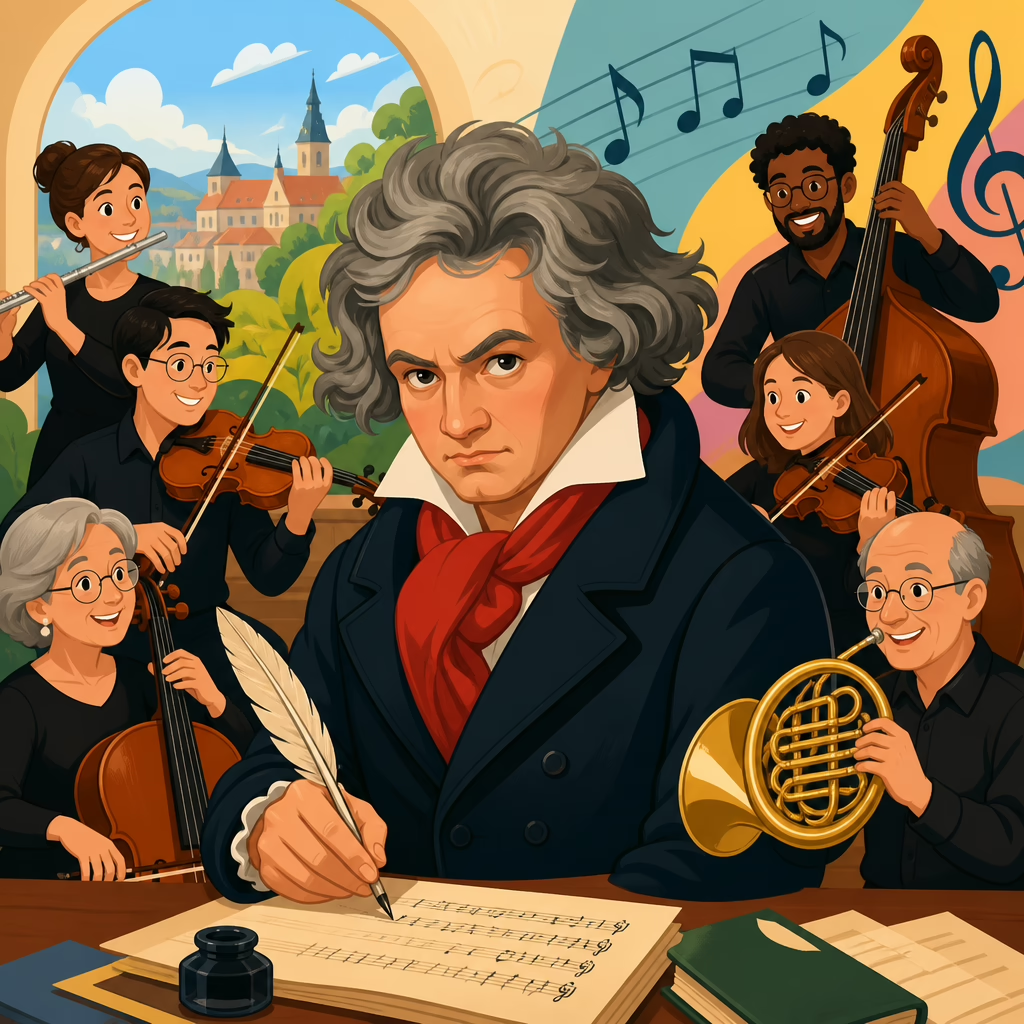
A Beginner’s Guide to Beethoven for Community Orchestras
Beethoven remains one of the most rewarding composers for community orchestras because his music combines clear structural logic with emotional force, giving amateur and volunteer ensembles a realistic path toward artistic growth. In this beginner’s guide to Beethoven for community orchestras, the goal is not to summarize his entire career, but to explain how local orchestras can choose his music wisely, rehearse it effectively, and present it in ways that serve players and audiences. Community orchestra usually means a mixed-ability ensemble with limited rehearsal time, volunteer administration, and practical constraints around string balance, winds, brass, percussion, venue acoustics, and librarian resources. Beethoven, in this context, refers mainly to the orchestral and concert overture repertory from the late eighteenth and early nineteenth centuries, especially the symphonies, incidental works, and shorter pieces commonly programmed by nonprofessional groups. This matters because Beethoven can elevate ensemble standards faster than almost any comparable repertory: intonation, rhythmic precision, articulation, dynamic contrast, and collective listening all become impossible to ignore. I have seen volunteer orchestras transform over a single season when Beethoven was introduced at the right level, with disciplined preparation rather than prestige-driven programming.
Choosing the right Beethoven for your ensemble
The first question every community orchestra asks is simple: where should we start with Beethoven? The best answer is usually not Symphony No. 5 or Symphony No. 9, despite their fame. For a beginner approach, the most accessible entry points are Symphony No. 1, Symphony No. 2, selected movements from Symphony No. 4, and overtures such as The Creatures of Prometheus or Consecration of the House if the wind and brass sections are dependable. These works still demand classical clarity, but they sit more comfortably under the fingers than the Eroica, Fifth, Seventh, or Ninth. In practical terms, Symphony No. 1 asks for disciplined ensemble playing without the sustained weight, extreme dynamic range, and psychological intensity of the middle-period symphonies. Symphony No. 2 extends stamina and scale but remains playable for a solid volunteer orchestra with balanced sections and a conductor who can teach style efficiently.
Difficulty in Beethoven is not only about fast notes. It involves transparency. Exposed wind entries, unison string passages, sudden accents, and rests that must feel active can challenge community players more than dense romantic textures. A passage that looks easy on paper often reveals weak subdivision or uncertain bow distribution within minutes. That is why repertoire selection should consider rehearsal hours, principal strength, and recent programming history. If your orchestra has not played much Haydn or Mozart, jumping directly into Beethoven’s Fifth can create frustration because the ensemble may not yet share a common language of classical articulation and phrase shape. Start with music that teaches Beethoven’s syntax before tackling his most iconic statements.
Programming also benefits from educational framing. If the ensemble includes youth players, adult returners, and lifelong amateurs, pair an approachable Beethoven work with a short spoken introduction, sectional listening list, or rehearsal notes. Many conductors create simple style guides covering sforzando versus accent, eighteenth-century bow stroke, timpani role, and treatment of repeated motifs. For outreach concerts or family programs, it can help to connect the orchestral repertoire to broader teaching materials; a useful example is this resource on Beethoven lesson plans for elementary music classes, which can support pre-concert education and audience engagement without diluting artistic standards.
Understanding Beethoven’s style before the first rehearsal
Community orchestras play Beethoven better when they understand what makes his style distinct. Beethoven inherited the formal balance of Haydn and Mozart, but he intensified motivic development, widened dynamic range, and used rhythmic insistence as a structural engine. In rehearsal, I often tell players that Beethoven is not just dramatic because he is loud; he is dramatic because tiny ideas are repeated, transformed, and strategically interrupted. A two-note gesture can carry an entire movement. That means every section must identify which material is foreground, which is accompaniment, and how the musical argument progresses from phrase to phrase.
Tempo is another beginner issue. Beethoven’s metronome marks are famous and controversial, and community orchestras should approach them with respect but not rigidity. In volunteer settings, a convincing tempo is one that preserves character and allows rhythmic integrity. A too-slow allegro becomes heavy and kills phrase direction; a too-fast allegro destroys articulation and balance. Conductors should establish pulse relationships across movements, especially where subdivisions shift between duple and triple patterns. For players, this means practicing with a metronome not only for note accuracy but for internalized metric stability during rests and syncopations.
Articulation must be unified early. Beethoven’s staccato dots, slurs, sf markings, and hairpins are not decorative; they define rhetoric. String principals should decide bowings that preserve lift and clarity at the frog and middle, avoiding late romantic habits of over-sustaining every quarter note. Winds need to match note length and release, particularly in shared motifs passed between oboes, bassoons, clarinets, and flutes. Brass, especially natural-horn-inspired lines now played on modern instruments, should aim for brilliance without covering texture. Timpani are often the hinge between pulse and character, and precise stick choice matters more than many community groups expect.
Rehearsal strategies that work in community orchestra settings
Efficient Beethoven rehearsal begins with triage. Do not spend the first full rehearsal sight-reading every movement from start to finish. Instead, identify structural pressure points: introductions, transitions, codas, exposed soft passages, and any place where accompaniment patterns obscure pulse. In a two-hour volunteer rehearsal, twenty focused minutes on one problematic transition can produce more progress than a complete run-through. I have repeatedly found that community players feel more confident when difficult passages are isolated, counted, tuned, and then returned to context immediately. Beethoven rewards that discipline because his construction is so logical.
Sectionals are especially useful. Strings should address bow distribution, off-the-string consistency, and synchronized retakes. Violas and second violins often carry inner rhythmic energy, and if they underplay, the music loses drive. Winds need tuning checkpoints and breathing plans for sustained or repeated-note passages. Brass should rehearse attacks in relation to timpani, not only to the baton. If the ensemble has limited rehearsal dates, recorded practice tracks can help; even simple MIDI references for cue placement and tempo transitions improve preparedness, provided players know those files are guides rather than musical models.
| Work | Why it suits beginners | Main challenge | Best use |
|---|---|---|---|
| Symphony No. 1 | Clear form, moderate length, teachable style | Transparent intonation and classical articulation | First full Beethoven symphony |
| Symphony No. 2 | Broader scale without extreme technical strain | Stamina and scherzo precision | Second-step Beethoven project |
| Prometheus Overture | Compact, energetic, audience friendly | Clean wind entries and fast string response | Opening piece or outreach concert |
| Egmont Overture | Famous drama in a manageable duration | Weight, pacing, and brass balance | Stand-alone Beethoven introduction |
Another effective strategy is to teach the bass line. In Beethoven, cellos, basses, bassoons, and lower brass often carry the harmonic and rhythmic blueprint. When those players understand cadences, sequence patterns, and arrival points, ensemble cohesion improves quickly. Conductors should sing or play reductions at the piano to reveal harmonic function, especially in transitions where players otherwise count mechanically. This does not require advanced theory from everyone; it requires giving musicians a reason for each crescendo, accent, or suspension. Once players hear function, they stop treating repeated figures as filler.
Finally, schedule run-throughs carefully. Beethoven can sound underpowered if assembled too late, but endless complete runs can bake in mistakes. A useful sequence is detail, context, then stamina. Rehearse fragments intensively, connect them into larger spans, and only then test full movements. Save one rehearsal for acoustical adjustment in the hall if possible, because Beethoven’s balances change dramatically between a carpeted school auditorium and a live church or civic theater.
Common mistakes and how to avoid them
The most common community orchestra mistake with Beethoven is over-romanticizing the sound. Players often add too much vibrato, too much sustained bow, and too much generalized loudness, which blurs the profile of the music. Beethoven needs contrast built from rhythm and articulation before sheer mass of tone. Another frequent problem is underestimating rests. His silences are structural events, not empty spaces. If the ensemble releases untidily or reenters without collective breath, tension collapses. Conductors should rehearse releases as carefully as attacks, often asking for spoken counting or subdivision from the whole ensemble.
Balance issues can also distort style. Modern strings can disappear under enthusiastic brass and timpani, especially in smaller orchestras where desk numbers are thin. Transparent seating, careful dynamic ceilings, and selective brass restraint solve more problems than simply asking strings to play louder. Wind intonation deserves constant attention, particularly in chords where classical tuning tendencies differ from equal-tempered keyboard instincts. Oboe-led tuning is useful, but Beethoven passages often need note-specific adjustment inside phrases, not just at the beginning of rehearsal.
A third mistake is treating Beethoven as culturally mandatory rather than musically teachable. Programming a famous symphony before the ensemble is ready can harm morale. Players know when they are surviving instead of performing. It is better to play Symphony No. 1 beautifully than Symphony No. 5 anxiously. Audiences respond strongly to conviction, clarity, and shape; they do not need the heaviest warhorse every season. Good Beethoven programming builds capacity over time, with each project adding one new technical or stylistic demand.
Building audience connection and long-term growth
Beethoven succeeds in community settings when the performance is presented as shared discovery, not distant monument. Audiences benefit from concise program notes that explain recognizable motifs, formal surprises, or historical context such as the expansion of the symphony orchestra around 1800. Short pre-concert talks can demonstrate how a rhythmic cell returns in different instruments or why a slow introduction creates suspense. These explanations help first-time listeners follow the music actively, and they often increase player commitment because the ensemble understands the story it is telling.
Long-term growth comes from sequencing repertoire intelligently across seasons. A community orchestra might begin with an overture and Symphony No. 1, then move to Symphony No. 2 and Egmont, later adding selected middle-period works once articulation, balance, and rhythmic discipline have matured. This path mirrors what I have seen work in real ensembles: steady expansion, not abrupt escalation. Supporting that progress with listening assignments, principal-led sectionals, annotated parts, and honest post-concert evaluation creates a culture in which Beethoven becomes a training ground rather than a one-off challenge.
The broader benefit is artistic identity. When a volunteer orchestra learns to play Beethoven with style, audiences hear seriousness of purpose, and players feel the difference immediately. Entrances lock, phrases travel, and contrasts mean something. Start with repertoire that fits your ensemble, prepare the style before the first rehearsal, and rehearse with precision rather than prestige in mind. That approach turns Beethoven from an intimidating symbol into practical, transformative music for community orchestras. Choose one suitable work, build a clear rehearsal plan, and let the ensemble grow into the composer step by step.
Frequently Asked Questions
Why is Beethoven a good choice for community orchestras?
Beethoven is a strong fit for community orchestras because his music offers both artistic value and practical teaching benefits. For amateur and volunteer ensembles, his works reward careful preparation in very clear ways: players can hear how rhythm, balance, articulation, and phrasing directly shape the character of the music. Unlike repertoire that depends mainly on color or atmosphere, Beethoven often builds his ideas from concise motives, strong harmonic direction, and highly recognizable formal structures. That makes his music especially useful for ensembles that are still developing stylistic confidence, because conductors and players can trace how small musical details contribute to the larger architecture of a movement.
Another reason Beethoven works so well is that his output includes a wide range of difficulty levels. A community orchestra does not need to begin with the largest symphonies to benefit from programming him. Overtures, selected symphonic movements, and more accessible orchestral works can introduce the style without overwhelming the ensemble. In rehearsal, Beethoven encourages discipline: pulse must be steady, entrances must be precise, and dynamic contrasts must be intentional rather than approximate. Those are valuable skills for any local orchestra, regardless of whether the players are preparing Beethoven, Brahms, or contemporary repertoire later in the season.
He also remains highly recognizable to audiences. That matters for community orchestras balancing educational goals, volunteer morale, and ticket sales. Beethoven can attract listeners who know his name but may not attend every concert, while also giving regular patrons a chance to hear familiar repertoire interpreted by musicians from their own community. In that sense, Beethoven supports both artistic growth and public engagement, which is exactly why he remains one of the most rewarding composers for community ensembles.
What Beethoven pieces should a beginner-friendly community orchestra start with?
The best starting point is repertoire that introduces Beethoven’s language without immediately demanding the endurance, ensemble polish, and stylistic maturity required by his most famous large-scale works. For many community orchestras, the overtures are an excellent entry point. Pieces such as the Egmont Overture or Coriolan can teach dramatic contrast, rhythmic clarity, and classical-romantic phrasing in a compact format. They are challenging enough to be meaningful, but they are often more manageable than taking on a full symphony too early.
Among the symphonies, the First and Second are often sensible places to begin. They still require discipline and alertness, but they generally place fewer extreme demands on the ensemble than the Third, Fifth, Seventh, or Ninth. The First Symphony helps players understand Beethoven’s roots in the Classical style while introducing his energetic use of accents, sforzandos, and structural tension. The Second Symphony broadens those demands slightly and can be a very effective next step for an orchestra building confidence. Depending on the ensemble’s strengths, selected movements from these symphonies may also be useful in educational settings or workshop rehearsals before committing to a full performance.
It is wise to avoid choosing repertoire based only on name recognition. The Fifth Symphony, for example, is familiar to almost everyone, but familiarity does not make it easy. Its exposed rhythmic writing, relentless precision demands, and interpretive expectations can be punishing for an underprepared ensemble. The same is true, in different ways, of the Seventh and Ninth. A more strategic approach is to match repertoire to the orchestra’s actual rehearsal time, string section depth, wind strength, brass reliability, and experience with classical style. Starting with the right Beethoven piece helps players succeed, and success builds the musical trust needed for larger works later on.
What are the biggest rehearsal challenges in Beethoven, and how can community orchestras address them?
The biggest challenge in Beethoven is that the music often sounds simpler on the page than it feels in rehearsal. Community orchestras quickly discover that even straightforward-looking passages can unravel if rhythm, articulation, and ensemble alignment are not carefully unified. Beethoven’s writing exposes uncertainty. Repeated rhythmic figures, sudden accents, syncopations, and sharply defined dynamic contrasts all require a shared concept across the ensemble. If one section plays a passage broadly while another plays it lightly and forward, the music loses its drive immediately.
For that reason, conductors should spend time early in the rehearsal process defining basic style rather than assuming players will absorb it automatically. Bowings should support articulation and direction, not merely convenience. Winds and brass need a common plan for attacks, note length, and tapering phrase endings. String sections must agree on whether accents are produced through speed, weight, length, or a combination of all three. These decisions are especially important in Beethoven because his musical rhetoric often depends on contrasts that must be heard clearly from the first measure. Precision is not an optional polish layer; it is part of the meaning of the music.
Another common issue is pacing. Community orchestras sometimes rehearse Beethoven by focusing almost entirely on difficult notes and transitions, which is understandable, but not sufficient. Players also need to understand the long line: where tension builds, where harmonic arrival points occur, and where energy must continue through rests or repeated figures. Short sectional work can be very effective, especially for strings dealing with coordination or winds balancing exposed chords, but it should feed into full-ensemble work that restores the larger structure. Successful Beethoven rehearsals usually combine detailed technical correction with repeated reminders that the music must move, speak, and connect from phrase to phrase. When the ensemble understands both the details and the architecture, Beethoven becomes far more playable.
How should community orchestras approach Beethoven’s style and interpretation?
A strong Beethoven interpretation begins with clarity. Community orchestras do not need to imitate every aspect of period-performance practice to play him convincingly, but they do need to respect the music’s rhetorical sharpness, formal logic, and rhythmic energy. In practical terms, that means avoiding a generalized, heavy orchestral sound. Textures should remain transparent whenever possible, inner voices should matter, and dynamic markings should be taken seriously. Beethoven often creates intensity through contrast and direction, not simply through louder volume or thicker tone.
Tempo is another important issue. Many ensembles struggle because they choose tempi that feel safe in the rehearsal room but undermine the character of the music in performance. A tempo that is too slow can make Beethoven sound square, overworked, and far more difficult to sustain. At the same time, a tempo that is too fast for the ensemble’s technical level can destroy articulation and confidence. The best solution is to choose a tempo that preserves the essential pulse and gesture of the movement while remaining realistic for the orchestra. Once a tempo is selected, articulation and phrasing should be built around it consistently.
Interpretively, it helps to think of Beethoven as both architect and dramatist. His forms are carefully organized, but they are never emotionally neutral. Players should understand when a motive is functioning as argument, when a phrase is answering another, and when a sudden silence or accent acts almost like spoken rhetoric. This kind of awareness makes rehearsals more meaningful because musicians are not just counting measures; they are shaping a musical narrative. For community orchestras, that narrative approach can be transformative. It allows players of mixed backgrounds to connect with the music in a direct way, and it often results in performances that feel more compelling to audiences even when the ensemble is not technically perfect.
How can a community orchestra present Beethoven in a way that connects with modern audiences?
Presenting Beethoven effectively begins with the understanding that audiences do not need a full music history lecture, but they do benefit from guidance. Beethoven’s music becomes more engaging when listeners are given a few simple points of entry: a recurring rhythmic idea to listen for, a dramatic contrast to notice, or a brief explanation of how a movement builds tension. Program notes, pre-concert talks, short onstage remarks, and digital content can all help audiences feel included rather than intimidated. The goal is to frame the listening experience without overexplaining it.
Thoughtful programming also makes a difference. Beethoven works especially well when paired with repertoire that highlights either his influence or his contrasts. A community orchestra might place a Beethoven overture alongside a newer piece that shares similar energy, or follow an early Beethoven symphony with a later composer who expanded the symphonic tradition in a different direction. These connections make concerts feel curated rather than routine. They also help audiences hear Beethoven as a living artistic presence instead of a mandatory historical monument.
Finally, community orchestras should not underestimate the power of local storytelling. Audiences often respond deeply when they understand why a volunteer ensemble chose a particular Beethoven work and what it has meant to prepare it. Sharing that journey through concert remarks, newsletters, social media, or community partnerships can build investment well before the performance begins. Beethoven’s music already carries emotional force, but when listeners know they are hearing neighbors, teachers, students, retirees, and working professionals come together to tackle demanding repertoire with commitment and care, the performance gains another layer of meaning. That connection between great music and local participation is one of the most compelling reasons for community orchestras to keep Beethoven at the center of their programming.