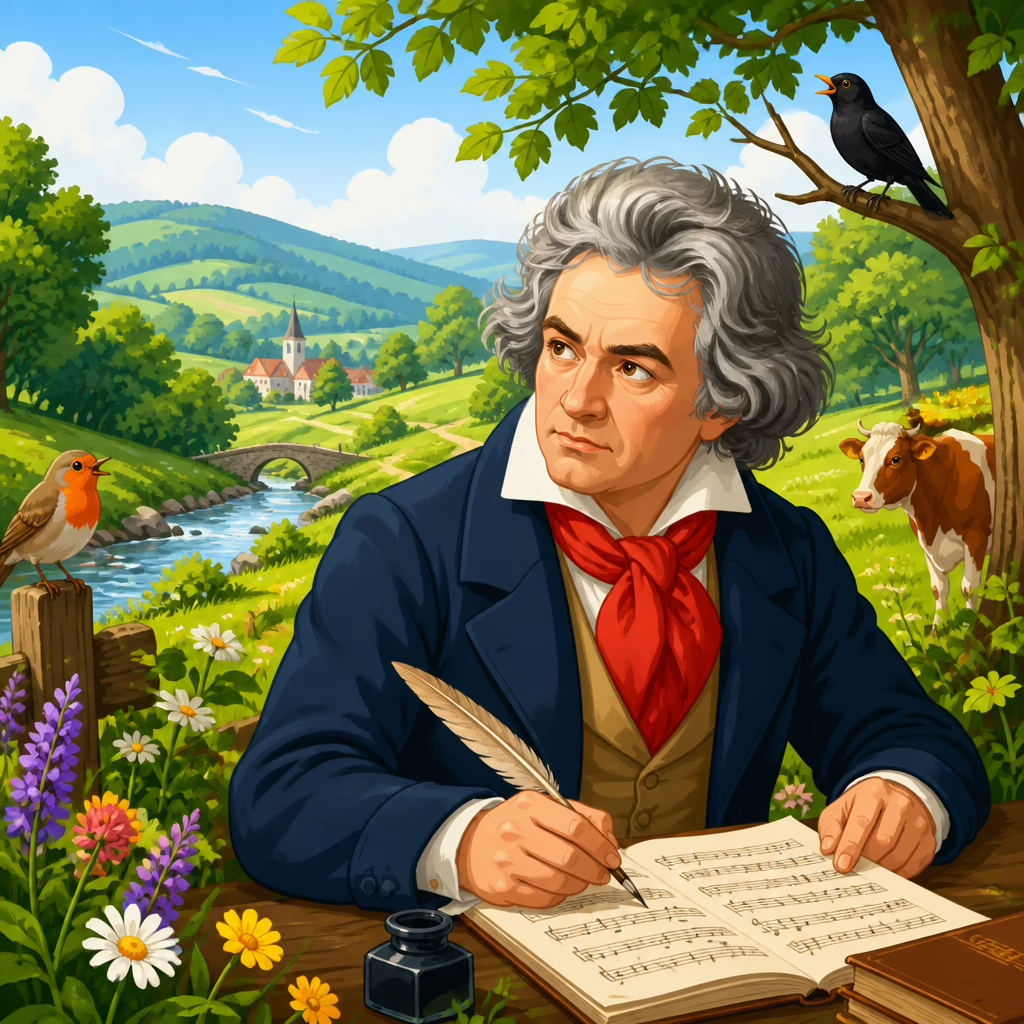
Beethoven and the Sounds of the Countryside
Ludwig van Beethoven did not treat the countryside as a decorative backdrop. He listened to it as a living score. Fields, streams, birdsong, village dances, shepherd calls, and the shifting weather around Vienna entered his imagination so deeply that they shaped how he organized rhythm, texture, harmony, and musical character. To understand Beethoven and the sounds of the countryside, it helps to separate simple pastoral style from Beethoven’s more exact practice. Pastoral style, inherited from earlier composers, uses recognizable signs of rural life: drones, lilting meters, simple tunes, and rustic instruments or their orchestral imitations. Beethoven certainly used those signs, but he went further. He translated outdoor hearing into musical process. In his work, the countryside is not only represented; it is experienced as motion, atmosphere, memory, and physical sensation.
This matters because Beethoven’s relationship to nature is often flattened into a single idea: that he liked walking and then wrote the “Pastoral” Symphony. My work with Beethoven sources, sketches, and performance traditions has shown me how incomplete that view is. The countryside mattered to him not as sentimental escape, but as a disciplined way of listening. He spent long periods outside Vienna in villages such as Heiligenstadt, Nussdorf, and Baden, where he could walk, think, and hear sounds less masked by urban noise. Those experiences fed not only Symphony No. 6 in F major, Op. 68, but also many smaller gestures across his output: drone basses, repeated-note calls, open-interval writing, peasant-dance accents, and flowing accompaniment patterns that suggest water, wind, or steady foot travel. The result is music that feels rooted in place without becoming mere scene painting.
The key work, of course, is the “Pastoral” Symphony, first performed in 1808. Yet even there Beethoven warned listeners not to mistake his intentions. He labeled the symphony “more the expression of feeling than painting.” That phrase is essential. It means he was not trying to imitate birds and storms as a novelty act. He was organizing emotional response to outdoor life. In practical musical terms, that produces long spans of harmonic stability, recurring rhythmic cells that feel like walking, and textures that breathe rather than push. The countryside becomes a framework for perception. Beethoven invites listeners to hear continuity between the natural environment and musical form, especially in how one sensation gradually becomes another: arrival becomes ease, ease becomes festivity, festivity becomes danger, danger becomes gratitude.
The countryside Beethoven actually knew
Beethoven’s rural sound world was grounded in places he visited repeatedly around Vienna, not in an abstract fantasy of Arcadia. During summers he often left the city for towns on its edges, where vineyards, wooded paths, brooks, and open land offered relief from social pressure and from the noise that increasingly troubled him as his hearing declined. Heiligenstadt is especially important. There, in 1802, he wrote the Heiligenstadt Testament, the painful document in which he described his despair over deafness and his determination to continue living for art. That setting matters. The countryside was not only cheerful refreshment; it was a place where he confronted suffering and regained purpose. When his music later evokes rural calm, it carries that emotional weight.
Anyone asking what Beethoven heard outdoors should imagine a mixed acoustic environment. There were bird calls, yes, but also cart wheels, church bells from a distance, dance fiddles, shepherd pipes, flowing water, thunder rolling across hills, and the uneven patterns of people moving through fields and taverns. Rural sound was episodic, repetitive, and layered. Beethoven’s orchestral writing often mirrors that reality. Instead of presenting one neat image, he builds overlapping strands: murmuring strings under sustained winds, punctuating horns over pedal tones, sudden accents interrupting smooth motion. That is one reason the “Pastoral” Symphony sounds persuasive even when the score is not literally imitating any single noise. It captures how countryside listening actually works: attention shifts between background continuity and distinct events.
Beethoven also absorbed rural music-making. Austrian and central European village traditions used simple harmonic frameworks, drones, repeated patterns, and strong dance pulses. In his hands these elements become sophisticated without losing their earthiness. He knew that a rustic effect could be created through parallel thirds and sixths, bagpipe-like bass notes, or rough offbeat accents, but he rarely leaves those devices untouched. He develops them symphonically. A peasant dance rhythm may begin as local color, then become structural energy driving a whole section. That is a hallmark of his countryside writing: materials that seem plain at first gain intellectual and emotional depth through repetition, variation, and large-scale design.
For readers who want broader context on the composer’s outdoor habits and their larger meaning, the best starting point is this guide to Beethoven’s love of walking and what it meant for his music. The countryside sounds discussed here make the most sense when placed inside that routine of movement, solitude, and concentrated listening.
How the “Pastoral” Symphony turns sound into form
Symphony No. 6 is the clearest case study because each movement traces a recognizable rural experience while remaining rigorously constructed. The first movement, “Awakening of cheerful feelings upon arrival in the countryside,” does not open with a dramatic announcement. Instead, Beethoven gives listeners a spacious, gently pulsing field of sound. The tonic and dominant are allowed unusual breadth, and the repeating accompaniment figures feel like settling into a walking pace. This is one of Beethoven’s most important countryside techniques: extended harmonic residence. By delaying sharp conflict, he recreates the steadiness of open space. The movement’s pleasure comes less from surprise than from immersion.
The second movement, “Scene by the brook,” is one of the most refined examples of environmental listening in orchestral music. The flowing accompaniment is often described as water, and that is accurate, but the movement’s deeper achievement lies in its layered stillness. Lower strings create continuous motion, while winds and upper strings place quiet details above it, as if the ear were noticing different sounds along the bank. Near the close, Beethoven famously identifies bird calls: nightingale in the flute, quail in the oboe, cuckoo in the clarinet. These are specific signals, yet they arrive only after the atmosphere is firmly established. He does not build the brook scene from cute effects. He builds an auditory habitat first, then lets individual creatures emerge naturally from it.
The third movement, “Merry gathering of country folk,” shifts from observation to social life. Here Beethoven uses asymmetry, stamping accents, and deliberately rustic phrasing to suggest village dancing. The music is genial but not polished in an aristocratic sense. Its charm depends on a slight roughness, the feeling of real bodies moving together rather than courtly display. Then comes the storm, which interrupts the celebration with astonishing directness. Trombones, piccolo, timpani, and trembling strings intensify the sonic field until weather becomes undeniable physical force. The finale, “Shepherd’s song; cheerful and thankful feelings after the storm,” restores calm, but not by returning to the beginning unchanged. Gratitude replaces mere pleasure. Beethoven marks a psychological passage that many walkers know intimately: serenity feels deeper after danger has passed.
| Movement | Countryside sound or experience | Primary musical method | Why it works |
|---|---|---|---|
| I. Arrival in the countryside | Walking, open space, release from city pressure | Repeated rhythmic cells, broad harmonic stability | Creates physical ease and a sense of breadth |
| II. Scene by the brook | Flowing water, distant detail, bird calls | Continuous accompaniment, layered woodwind color | Replicates how the ear hears background and foreground |
| III. Country gathering | Village dancing, rustic ensemble style | Offbeat accents, simple tune types, asymmetry | Suggests communal movement rather than elegance |
| IV. Thunderstorm | Rain, wind, thunder, alarm | Tremolo, dynamic surge, brass and timpani emphasis | Turns weather into irresistible kinetic drama |
| V. Shepherd’s song | Calm after danger, pastoral thanksgiving | Drone-like support, rounded melody, luminous orchestration | Transforms relief into spiritual repose |
Birds, brooks, storms, and dances beyond cliché
Beethoven’s countryside effects remain convincing because he avoids easy sentimentality. Birdsong in the “Pastoral” Symphony is brief and placed with care. The brook does not sparkle constantly like salon music; it flows with patience. The peasant dance is not a cartoon. The storm is not an excuse for empty noise. In rehearsal, conductors quickly discover that exaggeration weakens the piece. If the brook is too slow, it stagnates. If the dance is too heavy, it turns clumsy. If the storm is overdriven, the finale loses proportion. Beethoven’s notation requires balance between representation and structure, and that balance is the reason the symphony still feels fresh.
This is where many listeners misread the famous phrase about “expression of feeling.” Beethoven was not denying reference to real sounds. He was setting a hierarchy. Nature in his music is filtered through human response, but the response remains anchored to observed details. A cuckoo interval works because cuckoos were common and recognizable. A drone bass feels pastoral because bagpipe traditions and rustic instruments made that sonority culturally legible. A storm sequence lands because the dynamic and registral design mimic the escalation of actual weather. The feelings are inseparable from the acoustics that prompt them. Beethoven’s genius lies in preserving both levels at once.
The countryside also gave him a way to write simplicity without artistic compromise. In Vienna’s public musical world, complexity could easily become a display of mastery. Rural topics let Beethoven value recurrence, plainness, and elemental pulse. Yet he never writes simple music naively. Under the surface of a folk-like idea, he controls motivic relations and formal pacing with extraordinary care. I have always found this one of the strongest lessons in the “Pastoral”: directness is often the product of the highest craft. The score sounds natural because it is built so intelligently.
Rustic color in other Beethoven works
Although Symphony No. 6 is the central example, countryside sound appears elsewhere in Beethoven’s output. The Violin Sonata No. 5 in F major, Op. 24, nicknamed “Spring,” is not a literal nature piece, yet its bright lyricism, buoyant rhythmic lift, and open-air ease place it near the same expressive territory. The finale’s lightness resembles the bodily motion of outdoor movement more than salon refinement. The Piano Sonata in D major, Op. 28, often called the “Pastoral” Sonata, uses sustained bass patterns and relaxed continuity that evoke rural steadiness. These works show that Beethoven did not need explicit programs to tap pastoral associations.
The Symphony No. 7 offers another useful comparison. It is not countryside music in a programmatic sense, but its obsessive rhythmic drive often feels linked to dancing, procession, and collective motion. Beethoven learned from folk and rural types that repetition can intensify rather than simplify. In several scherzos and trios across his symphonies and chamber works, horns, drones, and ländler-like turns point toward rustic worlds. Even the use of open fifths or horn calls can trigger outdoor associations for listeners shaped by early nineteenth-century conventions. These are not accidental echoes. They belong to Beethoven’s stored vocabulary of place.
At the same time, not every relaxed texture in Beethoven should be called pastoral. Good interpretation requires restraint. A singing theme is not automatically a brook, and every drone is not a shepherd. Scholars and performers have to distinguish between topical reference and broader style. Still, when multiple cues align, the countryside becomes unmistakable. Beethoven knew exactly how much to suggest. He trusted listeners to complete the image.
Why countryside sound mattered so deeply to Beethoven
The deepest reason Beethoven returned to countryside sound is that it solved an artistic problem central to his middle period: how to unite personal emotion, public form, and sensory reality. Rural listening gave him a model. Outdoors, one experiences order without rigid design. Patterns recur, but not mechanically. Calm and violence coexist. Solitude can lead to heightened connection rather than withdrawal. The “Pastoral” Symphony translates those truths into musical architecture. It is therefore not an escape from serious Beethoven, but one of the clearest statements of his mature method.
There is also a biographical dimension that should not be ignored. As hearing loss advanced, Beethoven’s relationship to sound became more inward, but not less observant. Accounts from contemporaries describe his devotion to long walks and his habit of carrying sketch materials. The countryside offered both stimulation and refuge. It let him compose through remembered and imagined sound while remaining attached to the physical world. That tension between inner hearing and outer environment gives his rural music unusual authority. It does not sound like someone daydreaming about nature from a distance. It sounds like someone who depended on it.
Beethoven and the sounds of the countryside belong at the center of how we hear him, especially in the “Pastoral” Symphony. He took birds, brooks, dances, shepherd calls, and storms, then transformed them into form, feeling, and memory. His rural music is specific without being trivial, and emotionally generous without losing rigor. The countryside gave him more than subject matter; it gave him a way to think musically about continuity, contrast, and renewal. Listen for the steady pulse under the melody, the layered textures, the grounded harmonies, and the shift from observation to gratitude. Those details reveal a composer hearing the land as structure. Revisit the “Pastoral” and related works with that in mind, and Beethoven’s outdoor world becomes vividly, unmistakably alive.
Frequently Asked Questions
How did Beethoven use the countryside differently from earlier pastoral composers?
Beethoven did not approach the countryside as a set of ready-made musical decorations. Earlier pastoral writing often relied on familiar conventions: gentle drones to suggest rustic instruments, lilting dance rhythms, simple melodies, and a generally calm, idealized mood associated with shepherds and open fields. Beethoven knew that tradition, but he pushed beyond it. Rather than merely signaling “nature” through stock effects, he treated rural sound as something structurally important. The movement of water, the spacing of bird calls, the pulse of village dancing, and the instability of weather all became part of how he shaped musical time, contrast, and atmosphere.
This difference is essential for understanding Beethoven’s originality. In his music, countryside elements are not just ornaments laid on top of a conventional composition. They influence pacing, texture, harmonic expectation, and emotional direction. A stream may be suggested not only through a flowing figure, but through the persistence of accompaniment patterns that affect the listener’s sense of continuity. A peasant dance may not simply add color; it may alter the entire character of a movement through rhythmic weight and rougher accentuation. In that sense, Beethoven’s pastoral imagination is more observational and more integrated. He transforms listening into composition.
Why is Beethoven’s relationship to nature considered so important in his music?
Beethoven’s relationship to nature matters because it reveals how deeply he connected artistic creation with lived experience. He spent substantial time walking in the countryside around Vienna, and contemporary accounts repeatedly describe him as intensely alert to what he heard outdoors. For Beethoven, nature was not just emotionally restorative, though it certainly could be that. It was also musically instructive. The irregularity of wind, the continuity of streams, the spacing of distant calls, and the alternation between stillness and sudden activity gave him models for motion, contrast, and sonic layering.
This matters especially because Beethoven’s music often feels alive in a physical sense. It breathes, surges, pauses, and resumes with an energy that seems rooted in observation rather than abstraction alone. When listeners talk about his music as organic, they are often responding to this quality. The countryside offered him examples of how sound can unfold naturally without becoming shapeless. He could draw from patterns in the environment while still imposing a strong artistic logic. That balance—between the spontaneous and the controlled—is one reason his music feels both immediate and monumental.
Nature also gave Beethoven a way to think about feeling without relying on sentimentality. Rural sounds in his work can suggest serenity, gratitude, humor, labor, awe, or disturbance. In other words, the countryside becomes a field of human response rather than a simple postcard image. This richer view is one reason his engagement with nature remains so compelling.
What sounds of the countryside most clearly influenced Beethoven’s musical language?
Several kinds of rural sound seem to have entered Beethoven’s imagination with particular force. Flowing water is one of the clearest examples. In musical terms, streams could inspire repeated figurations, gently rolling accompaniment patterns, and textures that maintain movement without becoming dramatically goal-driven. These passages do more than “paint” a stream. They create a sustained sensory environment in which the listener feels continuity and calm.
Birdsong is another important influence, but Beethoven’s treatment is notable for its precision. He was capable of suggesting avian calls in ways that feel more specific than generic pastoral chirping. Even when he uses recognizable imitative gestures, the point is not novelty for its own sake. Bird calls help define place, atmosphere, and attentive listening. They remind the audience that Beethoven was not merely inventing an idyllic rural scene; he was responding to heard details.
Village dances and rustic celebrations also left a strong imprint on his music. These appear through vigorous rhythms, earthy accents, repeated patterns, and a certain intentional roughness that distinguishes peasant energy from courtly elegance. Beethoven understood that rural music-making could be communal, physical, and uneven in ways that were artistically valuable. He could translate that vitality into symphonic writing without smoothing it into refinement.
Finally, weather and distance are crucial. Thunder, gathering tension, sudden release, far-off calls, and the sense of open space all affected how Beethoven handled dynamics, orchestral layering, and dramatic transition. The countryside was not just peaceful in his imagination. It was changeable, sometimes unstable, and full of shifting acoustic perspectives. That complexity helped make his nature-inspired music feel vivid rather than static.
Is Beethoven’s “Pastoral” Symphony simply an example of nature painting?
No. Although the “Pastoral” Symphony is the most famous example of Beethoven’s engagement with the countryside, reducing it to nature painting misses its depth. Beethoven himself distinguished the work as “more the expression of feeling than painting.” That statement is often quoted because it captures his artistic priorities. He was not trying to create a literal soundtrack of the countryside in the narrow sense. Instead, he wanted to convey what it feels like to be immersed in a natural environment and emotionally transformed by it.
Of course, the symphony does contain clearly referential moments. There are flowing textures associated with a brook, bird calls rendered with unusual explicitness, rustic dance material, and a storm sequence of great dramatic force. But these details are embedded within a much larger musical design. The symphony unfolds as an experience: arrival in the countryside, immersion, collective festivity, interruption by weather, and eventual gratitude and calm. That arc gives the work emotional and philosophical weight beyond pictorial charm.
The “Pastoral” Symphony is therefore best understood as both representational and expressive. It includes recognizable sounds of rural life, yet those sounds serve a deeper purpose. They organize a meditation on perception, mood, vulnerability, and renewal. Beethoven’s greatness lies in the fact that he can make specific references while still creating a universal musical journey. Listeners do not need to identify every detail to feel the work’s coherence and humanity.
What can modern listeners learn by paying close attention to Beethoven and the sounds of the countryside?
Modern listeners can learn to hear Beethoven with greater nuance by recognizing that his rural references are not superficial. When you listen for countryside elements in his music, you begin to notice how carefully he shapes repetition, spacing, texture, and rhythm to suggest forms of life beyond the concert hall. You may hear that a flowing accompaniment is not merely background, but a way of organizing attention. You may notice that a rustic dance is not comic filler, but a statement about bodily movement, social energy, and collective sound.
This perspective also encourages a more active kind of listening. Beethoven invites audiences to hear relationships between sound and environment: near and far, calm and disturbance, order and unpredictability. Those relationships are still meaningful today. In an age when music is often consumed quickly and abstractly, Beethoven reminds us that composition can arise from concentrated listening to the world. His example suggests that art deepens when it absorbs real acoustic experience rather than relying only on inherited formulas.
Finally, listening this way helps explain why Beethoven’s pastoral imagination continues to resonate. He does not present the countryside as escape in a simplistic sense. He presents it as a place of encounter—between human feeling and the larger patterns of the natural world. That is why his music can feel intimate and expansive at the same time. The more closely we listen, the more clearly we hear that Beethoven was not just writing about nature. He was composing from within an intense act of listening to it.