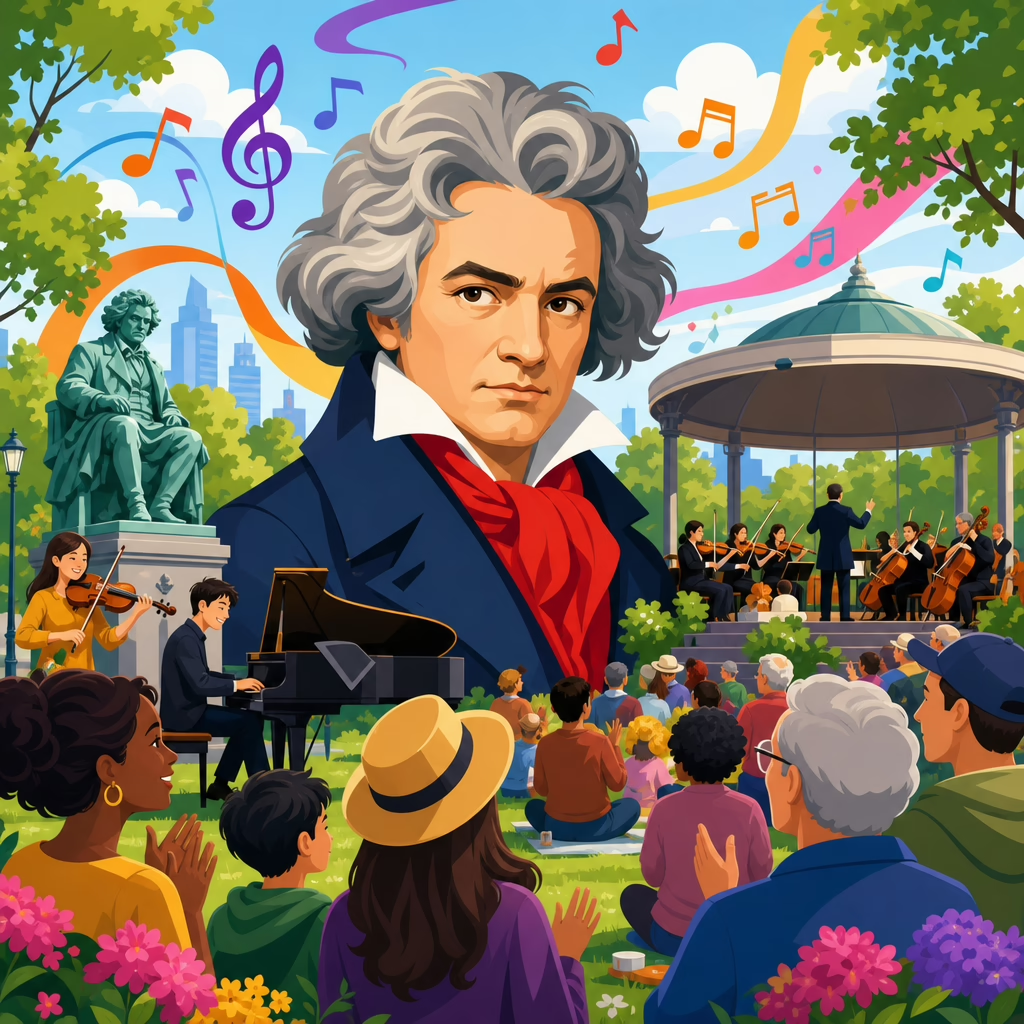
Public Music Programs That Celebrate Beethoven
Public music programs that celebrate Beethoven connect communities to one of the most influential composers in Western music through concerts, lectures, youth education, neighborhood festivals, library events, and civic partnerships. In this context, public music programs means activities designed for broad access rather than private patron circles: free park performances, school residencies, municipal orchestra series, university outreach, museum collaborations, radio broadcasts, and community choir projects. Beethoven celebrations matter because his music sits at the crossroads of art, history, politics, and education. The symphonies, piano sonatas, quartets, and choral works are not only repertory staples; they are practical tools for teaching listening skills, ensemble discipline, cultural history, and democratic participation. I have worked with presenters building these programs, and the successful ones do more than stage famous works. They translate Beethoven into civic experience.
That civic value is why this topic belongs at the center of community and education planning. Beethoven’s catalog gives program directors unusual flexibility. A small public library can host a talk on the opening motif of the Fifth Symphony. A youth orchestra can explore the dance rhythms in the Seventh. A citywide festival can pair the Ninth Symphony with public discussions about freedom, citizenship, and inclusion. Schools can use the “Ode to Joy” melody as an entry point for recorder classes or beginner strings. Senior centers often respond strongly to song arrangements and guided listening because the music carries cultural recognition even for audiences without formal training. When organizers design these events carefully, Beethoven becomes approachable without being diluted, and that balance determines whether a program feels welcoming or merely ceremonial.
Why Beethoven Works So Well in Public Programming
Beethoven remains uniquely effective for public programs because his music combines familiarity, emotional contrast, and a clear historical narrative. Audiences often know at least one work before they enter the room, whether from film, television, graduation ceremonies, or sports broadcasts. That familiarity lowers the barrier to attendance. At the same time, the music rewards deeper study. The Eroica Symphony opens conversations about heroism and political disillusionment. The Pastoral invites environmental themes, public park tie-ins, and interdisciplinary events with naturalists. The Ninth supports large-scale collaboration because choruses, soloists, orchestras, schools, and civic speakers can all participate. Even the bagatelles and shorter piano pieces fit casual settings where a full concert would be impractical.
Another reason is structure. Beethoven wrote with strong thematic identities, and those themes are easy to demonstrate in educational settings. A presenter can sing or clap the short-short-short-long rhythm from the Fifth Symphony, then show how that cell shapes an entire movement. In workshops I have seen, this single example captures children’s attention faster than abstract instruction about sonata form. For adults, hearing how a motif develops across a movement builds confidence because listeners start noticing design rather than guessing what they are supposed to admire. Public programs succeed when they convert passive admiration into active listening, and Beethoven’s music is exceptionally suited to that conversion.
His biography also matters, though it should be handled carefully. Public audiences respond to the broad facts: Bonn origins, Vienna career, changing patronage systems, increasing deafness, and artistic independence. Those themes support discussions about disability, resilience, labor, and identity. The best programs avoid reducing him to a mythic genius who transcended suffering through willpower alone. Instead, they explain the concrete reality: he relied on conversation books, changing instruments, publishers, aristocratic support, and a network of performers. That nuance respects the music and makes Beethoven feel more human, which increases educational value.
Common Formats for Public Beethoven Programs
Public music programs that celebrate Beethoven usually work best when format matches venue, audience, and budget. A municipal orchestra may anchor a festival with a symphony cycle, while a community arts center might build attendance through shorter mixed events. In practice, the strongest hub strategy uses layered programming. Large performances generate visibility, but small recurring activities build participation. For example, one city can present the Fifth Symphony downtown, host string quartet excerpts at branch libraries, offer a school composition workshop based on motif development, and stream expert talks through the local public radio station. Each element serves a different segment of the community while reinforcing the same cultural theme.
Educational framing is especially important. A public concert without context can still succeed artistically, but community impact grows when organizations add pre-concert talks, printed listening guides, bilingual program notes, and moderated question sessions. I have seen attendance rise when presenters replaced academic lectures with fifteen-minute guided listening demonstrations from the stage. Instead of discussing Beethoven in purely historical terms, musicians played examples: the transition in the first movement of the Eroica, the rhythmic drive of the Seventh, or the quartet texture in Op. 59. Hearing an idea immediately after explanation turns unfamiliar language into something tangible. That is a consistent lesson in public engagement work.
| Program format | Best setting | Main audience benefit | Example Beethoven focus |
|---|---|---|---|
| Outdoor concert | City park or plaza | Low barrier entry and family attendance | Symphony No. 6 “Pastoral” with host commentary |
| Library lecture-recital | Public library branch | Close listening and historical context | Piano sonatas such as “Moonlight” and “Pathétique” |
| School residency | K-12 classrooms | Curriculum alignment and student participation | Motif building through Symphony No. 5 |
| Community sing | Civic hall or church partnership | Direct participation and social connection | “Ode to Joy” chorus adaptation |
| Museum collaboration | Art museum gallery | Cross-disciplinary interpretation | Beethoven and the Napoleonic era |
| Radio or streaming series | Public media platform | Broad geographic reach | Complete symphony introductions with excerpts |
These formats are not interchangeable. Outdoor events need shorter speaking segments, visible conducting, and repertory with immediate impact. Library programs tolerate more detail and can handle manuscript images, recordings, and side-by-side comparisons. School settings require clear learning objectives, often tied to state arts standards. Community sings work only when materials are arranged for nonprofessional participants and rehearsal time is realistic. Choosing the wrong format is one of the main reasons Beethoven outreach feels elitist or inaccessible.
Designing Programs for Different Age Groups and Communities
Effective Beethoven programming starts with audience design, not repertoire prestige. Children need participatory hooks: rhythm clapping, movement, call-and-response singing, and short excerpts played live. The opening of the Fifth Symphony works because students can internalize the pattern in seconds. The finale of the Ninth can also work if the melody is taught first without text and later connected to broader themes of unity. Teen audiences often respond better to process than reverence. They engage when educators compare Beethoven’s sketching habits to drafting in creative writing or digital music production. Showing pages from his sketchbooks demonstrates that masterpieces were built through revision, not spontaneous perfection.
Adults in general audiences tend to want direct answers to practical questions. What should I listen for? Why is this piece important? How long is it? Will I understand it if I am new to classical music? Good public programs answer those questions before they are asked. I advise presenters to state plainly that listeners do not need technical training, then provide one or two anchors per piece. For the Seventh Symphony, that might be pulse and momentum. For the Emperor Concerto, it could be the relationship between soloist and orchestra. For late quartets, an honest introduction helps: the music is concentrated, exploratory, and best approached in smaller portions with guided examples.
Older adults often bring rich listening histories, so programs should respect memory and lived experience. Senior-center events succeed when musicians allow discussion, not just performance. Many participants remember hearing Beethoven in school, on records, or in wartime and postwar radio culture. Those memories can become a meaningful part of the event. Accessibility also matters across all age groups. Venues need clear signage, assistive listening support where possible, large-print materials, and pacing that acknowledges attention span and mobility. Public programming is not truly public if only experienced concertgoers can navigate it comfortably.
Community specificity is equally important. In multilingual neighborhoods, bilingual hosting and translated handouts increase attendance and trust. In areas with limited arts exposure, presenters should avoid assuming prior knowledge of orchestra etiquette. In communities focused on social justice or civic dialogue, Beethoven can be connected thoughtfully to debates about who has historically been included in canonical culture and who has been excluded. That conversation does not weaken the music; it makes the programming more honest and relevant.
Educational Methods That Make Beethoven Accessible
The most effective teaching methods for public Beethoven programs are demonstration, repetition, comparison, and participation. Demonstration means playing a short excerpt to illustrate a concept immediately. Repetition allows audiences to hear a motif, rhythm, or harmonic turn more than once before hearing it in full context. Comparison helps listeners understand style by contrast, such as placing Mozart’s more symmetrical phrasing beside Beethoven’s sharper dynamic surprises. Participation turns learning from observation into action, whether through clapping a pattern, singing a line, or marking a listening map during performance. These methods are standard in strong arts education because they reduce abstraction and increase retention.
Guided listening is especially powerful. A presenter might explain that the first movement of the Fifth Symphony is built from a tiny rhythmic idea, then ask the audience to track where that idea returns. In another program, a pianist can show how the “Moonlight” Sonata sustains atmosphere through texture rather than virtuosic display. With the Pastoral Symphony, educators can clarify that Beethoven was not literally imitating birds for the whole piece; he was expressing emotional responses to nature. That distinction matters because it teaches interpretation rather than simplistic storytelling. Public audiences appreciate precision when it is delivered clearly.
Technology can support this work if used with restraint. Projected score snippets, hearing-safe audio examples, and QR-linked playlists can extend engagement beyond the event. Public libraries and community colleges often use Naxos Music Library, Alexander Street databases, or medici.tv for supplementary listening. Orchestras increasingly pair in-person events with short explainer videos on YouTube or Instagram. The content should remain practical: two-minute demonstrations, conductor notes, or instrument spotlights. Overproduced digital extras rarely outperform concise, useful materials that help a listener return to the music with more confidence.
Partnerships with schools and universities add depth when they are reciprocal. Music education students can assist with workshops, but they need supervision and clear goals. Faculty experts can give talks, but they should translate scholarship into plain language. Conservatories can provide performers for community residencies, while local history organizations can supply context about past Beethoven receptions in the region. The strongest programs share resources rather than treating outreach as a one-way donation of expertise.
Planning, Funding, and Measuring Impact
Public music programs that celebrate Beethoven require operational discipline as much as artistic ambition. Budgeting starts with repertoire choice. A full Ninth Symphony demands orchestra, chorus, soloists, librarian time, venue capacity, rentals, rehearsal scheduling, and often extra marketing. By contrast, a lecture-recital around selected sonatas or chamber works can deliver high educational impact at a fraction of the cost. Neither model is inherently better; the right decision depends on goals. If the objective is visibility and broad civic symbolism, a major choral event may be justified. If the objective is recurring community engagement, a distributed series of smaller events usually offers better return.
Funding often comes from multiple sources. Municipal arts councils, state humanities agencies, national endowments, local foundations, and corporate sponsors all support music education under different criteria. Libraries and parks departments may contribute space or staffing. Schools can provide access to students but often need transportation and scheduling support. Clear grant language matters. Funders respond to defined outcomes such as number of participants, geographic reach, accessibility features, school alignment, or intergenerational engagement. A vague promise to celebrate a great composer is weaker than a specific plan to deliver six bilingual workshops, three free performances, and a public resource page with listening guides.
Measurement should include more than ticket sales. Track attendance, yes, but also first-time participant rates, repeat visits, school partnerships formed, digital views, survey responses, and qualitative comments about confidence or enjoyment. I recommend asking simple questions before and after programs: Did you feel this music was for people like you? Can you name one thing you listened for? Would you attend another classical event? These indicators show whether Beethoven programming is widening access or simply serving existing audiences. Long-term success comes from building cultural habit, not just filling seats once.
There are limitations, and responsible planners acknowledge them. Beethoven’s fame can overshadow living composers and local traditions if used too heavily. Canon-centered programming may unintentionally signal narrow cultural priorities. The solution is not to avoid Beethoven, but to frame him intelligently: pair him with contemporary responses, local ensembles, student compositions, or thematic conversations about freedom, nature, and public life. That approach preserves artistic seriousness while keeping community programming open rather than exclusionary.
Building a Strong Community and Education Hub Around Beethoven
As a miscellaneous hub within community and education coverage, this topic should point readers toward the full range of public-facing Beethoven activity: school lesson design, free concert models, family listening guides, library programming, disability access, choral participation, museum partnerships, public broadcasting, and grant planning. The hub function is important because organizers rarely need a single idea. They need an ecosystem. A parent looking for a child-friendly event, a librarian planning a lecture, a teacher building a cross-curricular unit, and an arts administrator writing a grant all approach Beethoven from different angles. A strong hub article helps each reader identify the right next step and signals that public programming is broader than the formal concert hall.
The practical takeaway is simple. Public music programs that celebrate Beethoven succeed when they combine artistic quality with clear access, strong educational framing, and realistic community design. Use familiar works strategically, but provide context. Match format to audience. Build partnerships that share resources. Measure whether people actually feel welcomed and informed. Most of all, treat Beethoven as a living public resource rather than a monument placed at a distance. If you are planning community arts coverage or developing local programming, start by mapping the audiences you want to reach and the Beethoven formats that will let them participate fully.
Frequently Asked Questions
What are public music programs that celebrate Beethoven?
Public music programs that celebrate Beethoven are community-focused events and educational initiatives designed to make his music, life, and influence accessible to broad audiences. Unlike private concerts or invitation-only patron events, these programs are built around public access and civic participation. They often include free park concerts, municipal orchestra performances, school residencies, university outreach events, public library talks, museum collaborations, neighborhood festivals, radio broadcasts, and family-friendly workshops. The goal is not only to perform Beethoven’s music, but also to create spaces where people can encounter it in meaningful, welcoming ways.
These programs often present Beethoven as more than a historical composer. They connect his work to themes that resonate in public life today, including artistic freedom, perseverance, democratic ideals, cultural heritage, and the power of music to bring people together. A city orchestra might perform a Beethoven symphony in an outdoor venue, while a local library hosts a lecture on his life and hearing loss, and a school district offers classroom activities tied to his most famous works. Together, these efforts help communities engage with Beethoven through performance, learning, and shared cultural experience.
Why is Beethoven such a popular focus for community and civic music programs?
Beethoven remains a central figure in public music programming because his music is both historically important and widely recognizable. His symphonies, piano sonatas, chamber works, and choral music have had an enormous impact on Western music, and many listeners are familiar with at least some of his most famous themes, even if they do not consider themselves classical music enthusiasts. That combination of significance and accessibility makes him an effective focal point for public programs that want to attract diverse audiences.
There is also a strong civic dimension to Beethoven’s legacy. Works such as the Ninth Symphony, especially its “Ode to Joy” finale, are often associated with shared humanity, hope, and collective aspiration. Public institutions, orchestras, schools, and arts organizations frequently use Beethoven-centered programming to spark intergenerational participation and cultural dialogue. His life story adds to that appeal as well. His determination to compose while coping with progressive hearing loss gives educators and presenters a powerful narrative about creativity, resilience, and human achievement. For communities seeking a composer whose work supports concerts, lectures, educational programs, and public celebrations alike, Beethoven offers exceptional depth and reach.
What kinds of events are usually included in Beethoven-themed public music programs?
Beethoven-themed public music programs are often intentionally varied so they can reach audiences with different ages, backgrounds, and levels of musical familiarity. A single program or festival might include live orchestral concerts, chamber music recitals, youth ensemble performances, conductor talks, music appreciation lectures, public rehearsals, and interactive family events. Outdoor performances in parks or civic plazas are especially common because they lower barriers to attendance and create a relaxed environment for first-time listeners. Municipal orchestra series may feature symphonies such as the Fifth, Sixth, or Ninth, while smaller organizations might spotlight string quartets, piano sonatas, or arrangements suitable for local ensembles.
Educational and interpretive events are also a major part of these programs. Schools may host visiting artists who demonstrate Beethoven’s themes and compositional ideas in age-appropriate ways. Libraries often organize talks, listening sessions, book displays, or multimedia presentations about his biography and historical context. Universities may contribute faculty lectures, student performances, and public seminars that connect Beethoven to broader questions in music history, philosophy, or politics. Museums and cultural centers sometimes collaborate on exhibitions that place his music alongside art, manuscripts, instruments, or historical materials from his era. Radio and community media can extend the reach of these programs by broadcasting performances, interviews, and educational segments, allowing residents to participate even when they cannot attend in person.
How do public Beethoven programs make classical music more accessible to a wider audience?
Accessibility is one of the defining strengths of public Beethoven programs. Organizers often remove practical and cultural barriers that can prevent people from engaging with classical music. This may include offering free admission, presenting events in familiar public spaces, scheduling programs at convenient times, and designing content for listeners with a range of experience levels. Rather than assuming prior knowledge, many programs provide introductions, program notes, pre-concert talks, guided listening sessions, or storytelling elements that help audiences understand what they are hearing. This approach makes Beethoven’s music feel less distant and more approachable.
Many public programs also broaden access by meeting people where they already are. A neighborhood festival might include live performances alongside food vendors and local arts activities. A school residency can introduce students to Beethoven through hands-on rhythm, melody, and composition exercises. A library event may combine music excerpts with discussion of his life, allowing people to engage intellectually and emotionally without needing formal training. Some organizations add multilingual materials, accessible seating, captioned presentations, or partnerships with disability advocates to ensure participation is genuinely inclusive. When public music programs are designed thoughtfully, Beethoven becomes not just a canonical composer, but a shared cultural resource available to the entire community.
What benefits do communities gain from hosting public music programs that celebrate Beethoven?
Communities benefit from Beethoven-centered public music programs in cultural, educational, and social ways. Culturally, these events strengthen public engagement with the arts and help residents connect with major works of the musical tradition in settings that feel open and communal. They can enhance a city’s cultural identity, support local performers and arts institutions, and create opportunities for collaboration among orchestras, schools, libraries, museums, universities, broadcasters, and civic organizations. When multiple partners participate, the result is often a richer local arts ecosystem with lasting value beyond a single concert or festival.
Educationally, these programs help audiences develop listening skills, historical awareness, and musical curiosity. Young people may encounter orchestral instruments for the first time, learn how a symphony is structured, or discover that classical music can express drama, joy, struggle, and triumph in ways that still feel relevant. Adults may gain a deeper understanding of Beethoven’s historical context, his artistic innovations, and his ongoing influence on later composers and public culture. Socially, public programs create shared experiences that bring together residents who might not otherwise gather in the same space. Whether through a free summer concert, a community sing, a lecture series, or a school-and-orchestra partnership, Beethoven programs can foster belonging, civic pride, and a sense that great music is part of public life, not reserved for a select few.