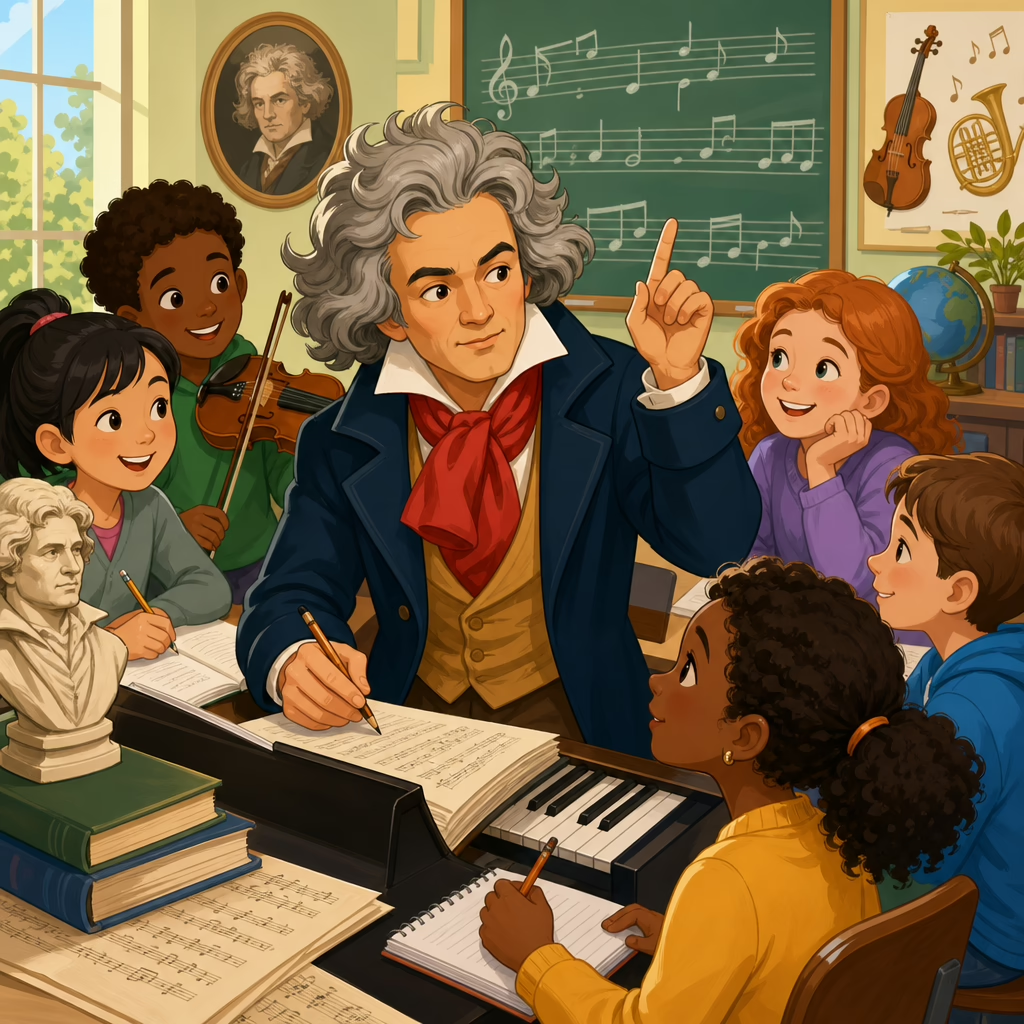
Beethoven in the Classroom: Curriculum Ideas for Music Educators
Beethoven remains one of the most practical composers for classroom teaching because his music lets educators address listening, history, creativity, literacy, emotion, and ensemble skills through material students can grasp at many ages. In school settings, “curriculum ideas” means more than a playlist or a worksheet. It means sequenced learning experiences, clear objectives, assessments, adaptations, and links to broader educational goals. When I have built Beethoven units for elementary general music, middle school humanities blocks, and secondary ensembles, the most successful lessons treated him not as a monument, but as a working artist solving musical problems in real time. That shift matters. Students respond more deeply when they hear motif, rhythm, and form as choices with purpose rather than facts to memorize.
Beethoven in the classroom also matters because he sits at the crossroads of major teaching themes. His life opens discussion about hearing loss, persistence, patronage, and political change in Europe around 1800. His music offers immediately recognizable examples of contrast, development, sonata form, variation, orchestration, and expressive intent. Even brief excerpts from Symphony No. 5, Für Elise, the Moonlight Sonata, the Eroica Symphony, the Ninth Symphony, or the Pastoral Symphony can anchor lessons that meet music standards while supporting literacy and social studies outcomes. For educators building a community and education hub, Beethoven is especially useful as a central connector. He supports miscellaneous classroom goals that often sit outside a single unit, from bell-ringer listening tasks to interdisciplinary projects, accessibility conversations, and performance-based assessments across grade bands.
Why Beethoven Works Across Grade Levels
Beethoven works across grade levels because his music combines strong surface features with deep structural interest. Younger students can identify loud and soft dynamics, repeated short-short-short-long rhythmic cells, or mood changes. Older students can analyze modulation, thematic transformation, phrase expansion, and how tonal tension drives form. That layered accessibility is rare. In practice, I have used the opening of Symphony No. 5 with third graders for movement and pattern recognition, then revisited the same excerpt with high school theory students to discuss motive economy and sonata form. The material scales naturally without becoming simplistic.
His biography also supports differentiated teaching. Elementary classes can discuss perseverance after learning that Beethoven continued composing while losing his hearing. Middle school students can examine myth versus reality, including the limits of the “heroic genius” narrative. High school students can compare primary and secondary sources, such as the Heiligenstadt Testament, to ask how personal crisis shaped artistic output without reducing the music to autobiography. These approaches encourage age-appropriate inquiry. They also help teachers avoid turning Beethoven into a statue rather than a human being with contradictions, habits, ambitions, and flaws.
From a practical planning standpoint, Beethoven repertoire fits multiple classroom formats: general music, choir, band, orchestra, piano lab, AP Music Theory, music appreciation, and integrated arts courses. Public-domain scores are widely available through IMSLP, while reputable listening guides can be found through the BBC, Carnegie Hall, the New York Philharmonic, and major conservatories. This broad resource base reduces preparation time and makes it easier to align a hub page with related lessons on listening maps, composer studies, orchestral instruments, and music history timelines.
Core Curriculum Themes to Build Around
The strongest Beethoven curriculum ideas usually grow from a small set of recurring themes rather than a survey of every famous piece. One reliable theme is motif and development. Beethoven is the standard example of how a tiny musical idea can generate an entire movement. Students can hear this immediately in Symphony No. 5, then try composing their own four-note motives and developing them through repetition, inversion, sequence, augmentation, or rhythmic displacement. Another theme is contrast. Beethoven often creates meaning through sudden shifts in texture, register, dynamics, articulation, and harmony. That makes his music effective for guided listening tasks in which students map where the music changes and explain the effect.
A third theme is form. Sonata form, theme and variations, rondo, scherzo, and symphonic cycle can all be introduced through Beethoven. The teacher’s role is to keep form concrete. Instead of defining exposition, development, and recapitulation in abstract terms, ask students to identify what material returns, what changes, and where tension increases. A fourth theme is expression and narrative. While instrumental music does not tell a fixed story, works such as the Pastoral Symphony invite students to debate what sounds pictorial, what sounds emotional, and how titles shape interpretation. These questions are especially valuable in mixed-ability classrooms because there is room for evidence-based disagreement.
Interdisciplinary themes round out the curriculum. Beethoven connects naturally to the Enlightenment, Napoleon, the French Revolution’s aftermath, changing concert culture, and the rise of the public composer. He also opens rich discussions about disability, adaptation, and creativity. Teachers should present his hearing loss carefully: not as inspiration theater, but as a real condition that affected communication, performance, and compositional process. That framing supports respectful, modern classroom conversations.
Lesson Formats, Activities, and Assessment Options
Teachers often ask what Beethoven lessons actually look like in a forty-five or fifty-minute class period. The answer depends on the setting, but a balanced sequence usually includes focused listening, brief historical framing, active response, and a demonstration of understanding. In elementary classrooms, students can begin with a steady-beat activity using the opening motive of Symphony No. 5, then move into body percussion patterns, draw dynamic contours, and finish by creating a class composition based on one repeated rhythm. In middle school, a listening map of Für Elise can introduce rondo form, with students labeling the recurring A section and contrasting episodes. In high school, students can annotate a score excerpt from the Eroica or analyze phrase elision in a piano sonata.
Assessment should match the task. If the objective is listening discrimination, a short written reflection or labeled form chart may be enough. If the objective is composition, use a rubric that checks motive clarity, development, structure, and notation accuracy. Performance classes can assess articulation, stylistic awareness, balance, and phrasing in Beethoven arrangements or excerpt studies. I recommend mixing formative checks with one richer summative task, such as a comparative listening essay, student podcast, mini-lecture, or rehearsal clinic presentation. Those formats reveal understanding more clearly than recall quizzes alone.
| Grade band | Focus | Sample Beethoven work | Classroom activity | Assessment |
|---|---|---|---|---|
| Elementary | Rhythm, dynamics, mood | Symphony No. 5, first movement opening | Clap the motive, move to dynamic changes, draw a listening map | Exit ticket naming two contrasts heard |
| Middle school | Form and theme return | Für Elise | Identify recurring A section and contrasting episodes | Labeled rondo diagram with brief explanation |
| High school ensemble | Style and phrasing | Symphony No. 7 or Egmont excerpts | Rehearse articulation, tempo relationships, and balance | Performance rubric and rehearsal reflection |
| High school academic | Motivic development and harmony | Eroica or Piano Sonata Op. 13 | Score study and analytical discussion | Short essay using musical evidence |
Technology can strengthen these lessons when used carefully. Noteflight and Flat allow students to compose short motives and variation sets. Chrome Music Lab can support younger learners experimenting with contour and repetition. SmartMusic and digital practice tracks help performance students isolate difficult passages. For listening, projected waveforms are less useful than clear timestamps, score excerpts, and teacher questioning. The goal is not to digitize every activity, but to make musical thinking more visible.
Repertoire Selection, Context, and Inclusive Teaching
Choosing Beethoven repertoire for classroom use requires more than selecting famous titles. Teachers should consider excerpt length, musical clarity, age appropriateness, available recordings, and how each piece serves a concept. Symphony No. 5 is excellent for motive and drama, but it can become overused if students only encounter Beethoven through that opening. Pairing it with the Pastoral Symphony broadens the picture by showing a different expressive world. Für Elise works well for form and piano texture, but it should be framed beyond “the easy famous piece.” The late string quartets, while demanding, can expose advanced students to ambiguity, fragmentation, and the idea that not all masterpieces sound immediately comfortable.
Context matters equally. Beethoven taught in isolation can reinforce a narrow canon. A stronger hub approach links him to contemporaries, predecessors, and later composers. Compare a Haydn symphonic opening with Beethoven’s to show what Beethoven inherited and intensified. Set Beethoven next to Florence Price, William Grant Still, or Shostakovich when discussing symphonic rhetoric, fate motifs, or music under social pressure. Pair the “Ode to Joy” theme with community singing traditions or modern protest and solidarity events to show how music circulates beyond concert halls. These comparisons do not diminish Beethoven. They teach students how influence, tradition, and reception work.
Inclusive teaching also means addressing accessibility. Some students process better through movement, color-coded form charts, or shortened excerpts. Others need vocabulary support before discussion. Deaf and hard-of-hearing students may engage through vibration, visual analysis, notation, and historical inquiry. Beethoven’s hearing loss can become a meaningful entry point here, provided the conversation is factual and respectful. Universal Design for Learning principles are useful: offer multiple means of representation, action, and engagement so Beethoven study is not limited to one listening-centered pathway.
Building a Hub Page That Supports Miscellaneous Classroom Needs
As a sub-pillar hub under community and education, this page should help educators find pathways into many smaller topics. That means organizing Beethoven content around practical use cases rather than only chronology. One cluster can focus on quick classroom activities: bell-ringers, listening journals, substitute plans, and five-minute composer spotlights. Another can focus on assessment tools: rubrics for listening maps, composition prompts, ensemble checklists, and discussion questions. A third can support interdisciplinary teaching with links to lessons on European history, poetry, disability studies, and arts integration. This structure helps the page serve the “miscellaneous” label without becoming random.
Internal linking strategy should mirror how teachers search. Useful related pages might include classroom music appreciation activities, composer study templates, lesson ideas for orchestral instruments, concert etiquette resources, music history timelines, social-emotional learning through music, and accessible arts instruction. Each supporting article should answer a narrower question, while this hub explains when and why a Beethoven-centered approach works. In my experience, pages perform best when headings use the exact problems educators face: how to teach Beethoven to elementary students, which Beethoven pieces work for listening lessons, how to connect Beethoven to history class, and how to assess a Beethoven unit.
To keep the hub authoritative, cite institutions and standards where relevant. The National Association for Music Education standards can guide objectives related to creating, performing, responding, and connecting. Public-domain score libraries, major orchestra education pages, and scholarly program notes provide trustworthy supporting material. Educators value clear recommendations, but they also want honest limits. State plainly that some Beethoven works require heavy scaffolding, some recordings differ drastically in tempo and articulation, and some historical narratives around genius and heroism need revision in modern classrooms.
Common Mistakes and Better Alternatives
A common mistake is teaching Beethoven as a list of dates, masterworks, and legends. Students may remember the scowl, the wig, and the deafness, yet learn very little about musical process. A better alternative is to center one musical idea per lesson and use biography only when it clarifies the art. Another mistake is relying on long uninterrupted listening sessions. Many students, especially younger ones, need segmented listening with one clear task at a time. Pause, replay, compare, and ask targeted questions such as: What returned? What changed? Where did the tension rise? Which instrument or register made that moment feel different?
Another weak practice is assigning oversimplified stories to instrumental works, as if every Beethoven movement encodes a fixed plot. This can flatten interpretation. Instead, teach students to distinguish between evidence and imagination. If a passage suggests a storm, ask what musical features create that impression: tremolo, low-register rumble, sudden dynamic expansion, dissonance, or rapid figuration. Finally, avoid presenting Beethoven as the endpoint of musical greatness. He is central, but he is not the whole story. The best curriculum uses him as a gateway to broader listening, better analytical habits, and richer conversations about culture, craft, and community.
Beethoven belongs in the classroom not because tradition says so, but because his music gives educators unusually flexible material for teaching how music works and why it matters. A well-designed Beethoven unit can build rhythmic awareness in children, sharpen formal analysis in adolescents, support ensemble artistry, and spark interdisciplinary inquiry about history, disability, creativity, and public culture. The key is to treat Beethoven as teachable material rather than untouchable heritage. Choose focused repertoire, define one or two clear objectives per lesson, use active listening and making, and assess understanding through visible musical thinking.
For a miscellaneous hub page, the greatest benefit is range. Beethoven can anchor quick activities, full units, performance preparation, humanities collaborations, and accessible adaptations without losing coherence. That makes him ideal for educators who need one reliable entry point into many classroom needs. Build your Beethoven resources around concepts, not just famous titles; connect them to related lessons across community and education; and keep examples concrete enough to use tomorrow. If you are updating your curriculum, start with one excerpt, one question, and one student-centered task, then expand the hub from there.
Frequently Asked Questions
1. Why is Beethoven such an effective composer to teach in general music, choir, band, and orchestra classes?
Beethoven works especially well in school music settings because his repertoire is rich enough for deep study but accessible enough to support instruction across age levels and ensemble types. Teachers can use his music to develop listening skills, historical understanding, expressive vocabulary, form analysis, rhythmic literacy, melodic contour recognition, and creative response. In elementary classrooms, even short excerpts can help students identify dynamics, tempo changes, mood, and instrumental color. In middle and high school settings, those same works can open discussions about motif development, sonata form, orchestration, interpretation, and the relationship between a composer’s life and artistic output.
Another reason Beethoven is so practical is that his music naturally supports sequenced learning rather than one-off exposure. A teacher might begin with guided listening to the opening motif of Symphony No. 5, move into rhythmic reading and performance of that motif, then ask students to compose short pieces using repetition and variation. From there, students can compare how Beethoven builds tension, organizes form, and creates emotional impact. That sequence turns a famous piece into a standards-based unit with measurable outcomes, not just a passive listening activity.
Beethoven also connects well to broader educational goals. His life and work invite interdisciplinary links to history, literature, social studies, and even social-emotional learning. Students can explore themes such as persistence, identity, innovation, and artistic voice. Because his music ranges from dramatic and heroic to lyrical and intimate, educators can design lessons that help students describe emotional character, defend interpretive ideas with evidence, and reflect on how music communicates meaning. For that reason, Beethoven is not simply “important” in a historical sense; he is genuinely useful for building curriculum that is age-appropriate, skill-based, and intellectually engaging.
2. What are some strong curriculum ideas for teaching Beethoven at the elementary level?
At the elementary level, the best Beethoven curriculum ideas are active, sequential, and rooted in clear musical goals. Rather than presenting a long biography or expecting students to sit through extended listening, teachers can select short, vivid excerpts and build movement, singing, playing, drawing, and discussion around them. For example, the opening of Symphony No. 5 can be used to teach short-short-short-long rhythm patterns, strong and weak beats, and the concept of a musical motif. Students might first echo the rhythm vocally, then perform it on body percussion, then transfer it to classroom instruments, and finally create their own four-beat patterns modeled on Beethoven’s idea.
Another effective approach is to use contrasting works to teach expression and listening vocabulary. A teacher might pair the “Ode to Joy” theme with a more dramatic excerpt and ask students to describe differences in tempo, dynamics, articulation, and mood. Younger learners can sort picture cards such as “calm,” “bold,” “smooth,” or “powerful,” while older elementary students can begin using more formal terms like crescendo, staccato, legato, and accent. This helps students move from general emotional reactions to more precise musical language.
Elementary teachers can also build Beethoven into literacy and creativity. Students can listen and draw what they hear, sequence story events to match musical sections, or invent movement phrases that reflect changes in the music. A simple unit might include four stages: listen and respond, identify a musical concept, perform or move to the concept, and create something new using the concept. Assessment can remain developmentally appropriate by using checklists, teacher observation, student self-reflection, and short performance tasks. In this way, Beethoven becomes a vehicle for teaching foundational music skills, not just a historical figure introduced during composer month.
3. How can music educators design a Beethoven unit that includes clear objectives, assessments, and differentiation?
A strong Beethoven unit begins with outcomes, not repertoire alone. Educators should first decide what students should know and be able to do by the end of the unit. Those objectives might include identifying a recurring motif by ear, describing how dynamics shape musical expression, comparing Classical and Romantic style traits, performing a rhythmic excerpt accurately, or composing a short variation based on a Beethoven theme. Once the targets are clear, the teacher can select excerpts and activities that build toward them in a logical progression.
Assessment should be embedded throughout the unit rather than reserved for the end. Formative assessment can include quick listening checks, exit tickets, small-group performances, student discussion, conducting responses, or annotated listening maps. Summative assessment might involve a short written reflection, a performance of a Beethoven excerpt or skill pattern, a student-created composition using motivic development, or a presentation connecting a work to its historical context. Effective Beethoven instruction balances musical understanding with practical evidence of learning, so students are not only hearing music but demonstrating growth in listening, analysis, performance, and creative thinking.
Differentiation is equally important. In mixed-ability classrooms, some students may be ready to analyze form and harmonic tension, while others need support identifying steady beat, phrase shape, or instrument families. Teachers can adapt by offering layered entry points: simplified rhythm patterns, visual listening guides, sentence stems for written responses, extension prompts for advanced learners, and choice-based tasks that let students respond through writing, performance, composition, or visual representation. English language learners may benefit from vocabulary previews and visual supports, while students with special needs may respond well to repetition, structured routines, movement-based learning, and shorter excerpts. A well-designed Beethoven unit is successful because it is thoughtfully scaffolded, standards-aligned, and flexible enough to meet a wide range of learners where they are.
4. How can Beethoven be used to connect music instruction with history, language arts, and social-emotional learning?
Beethoven offers excellent opportunities for interdisciplinary teaching because his music and life intersect with major cultural, historical, and human themes. In history or social studies connections, students can examine the political and social changes of late eighteenth- and early nineteenth-century Europe, including ideas about revolution, heroism, individualism, and public art. Teachers do not need to turn a music unit into a history lecture, but they can provide enough context to help students understand why Beethoven’s music sounded bold and significant in its time. That context can deepen listening and give students a clearer sense of how artists respond to the world around them.
Language arts connections are equally strong. Students can practice descriptive writing by responding to contrasting Beethoven excerpts, support claims with musical evidence, compare programmatic and absolute music, or write reflective journal entries about how a piece communicates emotion. Older students might read short informational texts about Beethoven’s life, deafness, or compositional process and then discuss how biographical knowledge should or should not shape interpretation. This kind of work strengthens close reading, vocabulary development, argumentation, and evidence-based discussion while keeping music at the center of the lesson.
From a social-emotional learning perspective, Beethoven can help students explore resilience, frustration, determination, and personal expression. His story is often introduced through the lens of hearing loss, but effective teaching goes beyond simplistic inspiration narratives. Instead, educators can guide students in asking thoughtful questions about challenge, identity, adaptation, and creativity. Students might reflect on how composers express conflict and resolution, how performers communicate feeling, or how individuals continue meaningful work through adversity. These discussions can be powerful when handled carefully and tied directly to musical experiences. In that sense, Beethoven supports not only academic integration but also deeper reflection about human experience and artistic voice.
5. What are the best ways to keep a Beethoven unit engaging and relevant for today’s students?
Keeping a Beethoven unit engaging starts with avoiding the idea that students must admire the composer simply because he is “great.” Relevance comes from active learning, purposeful questioning, and musical experiences that invite student voice. Instead of leading with dates and facts, teachers can begin with a compelling listening challenge, a recognizable motif, a dramatic contrast, or a creative task. Students are more invested when they are asked to notice, predict, move, perform, arrange, debate, and create rather than passively receive information. Beethoven’s music is especially well suited to this because it contains memorable themes, clear contrasts, and strong emotional energy.
Technology can also increase engagement when it serves instruction. Students might use digital audio tools to map form, compare performances, create short remixes of Beethoven motifs, or compose variations using notation software or classroom apps. Ensemble directors can invite students to analyze different interpretations of the same excerpt and discuss tempo, articulation, phrasing, and ensemble balance. General music teachers can use visualizers, interactive listening maps, or student-made multimedia responses. These strategies help students see Beethoven as living musical material that can be explored, manipulated, and interpreted, not just preserved.
Most importantly, relevance grows when students understand why they are learning what they are learning. If a Beethoven lesson teaches students how motifs work, how emotion is shaped through musical decisions, how form creates structure, or how artists develop ideas over time, then the learning transfers beyond a single composer. Teachers should make those connections explicit. A unit becomes meaningful when students can say, “I know how to hear structure better,” “I can perform this rhythm accurately,” “I can describe how music creates tension,” or “I can build my own piece from a small idea.” That is the real value of Beethoven in the classroom: his music gives educators a practical, flexible way to teach enduring musical understanding in a form students can experience