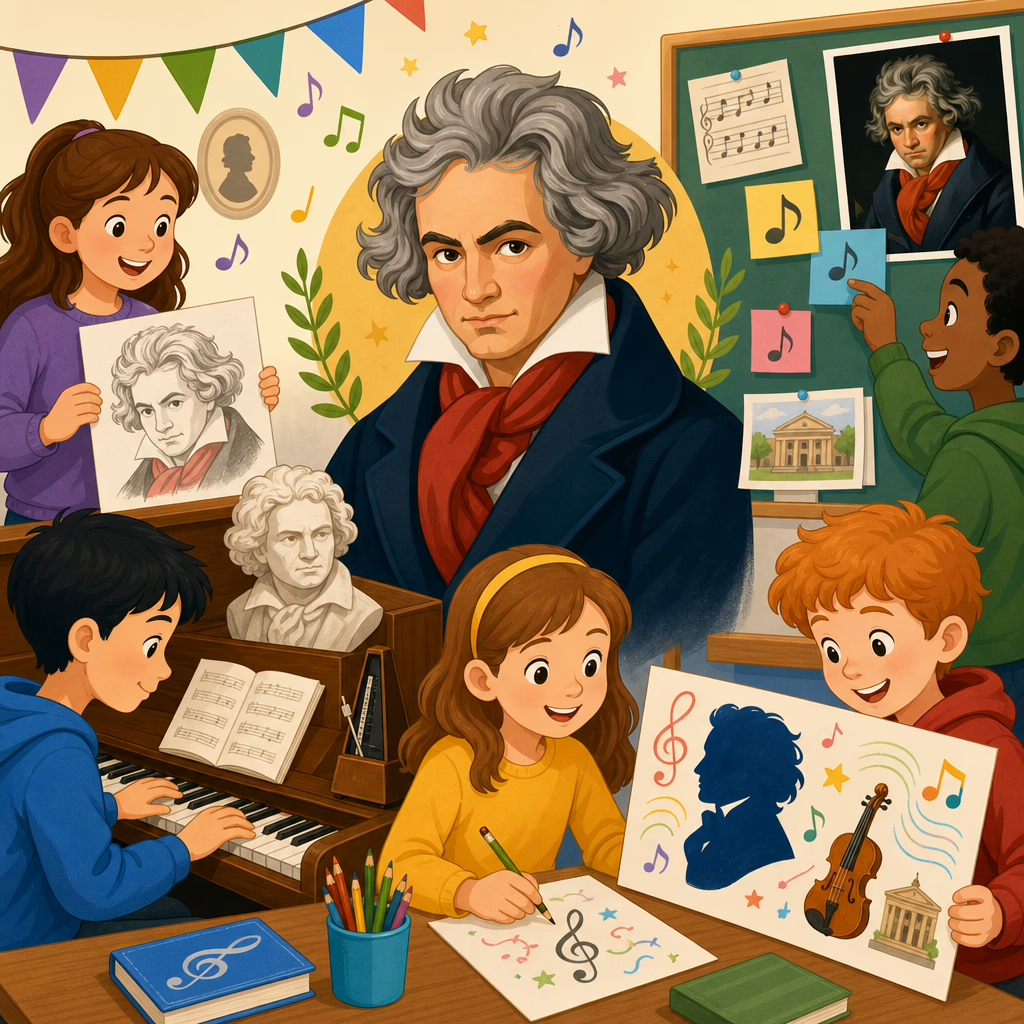
Organizing a School Beethoven Day: Activities and Planning
Organizing a School Beethoven Day gives students a vivid way to experience classical music through performance, history, art, and cross-curricular learning. A Beethoven Day is a themed school event built around the life, works, and legacy of Ludwig van Beethoven, usually combining assemblies, classroom activities, student performances, and family engagement. It matters because Beethoven is one of the most accessible major composers to teach: his music is recognizable, emotionally direct, and deeply connected to stories students remember, from his hearing loss to the famous opening of Symphony No. 5. In schools, I have seen a well-planned music day do more than fill a calendar slot. It can raise participation in ensembles, give non-musicians a point of entry into classical music, and help teachers connect music to literacy, history, science, and social-emotional learning.
For a school in the broader Community and Education space, this kind of event also works as a hub topic. It can link naturally to classroom listening guides, composer biographies, concert etiquette resources, instrument demonstrations, special education adaptations, parent volunteer ideas, and local arts partnerships. That hub function matters because a Beethoven Day should not stand alone as a one-off celebration. The strongest events are supported by a sequence of smaller articles, lesson plans, and handouts that answer practical questions: Which pieces are age appropriate? How long should an assembly be? What can elementary students make or perform? How do you include students who do not read music? When those answers are planned in advance, the day becomes structured, inclusive, and easier for staff to deliver.
At its core, organizing a School Beethoven Day means balancing educational value with logistics. You need a clear objective, a manageable schedule, and activities suited to the age range. Key terms are simple. A schoolwide assembly is the anchor event for all students. A classroom rotation is a timed activity block in which groups move between stations. A listening lesson teaches students how to identify elements such as rhythm, dynamics, tempo, motif, and instrumentation. A culminating performance is the final sharing session, whether that means a choir singing “Ode to Joy,” a recorder group, a student narrator presentation, or a short piano performance. Once those pieces are defined, planning becomes much more practical, and the event can serve both music specialists and general classroom teachers.
Set the educational goals before you schedule anything
The best Beethoven Day starts with learning goals, not decorations or repertoire. In practice, I begin by asking what students should know, do, and feel by the end of the day. For younger students, the goals may be identifying Beethoven as a composer, recognizing loud and soft dynamics, and responding physically to musical contrasts. For upper elementary and middle school students, goals can include understanding motif, recognizing the first movement theme of Symphony No. 5, describing how composers use variation, and discussing how Beethoven continued composing while losing his hearing. Secondary goals may include analysis of sonata form, the cultural context of Vienna, and the role of patronage in early nineteenth-century music.
Those goals shape every practical decision. If your purpose is broad exposure, a lively assembly and short stations are enough. If your purpose is deeper study, you need pre-teaching in the week before the event and follow-up reflection after it. A strong school plan also names success measures. These can be simple: student exit tickets, teacher observation forms, attendance at a family concert, or an increase in sign-ups for band, choir, or piano club. The National Core Arts Standards provide useful language for designing outcomes around creating, performing, responding, and connecting. Using standards-based goals also helps administrators see the event as instruction rather than entertainment.
It is worth stating one practical truth. Not every school needs an all-day festival. A half-day Beethoven Day can be more effective than an overextended event with rushed transitions. If staffing is limited, prioritize one excellent assembly, two classroom activities, and one student performance over a schedule filled with low-quality filler. Depth will do more for retention than quantity.
Build a realistic event plan with roles, timing, and budget
Once goals are defined, map the event backward from the date. Four to six weeks is usually enough lead time for an elementary or middle school Beethoven Day. Start by appointing one lead organizer, often the music teacher, and assign distinct responsibilities: scheduling, materials, communications, volunteer coordination, performance prep, and technology. Schools that skip role clarity often lose time to duplicated work or last-minute confusion. I have found that a simple shared planning document with deadlines is more valuable than elaborate event software for a one-day program.
Budget planning should be equally plain. Many successful Beethoven Days cost very little. Core expenses typically include printing, craft supplies, optional guest artist fees, and refreshments if there is a family component. If the school owns a keyboard, projector, and speakers, you already have the basic infrastructure. If you want live music, contact a local university music department, community orchestra, church musician, or private piano teacher. Many will offer a short educational performance at reduced cost, especially when students can ask questions. If funding is needed, parent-teacher organizations and local arts councils are common sources of support.
| Planning Area | Recommended Choice | Why It Works |
|---|---|---|
| Date and length | Half day for first-time events | Lower staffing pressure and easier pacing |
| Lead team | Music teacher, classroom teacher, administrator | Balances content, logistics, and approval |
| Anchor repertoire | Symphony No. 5 and “Ode to Joy” | Highly recognizable and age adaptable |
| Guest involvement | Local pianist or string player | Live demonstration increases attention |
| Assessment | Exit ticket plus teacher feedback | Easy to collect and useful for improvement |
Timing matters more than most schools expect. For elementary students, activity blocks of twenty to thirty minutes are ideal. Assemblies should usually stay within forty minutes unless they include active participation. Build five-minute transition buffers, especially if classes rotate between rooms. Also check licensing and equipment issues early. Public domain Beethoven scores are widely available through IMSLP, but your school still needs to confirm performance policies, room setup, and sound system reliability. Test projection and audio in the actual space, not just in a classroom.
Choose Beethoven activities that fit different ages and abilities
Effective Beethoven Day activities combine listening, making, moving, and discussing. For kindergarten through grade two, focus on simple recognition and response. Students can march to the four-note motif from Symphony No. 5, draw how music feels, sort cards by fast and slow tempos, or make paper “composer wigs” only if the craft supports the lesson rather than replacing it. A better art option is a listening-to-line drawing exercise in which students make bold marks for forte passages and smaller marks for piano passages. This teaches dynamic contrast in a concrete way.
For grades three through five, students are ready for more structure. One proven station is “Beethoven detective,” where students hear excerpts and match them to mood words such as heroic, mysterious, calm, or joyful. Another strong activity is theme-and-variation practice using classroom percussion. Start with a basic rhythm, then ask groups to change one musical element at a time: tempo, dynamics, or instrument choice. That mirrors the logic of variation without requiring advanced notation skills. Students can also examine a brief timeline of Beethoven’s life and discuss how hearing loss affected his work. This is a good moment to avoid simplistic “inspirational” messaging and instead emphasize adaptation, discipline, and artistic problem-solving.
Middle school and high school students benefit from analysis and debate. They can compare Beethoven with Haydn or Mozart, examine sonata form in simplified terms, or discuss why the “Eroica” Symphony was so radical for its time. A technology station can use notation software such as MuseScore to show motifs and orchestration visually. If your school has a band or orchestra, student ensembles can perform arranged excerpts from “Ode to Joy,” the “Moonlight” Sonata, or Symphony No. 7, second movement. Choirs can sing accessible versions of “Ode to Joy,” including English translations where appropriate, while discussing Friedrich Schiller’s original text and its later use as the anthem of the European Union.
Inclusion should be designed, not improvised. Provide visual schedules, printed key vocabulary, and listening maps for students who need extra structure. Offer tactile or movement-based responses for students who struggle with verbal analysis. Use captioned video clips and clear amplification for hearing accessibility, and make sure any sensory-sensitive students have a quieter observation option during louder performances. Universal Design for Learning principles are especially useful here because they encourage multiple ways to access content and show understanding.
Create a schoolwide experience that connects music to the wider curriculum
A Beethoven Day becomes much stronger when it reaches beyond the music room. In literacy classes, students can read a short biographical passage and practice summarizing the main idea. In history or social studies, teachers can place Beethoven in the context of Enlightenment ideas, Napoleonic Europe, and Vienna’s role as a cultural center. In science, classes can explore how hearing works, what frequencies are, and how sound travels through air and through surfaces. The conversation about Beethoven’s deafness can introduce topics such as assistive technology, communication strategies, and the difference between medical and social views of disability.
Mathematics connections are also practical. Rhythm patterns reinforce fractions and grouping. Students can measure phrase lengths, compare simple ratios in note values, or graph dynamic changes across a listening excerpt. Art classes can study portraiture from Beethoven’s era or design concert posters using limited text and strong visual hierarchy. Language teachers may explore German pronunciation in “Freude” and “Ode,” while older students can compare translations to see how meaning shifts. These connections help classroom teachers participate meaningfully instead of feeling that the event belongs only to the music department.
Community engagement adds another layer of value. Invite families to an end-of-day sharing session, display student work in hallways, or partner with a local library for a composer book display. If your city has a symphony orchestra, conservatory, or university school of music, ask for instrument demonstrations, discounted student tickets, or a short video greeting from a performer. These partnerships make the day feel authentic and can create lasting arts access beyond the event itself. I have seen schools get the best response when they keep the ask specific: one musician, twenty minutes, one instrument, five student questions. Clear requests get faster yeses.
Use strong teaching materials, rehearsal methods, and communication
Preparation in the week before Beethoven Day determines whether the event feels coherent. Send classroom teachers a concise pack with the schedule, objectives, vocabulary, and one-page activity guides. Include pronunciation for Beethoven, motif, symphony, sonata, and Vienna. Curate listening excerpts in advance rather than relying on full movements. For most classes, sixty to ninety seconds of a well-chosen passage is enough to teach a concept clearly. Good anchor excerpts include the opening of Symphony No. 5 for motif, the “Ode to Joy” theme from Symphony No. 9 for melody and form, and the beginning of “Für Elise” for recognition and piano texture. If you use recordings, choose reputable performances from major labels or established orchestras so articulation, tempo, and sound quality support the lesson.
Student performances need realistic rehearsal plans. If a recorder group is playing “Ode to Joy,” simplify the rhythm and tempo and rehearse entrances more than notes. If a choir is singing, spend time on diction and breathing, and teach students what the text means. Narration can be just as effective as playing. A student host introducing Beethoven’s life and the pieces being heard gives purpose to the assembly and develops speaking skills. Rehearse microphone use, standing positions, and transitions. Most audience issues are transition issues, not discipline issues.
Communication with families should explain why the event is happening, not just when. A short letter or email can describe the educational goals, the featured repertoire, and simple follow-up ideas such as listening together at home. If photographs or video will be taken, confirm permissions through normal school procedures. After the event, gather evidence while it is fresh: teacher comments, student reflections, attendance numbers, and photos of displays. Review what worked and what did not. Maybe the assembly was too long, the stations were too crowded, or the guest artist needed a better monitor speaker. That review is how a one-time Miscellaneous school celebration becomes a repeatable annual program.
Organizing a School Beethoven Day works best when the event is treated as both a celebration and a structured learning experience. Define the goals first, build a schedule your staff can actually deliver, choose activities that match student age and ability, and connect the music to history, science, literacy, and community life. Beethoven remains an ideal focus because his music offers immediate recognition and serious depth at the same time. Students can clap a famous motif, analyze a form, discuss perseverance, and perform for families within one coherent theme.
The biggest benefit is not simply that students learn facts about one composer. It is that they experience how music can organize a whole school around listening, thinking, creating, and sharing. That kind of event strengthens arts culture across the building and creates clear paths to future lessons, concerts, and partnerships. If you are building out a Community and Education hub for Miscellaneous music programming, start with a practical Beethoven Day plan, document the materials you use, and turn each activity into a reusable resource for the next school year.
Frequently Asked Questions
What is a School Beethoven Day, and why is it valuable for students?
A School Beethoven Day is a themed learning event centered on the life, music, and cultural impact of Ludwig van Beethoven. Rather than teaching classical music only through a single lesson or short listening activity, the day creates an immersive experience that can include assemblies, classroom projects, student performances, art activities, history connections, and family participation. The goal is to help students encounter Beethoven as more than a distant historical figure. They hear the music, explore the emotions behind it, connect it to important moments in history, and see how one composer’s work can influence many subjects across the curriculum.
The value of a Beethoven Day lies in how accessible and memorable it can be. Beethoven’s music is widely recognized, emotionally immediate, and full of contrasts that students can identify even without prior musical training. Younger students can respond to tempo, mood, rhythm, and storytelling in pieces such as the “Ode to Joy,” while older students can discuss perseverance, creativity, deafness, historical context, and the role of the artist in society. Because the event can combine listening, movement, performance, reading, writing, and visual art, it supports different learning styles and makes classical music feel relevant and alive. It also encourages school-wide participation, which helps build community and gives students a shared cultural experience they are likely to remember.
How do you plan a successful School Beethoven Day from start to finish?
Planning a successful School Beethoven Day begins with defining the scope of the event. Some schools choose a full-day celebration, while others build a shorter program around an assembly and classroom rotations. A strong first step is to set clear objectives, such as introducing students to Beethoven’s most famous works, connecting music with history and art, or creating performance opportunities. Once the goals are clear, schools can build a planning timeline that includes staff coordination, space scheduling, materials, technology needs, and communication with families. In most cases, it helps to form a small planning team made up of music teachers, classroom teachers, administrators, librarians, and arts staff so the event feels integrated rather than isolated.
From there, choose a practical structure. Many schools organize the day around a kickoff assembly, followed by grade-level activities and a closing sharing session or concert. It is helpful to select a few anchor pieces of music, such as Symphony No. 5, “Für Elise,” the “Moonlight Sonata,” and Symphony No. 9, because these works offer variety in mood and are easy to reference throughout the day. Classroom activities can then be matched to age group and subject area. Teachers should receive simple planning documents in advance, including background information on Beethoven, suggested listening excerpts, vocabulary, and ready-to-use activity ideas. If students will perform, rehearse early and keep selections manageable. If families are invited, provide schedules and expectations ahead of time. The most successful events balance ambitious ideas with realistic logistics, ensuring the day feels special without becoming overwhelming for staff or students.
What activities work best for different age groups during a Beethoven Day?
The best Beethoven Day activities are developmentally appropriate, interactive, and connected to clear learning goals. For younger students, activities should emphasize listening, movement, storytelling, and simple recognition. They might identify how a piece sounds happy, dramatic, calm, or stormy; move scarves or draw lines to match musical phrases; or listen to short excerpts and discuss what images or feelings the music suggests. Picture books about composers, rhythm games based on Beethoven motifs, and coloring or portrait projects also work well in early grades. The focus should be on curiosity and engagement rather than heavy biography or technical music analysis.
Upper elementary and middle school students can handle a wider mix of music, history, and creative response. They may compare two Beethoven pieces and describe differences in tempo, dynamics, and emotion; create timeline projects about his life and the Classical-to-Romantic transition; or explore how he continued composing after losing his hearing. Students can also write journal entries from Beethoven’s perspective, design concert posters, or build listening maps that follow themes in famous works. For older students, stronger analytical and interdisciplinary tasks are especially effective. High school classes might examine the political and cultural context of Beethoven’s era, discuss how the “Eroica” Symphony reflected changing ideas about heroism, or analyze how musical structure creates emotional impact. Chamber performances, student lectures, debates about artistic legacy, and research presentations can add depth. Across all age groups, the most effective activities combine active participation with guided listening so students are not just learning about Beethoven, but directly experiencing his music.
How can teachers connect Beethoven Day to other subjects besides music?
One of the greatest strengths of a School Beethoven Day is that it naturally supports cross-curricular learning. In history or social studies, teachers can place Beethoven within the broader context of late 18th- and early 19th-century Europe, including the French Revolution, Napoleon, changing political ideals, and the role of artists in public life. Students can explore how historical events influenced composers and how Beethoven’s work reflects both Enlightenment and Romantic ideas. In language arts, classes can read biographies, analyze descriptive writing about music, write reflective listening responses, or create poems inspired by Beethoven’s compositions. Students may also compare how different authors describe the same musical work, helping them develop close reading and interpretive skills.
Art teachers can use Beethoven’s music as a starting point for visual response, asking students to paint mood, movement, or contrast while listening to selected pieces. Drama teachers might stage short scenes from Beethoven’s life or guide students in creating tableaux based on emotional shifts in the music. In science, teachers can connect the day to lessons on sound, vibration, hearing, and the auditory system, making Beethoven’s hearing loss a meaningful entry point into human biology and acoustics. Mathematics classes can explore pattern, symmetry, rhythm, proportion, and musical form. Even foreign language teachers may incorporate German cultural context or key vocabulary related to Beethoven’s life and era. These links make the event educationally rich and help students understand that music is not separate from the rest of learning; it interacts with history, literature, science, and artistic expression in powerful ways.
How can schools involve families and make Beethoven Day memorable beyond the event itself?
Family involvement can turn a School Beethoven Day from a one-time school activity into a broader community experience. Schools can invite families to a final assembly, student concert, gallery walk, or open classroom showcase where students present what they learned through writing, art, and performance. Sending home a short guide in advance can also help families participate more fully. This guide might include a brief biography of Beethoven, links or titles for suggested listening, conversation prompts, and a schedule of the day’s highlights. Even simple take-home activities, such as a family listening challenge or a reflection sheet about favorite pieces, can reinforce learning and encourage discussion outside the classroom.
To make the event memorable, schools should think beyond the schedule and focus on experience. Display student artwork and Beethoven timelines in hallways, use music excerpts during arrival and transitions, and create visible themes throughout the building so the day feels cohesive. Consider recording student performances or compiling classroom projects into a digital slideshow to share with families afterward. Teachers can also follow up in the days after the event by revisiting favorite pieces, reflecting on what students learned, and connecting the experience to later units in music, history, or literature. Lasting impact comes from helping students remember not only facts about Beethoven, but also how the music made them think and feel. When students leave the event recognizing a major composer’s work, understanding part of his story, and feeling that classical music belongs to them too, the Beethoven Day has achieved something meaningful.