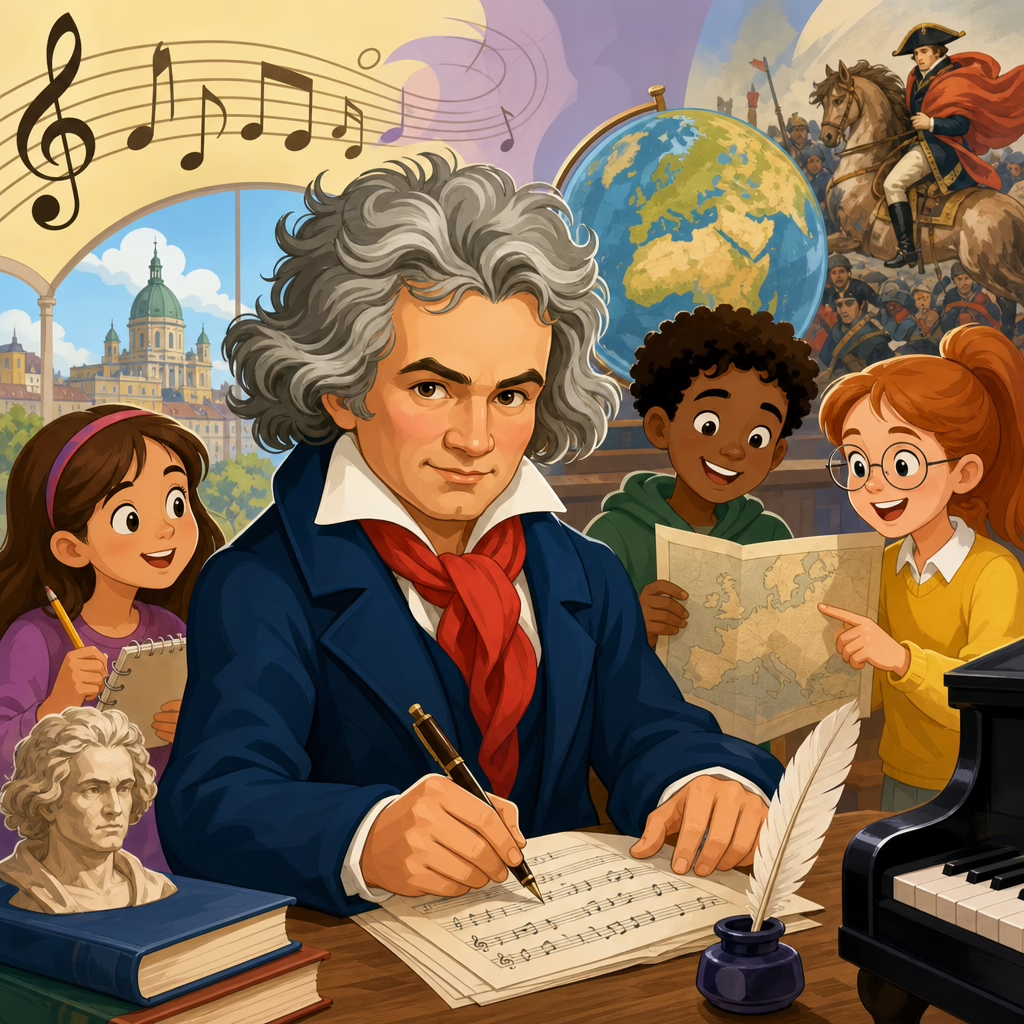
Beethoven-Inspired Lesson Plans for History and Music
Beethoven-inspired lesson plans for history and music give teachers a practical way to connect artistic achievement, political change, biography, listening skills, and classroom discussion in one coherent unit. In this context, a lesson plan is a structured sequence of activities, assessments, and materials that helps students understand both Ludwig van Beethoven’s music and the world that shaped it. A hub article matters here because “miscellaneous” in community and education often becomes a catchall without direction; when I build curriculum maps, I use a hub page to organize broad themes into teachable pathways, link related classroom resources, and show how one composer can anchor work across grade levels. Beethoven is especially effective because his life intersects with the French Revolution, Napoleonic Europe, Enlightenment ideals, patronage systems, disability history, and the transition from Classical to Romantic style. Students can hear those shifts, not just read about them. That makes these lesson plans valuable for music teachers, history teachers, homeschool families, museum educators, and community programs seeking interdisciplinary learning that remains academically rigorous while still engaging young listeners.
Used well, Beethoven-centered instruction does more than celebrate a famous composer. It teaches chronology, cause and effect, source analysis, emotional interpretation, and cultural literacy. It also gives students a framework for asking strong questions: What did audiences hear as new or shocking in Beethoven’s symphonies? How did war, censorship, class structure, and patronage influence composition and performance? What does Beethoven’s hearing loss tell us about adaptation, identity, and mythmaking? These are not abstract questions. I have seen students who resist textbook history become invested once they compare the “Eroica” Symphony with Napoleon’s public image or trace the “Ode to Joy” from nineteenth-century concert halls to the European Union. For a sub-pillar hub under community and education, the goal is comprehensive coverage: not one isolated worksheet, but a clear set of themes, classroom formats, project ideas, and resource types that can lead readers to deeper articles, local programming, and curriculum extensions. The best Beethoven-inspired history and music lessons therefore combine close listening with historical evidence, hands-on analysis, and discussion that treats students as thoughtful interpreters rather than passive recipients of facts.
Why Beethoven works as an interdisciplinary teaching anchor
Beethoven works across subjects because his career sits at a turning point in European culture. Born in Bonn in 1770 and active mainly in Vienna, he inherited the Classical traditions associated with Haydn and Mozart but expanded form, emotional range, orchestration, and public ambition in ways that shaped the nineteenth century. For history classes, that timing matters. His life spans the American Revolution’s aftermath, the French Revolution, the rise and fall of Napoleon, the Congress of Vienna, and rapid changes in urban concert culture. For music classes, he offers clear examples of sonata form, motive development, thematic transformation, dynamic contrast, and increasing independence from aristocratic service.
That combination lets teachers avoid the common trap of teaching music as isolated genius. Beethoven was not creating outside society. He depended on publishers, patrons, performers, instrument makers, and audiences. His career helps students understand how art circulates through real institutions. A lesson on the Third Symphony can move from manuscript history and dedication politics to the changing role of public concerts. A lesson on the Fifth Symphony can cover the famous four-note motive, but also discuss how later generations imposed narratives of fate and struggle. Students learn that meaning is created by composers, listeners, critics, and historical context together.
Community educators also benefit because Beethoven is familiar enough to attract interest but rich enough to sustain serious study. Libraries can pair listening clubs with short history talks. Youth orchestras can connect repertoire to civic education. Senior centers can use Beethoven programs to prompt discussion about resilience, hearing, memory, and cultural change. In each setting, the same principle applies: a strong Beethoven-inspired lesson starts with a specific learning outcome, then uses music as evidence rather than background decoration.
Core historical themes teachers can build into lessons
The most effective history and music units organize around themes instead of loose biography. One theme is revolution and political idealism. Beethoven admired Enlightenment values and initially associated Napoleon with republican promise, then reportedly reacted in anger when Napoleon crowned himself emperor. Whether every detail of the famous anecdote about the “Eroica” title page has been romanticized, the episode still opens a productive discussion about political disillusionment. Students can compare heroic language in music criticism with primary sources about leadership and empire.
Another major theme is patronage and class. Beethoven never fully fit the older model of a court servant, yet he still depended on noble support. This tension helps students analyze how artists negotiated status before modern mass media. Teachers can introduce Archduke Rudolf, Prince Lobkowitz, and Prince Kinsky to show how patronage, commissions, and annuities worked. Students often assume great composers simply sold masterpieces; in reality, careers depended on networks, contracts, dedications, and market timing.
Disability history is equally important. Beethoven’s hearing loss should not be reduced to a simplistic triumph narrative. A responsible lesson examines the Heiligenstadt Testament, his medical uncertainty, social isolation, adaptation strategies, and the limits of retrospective diagnosis. Students can discuss what accommodation meant in the early nineteenth century compared with now. This topic naturally connects music education with health history, identity, and representation.
Teachers can also use Beethoven to explain changing public culture. By the early nineteenth century, subscription concerts, music publishing, piano ownership, and criticism were expanding. Those developments affected what got composed and how it was heard. When students study Beethoven’s piano sonatas alongside improvements in piano construction, they see technology influencing style. When they examine the Ninth Symphony’s premiere, they encounter a growing public sphere in which large choral-orchestral works could serve cultural and civic symbolism.
Lesson plan formats that work in classrooms and community settings
In practice, Beethoven-inspired lesson plans work best when they follow a simple progression: set historical context, guide focused listening, analyze evidence, and ask students to produce something. Different settings need different time scales. A forty-minute general music class may use one movement and one historical question. A middle school humanities block can sustain a weeklong inquiry. An after-school community arts program may favor interactive stations over formal lectures.
Here is a practical comparison of lesson formats I have found reliable in schools, libraries, and youth ensembles:
| Format | Best use | Example Beethoven topic | Assessment |
|---|---|---|---|
| Single-period close listening | Introductory classes | Fifth Symphony motive and emotional interpretation | Exit ticket identifying one musical device and one historical connection |
| Document-based history lesson | Social studies integration | “Eroica,” Napoleon, and political ideals | Short paragraph citing one primary and one musical source |
| Performance workshop | Band, orchestra, choir | Ninth Symphony “Ode to Joy” phrasing and text meaning | Annotated score or rehearsal reflection |
| Project-based unit | Upper middle school or high school | Beethoven, patronage, and public concerts | Presentation, podcast, or mini exhibit |
| Community event lesson | Libraries, museums, family programs | Beethoven’s life timeline with listening stations | Group discussion or response card |
These formats keep instruction adaptable without becoming vague. For younger students, I recommend short excerpts, movement maps, and vocabulary such as loud and soft, fast and slow, steady beat, and repeated pattern. For older students, move toward sonata form, scherzo, variation, thematic development, and reception history. The key is alignment. If the objective is to understand political symbolism, do not spend the entire lesson only on composer biography. If the objective is formal listening, use history to sharpen attention, not overwhelm it.
Specific lesson ideas for different age groups
Elementary students respond well to pattern recognition and storytelling. One reliable lesson uses the opening of Beethoven’s Fifth Symphony to teach motive. Students clap the four-note rhythm, identify repetition and contrast, and then describe how the music feels using evidence from tempo, dynamics, and orchestral color. A linked history extension can be simple: explain that people in Beethoven’s time were living through war and uncertainty, then ask whether the music sounds calm, tense, bold, or mysterious. The goal is not adult-level political interpretation but evidence-based listening.
For upper elementary or middle school, “Ode to Joy” is especially versatile. Students can sing or play the melody, compare instrumental and choral versions, and learn the text’s basic message of human unity. A history teacher can then discuss why later institutions, including the European Union, adopted the melody as a symbol. This naturally opens conversation about how music acquires new meanings across time. Students see that a composition is not frozen at its premiere.
High school classes can handle richer case studies. A strong unit pairs excerpts from the “Eroica” Symphony with readings on Napoleon, revolutionary ideals, and Vienna’s political climate. Students evaluate whether the symphony’s scale and dramatic contrasts support the label heroic, and whether that heroism is personal, political, or artistic. Another excellent lesson centers on the Heiligenstadt Testament. Students read selected passages, listen to a slow movement such as the “Pathétique” Sonata’s Adagio cantabile or a late quartet excerpt, and discuss how biography informs interpretation without determining it completely.
For college-prep humanities or AP-level work, Beethoven is ideal for source comparison. Students can analyze contemporaneous reviews, letters, score excerpts, and later mythmaking. They can compare the reception of the late quartets with modern reverence for them, learning that works now considered canonical were sometimes initially bewildering. That teaches a vital historical principle: cultural value changes over time through institutions, critics, performers, and education.
Using primary sources, recordings, and technology effectively
The quality of materials determines whether a Beethoven lesson feels serious or superficial. Primary sources matter because they move students beyond summary. Useful documents include the Heiligenstadt Testament, letters, dedication pages, early reviews, and concert announcements. Reliable archives and institutions such as the Beethoven-Haus Bonn, the Library of Congress, major university libraries, and museum collections provide digitized materials that can be projected or assigned. Even one source can transform discussion by forcing students to distinguish evidence from legend.
Recordings should also be chosen deliberately. Students benefit from hearing more than one interpretation of the same excerpt. Compare two openings of the Fifth Symphony, one with brisk historically informed articulation and one with broader modern orchestral weight. That simple exercise shows that notation does not eliminate interpretation. For classroom use, recordings from conductors such as John Eliot Gardiner, Carlos Kleiber, Herbert von Karajan, or Nikolaus Harnoncourt can illustrate different approaches, provided teachers explain that no single recording is definitive.
Technology helps when it serves listening and analysis. Timeline tools can place Beethoven’s life alongside major political events. Notation apps or projected scores can highlight motives, dynamics, and instrumentation. Learning platforms can host discussion prompts such as: What evidence suggests this music was intended for public impact rather than private entertainment? Students can answer with both musical and historical examples. In community education settings, QR codes linking to short listening excerpts and source notes work well at exhibit stations. The best digital tools reduce friction and increase access; they should not distract from careful hearing and thoughtful reading.
Assessment, inclusion, and common teaching mistakes
Assessment in interdisciplinary Beethoven units should measure understanding, not just admiration. Good checks for learning ask students to make claims supported by evidence. A short response might ask: How does one musical feature in Beethoven’s Fifth Symphony create tension, and how might that tension connect to the era’s historical instability? A performance assessment might require students to annotate a phrase, indicating dynamics, articulation, and expressive intent. A project assessment might ask for a mini exhibit on Beethoven’s hearing loss using one primary source, one scholarly source, and one musical excerpt.
Inclusion matters because Beethoven can easily become a “great man” lesson that excludes broader perspectives. Teachers should acknowledge that the canon was shaped by institutions that elevated some figures over others. That does not diminish Beethoven’s importance; it places him in a larger cultural system. A stronger hub approach links Beethoven lessons to studies of Joseph Haydn, Wolfgang Amadeus Mozart, Clara Schumann, Fanny Mendelssohn, Florence Price, and non-European traditions, helping students compare how communities decide what is preserved and performed.
Several mistakes are common. One is relying on clichés about genius and suffering without evidence. Another is reducing listening to mood words with no musical explanation. A third is overloading history students with technical analysis or music students with political detail that never returns to the score. The fix is disciplined integration. Every activity should answer a clear question, use evidence, and connect back to the learning goal. When teachers do that, Beethoven-inspired lesson plans become more than miscellaneous enrichment. They become a durable hub for community and education work that links curriculum, performance, local programming, and lifelong listening.
Beethoven-inspired lesson plans for history and music succeed because they turn one composer into a gateway for many kinds of learning. Students can study revolution, patronage, disability history, public culture, and musical form without treating those subjects as separate silos. Teachers can scale the material from elementary pattern work to high school document analysis and community listening events. The strongest plans use focused objectives, primary sources, carefully chosen recordings, and assessments that require evidence-based claims. They also avoid myths, acknowledge tradeoffs, and place Beethoven within larger cultural networks rather than on an isolated pedestal.
As a sub-pillar hub for community and education, this topic should guide readers toward practical next steps: a lesson on the Fifth Symphony and motive, a history inquiry on the “Eroica,” a choral exploration of “Ode to Joy,” a source study of the Heiligenstadt Testament, or a community program built around listening stations and discussion. That breadth is the real benefit. Beethoven offers recognizable entry points, but the learning extends far beyond one name. Use this hub to map your unit, connect related resources, and build lessons that help students hear history and understand music with sharper attention. Start with one excerpt, one question, and one clear outcome, then expand from there.
Frequently Asked Questions
What should a Beethoven-inspired lesson plan for history and music include?
A strong Beethoven-inspired lesson plan should combine music study, historical context, biography, and student reflection into one organized sequence. At minimum, it should include a clear learning objective, selected musical excerpts, background on Beethoven’s life, and historical material that helps students understand the political and cultural environment of late eighteenth- and early nineteenth-century Europe. Teachers often begin with a short overview of Beethoven as a composer who lived during a time of enormous social change, including the effects of the Enlightenment, the French Revolution, and the rise of Napoleon. That foundation helps students see that music was not created in isolation, but in conversation with the world around it.
In practical terms, an effective plan usually includes a listening activity, a short reading or lecture, guided discussion questions, and some kind of assessment. For example, students might listen to excerpts from Symphony No. 3, Symphony No. 5, or Symphony No. 9 while identifying emotional shifts, recurring motifs, or changes in dynamics. They can then connect those observations to Beethoven’s personal struggles, especially his hearing loss, and to broader historical themes such as heroism, revolution, citizenship, and changing ideas about the individual. A well-designed lesson also provides materials such as timelines, primary source quotations, maps, vocabulary support, and note-taking guides so students can build understanding step by step.
To make the lesson plan coherent, teachers should sequence activities intentionally. A common structure is to begin with an engaging hook, move into content instruction, guide students through listening and analysis, and end with a written or discussion-based task. The final assessment might ask students to explain how Beethoven’s music reflects both his life and his historical era. When done well, the lesson plan becomes more than a music appreciation activity. It becomes an interdisciplinary unit that helps students analyze evidence, listen closely, think historically, and discuss how great artistic works emerge from real human and political circumstances.
How can teachers connect Beethoven’s music to major historical events in a meaningful way?
The best way to connect Beethoven’s music to history is to focus on major themes rather than treating music and historical events as separate topics. Beethoven lived during a period shaped by revolution, war, shifting governments, and new ideas about freedom and human dignity. Teachers can help students explore how those forces influenced artistic expression by pairing key compositions with historical moments. One of the clearest examples is Symphony No. 3, the “Eroica,” which is often used to discuss Beethoven’s complicated response to Napoleon. Students can learn that Beethoven initially admired Napoleon as a symbol of republican ideals, but later rejected him when Napoleon crowned himself emperor. That story opens the door to a rich discussion about political disillusionment, leadership, and the difference between ideals and power.
Another meaningful approach is to use timelines and source comparison. Students can place Beethoven’s major works alongside events such as the French Revolution, the Napoleonic Wars, the Congress of Vienna, and changing social structures in Europe. Then they can ask historical questions: What kind of society was Beethoven living in? How were artists supported? Why did ideas about the individual become so important during this period? Teachers do not need to claim that every note in a Beethoven composition directly represents a political event. Instead, they can guide students to understand that Beethoven’s music emerged in a world where questions of liberty, struggle, heroism, and human potential were especially urgent.
Classroom discussions become more meaningful when students are asked to interpret rather than memorize. For instance, after listening to a dramatic movement, students might discuss how the music communicates tension, conflict, or triumph, and then compare those feelings to the instability of Europe during Beethoven’s lifetime. Teachers can also introduce excerpts from letters, contemporary accounts, or patronage records to show how composers navigated social expectations and political realities. This method keeps the lesson grounded in evidence while still allowing students to think imaginatively. The result is a history-and-music unit that feels connected, intellectually honest, and memorable.
What are the best classroom activities for helping students engage with Beethoven’s life and works?
The most effective classroom activities are the ones that make students active participants in listening, questioning, and interpretation. Guided listening is usually the foundation. Rather than asking students to simply hear a piece, teachers can provide a listening chart that directs attention to tempo, mood, instrumentation, repetition, and contrast. Students can listen for the famous four-note motif in Symphony No. 5, describe how it changes throughout the movement, and discuss why that pattern feels so powerful. This turns listening into analytical work and gives students a concrete entry point even if they have little prior musical training.
Biographical activities are also especially useful because Beethoven’s life offers compelling material for student inquiry. Teachers can use a short biography, a timeline project, or station-based learning in which students rotate through topics such as Beethoven’s early training, his move to Vienna, his deafness, his public reputation, and his later compositions. Students can analyze excerpts from the Heiligenstadt Testament to explore Beethoven’s emotional world and his determination to continue composing despite personal hardship. This kind of activity helps humanize him without reducing the lesson to biography alone.
Discussion and creative response tasks can deepen engagement even further. Students might compare two Beethoven works and explain how each reflects a different emotional or historical perspective. They could write a journal entry from the point of view of a listener at an early nineteenth-century premiere, create a museum-style exhibit panel about Beethoven and the Age of Revolution, or participate in a structured seminar on whether Beethoven should be viewed primarily as a classical composer, a romantic innovator, or both. Teachers can also assign collaborative projects that combine research, listening, and presentation skills. These activities work well because they bring together historical thinking, musical analysis, and student voice in a format that feels purposeful rather than passive.
How can Beethoven lesson plans be adapted for different grade levels and learning needs?
Beethoven-inspired lesson plans are highly adaptable because the core themes can be taught at many levels of complexity. For younger students or middle school learners, teachers can focus on broad ideas such as emotion in music, important events in a composer’s life, and simple historical connections. Students might identify whether a musical excerpt sounds dramatic, peaceful, or energetic, then connect those feelings to a short story about Beethoven’s life. Basic timelines, vocabulary cards, short video clips, and guided questions can make the material accessible without oversimplifying it. At this level, the goal is usually to build curiosity, listening confidence, and an early understanding that music reflects the time in which it was created.
For older students, especially in high school, teachers can increase the analytical depth. They can introduce more sophisticated historical content about revolutionary Europe, patronage systems, social class, and changing cultural expectations for artists. Students can compare primary and secondary sources, evaluate interpretations of Beethoven’s political views, and write evidence-based responses about how specific compositions reflect larger intellectual and political developments. More advanced learners may also benefit from score excerpts, thematic analysis, or comparisons between Beethoven and other composers of the classical and romantic periods.
Adaptation also means making the lesson inclusive for diverse learning profiles. Teachers can support students through audio-visual materials, chunked readings, discussion scaffolds, graphic organizers, and multiple options for demonstrating understanding. Some students may do best with oral discussion, while others may show mastery through a written paragraph, a slideshow, a poster, or a short recorded explanation. English language learners may benefit from pre-taught vocabulary and sentence stems, while students who need enrichment can research a specific symphony or examine Beethoven’s influence on later composers. A flexible lesson plan recognizes that there is no single path to understanding Beethoven. The key is to preserve the richness of the content while offering multiple ways for students to access, process, and express what they learn.
Why is a hub article on Beethoven-inspired lesson plans useful for teachers and community education audiences?
A hub article is especially useful because it brings together ideas, resources, and teaching strategies that might otherwise be scattered across music education, history instruction, and general classroom planning. In community and education spaces, broad categories often become catchalls, which makes it harder for teachers, homeschoolers, tutors, and program leaders to locate practical, focused guidance. A dedicated hub article solves that problem by organizing the topic in a way that is both searchable and usable. Instead of forcing readers to piece together separate materials on Beethoven, European history, listening exercises, and classroom assessments, the article presents those elements as parts of one coherent teaching approach.
This matters because Beethoven is uniquely well suited to interdisciplinary instruction. His life and music create natural bridges between biography, politics, culture, artistic technique, and critical listening. A hub article can explain those connections clearly while also helping readers identify the right lesson ideas for their specific setting. For example, one teacher may need a single class period activity on Symphony No. 5, while another may want a full unit that links the “Eroica” to Napoleon and the French Revolution. A strong hub article can serve both readers by offering structure, examples, and pathways for deeper exploration.
For community education audiences, the value is just as strong. Museums, libraries, after-school programs, and enrichment groups often need adaptable material that balances substance with accessibility. A hub article can provide that balance by showing how Beethoven can be taught not merely as a famous composer, but as a gateway to understanding how art responds to human struggle