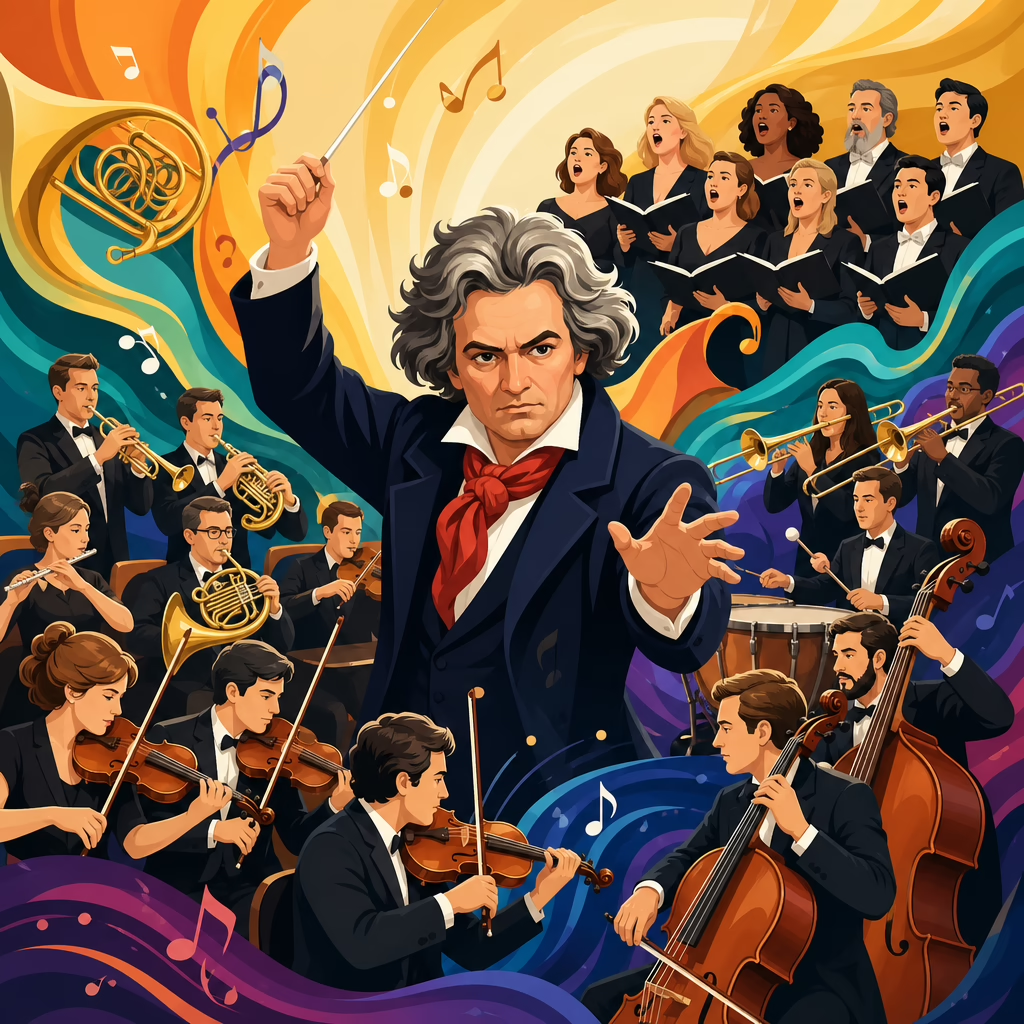
Orchestration in Beethoven’s Symphony No. 9
Beethoven’s Symphony No. 9 is one of the most closely studied orchestral works in Western music because its instrumentation, texture, and dramatic pacing changed expectations for what a symphony could express. In this article, orchestration means the practical and artistic use of instruments: how Beethoven assigns melody, harmony, rhythm, color, and weight across the orchestra and chorus to shape the listener’s experience. Symphony No. 9, completed in 1824, matters not only because it introduced voices into the symphonic genre on an unprecedented scale, but because it reveals Beethoven thinking like a dramatist, architect, and acoustic strategist at once.
When musicians discuss the orchestration in Beethoven’s Symphony No. 9, they are talking about far more than a list of instruments. They are examining register, balance, doubling, articulation, spacing, dynamic layering, and how timbre supports large formal ideas. I have coached players through sections of the score and the recurring challenge is always the same: every instrumental choice serves structure. The mysterious open fifths at the start, the violent scherzo attacks, the warm Adagio blend, and the explosive choral finale each depend on orchestration decisions that control tension over extraordinary spans of time.
The Ninth uses pairs of woodwinds with important doublings, a large brass section including trombones, contrabassoon, timpani, strings, solo vocal quartet, mixed chorus, and in the finale an expanded percussion palette with triangle, bass drum, and cymbals. None of these forces are present merely for spectacle. Beethoven deploys them selectively, often withholding a color until the form needs it most. That is why the score still feels modern: contrast arises from strategic timing, not constant mass. Understanding this orchestration helps listeners hear the symphony as a sequence of calculated sonic arguments rather than as a familiar monument.
As a hub article for the miscellaneous side of Beethoven Music, this guide connects the main orchestration questions readers usually ask. What instruments are used in Beethoven’s Symphony No. 9? How does Beethoven balance chorus and orchestra? Why are the timpani and low brass so important? What makes the finale sound revolutionary? The answers are in the score itself. Beethoven expands Classical orchestral practice inherited from Haydn and Mozart, but he does so with disciplined control. The result is a blueprint for later composers from Berlioz and Wagner to Mahler, Bruckner, and beyond.
Instrumentation and scale in Beethoven’s Symphony No. 9
The instrumentation of Beethoven’s Symphony No. 9 is larger than that of most earlier symphonies, yet the innovation lies in function as much as size. The woodwinds are piccolo in the finale, two flutes, two oboes, two clarinets, two bassoons, and contrabassoon. The brass include four horns, two trumpets, and three trombones: alto, tenor, and bass in period terms. Timpani anchor the percussion core, while triangle, cymbals, and bass drum appear in the Turkish-style episode of the last movement. Strings remain the foundation, but they are often treated in sharply differentiated layers rather than as a single blended mass.
Beethoven learned orchestral economy in the Classical tradition, so even when the forces expand, he writes with purpose. The contrabassoon darkens tuttis and reinforces bass lines at decisive moments; it is not a constant thunder machine. Trombones, still relatively novel in symphonies at the time, are introduced with rhetorical care, bringing solemnity and monumental weight. The piccolo cuts through thick textures in the finale not to dominate but to sharpen brilliance. This is why performances succeed or fail on balance. Conductors who treat every added instrument as a permanent volume upgrade miss Beethoven’s selective color logic.
| Section | Key forces | Main orchestration function |
|---|---|---|
| First movement | Full orchestra without chorus | Builds tension through dark low-register scoring and controlled brass weight |
| Scherzo | Prominent timpani, winds, brass, strings | Uses rhythmic attack, antiphony, and percussive energy |
| Adagio | Strings and woodwinds in refined blend | Creates warmth, lyric suspension, and chamber-like transparency |
| Finale | Orchestra, soloists, chorus, added percussion | Combines symphonic and vocal forces into staged dramatic progression |
A practical point often overlooked is that the score reflects early nineteenth-century instruments and halls. Natural horns and trumpets had different color profiles from modern valved instruments, and string sections used gut strings with less sustained projection. Beethoven’s orchestration therefore depends on attack, articulation, and registral separation as much as on decibel level. In rehearsal, the clearest way to hear his craft is to notice how often he avoids overcrowding the middle register. He leaves space so thematic lines, harmonic support, and rhythmic figures remain legible, even in dense passages.
The first movement: emergence, weight, and controlled darkness
The opening movement begins with one of the most influential orchestrational ideas in symphonic literature: a gradual emergence from harmonic ambiguity. Tremolo strings and open intervals create atmosphere before the full theme materializes. Beethoven is not simply being mysterious. He is staging the orchestra as though sound itself is coming into focus. The low strings and divided registral layers make the texture feel subterranean, and the delayed arrival of full wind and brass support preserves suspense. Many later composers borrowed this strategy, but few matched its architectural inevitability.
Throughout the movement, Beethoven uses tutti weight sparingly enough that climaxes retain force. Brass often reinforce harmonic pillars rather than continuously driving melody. Woodwinds color transitions, sharpen phrase edges, or briefly lighten the texture before the next orchestral surge. The strings carry much of the developmental strain, especially through tremolo, rapid figuration, and registral expansion. I find that players understand the movement best when they think in terms of pressure management. Beethoven alternates compression and release, with orchestration acting as the main valve controlling the emotional temperature.
One hallmark of this movement is the disciplined treatment of doubling. Beethoven often doubles to intensify contour or stability, not just loudness. Bassoons and lower strings can make a bass line feel implacable; winds added above string figures can harden the profile of a motive; brass entries can turn a cadence into a public declaration. Because the melodic cells are compact, timbre becomes part of thematic identity. Listeners may not name every instrument in real time, but they hear the difference between a figure murmured in strings and the same figure reinforced across the orchestra.
The scherzo: timpani, rhythm, and the mechanics of propulsion
The scherzo is frequently cited for its rhythmic power, and the orchestration is central to that effect. Beethoven gives the timpani a degree of thematic prominence that was startling for the period. Rather than treating the drums as mere punctuation, he makes them structural participants in the movement’s engine. Their sharply articulated intervals lock with strings and brass to create a hard-edged rhythmic profile. In performance, if the timpani articulation is too soft or too generalized, the entire movement loses definition and sounds merely busy instead of relentless.
String writing in the scherzo relies on precision, bite, and collective attack. Beethoven uses repeated notes, fugal interplay, and registral contrast to build kinetic tension. Winds often act as cutting agents, clarifying accents or answering strings with pointed gestures. Brass reinforce the vertical axis, making the pulse feel carved into stone. This is orchestration as mechanism. Every family contributes a distinct surface quality: strings supply momentum, timpani supply impact, winds supply contour, and brass supply public force. The movement’s humor is therefore not lighthearted charm but muscular surprise.
The trio offers contrast, and Beethoven achieves it through different orchestral behavior rather than simple reduction of volume. The texture becomes more spacious, dance impulse replaces hammering insistence, and wind color gains a more buoyant role. This contrast is essential because it resets the ear before the scherzo returns. One reason the movement remains so effective is that Beethoven does not merely alternate loud and soft. He alternates kinds of energy. The orchestration tells us whether motion should feel driven, airborne, blunt, or playful, and that distinction keeps the large form intelligible.
The Adagio: blended sonority, lyric breadth, and harmonic patience
The slow movement demonstrates Beethoven’s mastery of restraint. After the violence of the scherzo, he creates expansive calm through blended strings and carefully weighted woodwinds. The melodic lines unfold over long spans, and orchestration supports continuity rather than interruption. Violins often sing in sustained arcs while lower strings cushion the harmony with warmth instead of agitation. Winds enter not to compete but to tint the line, especially through clarinet and bassoon support that thickens the sonority without making it heavy. This is one of the clearest examples of Beethoven using color to alter perceived time.
Balance is especially delicate here. If strings dominate too completely, the movement can turn monochrome; if winds project too independently, the long-breathed serenity fractures. Beethoven writes many passages that function almost like chamber music inside a symphony. The transparency is intentional. He wants tenderness without sentimentality and breadth without vagueness. Conductors who shape the movement successfully usually preserve rhythmic backbone beneath the lyric surface. The score may sound spacious, but it is not loose. The orchestration distributes pulse subtly through inner voices, allowing melodic lines to float above a stable frame.
What makes the Adagio memorable is not only beauty of melody but the control of sonic temperature. Brass are withheld or softened, percussion recede, and even fuller passages keep rounded edges. Dynamic growth happens through layering and register rather than sheer force. This matters because the finale needs a point of departure. By making the slow movement glow rather than blaze, Beethoven reserves the most public orchestral and choral sonorities for later. The Adagio therefore performs a structural job: it enlarges emotional range while preserving headroom for the conclusion.
The finale: chorus, soloists, and the redefinition of symphonic orchestration
The last movement answers the question most listeners bring to Beethoven’s Symphony No. 9: how does the famous “Ode to Joy” finale work orchestrationally? The short answer is that Beethoven treats the movement as a sequence of staged entries. He begins with instrumental recitative-like interruptions in low strings and cellos and basses, reviewing earlier material and rejecting it. That low-register writing is crucial because it gives the orchestra a quasi-theatrical voice before any singer appears. The simple “Ode to Joy” theme then enters in an almost deliberately plain scoring, allowing recognizability to precede grandeur.
As the finale progresses, Beethoven expands the theme through variation in scoring as much as harmony or counterpoint. Woodwinds add brightness, fuller strings add breadth, brass add ceremonial force, and eventually chorus and soloists transform the symphony into a public utterance. The baritone’s “O Freunde, nicht diese Töne!” is not just a textual intervention; it is an orchestration pivot that clears rhetorical space for the human voice. Beethoven then balances syllabic choral writing against instrumental momentum so the text remains comprehensible while the symphonic drive continues underneath.
The so-called Turkish march episode is often misunderstood as a novelty insert. In fact, its triangle, cymbals, bass drum, piccolo, and lighter scoring create a strategically different social sound world, one associated in Beethoven’s time with military and popular styles. The point is contrast and accessibility. By shifting timbral codes, Beethoven broadens the finale’s expressive reach before reassembling the full forces for larger statements. Later, in the double fugue and climactic choral passages, he layers orchestra and voices with remarkable control. Thick does not mean opaque. The strongest performances preserve diction, contrapuntal clarity, and bass-line direction even at peak volume.
The finale’s lasting importance lies in how it fuses genres without abandoning symphonic logic. Opera, cantata, variation set, march, and fugue all leave fingerprints, yet the orchestration binds them into one arc. This is why the movement became a model and a warning for later composers. It proved that a symphony could include voices and still sustain large-scale coherence, but it also showed how difficult that feat is. Beethoven succeeds because every added force enters for a formal reason. Color follows argument. Spectacle is always subordinate to design.
Performance, legacy, and related paths for further study
For modern orchestras, the main challenge of Beethoven’s Symphony No. 9 orchestration is proportion. String sections are often larger than Beethoven would have known, modern brass are more penetrating, and choral forces vary widely. Historically informed performance practice has clarified many issues by using period instruments, smaller vibrato profiles, and sharper articulation, but large modern-instrument performances can also be convincing when conductors respect transparency. The key is not choosing one camp blindly. It is understanding the score’s priorities: rhythmic definition, registral clarity, textual intelligibility, and contrast between reserved and unleashed sonority.
Beethoven’s influence is measurable in specific orchestrational habits. Berlioz expanded coloristic thinking, Wagner developed the continuum of instrumental drama, Brahms absorbed Beethoven’s density management, and Mahler extended the symphony’s public scale. Yet the Ninth remains unique because its innovations are inseparable from its ethical and rhetorical ambition. For readers exploring the broader Beethoven Music hub, the next useful topics are Beethoven’s choral writing, his use of brass across the symphonies, period versus modern instruments, tempo controversies, and the evolution from the Eroica to the Ninth. Each subject reveals another layer of orchestral thinking in this score.
Orchestration in Beethoven’s Symphony No. 9 is best understood as purposeful distribution of sound across time. The score enlarges the orchestra, but its true achievement is discrimination: Beethoven knows when to strip texture down, when to let timpani define character, when winds should color rather than dominate, when brass should consecrate a climax, and when voices should enter as the culmination of a symphonic process. That control is why the work still sounds inevitable rather than overloaded.
The clearest takeaway is simple. Beethoven did not revolutionize the symphony by making it louder; he revolutionized it by making every instrumental and vocal color serve form, drama, and meaning. Listen again with that in mind, and familiar passages suddenly become legible as decisions: the shadowed opening, the percussive scherzo, the glowing Adagio, and the staged expansion of the finale. If you are building out your Beethoven Music reading, continue from this hub into articles on instrumentation, chorus, conducting choices, and historically informed performance to hear the Ninth with sharper ears.
Frequently Asked Questions
What makes the orchestration in Beethoven’s Symphony No. 9 so important in music history?
Beethoven’s Symphony No. 9 is historically important because its orchestration expanded the symphony from a purely instrumental form into something with a broader expressive and dramatic reach. When people discuss the work’s orchestration, they are not just referring to the list of instruments Beethoven used. They are talking about how he distributes musical ideas across strings, winds, brass, timpani, solo voices, and chorus in order to control energy, contrast, scale, and emotional impact. In this symphony, orchestration becomes a central part of the argument of the piece rather than a decorative surface added onto it.
One reason the score is so closely studied is that Beethoven constantly balances structural clarity with bold sonic imagination. He can create immense weight with full ensemble writing, then suddenly reduce the texture to something sparse and searching. Those shifts are not accidental; they help define the architecture of each movement. The listener experiences not just melody and harmony, but also a carefully staged progression of instrumental color, density, and intensity. This practical shaping of the orchestra gives the symphony its sense of inevitability and its extraordinary dramatic pacing.
The Ninth also changed expectations because it demonstrated that orchestration could carry philosophical and human meaning on a monumental scale. The addition of vocal soloists and chorus in the finale did not simply enlarge the performing forces. It redefined what a symphony could say and how orchestral sound could prepare for, support, and frame the entrance of the human voice. Beethoven uses instrumental writing to set up tension, rejection, memory, and release before the “Ode to Joy” theme fully emerges. That integration of orchestral and choral forces made the work a landmark and influenced generations of later composers who saw the orchestra as a dramatic, almost theatrical medium.
How does Beethoven use the orchestra differently in Symphony No. 9 compared with earlier symphonies?
Beethoven uses the orchestra in the Ninth with a greater sense of scale, contrast, and psychological purpose than was typical in many earlier symphonies. Earlier Classical orchestration often emphasized balance, elegance, and clearly defined roles among instrumental groups. Beethoven certainly inherited that tradition, but in this work he pushes it much further. Instead of treating the orchestra mainly as a unified body supporting formal design, he often treats it as a field of opposing forces, layered colors, and evolving textures. Instrumental groups can sound cooperative in one moment and confrontational in the next.
Strings remain central, but the winds and brass are given a stronger rhetorical role. They do more than reinforce harmony or add occasional color. They can announce ideas, intensify dramatic turns, sharpen rhythmic profiles, and alter the emotional temperature of the music. Beethoven is especially skilled at making a passage feel transformed simply by changing which section carries the material. A theme in the strings may sound urgent, while a related phrase in winds may sound reflective or ceremonial. That sensitivity to instrumental character is one of the defining strengths of the score.
Another major difference is Beethoven’s use of extreme contrasts in texture and volume. He moves from chamber-like clarity to overwhelming massed sound with remarkable control. These contrasts are not just exciting effects; they give the symphony a narrative quality. The first movement’s power, the scherzo’s forceful rhythmic drive, the slow movement’s luminous expansiveness, and the finale’s unprecedented combination of orchestra and chorus all show an orchestral imagination working at the edge of what the symphonic tradition had previously attempted. In that sense, the Ninth does not abandon earlier symphonic principles, but it dramatically enlarges them.
What role do texture and instrumental color play in shaping the listener’s experience of the symphony?
Texture and instrumental color are essential to how Symphony No. 9 communicates. Beethoven does not rely on melody alone to move the listener. He carefully varies the thickness of the musical fabric, the spacing of parts, and the combinations of instruments so that the same basic material can feel mysterious, tense, noble, intimate, or triumphant. Texture, in this context, means how many layers are sounding and how they interact. Color refers to the distinctive timbre created by strings, winds, brass, percussion, and voices in different combinations. Together, these elements shape the emotional contour of the piece.
For example, Beethoven often begins with textures that seem unsettled or incomplete, allowing sound to emerge gradually rather than presenting a fully formed musical statement at once. This creates suspense and gives the impression that the music is being discovered in real time. Elsewhere, he uses tightly coordinated full-orchestra writing to create an overwhelming sense of weight and public declaration. The listener feels these changes physically as well as intellectually. The orchestra can sound dark and driven, then suddenly transparent and lyrical, making each transition part of the drama.
Beethoven’s instrumental color also helps organize the symphony’s long span. Bright wind writing can relieve the pressure of dense string and brass textures. Brass and timpani can turn rhythmic motion into something monumental. Woodwinds can introduce warmth, distance, or human vulnerability. In the finale, the contrast between instrumental timbre and sung text becomes especially powerful. By the time the chorus enters, the orchestra has already prepared a space for the human voice through a series of bold orchestral gestures, interruptions, and recollections of earlier material. That means the listener experiences the choral arrival not as an isolated surprise, but as the culmination of a carefully orchestrated journey.
Why is the finale of Beethoven’s Symphony No. 9 considered such a breakthrough in orchestration?
The finale is considered a breakthrough because Beethoven combines instrumental and vocal forces within a symphonic structure in a way that feels both radical and purposeful. The significance lies not merely in the fact that he adds singers, but in how he stages their arrival and integrates them into the overall orchestral design. Before the famous “Ode to Joy” theme is fully established, Beethoven presents a sequence of dramatic orchestral recitatives, recalls earlier movements, and seems to reject previous musical paths. This is orchestration used as argument: the orchestra itself participates in a kind of searching, clearing the way for a new mode of expression.
Once the finale unfolds, Beethoven continues to think orchestrally even when voices are present. The chorus is not simply laid on top of the orchestra. Instead, instrumental color, rhythmic articulation, and vocal writing are coordinated to create changing levels of intimacy and grandeur. Sometimes the music feels almost conversational; at other times it expands into a public, ceremonial statement of immense power. Soloists, chorus, and orchestra are constantly rebalanced so that different shades of expression emerge from the same thematic material.
The finale is also remarkable for the breadth of its sonic world. It includes moments of simplicity, military brilliance, festive exuberance, and near-spiritual exaltation, all held together by Beethoven’s control of texture and pacing. He knows when to thin the sound to make a theme feel direct and universal, and when to build massive accumulations of energy for maximum impact. This approach influenced countless later composers, who saw in the Ninth a model for how orchestration could support not only musical development but also large-scale ideas about humanity, struggle, and collective joy.
How should listeners pay attention to orchestration when hearing Beethoven’s Symphony No. 9?
A useful way to listen is to focus on who has the musical foreground at any given moment and how that changes over time. Rather than hearing the orchestra as one undifferentiated mass, try noticing when Beethoven gives the main idea to strings, when winds answer or soften it, when brass intensify it, and when timpani sharpen the pulse. These shifts are often the key to understanding the drama of the symphony. A theme does not mean exactly the same thing every time it appears; its meaning changes according to its orchestral setting.
It also helps to listen for Beethoven’s handling of weight and space. Some passages feel dense and forceful because many instruments are active at once in closely coordinated rhythms. Others feel open because the texture is lighter, the lines are more separated, or the timbre is gentler. Beethoven uses these contrasts to guide the listener through tension, release, conflict, memory, and affirmation. If you notice when the orchestra suddenly contracts or expands, you will hear how orchestration contributes directly to the work’s dramatic pacing.
Finally, pay special attention to transitions, not just climaxes. Beethoven is a master of preparing big moments through orchestral means. The way he introduces color, withholds full power, or shifts from one instrumental group to another often matters as much as the arrival point itself. In the finale especially, listen for how the orchestra prepares the human voice, how the chorus changes the scale of the sound, and how instrumental writing continues to shape the meaning of the text. Approached this way, the Ninth becomes not only a masterpiece of melody and form, but also a profound lesson in how orchestration can direct the listener’s emotional and intellectual experience.