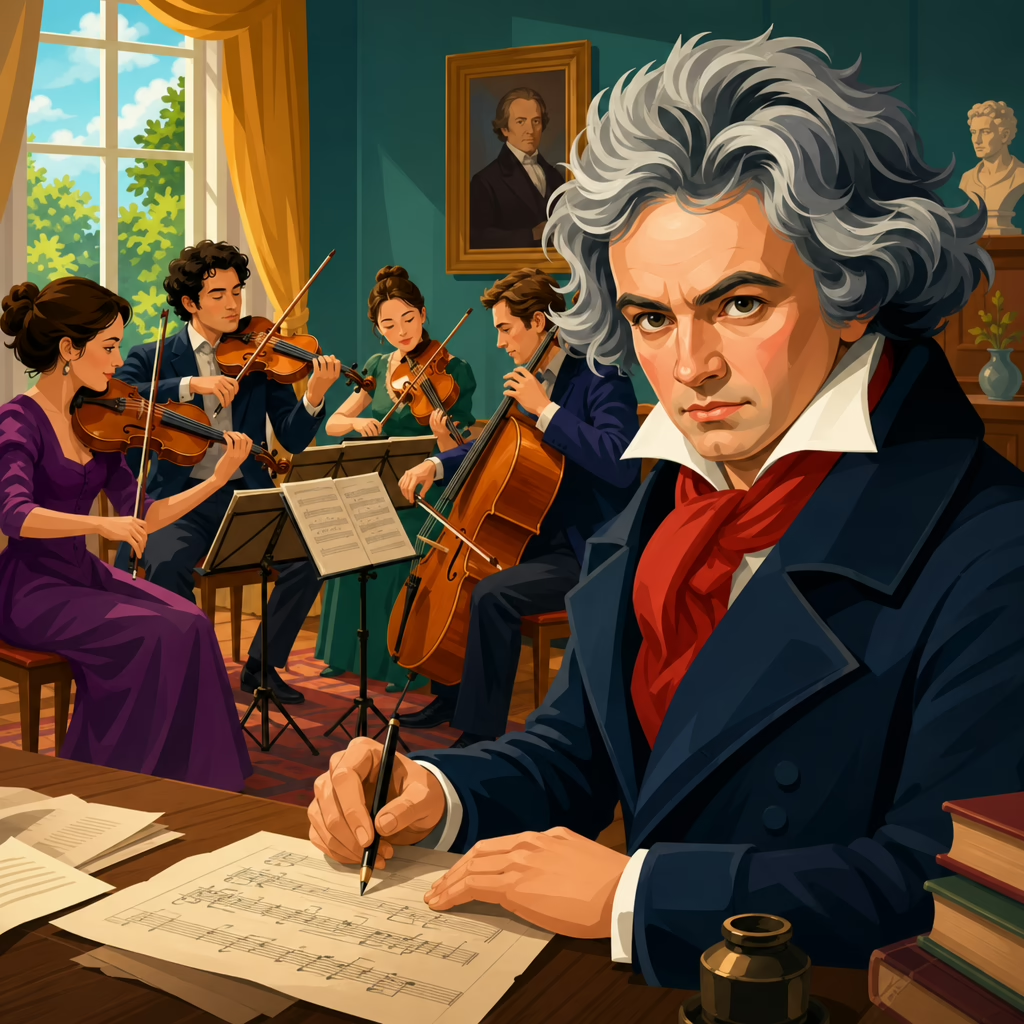
Beethoven’s Chamber Works: An Advanced Musician’s Perspective
Beethoven’s chamber works occupy a singular place in the history of Western music because they compress symphonic ambition, theatrical characterization, and experimental form into music written for small ensembles. For advanced musicians, this repertoire is not merely a collection of quartets, trios, sonatas, and divertimento-like pieces; it is a laboratory in which Beethoven tests motivic development, tonal architecture, instrumental color, and interpersonal rhetoric at the highest level. In practical terms, “chamber works” includes the string quartets, piano trios, violin sonatas, cello sonatas, string trios, wind and mixed-instrument works, and a range of occasional pieces that reveal how Beethoven thought when every line mattered. This body of music matters because it reshaped rehearsal culture, ensemble listening, and even the technical expectations placed on performers. In conservatories and professional studios, I have repeatedly seen players discover that Beethoven’s chamber music exposes every weakness in pulse, voicing, intonation, and structural hearing, while also rewarding the deepest level of collective imagination. As a hub within Beethoven music, this miscellaneous overview is useful precisely because the repertoire resists neat categorization: the same composer who wrote the Op. 18 quartets also wrote the late quartets, the “Kreutzer” Sonata, the Septet, the Clarinet Trio, the Serenade for flute, violin, and viola, and the remarkable sets of variations that trained generations of players to think compositionally.
To approach Beethoven’s chamber works intelligently, an advanced musician must define a few core terms. Motive means the smallest identifiable musical idea that can generate larger structures. Texture refers to how lines are layered, whether in homophony, counterpoint, or registral dialogue. Formal function describes what a passage is doing in time: initiating, transitioning, closing, destabilizing, or recomposing earlier material. Beethoven’s importance lies in the way he intensifies all three. A two-note cell may govern an entire movement; an accompanimental figure may become thematic; a transition may carry more drama than a first theme. His chamber writing also documents the expansion of instrumental technology and performance style around 1790 to 1827. Viennese pianos gained power and sustain, string playing became more public and projecting, and amateur salon traditions gave way to professional concert culture. Beethoven wrote into that change. The result is music that sounds intimate in scoring but public in argument. That tension explains why these works remain central to auditions, competitions, recordings, and scholarly debate. They teach ensemble hierarchy, leadership rotation, rhetorical timing, and the discipline of hearing harmony as a living force rather than a textbook progression.
How Beethoven’s chamber music evolved across his career
Beethoven’s chamber output is best understood in three broad periods, though the categories are porous. The early works draw on Haydn and Mozart but already push against inherited proportion. The six string quartets of Op. 18, completed around 1800, are often treated as apprentice works, yet that judgment underestimates their sophistication. In Op. 18 No. 1, the slow movement’s tragic rhetoric, reportedly linked to the tomb scene from Romeo and Juliet, shows Beethoven treating a quartet movement as dramatic narrative. The Piano Trios Op. 1 likewise signal ambition: the C minor trio, especially, announces a composer determined to elevate the genre beyond drawing-room entertainment. For advanced performers, these early works require classical poise without underplaying the latent volatility embedded in accents, dynamic contrasts, and unexpected harmonic turns.
The middle-period chamber works expand scope and physical intensity. The “Razumovsky” Quartets Op. 59 transform the quartet into a near-symphonic medium, with long spans, remote tonal plans, and thematic integration on an unprecedented scale. The “Kreutzer” Sonata, Op. 47, is equally disruptive. Its first movement juxtaposes ceremonial Adagio writing with explosive Presto energy; its scale and piano writing make clear that this is not a polite accompanied sonata but a true duo. The Cello Sonatas Op. 69 and Op. 102 mark a similar rebalancing between instruments, moving the cello from supportive bass voice to equal protagonist. When I coach these scores, the recurring issue is not technique alone but pacing: players often spend too much emotional capital early and fail to reserve space for Beethoven’s longer structural trajectories.
The late period rewrites the meaning of chamber music altogether. The late quartets—Opp. 127, 130, 131, 132, 135, and the Grosse Fuge, Op. 133—compress fugue, variation, recitative, dance, hymn, and fragmentation into designs that still challenge analysis. Op. 131’s seven connected movements create continuity without conventional interruption; Op. 132’s “Heiliger Dankgesang” suspends time through modal chorale writing and marked contrasts between weakness and renewed strength. These works are not enigmatic because they are abstractly difficult; they are difficult because Beethoven makes syntax itself unstable. Cadences dissolve, meter becomes rhetorical rather than merely regular, and character shifts arrive without apology. Any advanced musician entering this repertoire must study the historical context of Beethoven’s deafness and illness, but should resist reducing the music to biography. The scores are rigorously constructed, and they demand decisions rooted in harmony, articulation, and form.
Core genres every advanced musician should know
The string quartets are the central pillar, but Beethoven’s chamber world is broader and more interconnected than many players initially realize. The quartets establish his evolving approach to conversational texture, especially the redistribution of thematic responsibility across all four instruments. Yet the piano trios are equally instructive because they reveal his treatment of keyboard sonority in ensemble balance. In the Op. 70 trios, including the “Ghost,” the piano part can overwhelm if played with modern concert-grand habits, while too much caution drains the work of its orchestral imagination. Successful performances begin with transparent pedaling, clear bass hierarchy, and shared agreement on whether the strings are blending into the keyboard spectrum or cutting through it.
The violin sonatas form another essential branch. From the early Op. 12 set through the Op. 96 Sonata, Beethoven progressively dismantles the accompanist-soloist model inherited from the eighteenth century. In the “Spring” Sonata, melodic generosity can tempt performers into lyrical indulgence, but the movement architecture depends on rhythmic discipline and clean secondary material. In the “Kreutzer,” by contrast, the issue is controlled ferocity. Its technical hurdles—rapid passagework, registral extremes, and abrupt rhetorical shifts—only become persuasive when both players maintain a unified sense of proportion. I have found that rehearsing transitions at half tempo with spoken harmonic cues often solves more ensemble problems than repeated full-speed run-throughs.
The cello sonatas, string trios, and variation sets are indispensable for understanding Beethoven’s craftsmanship. The five cello sonatas trace the emancipation of the cello as a partner with melodic and structural agency. The string trios, especially Op. 9, are often overshadowed by the quartets, but they are among Beethoven’s finest studies in exposed texture. Without the second violin, every registral gap matters, and performers cannot hide poor intonation or vague harmonic rhythm. The miscellaneous works for winds and mixed ensembles broaden the picture further. The Septet Op. 20 became one of Beethoven’s most popular works in his lifetime, despite his later frustration with its success. The Clarinet Trio Op. 11, Horn Sonata Op. 17, Serenade Op. 25 for flute, violin, and viola, and the wind octet-related works reveal a composer fully aware of instrumental idiom, public taste, and the social settings in which chamber music circulated.
| Genre | Key works | Primary challenge for advanced players | What it teaches |
|---|---|---|---|
| String quartets | Op. 18, Op. 59, Op. 74, Op. 95, Opp. 127–135 | Long-form pacing and democratic voicing | Structural listening and collective rhetoric |
| Piano trios | Op. 1, Op. 70, Op. 97 | Keyboard-string balance on modern instruments | Texture management and harmonic grounding |
| Violin sonatas | Op. 12, Op. 24, Op. 30, Op. 47, Op. 96 | Duo coordination and proportional drama | Shared leadership and articulation clarity |
| Cello sonatas | Op. 5, Op. 69, Op. 102 | Equal partnership and bass-line flexibility | Line exchange and registral strategy |
| Mixed ensembles | Op. 11, Op. 17, Op. 20, Op. 25 | Idiom-specific color and blend | Style adaptation and social context |
Interpretive priorities: rhythm, articulation, tempo, and sound
If there is one recurring mistake in Beethoven performance, it is treating the notes as the music and the rhythmic grammar as secondary. Beethoven’s chamber works live or die by pulse hierarchy. Sforzandi are not generic loud notes; they function as structural markers, local disruptions, or expressive bites within a phrase. Rests are equally active. In Op. 95, for example, silences create compression and volatility that disappear when players relax between gestures. Metronome marks, where available, are important evidence, though not infallible commandments. The best results come when ensembles test tempo against articulation density, room acoustics, and instrument response rather than adopting a tradition by default.
Articulation in Beethoven is inseparable from form. Slurs often indicate rhetorical grouping rather than mere bowing convenience, and staccato can mean anything from buoyancy to menace depending on context, register, and dynamic. Urtext editions from Bärenreiter or Henle are indispensable starting points, but they should be compared with critical reports and, when possible, autograph or first-edition evidence. I advise players to mark every recurrence of a figure before deciding on a global articulation plan. Beethoven frequently changes a repeated idea by one slur, one accent, or one registral shift, and those details usually point to formal function.
Sound production is the final layer. Historically informed performance has changed the field by clarifying vibrato usage, bow stroke variety, tempo relationships, and fortepiano color. Even musicians playing on modern instruments benefit from these insights. A leaner vibrato, faster speech-like consonants in attacks, and lighter sustaining pedal often reveal inner counterpoint obscured by late-Romantic habits. At the same time, historical awareness should not become dogma. The goal is not antiquarian imitation but stylistic credibility. Beethoven can absorb a wide expressive range, provided the ensemble preserves textual precision and tonal accountability.
Rehearsal strategies and analytical methods that actually work
Advanced musicians improve fastest in Beethoven when rehearsal combines score study with practical problem-solving. Start by mapping form together, not privately and inconsistently. Label primary themes, transition zones, developmental cores, recapitulation strategies, codas, and deceptive returns. Then identify harmonic arrival points and points of maximum instability. This prevents the common problem of everyone shaping toward different goals. In the “Archduke” Trio, for instance, the first movement can feel expansive rather than diffuse when all three players agree which cadences are structural and which are temporary plateaus.
Next, isolate texture types. Rehearse chorale passages vertically for tuning and harmonic weight, contrapuntal passages horizontally for line continuity, and accompanimental figurations with reduced dynamics so the true melodic subject becomes audible. Quartet players should rotate leadership in rehearsal by assigning one member to cue entrances and phrase turns in each run. Duo players should rehearse with the nonplaying partner speaking bar numbers, harmonic functions, or character labels at predetermined checkpoints. It sounds clinical, but it builds shared awareness efficiently.
Recording rehearsals remains one of the most reliable diagnostic tools. The microphones hear ensemble spread, exaggerated rubato, and imbalanced voicing more honestly than players do in the room. Software such as Transcribe!, Amazing Slow Downer, or any DAW with marker capability helps compare takes and locate persistent issues. For score preparation, IMSLP is useful for access, but advanced musicians should still verify editions through scholarly sources. The point is not bureaucratic perfection; it is reducing avoidable uncertainty so interpretation rests on informed choice instead of habit.
Why the miscellaneous chamber works deserve more attention
The so-called miscellaneous chamber works are not peripheral curiosities. They are the connective tissue that shows Beethoven adapting his language to venue, players, and occasion. The Septet demonstrates his command of public-facing charm, elegant variation technique, and instrumental contrast. The Serenade Op. 25 reveals how lightly scored music can still contain bold harmonic humor and incisive phrase rhetoric. The Horn Sonata teaches breath-based timing and the negotiation between natural-horn idiom and piano texture. Even smaller occasional works, canons, and variation sets offer advanced musicians concise studies in voice leading, character transformation, and compositional economy.
These works also matter because they broaden programming and scholarship within Beethoven music. A sub-pillar hub on miscellaneous chamber repertoire should point listeners and performers beyond the canonical late quartets toward the full ecosystem of Beethoven’s chamber imagination. For recital planning, these pieces can frame more familiar sonatas and quartets with revealing contrast. For teachers, they provide repertoire that develops style awareness without immediately demanding the extreme endurance of the largest works. For scholars and content planners, they create internal pathways to deeper study of Beethoven’s wind writing, variation practice, and salon-to-concert transition.
For advanced musicians, the main lesson is straightforward: Beethoven’s chamber works reward disciplined curiosity. Study the famous scores, but do not stop there. Trace how a gesture in an early trio anticipates a quartet, how a variation set reveals the composer’s handling of bass function, or how a mixed-ensemble serenade clarifies his ear for timbre. Build interpretation from the score outward, test every decision in rehearsal, and listen for structure in every bar. That approach produces performances that are more convincing, more collaborative, and more alive. If you are mapping your Beethoven music journey, use this hub as your starting point, then explore each genre in depth and bring the same rigor to every “miscellaneous” work you touch.
Frequently Asked Questions
Why are Beethoven’s chamber works so central to an advanced musician’s training?
Beethoven’s chamber music is central to advanced study because it demands a level of structural awareness, technical control, and interpretive imagination that few other repertoires require so consistently. In these works, Beethoven treats a small ensemble as if it were capable of symphonic breadth, operatic drama, and philosophical argument. That means performers cannot rely only on beautiful tone or stylistic correctness; they must understand how a short motive grows into a large formal span, how harmonic tension is accumulated and released, and how each instrumental line participates in a larger rhetorical design. A string quartet, piano trio, or violin sonata by Beethoven often feels like a conversation in which every gesture has consequence, every silence carries weight, and every transition reshapes the meaning of what came before.
For advanced musicians, this repertoire is especially valuable because it exposes weaknesses immediately. Problems with rhythm, intonation, articulation, voicing, pacing, ensemble listening, or formal understanding become unmistakable in Beethoven. His textures are often transparent enough that no one can hide, yet dense enough that every participant must think orchestrally. The result is a kind of high-level musical training ground: players learn not just to execute notes, but to project argument, sustain long-range tension, and respond to colleagues with precision and flexibility. In that sense, Beethoven’s chamber works are not simply masterworks to be admired; they are working models of how composition, performance, and musical thought can meet at the highest level.
What should advanced players listen for when analyzing motivic development in Beethoven’s chamber music?
One of the most important things to listen for is Beethoven’s ability to generate large musical structures from very small cells. A rhythmic figure, interval, or contour that seems incidental at first often becomes the generative seed for an entire movement. Advanced players should track where a motive first appears, how clearly Beethoven presents it, and how quickly he begins to alter it through sequence, fragmentation, inversion, rhythmic displacement, harmonic reinterpretation, or changes in register and texture. In Beethoven, development is rarely decorative. It is the mechanism through which musical identity is tested, challenged, and transformed.
It is also crucial to listen for motivic continuity across formal boundaries. A cadence may seem conclusive on the surface, but Beethoven often uses a motive to undermine closure or to prepare the next section before it formally arrives. In sonata-form movements especially, the transition, development, recapitulation, and coda are not merely compartments; they are stages in the life of motivic material. Players who understand this can shape phrasing more intelligently, emphasize structural priorities, and avoid treating repeated figures as mechanically repetitive. Instead, each recurrence can be inflected according to its harmonic context and dramatic function.
Equally important is interpersonal distribution. In chamber music, Beethoven often passes motivic fragments rapidly between instruments, creating a composite line of thought that no single player owns completely. This requires ensemble members to hear beyond their own part and recognize when they are initiating a gesture, responding to it, interrupting it, or completing someone else’s sentence. The deepest performances come from groups that can make this motivic web audible to the listener, so that the work’s inner logic feels inevitable rather than merely well rehearsed.
How does Beethoven use tonal architecture and form differently in his chamber works compared with earlier Classical composers?
Beethoven inherits the formal language of Haydn and Mozart, but he expands its expressive and architectural possibilities with unusual force. In earlier Classical chamber music, tonal design often provides balance, proportion, and elegance. Beethoven certainly values those qualities, yet he increasingly treats tonality as a dramatic field in which conflict, instability, delay, and revelation can unfold. Key relationships are not merely formal markers; they become part of the work’s expressive identity. A remote modulation, an obsessive dominant prolongation, an unexpected return, or a coda that feels like a second development can change the emotional stakes of an entire movement.
For advanced musicians, this means formal analysis must go beyond labeling sections. It is not enough to identify exposition, development, and recapitulation. One must ask how Beethoven stretches or destabilizes those categories. Does the exposition present a genuine contrast between themes, or is it built from a single argumentative idea? Does the development intensify through harmonic exploration, contrapuntal density, rhythmic fixation, or textural thinning? Does the recapitulation resolve tensions cleanly, or does it reopen questions in a transformed light? In many mature chamber works, the coda becomes structurally decisive, functioning not as an appendix but as the final proving ground of the movement’s central material.
This heightened sense of tonal architecture is one reason Beethoven’s chamber music feels so consequential in performance. Players must pace climaxes over long spans, understand where harmonic pressure is being stored, and know when apparent arrivals are provisional rather than final. The ensemble’s interpretive success depends on hearing the movement as a whole dramatic trajectory, not as a sequence of attractive moments. Beethoven’s originality lies not simply in breaking forms, but in making form itself feel alive, urgent, and psychologically charged.
What makes ensemble communication especially demanding in Beethoven’s quartets, trios, and sonatas?
Beethoven’s chamber writing is demanding because it treats ensemble playing as a form of intelligent discourse rather than coordinated accompaniment. Even in passages where one instrument appears to lead, the surrounding parts usually comment on, destabilize, reinforce, or redirect that leadership. Inner voices matter enormously. Accompanimental figures often contain the rhythmic engine, the harmonic trigger, or the motivic clue that gives the phrase its meaning. As a result, successful performance depends on a very high level of mutual awareness: each player must know not only what they are doing, but why the others are doing what they are doing at that exact moment.
Rhythm is a major factor here. Beethoven frequently creates tension through syncopation, off-beat accents, sforzandi in unexpected places, abrupt silences, and competing layers of pulse. These details can make an ensemble sound electrifying when they are coordinated with confidence, or merely unstable when they are not. Advanced groups therefore need a shared understanding of subdivision, articulation hierarchy, and rhetorical timing. Rubato, tempo modification, and dynamic expansion must feel collectively earned, not individually imposed. Beethoven gives performers tremendous expressive opportunity, but only if they maintain a disciplined common pulse underneath the drama.
Another challenge is the constant shift between equality and hierarchy. In one phrase, the cello may carry the structural bass while the first violin projects the melodic profile; in the next, the viola may introduce the crucial motive, or the piano may become both protagonist and accompanist at once. In violin sonatas and cello sonatas especially, Beethoven moves far beyond the older keyboard-dominated model and creates genuine partnership. That requires performers to negotiate balance, timbre, and rhetorical priority with unusual sensitivity. The best ensembles make these shifts feel natural, allowing the listener to hear Beethoven’s conversational brilliance rather than a fixed pecking order among instruments.
How should advanced musicians approach interpretation in the late Beethoven chamber works?
The late chamber works require a balance of humility and boldness. On one hand, they demand rigorous attention to detail: articulation, dynamic nuance, voice leading, counterpoint, tuning in extreme harmonic contexts, and the pacing of highly irregular phrase structures. On the other hand, they resist overly literal or cautious playing. These works often move between intimacy and monumentality, austerity and volatility, detachment and deep lyricism. An advanced musician must therefore avoid two opposite mistakes: treating the music as abstract untouchable monument, or domesticating it into something merely refined and polite.
A strong interpretive approach begins with the score as a record of thought. Beethoven’s markings, textures, and formal decisions are unusually specific, and they should be studied in relation to one another rather than isolated as local effects. A sudden dynamic shift may be harmonic in meaning, not just expressive in surface character. A fragmented phrase may be part of a larger contrapuntal or rhetorical strategy. A fugato, variation chain, hymn-like passage, or recitative-style interruption should be understood in terms of its structural role within the movement and the work as a whole. This level of study allows performers to make interpretive choices that sound inevitable rather than mannered.
At the same time, late Beethoven must be communicated with a sense of risk. These pieces often feel as though they are discovering their own language in real time. The performer’s job is not to smooth away their strangeness, but to clarify it. That may mean allowing silences to speak, preserving the severity of stark textures, trusting the spaciousness of slow tempos when the line remains alive, or embracing abrupt contrasts without apology. For advanced musicians, the goal is not simply to play the late works correctly, but to reveal how Beethoven turns chamber music into a site of inquiry—about form, time, memory, and human expression itself.