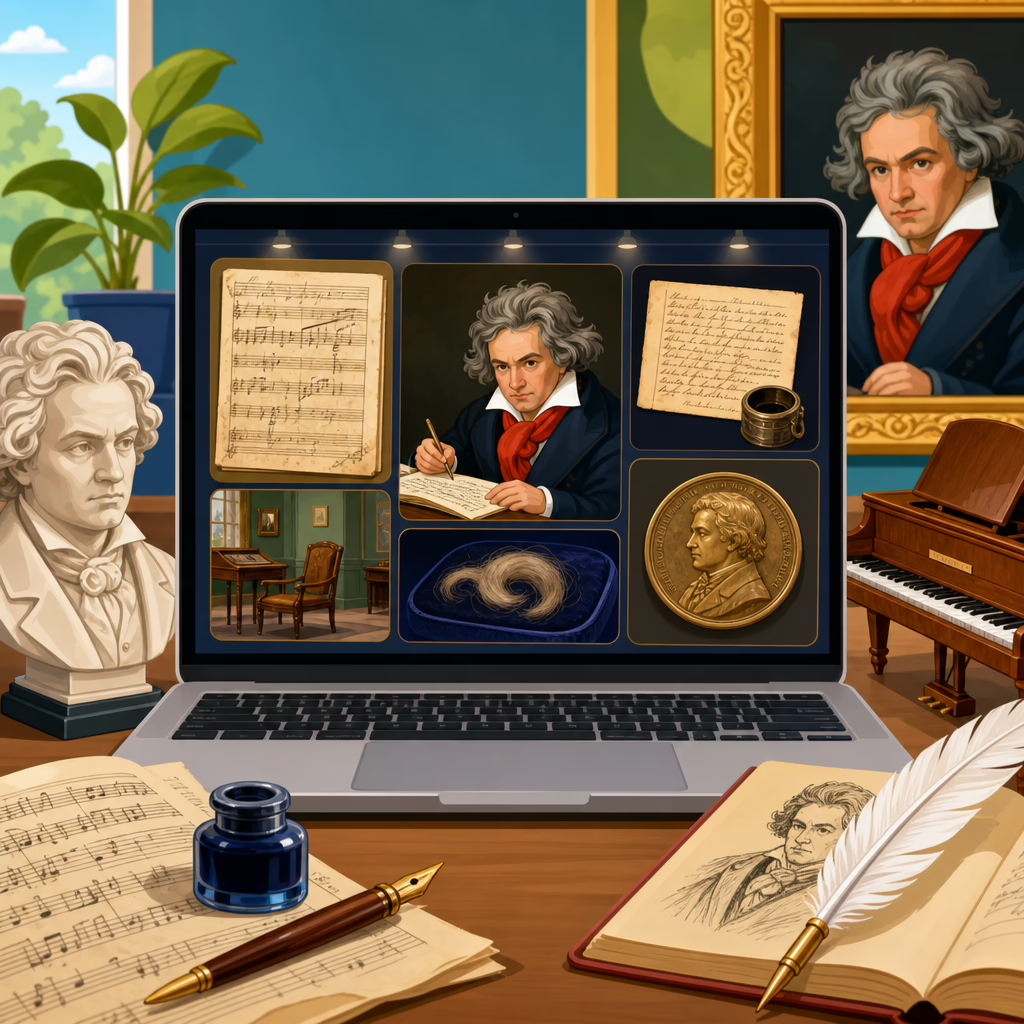
Online Photo Exhibits of Beethoven Artifacts and Memorabilia
Online photo exhibits of Beethoven artifacts and memorabilia have changed how scholars, performers, collectors, and curious listeners encounter the composer’s material legacy. Instead of relying on a single museum visit or a printed catalog, readers can now study autograph manuscripts, hearing devices, portraits, locks of hair, concert programs, death masks, household objects, and commemorative editions through searchable digital collections. In practice, these online photo exhibits function as both public galleries and research tools: they preserve fragile items, expand access across borders, and connect isolated objects into a clearer picture of Beethoven’s life, work, and afterlife. For anyone exploring a multimedia gallery on Beethoven, the miscellaneous category matters because some of the most revealing evidence does not fit neatly into manuscripts, audio, or performance history alone.
When archivists use the term artifact, they usually mean a physical object directly connected to Beethoven’s life or creative process, such as a writing desk, conversation book, ear trumpet, or signed letter. Memorabilia is broader. It includes later objects created to remember, market, or interpret Beethoven: medals, postcards, busts, posters, first-edition title pages, commemorative stamps, and exhibition souvenirs. In my own work reviewing digital museum records, I have found that the line between the two can blur quickly. A lock of hair may be cataloged as a relic, a scientific specimen, or a memorial object depending on the institution. That ambiguity is exactly why a well-structured hub page is useful: visitors need context before they can evaluate what an image really shows and why it matters.
The best online photo exhibits do more than display attractive images. They answer practical questions immediately: Is the object authentic, attributed, or disputed? Which institution holds it? When was it photographed? Is the image color-corrected? Does the metadata include dimensions, provenance, previous owners, or conservation notes? Those details determine whether a digital image is merely illustrative or genuinely informative. They also help users move deeper into related multimedia gallery resources, such as manuscript image archives, museum collection portals, performance ephemera databases, and exhibition catalogs. As a hub for miscellaneous Beethoven material, this article maps the major object types, the institutions and standards that shape trustworthy exhibits, and the methods readers can use to interpret images carefully rather than passively scrolling past them.
What appears in online photo exhibits of Beethoven artifacts and memorabilia
A comprehensive online photo exhibit of Beethoven material usually mixes personal possessions, creative tools, commemorative objects, and documentary images. The most sought-after items are autograph leaves, annotated scores, and letters, but the miscellaneous category often reveals equally important evidence. Ear trumpets associated with Beethoven, for example, help visitors understand the practical reality of his hearing loss, though museums must distinguish between devices he certainly used and examples merely typical of the period. Conversation books occupy a special place because they are both objects and records of social interaction; images of their covers, bindings, and marginal wear communicate use patterns that transcriptions alone cannot capture.
Portraits and sculptural likenesses are another core category. Online exhibits frequently include paintings by Joseph Karl Stieler, engravings circulated during Beethoven’s lifetime, medallions, and later busts inspired by the life mask or death mask tradition. These images matter because they shaped the public image of Beethoven as much as the music did. A nineteenth-century engraved portrait reproduced on sheet music can tell a different story from an official painted likeness in a state collection. The same applies to household and personal objects. Spectacles, quill cases, furniture, and domestic items may seem minor beside a symphony manuscript, yet they bring scale and routine into view and help audiences imagine Beethoven as a working professional in specific rooms, cities, and social networks.
Commemorative memorabilia extends the timeline beyond 1827. Centenary exhibitions, festival posters, postcards from the Beethoven-Haus in Bonn, philatelic issues, and branded editions produced in 1927, 1970, or 2020 all reveal how each era refashioned Beethoven for its own purposes. I often advise readers not to dismiss these items as secondary. Later memorabilia can document changing politics of memory, nationalism, tourism, recording culture, and design history. A digital gallery that places an authentic autograph next to a mass-produced commemorative plate is not trivializing the composer; it is showing how cultural memory is manufactured, circulated, and monetized over time.
Where to find reliable collections and what makes them trustworthy
The strongest starting point is the Beethoven-Haus Bonn, which maintains one of the most important repositories of Beethoven documents and objects. Its digital offerings often combine collection records, high-quality photography, manuscript scans, and scholarly descriptions. Other significant institutions include the Austrian National Library, the Gesellschaft der Musikfreunde in Vienna, major university libraries, regional museums in Vienna and Bonn, and international platforms that aggregate cultural heritage records. Auction houses can also be useful when objects pass through the market, but their descriptions should be checked against museum catalogs and specialist scholarship because sale listings are written for buyers, not always for long-term historical precision.
Trustworthy online photo exhibits share several characteristics. First, they identify the holding institution and inventory number clearly. Second, they provide provenance, even if incomplete. Third, they separate verified facts from interpretation. Fourth, they include imaging details, rights statements, and, ideally, multiple views. Finally, they use recognized metadata frameworks or at least consistent fields for creator, date, material, dimensions, and object history. In practice, this means a user can trace an item from image to record to source institution without guessing. If a site shows a “Beethoven death mask” with no accession number, no collection history, and no note on casting date, caution is justified.
| Source type | What it does well | Main limitation | Best use |
|---|---|---|---|
| Museum collection portal | Stable metadata, institutional authority, conservation context | Coverage may be selective and images may be restricted | Authenticity checks and object history |
| Digital exhibition site | Narrative interpretation, thematic grouping, educational framing | Sometimes lighter metadata than the core catalog | Learning connections across objects |
| Library manuscript database | Detailed cataloging, pagination, high-resolution scans | Less focus on three-dimensional artifacts | Letters, sketches, conversation books, printed editions |
| Auction archive | Market history, provenance clues, professional photography | Descriptions can be promotional or incomplete | Tracking privately held memorabilia |
From experience, the safest method is triangulation. Start with a museum or library record, compare it with a published catalog or critical edition, and only then use secondary websites or collector pages. This three-step check catches common errors such as reversed dates, misidentified sitters in portraits, and assumptions that every ear trumpet shown online belonged personally to Beethoven. Reliable collections earn trust because they make verification possible.
How to read digital images of Beethoven objects like a researcher
Looking closely at online photo exhibits is a learned skill. A high-resolution image can reveal more than a label if you know what to examine. Begin with material evidence: paper type, watermark visibility, ink color, binding wear, cracking in varnish, metal corrosion, or tool marks. These details help distinguish original objects from later reproductions. For manuscripts and letters, inspect edges, folds, and pasted repairs; they often indicate circulation and use. For portraits, compare costume, inscription, and publication line to determine whether you are seeing a lifetime likeness, a later engraving after an earlier painting, or a twentieth-century reproduction of a famous image.
Scale is just as important. Many digital exhibits fail to communicate size unless dimensions are listed or a ruler appears in one image. A pocket notebook, lock pendant, or seal stamp can look monumental on a screen. Serious users should always read dimensions before drawing conclusions about function. Likewise, color online is interpretive. Lighting, white balance, and monitor settings affect how varnish, paper tone, and staining appear. Conservation photography may intentionally emphasize damage, while promotional photography may smooth it out. Neither is dishonest if disclosed, but each serves a different purpose.
Contextual reading matters most with memorabilia. Ask who made the object, for whom, and why. A medal issued for a Beethoven anniversary is not evidence about Beethoven’s daily life; it is evidence about commemoration at a later date. A souvenir bust sold near a museum says something about heritage tourism and public demand. A modern facsimile score may be visually based on an autograph but remains a modern educational product. When online exhibits explain these distinctions directly, they help users avoid the common mistake of treating every Beethoven-related image as equally primary. The value of a miscellaneous gallery lies precisely in showing that different object types answer different historical questions.
Key artifact categories that reward close attention
Several categories deserve special emphasis because they repeatedly attract interest and misunderstanding. Hearing-related objects come first. Ear trumpets linked to Beethoven are famous, yet attribution is complicated. Some devices survive with stronger documentary ties than others, and museums sometimes display representative examples from the early nineteenth century alongside attributed originals. The educational value remains high, but labels must be read carefully. These items illuminate the mechanics of assisted hearing before electronic amplification and make Beethoven’s social adaptations more concrete than biographical summaries can.
Conversation books are another essential category. After Beethoven’s hearing declined significantly, visitors often wrote their side of conversations while he replied aloud or occasionally in writing. Online images of these books show not only text but also paper quality, page sequence, handling marks, and the density of interaction. Scholars use them to reconstruct networks, daily business, and the circumstances around late works. They are not transparent transcripts of every exchange, yet as photographed objects they bridge manuscript culture and lived routine in a way few artifacts can.
Hair relics, death masks, and life masks occupy a more contested territory. They are culturally powerful because they suggest physical proximity to Beethoven himself, but they require rigorous provenance review. The widely discussed scientific testing of a lock once believed to be Beethoven’s demonstrated how unstable older attributions can be. This is a useful lesson for digital exhibitions: spectacular objects need the most careful explanation. Even when authenticity is uncertain, the object may still be historically meaningful as evidence of nineteenth-century relic culture, collecting habits, and the desire for tangible contact with genius.
Printed ephemera rounds out the category. Concert announcements, subscription notices, title pages, memorial programs, and exhibition leaflets may not seem glamorous, yet they often answer practical questions faster than famous relics do. They show dates, venues, sponsors, pricing, and intended audiences. In online photo exhibits, these items also reveal typography, paper economy, and marketing language, making them especially useful for readers tracing Beethoven’s reception history across different places and periods.
Why miscellaneous memorabilia strengthens a multimedia gallery hub
A sub-pillar hub succeeds when it connects scattered interests into a navigable system, and miscellaneous Beethoven artifacts do exactly that. They link visual culture to biography, material history to musicology, and museum objects to broader digital humanities workflows. A user who arrives looking for a portrait may also need manuscript sources, timeline context, or audio related to a specific work. A visitor interested in hearing devices may benefit from internal paths to articles on deafness history, instrument technology, or late-style composition. Because miscellaneous objects cross categories naturally, they create strong pathways throughout a multimedia gallery.
This hub role is especially important for search intent. Readers often begin with broad questions: What Beethoven items survive? Where can I see Beethoven’s belongings online? Are Beethoven relics authentic? What is in the Beethoven-Haus digital collection? A well-built article answers those questions directly while also guiding users toward narrower resources on letters, portraits, exhibitions, and archives. In editorial practice, I have seen miscellaneous collection pages outperform narrower articles because they satisfy both introductory curiosity and advanced comparison needs. They also support educators who need one reliable overview before assigning deeper research.
The broader benefit is preservation awareness. Digital photo exhibits reduce handling of fragile artifacts and open collections to users who cannot travel to Bonn, Vienna, Berlin, London, or New York. They also create a durable public record when objects move through private hands. Not every image will be high resolution, and not every collection is open access, but the cumulative effect is substantial: Beethoven’s material world becomes less dependent on geography, privilege, and institutional gatekeeping. For a multimedia gallery, that expanded access is not just convenient; it is mission-critical.
Online photo exhibits of Beethoven artifacts and memorabilia are most valuable when they combine visual richness with catalog-level precision. The strongest collections identify objects clearly, explain provenance honestly, distinguish original artifacts from later memorabilia, and supply enough metadata for independent verification. For readers, the key is to treat each image as evidence with a specific historical function, not as interchangeable decoration. Ear trumpets, conversation books, portraits, hair relics, programs, medals, and souvenir objects all belong in the story, but each answers a different question about Beethoven’s life, reception, and legacy.
As the miscellaneous hub within a multimedia gallery, this topic does important connective work. It helps newcomers understand what survives, where to find it, and how to judge digital exhibits responsibly. It also gives advanced users a framework for moving between museum portals, library databases, exhibition sites, and market archives without losing sight of authenticity and context. That balance between access and rigor is what makes online Beethoven collections useful rather than merely attractive.
If you are building your own research list or planning related content, start with one authoritative institutional collection, compare records across at least two sources, and follow the object trail outward into portraits, printed ephemera, and commemorative material. That simple habit will turn a casual browse into informed discovery.
Frequently Asked Questions
What can people typically find in online photo exhibits of Beethoven artifacts and memorabilia?
Online photo exhibits of Beethoven artifacts and memorabilia usually bring together a wide range of objects that help readers understand both the composer’s creative work and his everyday life. A strong digital exhibit may include high-resolution images of autograph manuscripts, sketchbooks, annotated scores, first and early printed editions, letters, portraits, and concert programs. Many also feature personal items such as ear trumpets and other hearing devices, household objects, writing tools, spectacles, medals, locks of hair, death masks, and commemorative items produced after his death. Some collections extend even further, showing publication title pages, furniture, instruments associated with Beethoven or his circle, and objects tied to anniversaries and public remembrance.
What makes these exhibits especially valuable is not just the object list, but the way the material is presented. Instead of a brief caption in a printed catalog, users often get zoomable images, multiple viewing angles, curatorial notes, provenance information, dating, dimensions, conservation details, and links to related objects in the same collection. That means a scholar can compare paper types or handwriting features, a performer can study articulation marks in a manuscript, and a general listener can see how Beethoven was visually represented across different periods. In short, these exhibits turn scattered historical materials into a more accessible, searchable record of Beethoven’s material legacy.
Why are online photo exhibits important for Beethoven scholarship, performance, and public learning?
These digital exhibits matter because they remove many of the barriers that once limited access to rare historical objects. In the past, seeing an autograph score, an early portrait, or a personal belonging often required travel to a specific archive, museum, or library, along with appointments, permissions, and sometimes specialized institutional access. Online photo exhibits make much of that material available to scholars, performers, students, collectors, and curious readers anywhere in the world. That wider access helps democratize Beethoven research and allows more people to engage directly with primary sources rather than relying only on summaries, reproductions in books, or secondhand descriptions.
They are also important because they support different kinds of inquiry at once. Musicologists can trace revisions across manuscript pages, compare sources, and study how Beethoven’s works evolved. Performers can consult visual evidence that may affect interpretation, such as notation details, page layout, corrections, or historical publication practices. Historians and cultural researchers can examine how Beethoven’s image was constructed through portraits, memorial objects, and anniversary editions. Even casual visitors gain a richer sense of the composer as a historical person rather than an abstract genius. By combining images with metadata, essays, timelines, and cross-references, online exhibits function as educational tools, research platforms, and public history resources all at the same time.
How can viewers tell whether an online exhibit of Beethoven artifacts is trustworthy and academically useful?
A trustworthy online exhibit usually shows clear signs of professional curation and transparent documentation. The strongest indicators include the name of the holding institution, museum, archive, library, or recognized private foundation; detailed catalog records; specific object titles; approximate or exact dates; provenance or ownership history; accession numbers; and descriptions that explain what the item is and why it matters. High-quality exhibits often credit curators, conservators, photographers, and scholars, and they may include references to published research, exhibition history, or established Beethoven catalog systems. When an exhibit identifies whether an image is of an autograph manuscript, a copy, a later commemorative object, or an attributed portrait, that level of precision usually signals reliability.
It is also helpful to look for context rather than just attractive images. Academically useful exhibits do more than display memorabilia; they explain authenticity issues, restoration concerns, uncertain dating, and gaps in the historical record. Reputable collections will often distinguish between objects securely connected to Beethoven and those linked more loosely through tradition, family ownership, or later collecting culture. Search tools, stable object pages, citation guidance, and rights information are additional positive signs. If a site provides no institutional background, no descriptive metadata, and no explanation of where the object came from, it should be treated more cautiously. For serious research, the best approach is to use digital exhibits connected to established collections and, when possible, compare findings across multiple authoritative sources.
What are the benefits of viewing Beethoven memorabilia online instead of only in person?
Viewing Beethoven memorabilia online offers practical and intellectual advantages that go beyond convenience. The most obvious benefit is access: people who may never be able to visit Vienna, Bonn, Berlin, London, New York, or other major holding institutions can still study important materials from home. Digital exhibits are available across time zones and often allow repeated viewing, which is especially useful for close observation. A visitor in a museum may have only a few minutes in front of a manuscript behind glass, but an online user can zoom in, revisit the same page, compare related objects, and move back and forth between items at their own pace.
There are also advantages in terms of comparison and discovery. Online platforms make it easier to connect manuscripts with portraits, letters with publications, or personal objects with broader historical narratives. Search and filtering tools can reveal relationships that are difficult to see in a physical gallery organized around space limitations. In some cases, digital photography can capture details that are hard to observe in person, especially when interfaces offer magnification, color correction, or alternate views. That said, digital exhibits do not completely replace physical encounters. Scale, material texture, and three-dimensional presence are still best appreciated in person. But online access dramatically expands who can encounter these artifacts and how deeply they can study them, making Beethoven’s world more available than ever before.
How should readers use online Beethoven photo exhibits for research, teaching, or personal exploration?
The best way to use these exhibits depends on your goal, but a careful, source-aware approach works well in every case. For research, begin by identifying the object type and reading the full catalog entry rather than relying only on the image. Note the institution, date, provenance, object number, and any remarks about attribution, condition, or relation to other sources. If you are working with manuscripts or early editions, compare multiple items whenever possible and consult the exhibit alongside scholarly editions, thematic catalogs, and secondary literature. Digital exhibits are excellent starting points for source study, but they are most powerful when combined with broader historical and musicological research.
For teaching, online photo exhibits are especially effective because they make abstract topics concrete. Instructors can use portraits to discuss Beethoven’s public image, hearing devices to explore disability and biography, manuscript pages to demonstrate compositional revision, and commemorative objects to show how cultural memory is built over time. For personal exploration, the key is to move beyond famous icons and look at the full range of material culture surrounding Beethoven. A concert program, household item, or later memorial edition can be just as revealing as a celebrated manuscript. Whether the user is a specialist or a newcomer, these collections reward slow looking, comparison, and curiosity. They are not simply galleries of relics; they are windows into Beethoven’s creative process, daily life, historical reception, and enduring global significance.