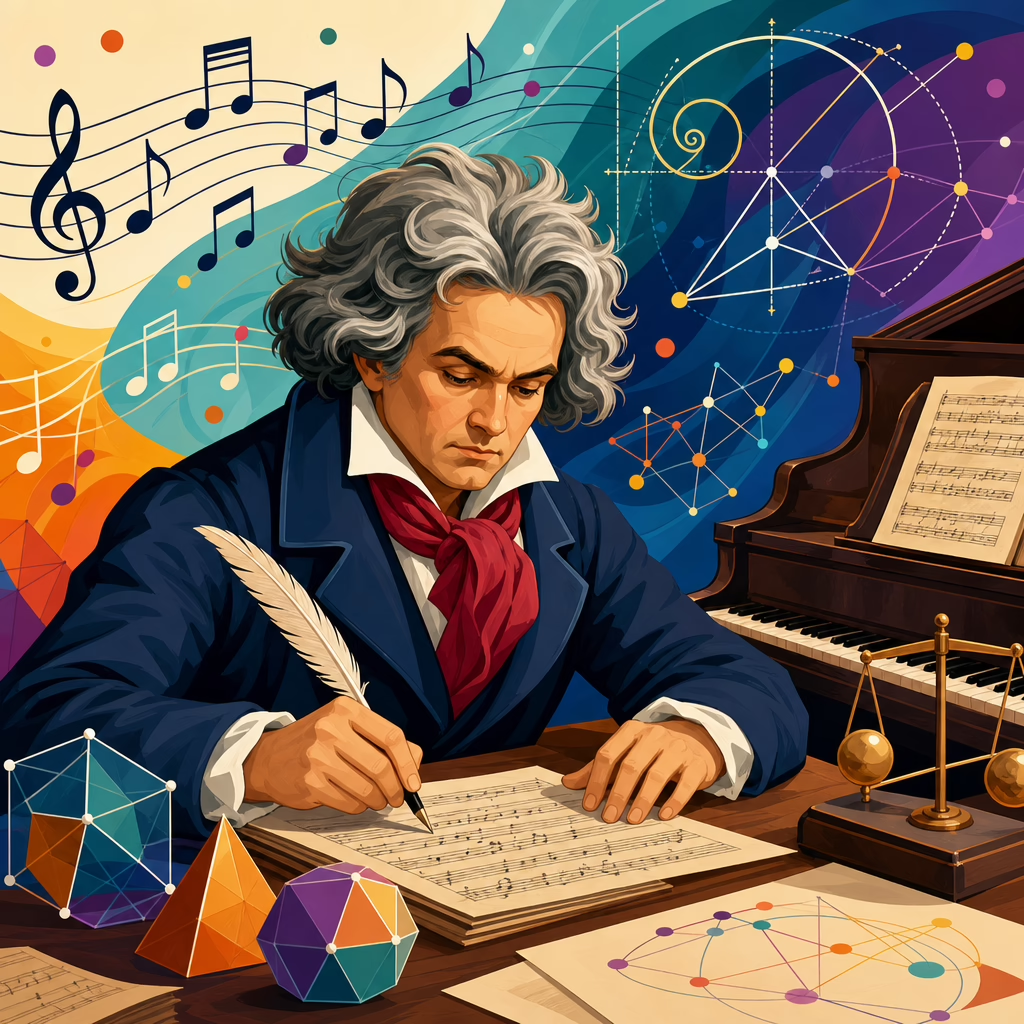
Music and Mathematics: The Logic Behind Beethoven’s Compositions
Music and mathematics meet with unusual clarity in Ludwig van Beethoven’s work, where rhythmic proportion, thematic development, and formal balance reveal a mind that thought structurally as well as emotionally. When people ask whether Beethoven “used math,” they usually mean something narrower than arithmetic: they are asking whether his compositions follow logical patterns that can be described, measured, and understood. The answer is yes, but with an important qualification. Beethoven did not write like a calculator. He wrote like a composer who understood that duration, symmetry, interval, repetition, contrast, and variation could be organized with near-architectural precision. That precision is one reason his music still feels inevitable two centuries later.
In practical terms, mathematics in music includes pulse, meter, ratio, proportion, permutation, and large-scale form. A measure divides time into countable units. A rhythm places notes into fractions of those units. Harmony depends on frequency relationships, even when a composer thinks primarily in terms of keys and chords rather than acoustic formulas. Form depends on recurrence and difference: a theme returns, expands, contracts, modulates, and resolves according to patterns listeners can sense even if they cannot name them. In Beethoven’s case, these patterns are unusually strong. Across the symphonies, piano sonatas, quartets, and chamber works, he repeatedly turns small motives into complete musical arguments through disciplined transformation.
This matters because Beethoven sits at the center of Western concert music. He inherited Classical balance from Haydn and Mozart, then pushed it toward the scale and intensity associated with the nineteenth century. Studying the logic behind Beethoven’s compositions helps listeners hear more than “great melodies.” It shows how the opening four-note idea of the Fifth Symphony can generate an entire movement, why the Eroica feels both expansive and coherent, and how late works create freedom without collapsing into disorder. For a hub page within Beethoven Technology & Science, this topic also connects naturally to acoustics, cognition, notation, instrument design, and analysis. It is the meeting point where art becomes measurable without losing its force.
From years of score study, rehearsal work, and comparative listening, I have found that Beethoven rewards both intuitive and analytical ears. Performers feel his balance physically in breath, bow, fingering, and phrasing. Analysts see it in motivic cells, phrase lengths, modulatory plans, and rhythmic compression. Listeners hear it as tension and release. The same passage can be described emotionally, technically, and mathematically at once. That multidimensional quality makes this subject ideal as a hub: it can guide readers toward articles on Beethoven and acoustics, Beethoven and hearing loss, Beethoven and instrument technology, Beethoven and pattern recognition, and Beethoven’s influence on modern music theory. To understand Beethoven’s logic is to understand how structure creates expressive power.
How Beethoven Turned Small Motives into Large Structures
Beethoven’s most famous compositional habit is motivic development, the process of taking a tiny idea and generating an extended work from it. In plain terms, a motive is a short, recognizable fragment: a rhythm, an interval pattern, or a compact melodic shape. Beethoven treats motives almost like variables in an equation. He repeats them, transposes them, fragments them, inverts them, stretches their rhythm, and relocates them in different harmonic settings. This is why many of his movements feel tightly argued. The material is not merely repeated; it is transformed according to discernible rules.
The opening of Symphony No. 5 in C minor, Op. 67, is the textbook example. The famous short-short-short-long rhythm is more than a dramatic gesture. It becomes the engine of the first movement, appearing in different voices, pitch levels, and harmonic contexts. Beethoven uses sequencing, fragmentation, and dynamic contrast to make a minimal unit carry maximum structural weight. Analysts have long noted that this economy gives the movement unusual coherence. Even transitions and accompaniments often seem related to the opening cell. Listeners may not consciously count these recurrences, but they perceive the result as unity.
The same logic appears in piano sonatas such as the “Appassionata,” Op. 57, and in string quartets where motivic consistency supports much more complex harmonic travel. Beethoven frequently compresses the distance between theme and development. Instead of presenting a complete melody and only later “working it out,” he often embeds developmental pressure in the theme itself. That approach is one reason his music can feel urgent from the first bar. The material already contains its own consequences. In scientific terms, the opening conditions strongly shape the whole system.
Rhythm, Meter, and Proportion in Beethoven’s Musical Architecture
Mathematical logic in Beethoven is not limited to pitch patterns. It is equally present in time. Rhythm is countable duration, and Beethoven understood that tiny alterations in timing could restructure an entire phrase. He plays with syncopation, offbeat accents, hemiola, sforzando placement, and silence to disrupt expectations without destroying meter. This balance between measurable order and strategic instability is one of his signatures.
Consider the first movement of the “Eroica” Symphony, No. 3 in E-flat major, Op. 55. Its large form feels expansive, yet its parts are governed by proportion. Themes are grouped into phrases that imply regularity, then Beethoven extends or truncates them. Cadences arrive late. Development sections expand far beyond what many earlier listeners expected. But the movement does not become shapeless. The return points, tonal pillars, and rhythmic profiles create a framework that allows asymmetry to make sense. In performance, these details are tangible. Conductors and ensemble players count through them rigorously because the drama depends on exact placement.
Beethoven’s scherzos also show sophisticated temporal logic. The Scherzo of the Ninth Symphony, Op. 125, uses obsessive rhythmic drive and fugal procedures to create momentum through repeated metric patterning. In the piano sonatas, especially middle-period works, he often creates tension by superimposing phrase logic over bar-line logic. A phrase may begin weakly, arrive forcefully across the measure, then rebound into silence. These are not decorative choices. They are compositional decisions that determine how listeners orient themselves in musical time.
| Work | Mathematical feature | How it functions | Plain-language effect |
|---|---|---|---|
| Symphony No. 5, first movement | Motivic compression | One rhythmic cell generates themes, transitions, and development | The movement feels unified and relentless |
| Symphony No. 3, first movement | Large-scale proportion | Expanded development balanced by strong tonal return points | The music feels vast but controlled |
| Piano Sonata Op. 57 | Rhythmic transformation | Short figures are stretched, fragmented, and redistributed | Tension grows from familiar material |
| String Quartet Op. 131 | Linked formal design | Seven movements connect without conventional breaks | Complexity feels continuous rather than episodic |
Harmony, Frequency, and the Science Beneath the Notes
Any discussion of music and mathematics must include acoustics. Beethoven did not compose with a modern oscilloscope, but he worked within a tonal system grounded in frequency relationships. Intervals such as the octave and fifth are perceived as stable partly because of simple numerical ratios in the harmonic series. By Beethoven’s lifetime, keyboard tuning practices had shifted toward well-tempered and increasingly equalized systems that allowed freer movement between keys. That technological and theoretical environment mattered. It let Beethoven exploit remote modulations and dramatic tonal contrasts with greater practical consistency.
His music often turns key relationships into structural arguments. In sonata form, the move from tonic to a contrasting key is not just a color change; it is a controlled redistribution of harmonic tension. The recapitulation solves that tension by returning material to the tonic. Beethoven intensifies this inherited model. He may prepare a key through dominant pressure, evade expected resolution, or pivot through enharmonic reinterpretation. To a listener, this feels like suspense and release. To an analyst, it is a system of tonal probabilities manipulated with extraordinary confidence.
The “Hammerklavier” Sonata, Op. 106, demonstrates this on a huge scale. Its harmonic plan is daring, but not arbitrary. Beethoven uses distant tonal regions to expand the expressive and cognitive range of the form. The late quartets go even further, often juxtaposing learned counterpoint with harmonic ambiguity that sounds startlingly modern. Yet even in these works, the writing is not random. Voice leading remains exact, motivic references persist, and cadence types still control perception. Acoustic principles, keyboard technology, and tonal syntax all support the sense that Beethoven’s boldness rests on an underlying logic.
Counterpoint, Variation, and Beethoven’s Rule-Bound Freedom
Another place where mathematical thinking becomes visible is counterpoint, the disciplined combination of simultaneous lines. Counterpoint is governed by explicit constraints involving interval treatment, motion types, dissonance control, and imitation. Beethoven studied these traditions seriously, especially in relation to Bach and Handel, and in his later years he integrated them into a highly personal style. This is where many readers discover that Beethoven’s “freedom” often depends on strict control.
The “Grosse Fuge,” Op. 133, is the clearest example. For many early audiences it sounded chaotic, but detailed analysis shows extraordinary rigor. Subjects are announced, answered, inverted, fragmented, and recombined. Rhythmic layers collide, yet they do so within a fiercely organized contrapuntal design. The result is difficult because Beethoven pushes every variable at once: register, articulation, meter, intervallic contour, and texture. Modern performers often describe the piece as a system that only becomes intelligible after painstaking structural work. Once understood, it feels less like disorder and more like compressed logic under pressure.
Variation form reveals a related skill. In the Diabelli Variations, Op. 120, Beethoven takes a modest waltz by Anton Diabelli and subjects it to a vast range of transformations. Some variations preserve contour; others isolate rhythm, bass line, or harmonic skeleton. This is close to mathematical mapping: identify the invariant features, then alter selected parameters one by one or in combination. The listener experiences surprise, but the surprise works because the original object remains traceable. Beethoven’s imagination is immense, yet it is tethered to clear procedures. That balance is central to his compositional logic.
What Modern Analysis, Performance, and Technology Reveal
Today, Beethoven’s mathematical side is easier to examine than ever. Digital scores in formats such as MusicXML, analytical software including Sonic Visualiser and Humdrum, and corpus-based musicology allow researchers to compare phrase lengths, rhythmic distributions, harmonic rhythm, and motivic recurrence across works. These tools do not replace musicianship, but they sharpen claims that were once based mainly on close reading. For example, computational studies can track how often a motive appears in altered form or show how Beethoven increases rhythmic density across a movement to intensify momentum.
Performance practice adds another layer. Metronome debates, especially around Beethoven’s often controversial markings, show how numerical instruction interacts with lived musical reality. Beethoven embraced Johann Nepomuk Maelzel’s metronome and supplied marks for many works, suggesting he cared about measurable tempo with unusual specificity. Yet performers know that tempo is not the whole story. Articulation, instrument response, hall acoustics, and phrase hierarchy affect perceived speed. A passage may be mathematically steady and still feel flexible. This is a useful corrective to simplistic claims that Beethoven composed by numbers.
As a hub for the miscellaneous branch of Beethoven Technology & Science, this topic points readers outward. Related articles should explore Beethoven and acoustics, the physics of piano sound in his era, hearing loss and auditory perception, manuscript studies, computational analysis of motives, and how modern recording technology changes our understanding of his textures. The central lesson remains consistent: Beethoven’s power comes from combining emotional immediacy with structural intelligence. The logic behind his compositions is real, audible, and measurable, but it never reduces the music to formulas.
Beethoven’s compositions prove that music and mathematics are not rivals but partners. Countable rhythm, proportional form, harmonic relation, contrapuntal constraint, and motivic transformation all shape the listening experience. What makes Beethoven exceptional is not merely that these elements exist in his work, but that he uses them to produce overwhelming expressive force. The Fifth Symphony turns a tiny cell into destiny. The Eroica balances unprecedented scale with coherence. The late quartets show that rigor and imagination can intensify each other rather than compete.
For readers exploring Beethoven Technology & Science, this hub offers the conceptual foundation for the wider subtopic. If you understand how Beethoven organizes time, pitch, and form, you can better understand his instruments, his notation, his acoustical world, and even the analytical tools scholars use today. His music rewards repeated listening because its logic is layered: immediate on the surface, deeper with study, and richer still in performance. That is why Beethoven remains central to conversations about creativity and structure.
The practical takeaway is simple. Listen actively, follow a score when possible, and compare how conductors or pianists shape the same passage. Notice repeated rhythms, phrase extensions, key changes, and returns. The more clearly you hear Beethoven’s architecture, the more vivid his emotion becomes. Explore the related articles in this sub-pillar hub to see how science, technology, and musical craft converge in one of history’s most influential composers.
Frequently Asked Questions
Did Beethoven actually use mathematics when composing music?
Yes, but not in the simplistic sense of sitting at a desk solving equations and then turning those calculations into melodies. When people ask whether Beethoven used mathematics, they are usually asking whether his music shows measurable order, proportion, pattern, and logic. In that sense, the answer is clearly yes. Beethoven worked with rhythm, meter, phrase length, harmonic pacing, motivic repetition, and large-scale form in ways that can be analyzed mathematically. His music often reveals carefully controlled relationships between small musical ideas and the larger architecture of an entire movement.
That said, it is important not to turn Beethoven into a cold technician. He was not composing “by formula.” Instead, he had an extraordinary ability to organize emotional expression through structure. A short rhythmic motive might be repeated, varied, expanded, compressed, displaced, or reinterpreted across a movement, creating a sense of inevitability that feels both dramatic and logical. This is where music and mathematics intersect in Beethoven: not as raw arithmetic, but as disciplined pattern-making. His work demonstrates that feeling and formal design are not opposites. In Beethoven, they are often inseparable.
How does Beethoven’s music show logical structure and proportion?
Beethoven’s music shows logical structure through the way its parts relate to one another across time. He often builds a movement from a very small amount of musical material, then develops that material with remarkable consistency. A motive introduced at the beginning may return in altered rhythm, different keys, new textures, or transformed harmonic settings. This creates coherence, because listeners hear that the piece is growing from a central idea rather than moving randomly from one theme to another.
Proportion also matters deeply in Beethoven’s writing. Musical sections are frequently balanced in ways that give the ear a sense of completion, tension, release, and return. Expositions, developments, recapitulations, and codas are not just labels from textbook form; in Beethoven’s hands, they become dramatic spaces with distinct functions. He controls the timing of climaxes, transitions, and thematic returns so that the entire movement feels shaped rather than merely assembled. Even when he surprises the listener, the surprise usually works because it interrupts an established pattern. That is a fundamentally logical way of composing. The result is music that feels emotionally powerful precisely because it is so strongly organized beneath the surface.
Is rhythm one of the main ways mathematics appears in Beethoven’s compositions?
Absolutely. Rhythm is one of the clearest areas where mathematical thinking becomes audible in Beethoven’s music. Rhythm involves measurable durations, repeated groupings, accents, patterns of tension and release, and relationships between pulse and phrase. Beethoven was a master at taking a simple rhythmic cell and making it drive an entire movement. The famous four-note opening of the Fifth Symphony is the best-known example, but it is far from the only one. A compact rhythmic figure can become the engine of form, character, and momentum.
What makes this mathematical is not merely that beats can be counted. It is that Beethoven manipulates rhythmic proportions with precision. He may delay an expected accent, extend a phrase beyond its normal balance, or intensify momentum through repeated subdivisions. He can make a passage feel stable by confirming the meter, or unstable by pushing against it. These choices are measurable, but they are also expressive. Beethoven understood that rhythmic order creates expectation, and expectation creates drama. In that sense, rhythm becomes both a numerical framework and a psychological tool. His music often feels so compelling because the listener is constantly responding to patterns that are exact enough to be felt physically, yet flexible enough to remain alive and unpredictable.
What does thematic development reveal about the connection between music and mathematics in Beethoven’s work?
Thematic development is one of the strongest arguments for the idea that Beethoven composed with a highly logical mind. Rather than relying only on long, self-contained melodies, he often begins with a compact musical idea and then subjects it to transformation. That idea can be sequenced, inverted, fragmented, transposed, rhythmically altered, harmonically recontextualized, or passed between instruments in different registers. Each transformation preserves some identity while changing the surface. This is very close to a mathematical way of thinking: a core object is defined, then explored through systematic variation.
In Beethoven’s music, thematic development is not decorative. It is structural. It helps unify entire movements by showing how seemingly different passages are related beneath the surface. This creates an impression of necessity, as though the music is discovering the consequences of its own opening material. Listeners may not consciously track every transformation, but they often feel the coherence. That feeling comes from pattern recognition. Beethoven’s genius lies in making development sound dramatic rather than academic. The logic is there, but it never feels merely mechanical. Instead, it feels like thought in motion—ideas tested, challenged, expanded, and resolved over time.
Does analyzing Beethoven mathematically reduce the emotional power of his music?
No, and in many cases it does the opposite. Careful analysis can deepen our appreciation of Beethoven’s emotional force by showing how expertly that force is constructed. The drama in his music does not arise in spite of structure; it often arises through structure. When a long-awaited return finally arrives, when a rhythmic pattern refuses to let go, or when a development section pushes instability to the breaking point, the emotional impact is stronger because Beethoven has shaped expectation so carefully. Understanding the logic behind those effects can make the experience more vivid, not less.
It is helpful to remember that mathematical description and artistic meaning are not competing explanations. One can describe a symphonic movement in terms of proportion, motivic transformation, tonal relationships, and formal balance, while also recognizing its urgency, struggle, grandeur, or tenderness. Beethoven’s achievement is that these dimensions reinforce one another. His music can be counted, mapped, and analyzed, but it also breathes, argues, surprises, and sings. The logic behind his compositions does not imprison expression. It gives expression a framework strong enough to carry extraordinary emotional weight. That is one reason Beethoven continues to fascinate both musicians and analysts: his works satisfy the intellect without ever losing their human intensity.