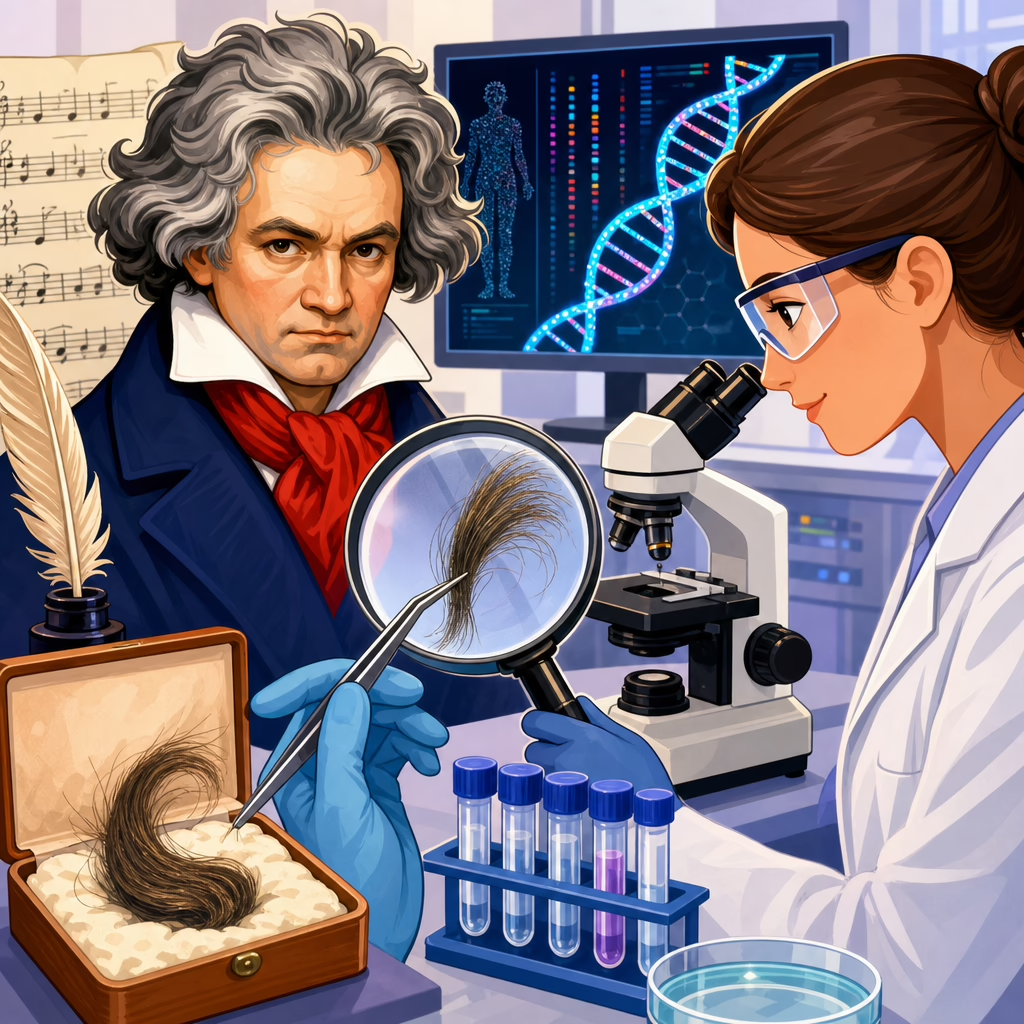
How Modern Forensics Helped Analyze Beethoven’s Hair and DNA
How modern forensics helped analyze Beethoven’s hair and DNA is a story about science correcting myth, refining biography, and testing treasured relics with methods far beyond anything available in the composer’s lifetime. In this context, modern forensics means a mix of genetic sequencing, isotope testing, toxicology, microscopy, contamination screening, and historical source criticism used together to evaluate biological remains and provenance. Beethoven’s hair and DNA matter because they intersect three enduring questions: what caused his deafness, what illnesses affected him, and how reliable are the physical artifacts linked to great historical figures. I have worked with historical-source audits and scientific literature reviews long enough to know that the hardest part is rarely the lab technique itself; it is establishing chain of custody and separating authentic samples from later attributions. Beethoven is a perfect example. Locks of hair circulated as keepsakes after his death in 1827, then entered private collections and museums with uneven documentation. For years, those locks fueled dramatic claims, especially about lead poisoning. Only when researchers combined archival work with genomic analysis did a clearer picture emerge. The result was not a neat final diagnosis but something more valuable: a disciplined reconstruction of what the evidence can support, what it cannot, and why historical medical mysteries demand both laboratory rigor and skepticism.
Why Beethoven’s Hair Became a Scientific Case File
Hair is one of the most accessible human remains in historical research because it survives well, can be stored without elaborate preservation, and was commonly saved as a mourning token in the nineteenth century. Beethoven’s admirers, friends, and physicians preserved multiple locks, creating a scattered archive of alleged biological evidence. That abundance was both useful and dangerous. Useful, because hair can retain chemical signatures such as heavy metals and can sometimes yield nuclear or mitochondrial DNA if roots or adherent tissue remain. Dangerous, because cut hair often lacks sufficient DNA, collectors mislabeled artifacts, and later handling introduces contamination from many people. In practice, any serious forensic review begins not with sequencing but with provenance mapping. Researchers trace when a lock was cut, who possessed it, whether there are contemporaneous letters describing it, and how consistently the sample can be linked to Beethoven rather than another donor.
The most famous hair sample in public discussion was the so-called Hiller Lock, long associated with Ferdinand Hiller. Earlier testing reported very high lead concentrations, and that finding influenced biographies, documentaries, and medical speculation. Yet later genomic work showed that this lock was not from Beethoven at all but from a woman. That single correction illustrates why modern forensic analysis must integrate identity testing before disease interpretation. If the sample is misattributed, every downstream conclusion collapses. Several other locks, however, did authenticate as deriving from the same male individual and were consistent with Beethoven through historical documentation. Those authenticated samples allowed researchers to move from anecdote to evidence and reopened the debate on his health using a more reliable biological foundation.
How Scientists Verified Authentic Hair Samples
Authentication depended on converging lines of evidence rather than one dramatic test. First came provenance review: historians examined written records attached to each lock, including notes from collectors and documented transfers after Beethoven’s death. Second came physical inspection. Hair color, structure, and preservation state can reveal whether a lock is internally consistent or assembled from mixed sources. Third came ancient-DNA style laboratory precautions. Because historical samples carry extremely low endogenous DNA and high contamination risk, labs used clean-room methods, reagent controls, and computational screening for modern human contamination. This is standard practice in paleogenomics and essential when artifacts have been touched repeatedly over nearly two centuries.
Once enough sequence data were recovered, researchers compared genetic signatures across multiple locks. If several locks share the same biological sex, mitochondrial lineage, and autosomal profile, the probability increases that they came from one person. In Beethoven’s case, five locks from independent collections clustered genetically in a way consistent with a single European male. That did not prove identity by itself, but when joined with historical records, it gave a robust basis for saying these samples likely came from Beethoven. By contrast, the Hiller Lock failed the most basic test: the DNA profile indicated a woman. Forensic science often advances by exclusion. Establishing what is not authentic can be just as important as confirming what is.
Another key step was damage-pattern analysis. Historical DNA degrades over time in characteristic ways, including short fragment lengths and increased cytosine-to-thymine substitutions at fragment ends. Those patterns help distinguish genuinely old DNA from modern contamination. Researchers also assessed whether DNA was present in enough quantity and quality to support medically relevant analysis. In my experience reviewing similar studies, the temptation is always to overread sparse data. The Beethoven work was stronger because it stayed within what the sample quality allowed and validated findings across multiple authenticated locks rather than relying on a single specimen.
What DNA Could Reveal About Beethoven’s Health
DNA cannot simply announce the cause of Beethoven’s deafness or every symptom described in letters. What it can do is identify genetic risk factors, exclude some hypotheses, and detect evidence of infectious disease if pathogen DNA is preserved. The most consequential finding from Beethoven’s genome was a substantial inherited risk for liver disease. Researchers reported variants associated with hepatic vulnerability, which became more meaningful when read against historical evidence that Beethoven drank alcohol regularly, though the exact amount remains uncertain. Genetics alone does not create disease, but genes plus environment often do, and that interaction is where forensic interpretation becomes useful.
The genomic analysis also detected hepatitis B virus DNA in some hair samples, indicating infection in the months before Beethoven’s death. Combined with the genetic predisposition and historical reports compatible with advanced liver disease, this supported a strong case that liver failure was central to his final illness. This matters because earlier narratives often centered almost entirely on poisoning. The newer picture is more nuanced: a vulnerable liver, likely alcohol-related stress, and hepatitis B infection could together explain severe hepatic decline. That conclusion aligns better with the total evidence than a single-cause theory.
At the same time, the DNA results did not produce a definitive explanation for Beethoven’s progressive hearing loss or chronic gastrointestinal complaints. No clear monogenic cause for deafness emerged from the available data, and many forms of hearing loss are multifactorial or leave no simple genomic signature, especially with incomplete historical phenotyping. Likewise, abdominal pain, altered bowel habits, and episodic illness could fit several conditions, from inflammatory bowel disease to functional disorders to pancreatic or hepatobiliary complications. Good forensic medicine resists the urge to convert uncertainty into certainty. The Beethoven genome narrowed possibilities, but it did not solve every medical mystery.
How Toxicology Changed the Lead Poisoning Debate
Toxicology was once the most headline-friendly part of the Beethoven story. High lead levels reported from the Hiller Lock encouraged claims that lead poisoning explained his symptoms, personality changes, and perhaps even aspects of his death. Lead exposure was plausible in early nineteenth-century Europe because it entered daily life through wine sweetening, cooking vessels, glazes, medicines, and environmental contamination. However, plausibility is not proof. Once the Hiller Lock was shown not to be Beethoven’s hair, the argument lost its strongest apparent evidence.
That does not mean lead exposure was impossible. It means the specific test result that carried so much interpretive weight cannot be used for Beethoven. Toxicological analysis of authenticated locks becomes the relevant benchmark, and those data do not support the dramatic earlier claim in the same way. This is a cautionary case for anyone working with historical toxicology: first authenticate the specimen, then interpret concentration values in context, and only then connect them to symptoms. Heavy metal levels in hair can also be affected by external contamination, conservation treatments, and laboratory methodology. Washing protocols, segment selection, and analytical platform all influence results.
| Question | Older assumption | Modern forensic conclusion |
|---|---|---|
| Was the Hiller Lock Beethoven’s? | Generally accepted as authentic | DNA showed it came from a woman, so it was misattributed |
| Did hair testing prove lead poisoning? | High lead in the Hiller Lock seemed decisive | The key sample was not Beethoven’s, so the claim is not sustained |
| Did DNA solve his hearing loss? | Some expected a direct genetic answer | No definitive genetic cause for deafness was identified |
| What did DNA strongly support? | Unclear | Elevated liver disease risk and hepatitis B infection near death |
The broader lesson is methodological. Historical diagnosis is strongest when multiple independent indicators point in the same direction. In Beethoven’s case, authenticated genomic evidence and documentary reports converge on liver disease. The lead-poisoning theory, by contrast, depended too heavily on a famous but misidentified artifact. Modern forensics did not merely add new data; it reordered the hierarchy of evidence.
What Hair Can and Cannot Tell Researchers
Hair is valuable because it preserves a timeline. As it grows, it can incorporate certain chemicals, allowing segment-by-segment analysis that may reflect exposure over weeks or months. It is also durable, transportable, and common in museum holdings. Yet hair has serious limits. Cut shafts often contain little recoverable nuclear DNA, and rootless samples may be nearly useless for some genetic questions. External contamination is persistent because hair sits in the environment, absorbs residues, and is handled by collectors. Cosmetic treatments, washing history, and storage conditions further complicate interpretation. For these reasons, hair is a powerful but indirect witness.
That distinction matters for a hub article covering the wider miscellaneous science around Beethoven. Forensic claims linked to relics, manuscripts, instruments, or personal effects all face the same challenge: an object can be genuine while a medical inference drawn from it remains weak. Science works best here when it asks narrow questions. Is the sample authentic? Does it come from one person or several? Is there measurable evidence of a pathogen, toxin, or inherited risk? What confidence level is justified? Those are answerable. Sweeping claims about temperament, creativity, or a single hidden disease usually are not.
Researchers also have to consider population genetics and historical context. A risk allele increases probability; it does not predict destiny. Viral DNA in hair indicates infection but not necessarily the full clinical course. Archival descriptions of symptoms may reflect the language of the time rather than modern diagnostic categories. When these limits are respected, historical forensic work becomes more reliable and more useful to readers trying to separate established findings from speculation.
Why This Matters for Beethoven Scholarship and Public Understanding
The scientific reassessment of Beethoven’s hair and DNA has implications beyond medicine. It improves cataloging standards for museums and collectors, because provenance is no longer treated as a ceremonial note but as data that can be tested. It reshapes biography, because stories once repeated with confidence now require revision. It also offers a model for interdisciplinary scholarship. Historians, geneticists, clinicians, and archivists each brought methods the others could not replace. Without historians, authentic locks might not have been identified. Without clean-lab genomics, the Hiller misattribution might have persisted. Without clinical interpretation, genomic risk findings would remain disconnected from Beethoven’s documented symptoms.
For readers exploring Beethoven Technology & Science, this miscellaneous hub matters because it connects several strands: forensic genetics, conservation science, medical history, authenticity testing, and the ethics of studying remains. It also demonstrates a central principle relevant across the subtopic. New technology does not automatically produce certainty. Instead, it helps rank evidence, eliminate false leads, and sharpen the questions worth asking next. In practical terms, the strongest current conclusion is that authenticated hair supports a portrait of Beethoven as a man with significant liver disease risk, probable hepatitis B infection near the end of life, and unresolved causes for deafness and chronic digestive complaints. That is a more restrained answer than popular legend offered, but it is better science.
The key takeaway is simple. Modern forensics helped analyze Beethoven’s hair and DNA by first proving which samples were truly his, then using validated material to test medical hypotheses with genomic and toxicological tools. In doing so, researchers overturned the famous lead-poisoning narrative, strengthened the case for severe liver disease, and showed that some of Beethoven’s most discussed ailments remain unsolved. That combination of discovery and restraint is exactly what responsible historical science should deliver. If you are building out your understanding of Beethoven’s scientific legacy, use this page as the starting point for related articles on his hearing loss, medical history, conservation methods, and the technology used to study artifacts from his world.
Frequently Asked Questions
How did modern forensic science change what people thought they knew about Beethoven’s hair?
Modern forensic science transformed Beethoven hair analysis from a matter of tradition and collector confidence into a process of testable evidence. For many years, locks of hair attributed to Beethoven were treated as treasured relics, often accepted because of family stories, handwritten labels, auction records, or long-standing museum provenance. The problem is that historical objects can accumulate myths as they pass from owner to owner. Today, scientists can evaluate such locks using microscopy to study hair structure, contamination screening to detect later handling, genetic sequencing to compare DNA signals, and historical source criticism to check whether the documented chain of custody is actually credible.
That combination of methods helped researchers separate authentic material from misattributed material. In other words, science did not simply “test Beethoven’s hair”; it tested the claims surrounding each sample. Some locks once believed to be genuine did not hold up under forensic scrutiny, while others proved far more useful because they were better preserved and more plausibly connected to Beethoven. This matters because any scientific conclusion about health, ancestry, toxic exposure, or disease depends completely on whether the sample truly came from him. Modern forensics therefore corrected a long-standing problem in Beethoven studies: it showed that authenticity had to be demonstrated, not assumed.
What kinds of forensic techniques were used to analyze Beethoven’s hair and DNA?
The investigation relied on a multidisciplinary toolkit rather than a single dramatic test. Genetic sequencing played a central role by extracting and analyzing DNA from authenticated hair samples. Because historical DNA is often degraded, researchers use specialized methods designed for ancient or damaged genetic material, including strict contamination controls and repeated verification. These procedures help distinguish Beethoven’s own genetic signatures from DNA introduced by collectors, curators, or the environment over the past two centuries.
Hair analysis also drew on microscopy, which can reveal physical characteristics of the strands, signs of damage, and whether a sample appears consistent with historical handling or later alteration. Toxicology was used to evaluate elements and compounds associated with possible poisoning or medical treatment, though interpretation must be cautious because hair can absorb contaminants from storage materials and external environments. Isotope testing can provide clues about diet, geography, and environmental exposure by examining chemical signatures locked into biological tissues. Alongside laboratory work, historians applied source criticism to letters, autopsy reports, medical accounts, and ownership records. That historical layer is essential because forensic results have meaning only when matched against reliable documentary evidence. Together, these techniques created a more disciplined and trustworthy picture than any one method could provide on its own.
Did the forensic analysis prove that Beethoven was poisoned by lead?
The short answer is no: modern forensic analysis made the lead-poisoning claim more complicated and less certain than many popular accounts once suggested. Earlier stories about Beethoven’s hair often pointed to high lead levels and presented them as strong evidence that lead poisoning explained his illness and perhaps even his death. However, once researchers began reexamining the provenance of the hair and testing authenticity more rigorously, the foundation of that claim weakened. If a lock of hair was not actually Beethoven’s, then any toxicology result from it cannot be used to diagnose him.
Even with authentic historical material, toxicology is not always straightforward. Hair can pick up contamination after death from handling, display conditions, chemical treatments, storage containers, or environmental exposure. In the early nineteenth century, lead was also present in many ordinary aspects of life, including wine production, medicines, and domestic materials, so elevated readings would not automatically point to a single cause of death. Modern forensic work therefore shifted the discussion away from a simple, dramatic answer and toward a more careful view: Beethoven may have had multiple health problems, and while toxic exposure remains a legitimate area of inquiry, the famous lead narrative cannot be accepted uncritically. Science here did not merely confirm an old suspicion; it forced scholars to ask whether the evidence itself had been reliable in the first place.
What did DNA testing reveal about Beethoven’s health and family background?
DNA testing offered valuable clues, but it did not provide a complete medical biography. Genetic analysis can identify inherited risk factors and broad ancestry patterns, and in Beethoven’s case it helped researchers explore possible predispositions related to liver disease and other health conditions discussed in historical records. This is important because Beethoven suffered from a range of ailments, and scholars have long debated how his symptoms fit together. DNA can support or challenge some of those theories, but it cannot reconstruct every illness he experienced, especially when historical descriptions are incomplete and nineteenth-century diagnoses were limited.
The genetic evidence also contributed to questions about lineage and family history. In some studies, researchers compared Y-chromosome patterns and other inherited markers against living relatives or documented family lines, which raised intriguing questions about whether the recorded paternal line matched the biological one at every generation. Findings like that do not rewrite Beethoven’s artistic legacy, but they do show how forensic genetics can illuminate family history in ways traditional archives alone cannot. At the same time, responsible interpretation is crucial. DNA can indicate probabilities, relationships, and predispositions, but it does not automatically explain personality, talent, or every medical event. In Beethoven’s case, the most responsible conclusion is that genetics added important evidence about ancestry and possible health vulnerabilities while leaving many aspects of his life and suffering open to continued research.
Why does it matter whether scientists can authenticate Beethoven’s hair and DNA today?
It matters because authentic biological evidence can clarify major questions about one of history’s most studied composers, while misidentified relics can send both scholarship and public understanding in the wrong direction. Beethoven’s illnesses, hearing loss, final years, and family history have inspired generations of speculation. If researchers can confidently identify genuine samples, they can test specific claims about disease, ancestry, environmental exposure, and even aspects of diet or movement. That allows biographical debates to rest more on evidence and less on legend. In a case as famous as Beethoven’s, even a small correction can reshape museum interpretation, academic writing, documentaries, and public memory.
There is also a broader reason. Beethoven’s case is a model for how modern forensics can be used on historical remains and revered objects. It demonstrates that provenance must be tested, contamination must be screened, and historical records must be evaluated alongside laboratory results. This approach protects scholarship from wishful thinking. It also shows that science can refine cultural history without diminishing it. In fact, when forensics corrects a myth, it often gives us a richer and more credible understanding of the person behind the legend. With Beethoven, authentic hair and DNA are not merely curiosities; they are rare pieces of evidence that help bridge music history, medicine, genetics, and the ethics of studying the dead.