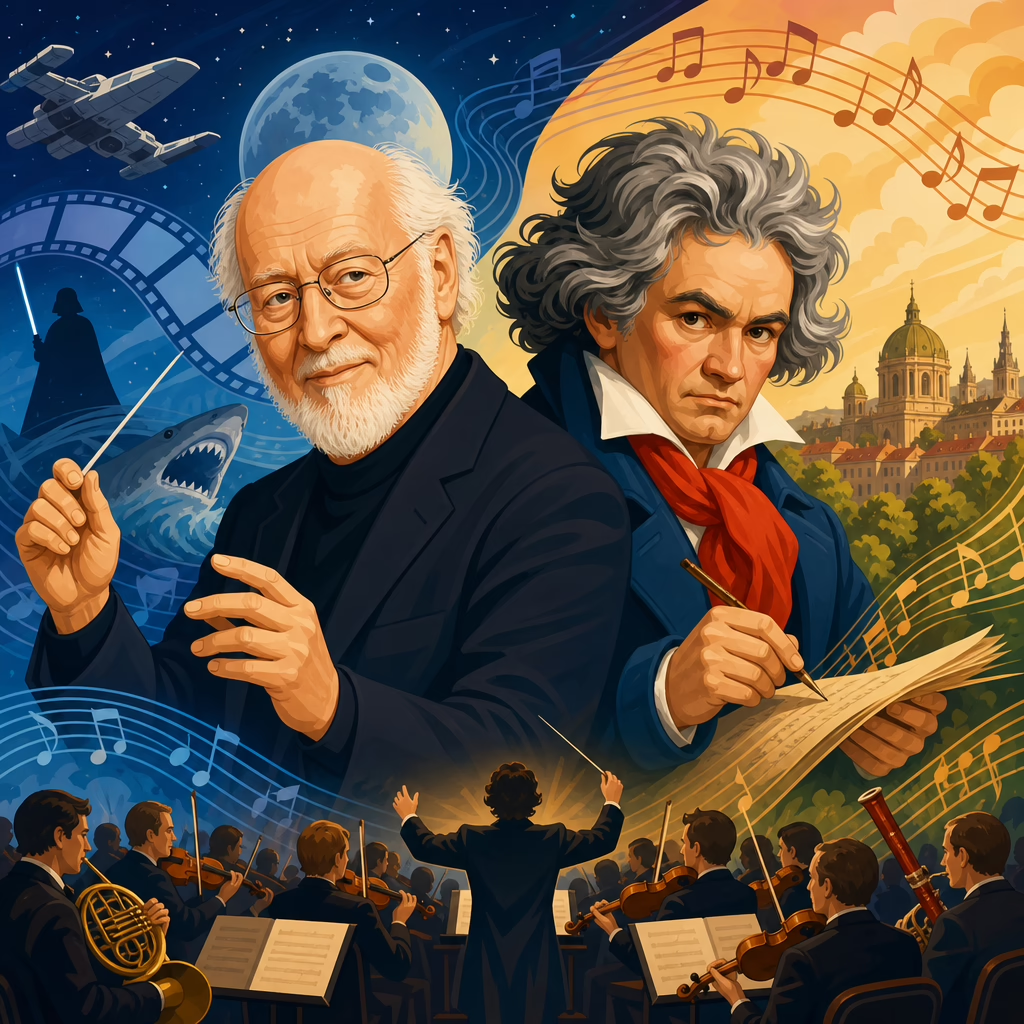
John Williams and Beethoven: Orchestral Links
John Williams and Beethoven are separated by two centuries, different patronage systems, and radically different media, yet their orchestral links are unusually concrete. This hub article examines how Beethoven’s methods echo through Williams’s film scores, where the connection is strongest, and why the comparison matters for listeners studying Beethoven’s influence on future generations. By orchestral links, I mean shared approaches to brass writing, motivic development, rhythmic drive, formal pacing, harmonic tension, and the dramatic use of the orchestra as a narrative engine rather than a decorative backdrop. Having worked with orchestral scores in both concert and screen contexts, I find this comparison useful because it moves beyond vague claims of influence and points to techniques you can hear, name, and trace across repertory. Beethoven expanded what an orchestra could say in public, emotional, and heroic terms. Williams inherited an orchestral tradition already shaped by Wagner, Strauss, Korngold, and Holst, but Beethoven remains a foundational presence underneath that lineage. Understanding these links helps listeners hear film music more historically and hear Beethoven more as a living force than a museum figure.
Why Beethoven Still Matters to John Williams’s Orchestral Language
Beethoven matters to John Williams because he helped define the modern idea of symphonic argument. In Beethoven, a small musical cell can generate an entire movement, rhythm can feel like destiny, and orchestral color can intensify structure instead of merely illustrating it. Williams applies those same principles when scoring character, conflict, and motion. The opening of the “Imperial March,” for example, is memorable not only because of its brass profile but because the motif is architecturally useful: it can be fragmented, sequenced, reharmonized, slowed, accelerated, and layered against counterlines. That is a Beethovenian way of thinking. The same is true of Williams’s handling of momentum in action cues, where rhythmic ostinatos and sharply profiled motives do structural work comparable to Beethoven’s developmental passages.
The comparison should not imply imitation. Williams’s language also reflects late Romantic harmony, Golden Age Hollywood orchestration, jazz fluency, and twentieth-century concert music. Still, Beethoven’s legacy enters at a deeper level: the orchestra as a field of conflict and resolution, the theme as a dramatic object that changes under pressure, and the brass section as a carrier of public rhetoric. These are not accidental similarities. They are part of the long orchestral inheritance that connects the concert hall and the cinema.
Shared Techniques: Motive, Rhythm, and Dramatic Form
The clearest link between Beethoven and Williams is motivic economy. Beethoven’s Fifth Symphony is the classic model: a short rhythmic idea generates large-scale coherence. Williams often works similarly, though with themes designed for immediate recognition on screen. In “Jaws,” the famous two-note figure functions almost like an elementary Beethovenian germ. In “Close Encounters of the Third Kind,” a simple pitch set becomes the basis for communication, escalation, and transformation. In “Star Wars,” leitmotifs are more expansive than Beethoven’s cells, yet Williams still treats them developmentally, adjusting instrumentation, interval emphasis, tempo, and harmony according to narrative context.
Rhythm is another major link. Beethoven’s rhythmic insistence gave symphonic music unprecedented propulsion. Williams uses comparable insistence in chase music, battle scenes, and ceremonial marches. Listen to the repeated-note figures, syncopated brass interjections, and sharply articulated string patterns in “Raiders of the Lost Ark” or “The Last Crusade.” These passages do not simply fill time under action; they organize tension the way Beethoven organizes tension in developmental writing. The audience feels direction because rhythm is functioning structurally.
Formal pacing also connects them. Beethoven taught later composers how to build expectation over spans larger than a tune. Williams excels at this in long-form cues where material is introduced, withheld, restated, and culminated. His concert pieces and extended suites reveal this even more clearly than the films themselves. The result is music that can survive outside the screen narrative because it possesses internal logic, not just visual synchronization.
Brass, Strings, and the Expanded Emotional Range of the Orchestra
Beethoven’s orchestral revolution was partly a matter of expressive range. He pushed brass beyond ceremonial punctuation toward thematic and structural prominence, intensified string writing through relentless rhythmic energy, and used dynamic contrast as drama. Williams inherits all three tendencies. His brass writing is famously brilliant, but its power lies in function, not loudness alone. Trumpets and horns often articulate identity, authority, or threat with a directness that recalls Beethoven’s public style. The horns in Williams’s heroic themes, from “Superman” to “E.T.,” occupy a lineage that runs through Beethoven’s symphonic horn calls and onward through nineteenth-century orchestral practice.
Strings provide another link. Beethoven often uses strings as engines of momentum, especially through tremolo, repeated patterns, and driving accompaniment figures. Williams deploys strings similarly in suspense and pursuit cues. Fast string ostinatos under brass declarations are a signature of his action writing, but the technique has classical roots. Woodwinds, meanwhile, shape contrast and humanity in both composers. Beethoven’s winds often clarify texture and introduce tonal light; Williams uses solo woodwinds for wonder, innocence, or lyrical relief, as in many passages from “Harry Potter” and “Memoirs of a Geisha.” The orchestra becomes a cast of characters, each section carrying dramatic meaning.
Direct Listening Points: Where the Similarities Are Most Audible
Listeners often ask where to begin. The most audible similarities appear when comparing types of gesture rather than searching for exact quotations. Beethoven’s Seventh Symphony, especially its rhythmic obsession and cumulative energy, offers a useful parallel to Williams’s action writing. Beethoven’s Eroica shows how heroic scale can be created through motivic insistence, brass emphasis, and formal expansion; those same values inform Williams’s adventure scores. Beethoven’s Fifth demonstrates how a hard-edged rhythm can unify large spans, a principle Williams repeatedly uses when a film needs musical inevitability.
For lyrical comparison, Beethoven’s slow movements are also relevant. Williams is not only a composer of fanfares. His ability to sustain noble cantabile lines over carefully controlled harmonic rhythm recalls the long-breath approach of Beethoven’s adagios, even when the harmonic language is more late Romantic. Think of Williams’s “Across the Stars” or “Princess Leia’s Theme.” These melodies are not Beethovenian on the surface, but their orchestral framing shows similar concern for balance between melodic clarity and structural support.
| Beethoven work or trait | Comparable John Williams example | What to listen for |
|---|---|---|
| Symphony No. 5 motivic concentration | “Jaws,” “Imperial March” | Short ideas generating tension across large spans |
| Symphony No. 7 rhythmic propulsion | “Raiders March” action cues | Pulse-driven momentum and cumulative energy |
| Eroica heroic scale | “Superman March,” “Star Wars” main title | Brass-led grandeur, public rhetoric, formal sweep |
| Dynamic contrast and orchestral drama | “Duel of the Fates,” “The Rebellion Is Reborn” | Sectional contrast used to narrate conflict |
The Historical Path Between Them: Not a Straight Line, but a Real One
The link from Beethoven to John Williams is historically mediated, not direct in a simplistic sense. Beethoven influenced Berlioz, Wagner, Brahms, Bruckner, Mahler, and Strauss, each of whom expanded orchestral thinking. Film music then absorbed late Romantic and early modern concert traditions through composers such as Max Steiner, Erich Wolfgang Korngold, Franz Waxman, and Miklós Rózsa. Williams studied and internalized that tradition deeply. When listeners hear Beethovenian energy in Williams, they are often hearing Beethoven filtered through this broader symphonic inheritance.
Korngold is especially important because his swashbuckling film scores translated Austro-German symphonic technique into cinematic storytelling. Yet Korngold himself stands in a post-Beethoven lineage. The same applies to Holst’s impact on Williams: even where “The Planets” feels like the closer stylistic reference, Holst’s control of orchestral masses and rhythmic insistence belongs to a world Beethoven helped make possible. Influence in music history is cumulative. Beethoven’s role is foundational because he altered expectations about scale, development, and expressive urgency, which later composers transmitted into the film-score tradition Williams inherited.
Important Differences That Keep the Comparison Honest
A strong comparison requires clear limits. Beethoven wrote primarily for autonomous concert performance, while Williams often writes to picture, timing, dialogue, editing, and franchise continuity. Beethoven’s thematic processes usually unfold without external narrative cues; Williams must synchronize musical events to plot and image. That affects form. A Beethoven movement can pursue argument for twenty minutes; a film cue may need to pivot in seconds. Williams is therefore more modular, more flexible in tempo changes, and more willing to juxtapose materials abruptly when the scene demands it.
Harmony also differs. Beethoven’s harmonic language is rooted in late Classical tonality stretched to its limits. Williams, though fundamentally tonal, often uses richer extended chords, pandiatonic collections, bitonality, chromatic mediants, and coloristic dissonance inherited from later composers. Orchestration differs too. Modern recording, larger orchestras, close miking, and post-production give Williams resources Beethoven never had. Even so, the underlying comparison remains valid because it concerns compositional thinking as much as sonority. Both composers know how to make orchestral material carry consequence.
How This Hub Connects the Wider “Miscellaneous” Subtopic
As a sub-pillar hub within Beethoven’s influence on future generations, this article sits in the “Miscellaneous” category because John Williams does not fit neatly into a single school, nation, or concert genre. The topic intersects film music history, orchestration studies, reception history, and listener education. From here, related articles can branch into Beethoven and cinematic heroism, Beethoven’s influence on blockbuster brass writing, Beethoven and leitmotivic storytelling, comparisons between Beethoven and Holst in Williams’s scores, and the role of symphonic development in modern franchise music. That breadth is useful because influence is rarely linear. It travels through pedagogy, repertory, conducting traditions, conservatory training, and repeated listening as much as through direct quotation.
For readers building a study path, start with Beethoven’s Third, Fifth, and Seventh Symphonies, then compare them with “Star Wars,” “Superman,” “Raiders of the Lost Ark,” and “Jaws.” If you read full scores, focus on brass deployment, string ostinatos, and the treatment of recurring motives in transitions and climaxes. If you are listening casually, track how both composers create anticipation before a major arrival. That single habit reveals a great deal about orchestral thinking across centuries.
John Williams and Beethoven are linked not by superficial resemblance but by durable orchestral principles. Both treat the orchestra as a dramatic system, not a neutral container for melodies. Both rely on memorable motives that can withstand repetition and transformation. Both understand that rhythm can create inevitability, that brass can project public meaning, and that large emotional effects come from disciplined structural control. The historical path between them runs through the nineteenth century, late Romanticism, and Hollywood’s symphonic tradition, but Beethoven remains one of the deepest sources beneath Williams’s sound world. Recognizing that lineage makes film music richer and Beethoven more immediate.
The main benefit of this comparison is practical listening. Once you hear how motive, pacing, contrast, and orchestral rhetoric function in both composers, familiar scores open up in new ways. You stop hearing “classical influence” as a vague compliment and start hearing precise craft choices. Use this hub as your starting point, then explore the related articles in this subtopic to follow Beethoven’s influence into film music, modern orchestration, and the broader afterlife of the symphonic tradition.
Frequently Asked Questions
How are John Williams and Beethoven actually connected at the orchestral level?
John Williams and Beethoven are connected less by direct imitation than by shared orchestral thinking. Even though Beethoven wrote for the concert hall and Williams writes primarily for film, both composers rely on clear thematic identities, strong motivic development, bold brass writing, and a powerful sense of rhythmic momentum. Beethoven’s symphonic method often begins with a compact idea that grows through repetition, variation, sequencing, fragmentation, and dramatic recontextualization. Williams uses that same basic principle in many of his best-known scores: a musical idea is introduced with clarity, then reshaped as the drama changes, rather than simply repeated as a static label.
The orchestral link is especially strong in the way both composers treat the orchestra as a dramatic engine rather than a decorative backdrop. Beethoven pushes instrumental families into dialogue, often using brass and timpani to intensify structure and emotional trajectory. Williams likewise uses brass not just for spectacle but for architecture, marking turning points, heroic assertions, or looming threat with carefully weighted orchestral color. In both composers, rhythm is not merely accompaniment; it creates forward motion and often becomes inseparable from the identity of the theme itself.
There is also a formal connection. Beethoven’s music is famous for directing listeners through tension, expansion, release, and return. Williams adapts this long-range sense of shape to cinematic storytelling. Even within cue-based film structure, he often builds music in a symphonic way, balancing contrast and continuity across scenes. That is why comparisons between the two are not superficial. The link is not “Williams sounds like Beethoven” in a simplistic sense, but rather that Williams inherits and modernizes Beethovenian habits of orchestral drama, especially in how small ideas generate large musical events.
Where is Beethoven’s influence strongest in John Williams’s music?
Beethoven’s influence is strongest in John Williams’s handling of motive, brass sonority, rhythmic insistence, and large-scale dramatic build. Williams is a highly eclectic composer with roots in late Romanticism, Golden Age Hollywood, jazz, and twentieth-century concert music, so Beethoven is only one part of a larger lineage. Still, when Williams constructs a cue or theme from a concise musical cell and then develops it across multiple dramatic situations, the Beethoven connection becomes especially clear. Beethoven’s legacy is not limited to melody; it lies in how a musical idea behaves over time. Williams often works the same way.
The brass writing is another major point of contact. Beethoven helped redefine the dramatic role of brass within the orchestra, making horns, trumpets, and timpani essential participants in structural climax and momentum. Williams extends that tradition in a modern symphonic-film context. His brass sections often articulate heroic profile, ceremonial grandeur, danger, or unstoppable energy with a precision that recalls the rhetorical power Beethoven brought to orchestral writing. Williams’s brass is not merely loud or colorful. It is directional, often carrying the dramatic argument of a cue.
The influence is also evident in rhythmic propulsion. Beethoven frequently drives movements with short rhythmic figures that accumulate force through insistence and transformation. Williams applies comparable techniques in action writing and in moments of mounting tension, where repeated rhythmic cells push the music forward while orchestration and harmony intensify. Finally, the connection appears in formal thinking. Even when composing in short cinematic spans, Williams often shapes musical material with the kind of developmental logic listeners associate with symphonic tradition. That is where Beethoven’s presence feels most substantial: not in surface resemblance alone, but in the deeper mechanics of musical storytelling.
Does John Williams use Beethoven-like motivic development, or are the similarities mostly stylistic?
John Williams absolutely uses Beethoven-like motivic development, and that is one of the most meaningful reasons the comparison matters. Many film composers write memorable themes, but not all of them develop those themes in a sustained, structurally significant way. Williams often does. Like Beethoven, he understands that a motive can serve as more than a recognizable tag; it can be the seed of an entire musical argument. A short interval, rhythm, or contour can be varied, displaced, expanded, darkened, fragmented, or orchestrated differently to reflect changing emotional and narrative conditions.
Beethoven’s music is often built from strikingly compact material. What makes it powerful is the way that material evolves under pressure. Williams frequently applies a similar process in film scoring. A theme may appear first in broad, confident form, then later return in reduced orchestration, altered harmony, or compressed rhythm to suggest uncertainty, memory, threat, or transformation. That is developmental thinking in a Beethovenian sense. The listener is not just hearing a tune recur; the listener is hearing the consequences of dramatic change registered inside the theme itself.
At the same time, the similarities are not purely technical. They are also expressive. Motivic development creates coherence, and coherence deepens emotional impact because it allows listeners to sense continuity beneath changing surfaces. Beethoven used that principle in symphonies and overtures; Williams uses it in franchise scoring and long-form cinematic storytelling. This is one reason his music often feels richer and more structurally satisfying than functional underscore. He writes themes that can live, struggle, adapt, and return, which places him in a line of composers for whom motive is the basis of drama, not just identification.
Why does the comparison between Beethoven and John Williams matter for listeners and students?
The comparison matters because it helps listeners hear Beethoven not as a remote historical monument but as a living force in modern orchestral language. For students especially, John Williams can serve as an accessible entry point into Beethovenian technique. Many people immediately recognize Williams’s command of theme, momentum, and orchestral impact. Once those qualities are identified in film music, it becomes easier to recognize similar processes in Beethoven: the shaping of tension through repetition, the development of compact motives, the strategic role of brass and timpani, and the architectural use of contrast and return.
This comparison also corrects a common misunderstanding about influence. Beethoven’s legacy is not just a matter of later composers borrowing a dramatic gesture or a heroic mood. His deeper influence lies in the idea that orchestral music can think dynamically, that themes can undergo conflict and transformation, and that instrumental color can reinforce structural drama. Williams demonstrates how those principles remain effective in a completely different medium. By studying the connection, listeners can better understand how the symphonic tradition adapts across centuries without losing its core disciplines.
For general audiences, the comparison enriches listening. It encourages a shift away from hearing film scores as background and toward hearing them as crafted orchestral works with lineage and logic. For music students, it offers a practical model for tracing continuity between concert music and media music. For Beethoven listeners, it reveals how foundational techniques survive outside the concert hall. And for Williams listeners, it shows why his music has such unusual durability: it is grounded in long-tested methods of thematic construction and orchestral drama that reach back to composers like Beethoven.
What specific orchestral traits do Beethoven and John Williams share in brass writing, rhythmic drive, and form?
In brass writing, both Beethoven and John Williams use the brass section for far more than occasional emphasis. Beethoven helped establish brass as a central source of ceremonial power, tension release, battlefield energy, and structural arrival. His horns and trumpets often crown climaxes, sharpen rhythmic attack, and project a public, almost architectural force. Williams inherits that conception and expands it with the resources of the modern orchestra. His brass writing is often noble, rhythmically precise, and dramatically strategic, whether signaling heroism, menace, triumph, or urgency. In both composers, brass frequently defines the profile of the musical moment.
In rhythmic drive, the similarity lies in propulsion through concise, repeatable figures. Beethoven is a master of turning a small rhythmic cell into an engine of momentum. He layers insistence, accent, sequence, and orchestral reinforcement until the entire movement feels animated by one concentrated impulse. Williams uses comparable methods in action cues and dramatic builds. Repeated ostinatos, sharply profiled rhythmic themes, and intensifying accompaniments generate momentum that feels cumulative rather than episodic. Even when the harmonic language differs, the effect can be strikingly related: rhythm becomes the carrier of dramatic necessity.
In form, both composers think in terms of directed motion. Beethoven’s music often unfolds through clearly articulated stages: statement, development, conflict, climax, and resolution. Williams adapts that logic to narrative timing. A film cue may be shorter or more flexible than a symphonic movement, but he often shapes it with a similar sense of trajectory. Themes are introduced purposefully, transitions are energized through development, and climaxes are prepared through texture, harmony, and orchestral scaling. This is why the phrase “orchestral links” is so useful here. The connection is not a vague resemblance. It is a set of concrete shared practices in how the orchestra is used to project drama, continuity, and emotional force.