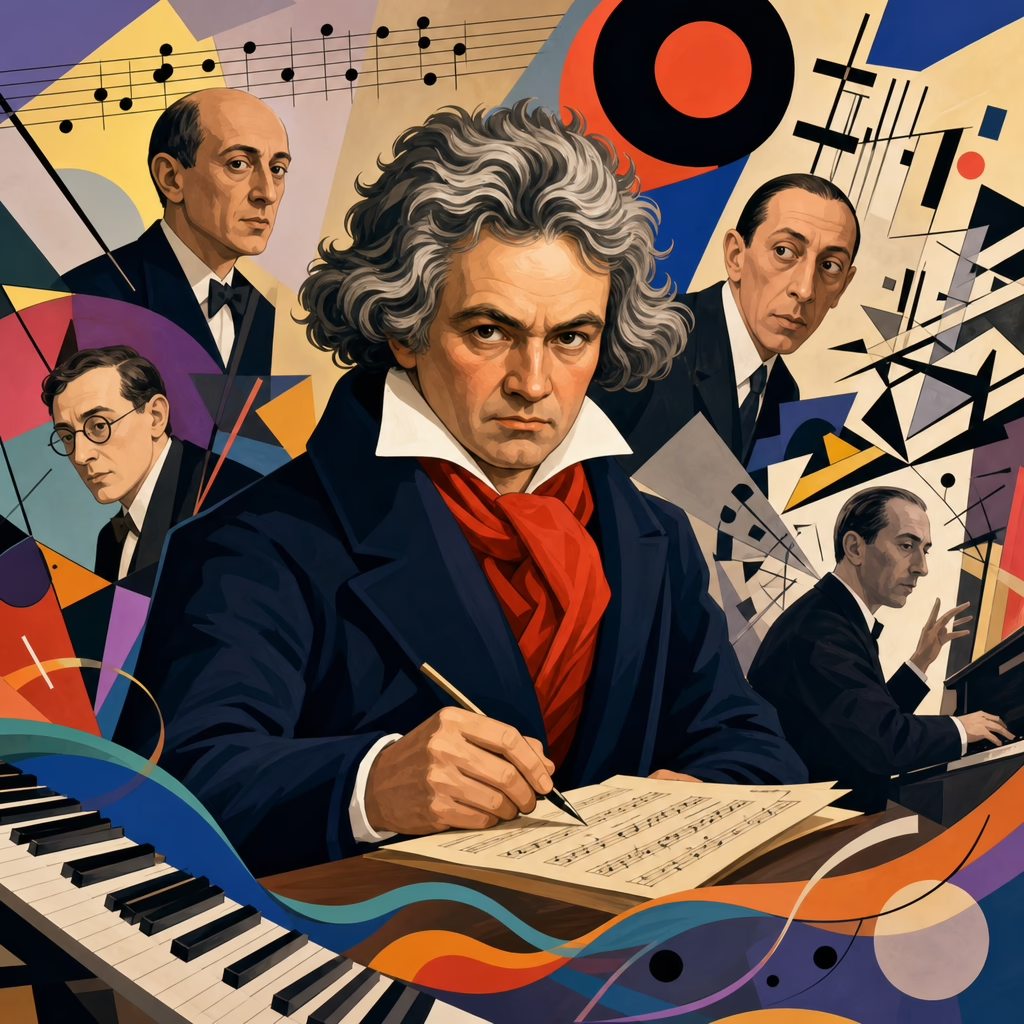
Beethoven’s Legacy in the 20th Century Avant-Garde
Beethoven’s legacy in the 20th century avant-garde is one of the most revealing stories in modern music history, because the composers who seemed most determined to escape the past kept returning to him as a model, opponent, and measuring stick. In this context, the avant-garde refers to composers and movements that pushed musical language beyond accepted norms through new systems of harmony, form, rhythm, texture, performance practice, and technology. Beethoven’s legacy means more than the continued performance of his symphonies and sonatas; it includes ideas about artistic autonomy, structural logic, expressive extremity, historical rupture, and the belief that a composition can redefine what music is allowed to do. I have worked through this repertoire in programming notes, score study, and performance preparation, and one pattern appears constantly: when 20th century innovators explain why they broke rules, they often describe Beethoven as the first great breaker of rules. That matters because the avant-garde did not emerge from a vacuum. It developed in dialogue with inherited concepts such as motivic development, organic form, heroic scale, late-style fragmentation, and the social prestige of the serious concert work. Understanding that dialogue helps listeners make sense of music that can otherwise sound forbidding. It also clarifies why Beethoven remained central even in circles devoted to atonality, total serialism, chance procedures, micro-intervals, political theater, and electronic sound. The result is a legacy that is not nostalgic but active: Beethoven became a usable force for composers who wanted to dismantle tradition while still claiming historical seriousness.
Beethoven as the blueprint for musical radicalism
The first and most important link between Beethoven and the avant-garde is the idea that innovation can carry ethical and historical weight. Beethoven expanded inherited Classical forms from Haydn and Mozart, but he also transformed them through unprecedented compression, expansion, and conflict. A tiny rhythmic cell, such as the famous opening of the Fifth Symphony, could generate an entire movement. A finale could become a philosophical destination rather than a polite conclusion. Dissonance could be structural rather than decorative. By the early 20th century, these habits made Beethoven look less like a monument of order and more like a composer of disruption. Arnold Schoenberg argued precisely this point when defending modern music: what appeared chaotic in new works often had a rigorous inner logic, and Beethoven stood as the classic proof that difficult music could later become canonical.
That argument was crucial for atonal and serial composers. Schoenberg’s notion of “developing variation,” though rooted in Brahms as well, depends heavily on Beethovenian continuity, where every event feels derived from prior material. Alban Berg’s Lyric Suite and Wozzeck show how compressed motives can govern large structures with Beethoven-like inevitability, even when tonality has dissolved. Anton Webern carried the principle further, creating miniatures in which every interval has formal responsibility. The surface changed radically, but the belief that a work should grow organically from concentrated material is a Beethovenian inheritance. In practical listening terms, this means that much avant-garde music rewards attention not to melody alone but to recurrence, transformation, and proportion.
The same blueprint appears in debates about the role of the composer. Beethoven helped establish the image of the composer as an autonomous creator rather than a court servant supplying elegant entertainment. That image became foundational for the 20th century avant-garde, whose leading figures often saw themselves as investigators, critics, and world-builders. Pierre Boulez, Luigi Nono, Karlheinz Stockhausen, and Elliott Carter differed sharply in style, yet each wrote with the assumption that a composition could intervene in musical history. That confidence descends directly from Beethoven’s example of the work as event, statement, and challenge.
Late Beethoven and the aesthetics of difficulty
If the middle-period symphonies modeled scale and struggle, the late works modeled estrangement, abstraction, and formal risk. The late string quartets, the Missa solemnis, the final piano sonatas, and the Diabelli Variations became especially important to avant-garde composers after 1900 because they seemed to anticipate modern discontinuity. Sudden contrasts, fugues that feel both archaic and futuristic, variations that interrogate tiny units of material, and passages of exposed inwardness all suggested that Beethoven had already exceeded conventional style from within. The common modernist claim that true art resists easy consumption found one of its strongest historical precedents here.
György Ligeti studied Beethoven’s late procedures carefully, especially the tension between strict construction and unstable surface. His own music, from the Second String Quartet to the Piano Etudes, does not imitate Beethoven directly, but it treats form as a field of transformation rather than a fixed template. Luciano Berio’s Sinfonia engages the past through quotation and fracture, a strategy that resonates with the layered historical consciousness listeners also hear in late Beethoven. Even when composers rejected Beethoven’s rhetoric, they were often attracted to his willingness to make works knotty, excessive, and unresolved.
The aesthetics of difficulty had institutional consequences too. Concert presenters, conservatories, and critics used Beethoven as a benchmark for serious listening. I have seen this repeatedly in program design: placing a new quartet next to Op. 131 or Op. 130 signals that complexity is not a flaw but a tradition. For audiences, that framing matters. It teaches that challenge belongs to the concert hall and that immediate transparency is not the only measure of value. The avant-garde inherited not just Beethoven’s techniques but also the permission to ask more of performers and listeners.
Formal innovation, fragmentation, and new continuity
One reason Beethoven’s legacy remained powerful across very different avant-garde movements is that he offered multiple models of form. He could intensify sonata form, suspend it, hybridize it, or undermine expectations from within. Twentieth-century composers seized on this flexibility. Carter’s large chamber works, for example, pursue continuity through character conflict and metric stratification rather than tonal cadence, yet their long-range dramatic planning is recognizably Beethovenian. Carter often treated instrumental groups almost as protagonists in argument, a principle listeners know from Beethoven’s quartets and symphonies.
At the same time, Beethoven’s late fragmentation encouraged composers interested in discontinuity. The abrupt sectional changes in works by Bernd Alois Zimmermann or the montage procedures of Berio can be heard as radicalized extensions of a Beethovenian willingness to let sharply distinct materials coexist inside a unified span. What changes in the 20th century is the degree of rupture. Instead of reconciling every contrast under tonality, avant-garde composers might preserve fracture as the point. Yet even that move remains linked to Beethoven, because he had already made instability central to form.
For performers and listeners, the practical lesson is simple: avant-garde form is rarely random. Whether the music is serial, post-tonal, spectral, or collage-based, it usually organizes time with exceptional discipline. Beethoven’s example trained generations to hear relationships across long distances. That listening habit makes new music more intelligible than it first seems.
| Beethovenian concept | 20th century avant-garde adaptation | Representative example |
|---|---|---|
| Motivic concentration | Serial cells and intervallic control | Webern, Symphony Op. 21 |
| Organic development | Developing variation in atonal forms | Schoenberg, String Quartet No. 4 |
| Late-style fragmentation | Collage, discontinuity, montage | Berio, Sinfonia |
| Heroic large-scale argument | Expanded modernist formal drama | Carter, Concerto for Orchestra |
| Counterpoint as expressive force | Post-tonal fugue and layered polyphony | Ligeti, Chamber Concerto |
Politics, humanism, and the burden of the masterpiece
Beethoven’s legacy in the 20th century avant-garde was never purely technical. It was also political and philosophical. The Ninth Symphony, with its chorus and Schiller’s “Ode to Joy,” became a charged symbol across ideologies: liberal humanism, revolutionary aspiration, European unity, and, at times, authoritarian appropriation. Avant-garde composers inherited both the promise and the burden of that symbolism. They asked whether large public art could still speak ethically after war, fascism, and genocide. Nono’s politically engaged works answer differently from Boulez’s high modernist abstractions, yet both exist in a world where Beethoven had already defined the concert work as a potential act of historical address.
This burden becomes especially clear after 1945. The devastation of World War II made inherited musical rhetoric suspect. Some composers felt that Beethovenian heroism had been compromised by nationalist misuse. Others believed that only uncompromising new language could rescue serious music from empty repetition. The Darmstadt generation is often described as anti-Romantic, but that description is incomplete. Their severity, systematic thinking, and insistence on renewal also resemble Beethoven’s own refusal to remain stylistically comfortable. In other words, even rejection could be a form of inheritance.
There is also a practical institutional dimension. Canonical Beethoven performances dominated orchestral programming, which gave avant-garde composers a target and a platform. Writing against the canon still meant writing in its shadow. Festivals, public broadcasters, and state-funded ensembles often justified support for new music by placing it in a lineage of great European art anchored by Beethoven. That is one reason his influence extends even into movements that denied influence outright.
Instruments, performance practice, and the avant-garde ear
Another underappreciated part of Beethoven’s legacy is how he changed the physical expectations placed on performers. His piano writing expanded the instrument’s expressive and technical horizon. His string quartets demanded a new level of ensemble precision, stamina, and interpretive depth. His symphonies required orchestral discipline capable of sustaining long-range architectural purpose. The avant-garde inherited this performance culture and then intensified it. Extended techniques, complex rhythms, unconventional notation, and electronics may seem far removed from Beethoven, but they depend on the same basic assumption: performers are collaborators in realizing difficult, consequential works.
As someone who has studied rehearsal processes for both Beethoven and postwar modernism, I find the continuity striking. In Beethoven, the challenge might be balancing sforzando accents inside a transparent texture or sustaining a fugue’s line through rapid registral shifts. In Carter, Ferneyhough, or Lachenmann, the challenge may involve nested tuplets, noise-based timbres, or instrumental actions not taught in basic conservatory training. Yet the rehearsal ethic is similar. Players must treat notation as precise thought, not approximate suggestion.
Lachenmann is especially relevant here. His “musique concrète instrumentale” reimagines instruments as sources of friction, breath, scrape, and pressure. On the surface this seems opposite to Beethoven. But the deeper connection lies in the expansion of what instrumental music can communicate. Beethoven taught later composers that the medium was not fixed. Lachenmann, Helmut Oehring, and others simply pursued that lesson into new sonic territory. For listeners, this means that unusual sounds in avant-garde music are rarely gimmicks; they function structurally and expressively, just as Beethoven’s once-shocking accents, extremes, and formal dislocations did in his own time.
Quotation, critique, and Beethoven in postmodern modernity
By the later 20th century, Beethoven no longer functioned only as an ancestor of formal rigor. He also became an object of quotation, critique, and reinterpretation. Mauricio Kagel’s Ludwig van, created for the Beethoven bicentenary in 1970, is a landmark example. Kagel surrounded Beethoven with irony, collage, and media satire, exposing how cultural institutions turn genius into merchandise and ritual. Yet the work’s satire proves Beethoven’s ongoing centrality. One does not parody a figure who has lost power.
Alfred Schnittke’s polystylism, Berio’s re-compositional practices, and Hans Zender’s interpretive transformations all show related impulses. Beethoven becomes material inside a broader discourse about memory, canon, and mediation. This postmodern turn did not cancel the avant-garde’s earlier seriousness; it complicated it. Composers could admire Beethoven’s structural genius while distrusting the museum culture built around him. They could cite him in fragments, distort him electronically, or juxtapose him with noise and speech in order to ask what historical continuity means in an age of recording, mass reproduction, and fractured identities.
For a hub within Beethoven’s influence on future generations, this is the key point: the 20th century avant-garde did not produce a single Beethoven. It produced many Beethovens. There is Beethoven the motivic architect, Beethoven the late visionary, Beethoven the humanist icon, Beethoven the institutional monument, Beethoven the political symbol, and Beethoven the object of critique. Each version generated different descendants across serialism, experimental music, political composition, new performance practice, and postmodern quotation.
Beethoven’s legacy in the 20th century avant-garde endures because it reaches deeper than style. He gave later composers a model of the artwork as inquiry, confrontation, and transformation, and that model survived even when tonality, form, and instrumentation changed beyond recognition. The most radical figures of the last century inherited his concentration of material, his expansion of form, his tolerance for difficulty, and his conviction that music can carry historical meaning. They also inherited the problems attached to greatness: canonization, ideological misuse, and the pressure to define oneself against an overwhelming predecessor. That tension is exactly why Beethoven remained relevant. He was never just a composer to preserve; he was a problem to solve. For readers exploring this Miscellaneous hub under Beethoven’s influence on future generations, the clearest takeaway is that avant-garde music makes more sense when heard as argument with Beethoven rather than escape from him. Follow that thread into Schoenberg, Webern, Carter, Ligeti, Nono, Lachenmann, Kagel, and Berio, and the century’s boldest music becomes more connected, more human, and far less mysterious. Continue through the related pages in this subtopic to trace each branch of that influence in detail.
Frequently Asked Questions
Why did 20th-century avant-garde composers keep returning to Beethoven if they wanted to break with tradition?
Because Beethoven represented the central problem and possibility of modern composition at the same time. For many avant-garde composers, he was not simply a historical master from the classical canon; he was the composer who had already made music feel like an arena of struggle, rupture, ambition, and formal transformation. Even those who wanted to move beyond tonality, inherited forms, and Romantic expressiveness recognized in Beethoven an artistic model of radical seriousness. He had pushed the resources of his own language to their limits, expanded the scale and dramatic force of instrumental music, and treated composition as a site of experiment rather than polite repetition. That made him uniquely relevant to 20th-century artists who defined themselves through innovation.
At the same time, Beethoven was also the figure many avant-garde movements needed to resist. To reject the past in any meaningful way, composers often had to confront the strongest embodiment of that past. Beethoven stood for structural coherence, developmental logic, heroic expression, and the ideal of the autonomous musical work. Composers working in serialism, chance music, electronic music, postwar modernism, and other avant-garde currents measured their own departures against those values. In other words, returning to Beethoven was often a way of asking: what must music abandon, preserve, or reinvent in order to remain historically serious after the collapse of older tonal and formal systems?
This is why Beethoven functioned as model, opponent, and measuring stick all at once. Arnold Schoenberg could claim descent from the German tradition even while transforming its harmonic basis. Anton Webern could distill motivic concentration to an extreme that many heard as a remote continuation of Beethovenian rigor. Pierre Boulez could criticize Beethoven’s legacy of monumental organic form while still responding to the authority Beethoven represented in European musical thought. Even radically different figures such as John Cage defined themselves partly by rejecting assumptions that Beethoven had helped canonize, especially the idea of music as a tightly controlled vehicle of intentional expression. The repeated return to Beethoven, then, was not nostalgic inconsistency. It was evidence that the avant-garde understood him as a foundational question in modern music: how can one be historically new in the shadow of the composer who had already made artistic revolution seem inseparable from tradition?
How did Beethoven’s approach to form influence avant-garde music in the 20th century?
Beethoven’s impact on form was profound because he changed how composers thought about musical structure. Before him, form could often be understood primarily as the orderly arrangement of established patterns. Beethoven did not discard those patterns, but he made form feel dynamic, conflict-driven, and developmental. Themes were no longer just presented and repeated; they were tested, fractured, recombined, and forced through dramatic processes. This idea that musical form could emerge through transformation rather than decorative sequence became one of his most durable legacies, especially for composers interested in constructing works with strong internal necessity.
In the 20th-century avant-garde, that legacy survived even when traditional tonal language disappeared. Schoenberg’s concept of developing variation, for instance, can be understood as an extension of Beethovenian thinking. Rather than relying on obvious repetition, the music generates coherence through continuous transformation of small motivic cells. This principle remained influential far beyond early modernism. Webern’s compressed works often seem worlds away from Beethoven stylistically, yet they preserve the idea that a piece can derive immense structural force from the unfolding of tightly organized relationships. Even in music that abandons classical proportions, one can hear Beethoven’s afterlife in the belief that form should be earned through process.
Postwar composers responded to this inheritance in multiple ways. Some intensified it. Total serialists sought highly integrated structures in which pitch, rhythm, dynamics, and articulation could all participate in formal design, creating a new kind of coherence after tonality. Others challenged Beethovenian teleology, the sense that music drives toward climactic resolution through directed development. Boulez, Karlheinz Stockhausen, and other avant-garde figures often preferred open, multi-directional, or discontinuous forms that disrupted the older narrative of conflict and triumph. Yet even these critiques remained deeply engaged with Beethoven’s example, because they were still debating the value of organic unity, continuity, and directed time.
The influence also extended to later experimental and postmodern practices. Some composers preserved the notion of rigorous construction while replacing tonal syntax with new systems. Others retained Beethoven’s seriousness about formal invention but treated form as collage, interruption, modularity, or spatial distribution. In each case, Beethoven’s legacy lay not in the survival of sonata form as a textbook template, but in the enduring idea that musical form is a central artistic problem. The avant-garde inherited from him a heightened sense that structure is never neutral: it expresses a worldview about order, conflict, continuity, and change.
Was Beethoven important to serialism and atonality, or was his influence mostly symbolic?
Beethoven was important in ways that were both symbolic and technical. Symbolically, he represented the highest authority of the German-Austrian tradition, so composers introducing atonality and serial procedures often invoked him to show that their innovations were not random destruction but part of a serious historical continuum. Schoenberg was especially explicit about this. He did not present twelve-tone composition as a rejection of the great tradition, but as a means of preserving the structural discipline and developmental integrity associated with composers such as Bach, Brahms, and Beethoven. In that framing, Beethoven became a legitimizing ancestor for music that many listeners initially experienced as radically unfamiliar.
Technically, Beethoven’s influence was anything but superficial. His music offered a powerful model of motivic economy, thematic transformation, and large-scale integration. These qualities mattered deeply to modernists searching for coherence beyond common-practice tonality. When tonal centers could no longer organize a piece in conventional ways, composers turned to intervallic relations, motivic cells, registral design, rhythmic patterning, and serial order as alternative means of control. Beethoven’s music had long demonstrated how a work could grow from minimal material through relentless development. That principle translated readily into modernist composition, even when the sonic results were dramatically different.
Schoenberg’s writings and music make this continuity particularly clear. His idea of developing variation extends Beethovenian logic into a new harmonic world, and many of his works aim for a level of structural concentration comparable to Beethoven’s. Webern, in turn, reduced musical material to an extraordinary degree, creating pieces in which every gesture carries structural weight. This can sound anti-Beethovenian on the surface because the scale is so compressed, but the underlying emphasis on maximum consequence from minimal material is closely related to a Beethovenian ideal of necessity. Alban Berg, meanwhile, often fused modernist language with expressive and formal gestures that openly recall the 19th-century tradition.
Even critics of serialism recognized this connection. The debate was never simply whether modernism had abandoned Beethoven, but whether it had preserved his deeper values in transformed form. For some, serialism continued Beethoven’s commitment to rigorous construction under new historical conditions. For others, it retained only the discipline while losing the immediacy, bodily energy, or rhetorical power associated with his music. Either way, Beethoven remained central. His presence in discussions of serialism and atonality shows that his legacy was not a ceremonial nod to the past; it was woven into the modernist struggle to redefine musical coherence itself.
How did avant-garde composers challenge Beethoven’s ideals rather than simply inherit them?
One of the most important aspects of Beethoven’s 20th-century legacy is that it includes active resistance. Avant-garde composers did not merely absorb his influence; many identified core Beethovenian assumptions and deliberately worked against them. Among the most contested were the ideals of organic unity, heroic subjectivity, developmental teleology, and the tightly bounded masterpiece shaped by a controlling composer. These values had become so central to European art music that challenging them often meant confronting Beethoven’s example directly, whether named or unnamed.
John Cage is one of the clearest cases. Cage objected to the notion that music must be organized as an expression of the composer’s will, moving purposefully through a structured dramatic arc. In place of Beethovenian intentionality, he explored chance operations, indeterminacy, non-hierarchical sound, and forms that do not culminate in traditional resolution. This was not simply iconoclasm for its own sake. Cage believed that the inherited model of musical control excluded other ways of hearing and being. By loosening or removing authorial domination, he challenged one of the deepest assumptions associated with the Beethoven-centered canon.
Postwar European modernists mounted different critiques. Boulez and Stockhausen questioned whether the old models of thematic development and large-scale tonal drama could still carry meaning after the social and historical ruptures of the 20th century. Rather than presenting music as an organic totality unfolding toward predetermined goals, they often favored fragmentation, multiplicity, serial distribution, timbral innovation, and nontraditional conceptions of time. Luigi Nono introduced political urgency and sonic experimentation in ways that complicated the idea of the self-contained autonomous artwork. Helmut Lachenmann later challenged inherited listening habits themselves, shifting attention from expressive themes and harmonic progression toward the physical production of sound and the resistance of instrumental material.
Yet these acts of opposition still confirm Beethoven’s significance. A composer does not become a target of critique unless he remains structurally important to the culture being questioned.