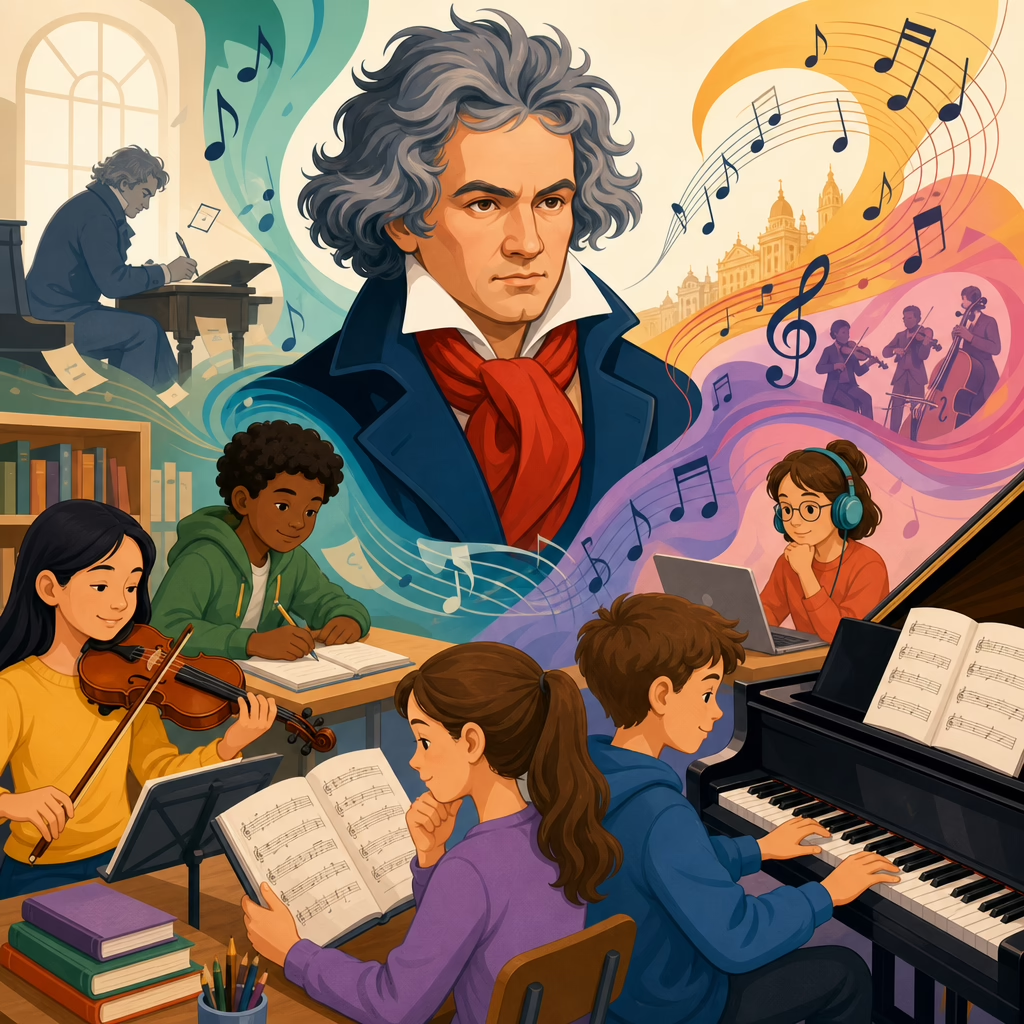
How Beethoven’s Compositions Shape Music Education Today
Beethoven’s music remains central to music education because his compositions unite technical discipline, historical change, emotional depth, and creative problem solving in ways few other composers can match. In conservatories, school ensembles, private studios, and university musicology departments, teachers still use his sonatas, symphonies, variations, quartets, and shorter works to train listening, interpretation, analysis, ensemble skills, and artistic independence. When educators ask why Beethoven matters today, the practical answer is simple: his works function as a complete curriculum. They teach rhythm, form, harmony, phrasing, touch, articulation, balance, structure, and cultural context while also forcing students to make meaningful interpretive decisions. That combination keeps Beethoven at the center of piano pedagogy, orchestral training, chamber music coaching, conducting study, theory instruction, and interdisciplinary arts education.
In teaching terms, Beethoven sits at a crucial bridge between Classical clarity and Romantic expansion. Students encounter sonata form in Haydn and Mozart, but with Beethoven they see how inherited structures can be stretched, dramatized, and reimagined. They also confront a composer whose life story raises enduring educational questions about resilience, hearing, disability, authorship, and artistic identity. I have seen young pianists understand phrase architecture for the first time through a Beethoven sonatina movement, and advanced conservatory players rethink everything about tempo flexibility after working on a late sonata. His music scales unusually well across levels. Beginners may meet simplified themes such as “Ode to Joy,” intermediate students tackle bagatelles and easier sonatas, and advanced musicians spend years inside the “Eroica,” the Razumovsky quartets, or Op. 111. Few composers provide that full educational ladder with equal authority.
This broad usefulness explains why Beethoven anchors a “Miscellaneous” hub within a larger discussion of influence on future generations. His impact is not confined to one classroom type or one repertoire stream. It reaches ear training labs, conducting seminars, composition workshops, school choir rehearsals, music technology projects, humanities courses, and public outreach programs. To understand how Beethoven’s compositions shape music education today, it is necessary to look beyond fame and examine what teachers actually do with the music: how they sequence pieces, what skills they target, which standards they connect to, and why students continue returning to this repertoire long after exams end.
Beethoven as a Foundation in Piano Study
Piano education is where Beethoven’s presence is most visible. Major graded systems, including ABRSM, Trinity College London, and Royal Conservatory repertoire pathways, regularly include Beethoven because his keyboard works develop control without allowing students to hide behind surface effect. Even short pieces expose timing, voicing, hand balance, and structural awareness. A student can play many Romantic miniatures persuasively with color and instinct, but a Beethoven movement immediately reveals whether rhythm is stable, ornaments are integrated, and cadences are understood. Teachers use this repertoire precisely because it tells the truth.
The sonatinas often assigned to late-intermediate players build essential habits: clear Alberti-style accompaniment, right-hand singing tone, basic sonata-form awareness, and clean articulation. Early sonatas such as Op. 14 or Op. 49 teach proportion and character contrast. The “Pathétique,” “Moonlight,” “Waldstein,” “Appassionata,” and late sonatas then mark increasingly advanced stages in technical and conceptual development. In lessons, Beethoven frequently becomes the turning point where students stop merely learning notes and start learning architecture. They identify exposition, development, and recapitulation; trace harmonic tension; plan climaxes; and connect fingering choices to long-line phrasing. That is why his keyboard writing remains a benchmark for juries, competitions, and recital programming.
Teachers also value Beethoven for interpretation training. His notation is more detailed than many Classical predecessors, yet still leaves room for judgment. Students must weigh urtext editions, pedal choices on modern instruments, metronome controversies, and the realities of historical pianos versus concert grands. This creates strong pedagogical conversations about informed freedom. In my experience, a studio that teaches Beethoven well also teaches students how to justify musical decisions with evidence rather than imitation.
How Beethoven Strengthens Theory, Analysis, and Listening Skills
Music theory classrooms return to Beethoven because his works make abstract concepts audible. Instead of discussing modulation or motivic development in isolation, instructors can point to famous, memorable passages and show exactly how those techniques create momentum. The opening four-note motive of Symphony No. 5 is an ideal example. Students hear a tiny rhythmic cell drive an entire movement, then track how repetition, fragmentation, sequence, and orchestration transform it. That direct link between concept and sound is invaluable in secondary school, undergraduate theory, and advanced analysis seminars.
Beethoven also clarifies form. Sonata form, variation form, scherzo and trio, rondo, fugato writing, cyclic relationships, and expanded codas become easier to teach when students can hear both standard patterns and purposeful deviations. In the “Eroica” Symphony, for example, the scale and harmonic boldness of the first movement demonstrate how a composer can inherit Classical procedures and enlarge them dramatically. In the Diabelli Variations, students observe how one simple waltz can generate radically different textures, characters, and compositional problems. In the late string quartets, they encounter formal experimentation that challenges neat textbook labels, which is itself educational because it shows that theory describes music after the fact rather than policing it in advance.
Aural skills benefit just as much. Beethoven sharpens interval recognition, cadential hearing, phrase prediction, and harmonic listening because the music is structurally explicit. Dictation teachers often use Beethoven themes because they are memorable but not simplistic. Conducting students learn to hear bass motion, offbeat accents, and inner-voice activity. Even nonmajors in general music appreciation courses tend to respond strongly when guided through a Beethoven listening map, since the contrasts are dramatic and the motives are easy to follow once pointed out.
Ensemble Training, Conducting, and Classroom Collaboration
Beethoven’s compositions are indispensable in ensemble education because they teach collective discipline. School orchestras and youth symphonies regularly program simplified arrangements or selected movements, while advanced conservatory ensembles study complete symphonies, overtures, and chamber works. The reason is not just prestige. Beethoven requires players to count accurately, listen laterally, balance texture, and understand long-range pacing. In rehearsal, conductors can address articulation consistency in Symphony No. 1, rhythmic propulsion in Symphony No. 7, brass and string coordination in Symphony No. 5, or sectional blend in the slow movements of the piano concertos. These are transferable ensemble skills, not composer-specific trivia.
Chamber music coaches rely on Beethoven for similar reasons. His violin sonatas, cello sonatas, piano trios, and quartets demand active dialogue rather than accompaniment thinking. Students learn that a secondary line may carry the structural argument, that rests are part of phrasing, and that balance changes measure by measure. The Razumovsky Quartets, for instance, are educational laboratories in score awareness. Every player must understand thematic ownership, rhythmic alignment, and harmonic function across the full texture.
| Educational setting | Common Beethoven repertoire | Core skills developed |
|---|---|---|
| Beginning piano | “Ode to Joy,” easy dances, selected bagatelles | Pulse, phrasing, legato, basic form |
| Intermediate studio study | Op. 49 sonatas, Sonatinas, easier variation sets | Articulation, voicing, sonata form, style |
| Advanced conservatory performance | “Appassionata,” Op. 109–111, concertos | Architecture, endurance, interpretation, tonal control |
| Youth orchestra and university ensemble | Symphonies Nos. 1, 5, 7, overtures | Rhythmic precision, balance, sectional listening |
| Chamber music coaching | String quartets, piano trios, violin sonatas | Dialogue, cueing, blend, structural awareness |
Conducting programs especially value Beethoven because his scores expose gesture quality. A vague beat pattern quickly produces muddy attacks or unstable tempo. Students must learn preparatory beats, rebound, subdivision, and left-hand cueing with precision. Beethoven thus becomes practical training in leadership, communication, and rehearsal efficiency.
Historical Understanding, Creativity, and Cross-Disciplinary Teaching
Modern music education increasingly asks students not only to perform but also to contextualize, create, and connect. Beethoven supports all three goals. Historically, his output helps teachers explain the transition from court-centered patronage to a more public concert culture and a stronger idea of the independent artist. Students studying nineteenth-century Europe can connect the “Eroica” to debates about heroism, politics, and Napoleon; the Ninth Symphony to changing concepts of universal brotherhood; and Beethoven’s deafness to questions about technology, adaptation, and identity. These are not decorative anecdotes. They help students understand how music circulates in society.
Composition and improvisation classes also draw from Beethoven in practical ways. His sketchbooks show revision as a disciplined process rather than a flash of genius, which is a powerful lesson for young composers. Teachers often ask students to build a movement from a short motive, vary a simple theme, or expand a cadence using Beethovenian models. This is especially effective because the musical materials are concrete. A composition student can examine how the first movement of Symphony No. 5 grows from a compact rhythmic idea, then try generating original material from a similarly limited cell. The lesson is that invention often comes from development, not from waiting for inspiration.
In general education settings, Beethoven remains useful because his music supports interdisciplinary projects. Literature classes compare ideals of the individual artist; philosophy courses discuss aesthetics and expression; disability studies examines the mythology and reality of Beethoven’s hearing loss; and digital humanities projects use scores, recordings, and manuscript archives from institutions such as the Beethoven-Haus Bonn. Music technology students can compare period-instrument recordings with modern orchestral performances using waveform, tempo, and spectrographic analysis. That kind of work helps explain why Beethoven still belongs in contemporary curricula rather than only in traditional recital culture.
Why Beethoven Still Matters for Diverse Learners and Modern Teaching
A fair question is whether Beethoven’s central position excludes other voices. Good music education should absolutely broaden the canon, and many programs now place Beethoven alongside composers from underrepresented traditions, living creators, jazz artists, film composers, and global repertories. Yet expanding the curriculum does not require removing Beethoven. It requires teaching him more thoughtfully. When educators present his music as one influential tradition among many, students gain both historical literacy and comparative perspective. They can examine how sonata strategies relate to later symphonic writing, how motivic development appears in film scoring, or how performance practice debates differ across genres.
Beethoven also adapts well to modern pedagogical tools. Digital score platforms such as Henle Library, nkoda, and IMSLP help students compare editions. Streaming archives make it easy to contrast recordings by Wilhelm Kempff, Alfred Brendel, Mitsuko Uchida, John Eliot Gardiner, Carlos Kleiber, and historically informed ensembles. In flipped classrooms, teachers assign listening guides before rehearsal; in lesson studios, they annotate phrase plans on tablets; in online teaching, they use Beethoven excerpts to demonstrate rhythm and structure because students often already recognize the themes. Familiarity lowers the entry barrier while the music’s depth sustains serious study.
The lasting educational power of Beethoven’s compositions lies in their unusual breadth. They train the hands, ears, intellect, and imagination at once. They reward beginners with memorable melodies and challenge experts with endless interpretive questions. They illuminate theory without reducing music to diagrams, and they humanize history without turning biography into myth. Most importantly, they teach students how to listen for structure and meaning together. That is the core habit strong music education aims to build.
For schools, private teachers, ensemble directors, and curriculum planners, the practical takeaway is clear: keep Beethoven in the program, but teach him actively, contextually, and in conversation with a wider musical world. Use the sonatas to build technique, the symphonies to train ensemble discipline, the quartets to sharpen listening, and the larger cultural story to deepen curiosity. A well-designed Beethoven pathway does more than preserve tradition. It equips future musicians and informed listeners with durable skills they will use across every style they encounter. If you are building a music curriculum or expanding this subtopic hub, start by mapping where Beethoven already appears and where his works can teach more intentionally.
Frequently Asked Questions
Why is Beethoven still so important in music education today?
Beethoven remains essential in music education because his works bring together nearly every skill serious music study is meant to develop. His music demands technical control, but it also asks students to think historically, listen deeply, shape long musical arguments, and communicate genuine emotional meaning. That combination is rare. A student can practice scales and fingerings in many composers, but Beethoven teaches how technique serves expression, structure, and artistic purpose at the same time.
Teachers continue returning to Beethoven because his catalog works across levels and settings. Early piano pieces, shorter bagatelles, and selected movements can introduce younger students to phrasing, articulation, balance, and form. At more advanced levels, the piano sonatas, string quartets, symphonies, and variation sets challenge students to manage large-scale architecture, harmonic tension, rhythmic drive, and interpretive responsibility. In ensemble settings, Beethoven helps students learn how individual lines contribute to a larger whole. In music history and theory classrooms, his music provides a clear lens for studying the transition from Classical ideals to Romantic expansion.
Just as important, Beethoven’s music teaches independence. His compositions often resist easy answers. Students must decide how to pace a crescendo, how to balance clarity with intensity, how to connect motives across a movement, or how to make dramatic contrasts feel inevitable rather than exaggerated. Those are not merely technical choices; they are artistic judgments. That is why Beethoven continues to shape music education today: his works do not just train performers to play correctly, but to think, listen, and interpret like mature musicians.
What specific musical skills do students develop by studying Beethoven’s compositions?
Studying Beethoven develops a wide range of practical and intellectual skills. On the technical side, performers learn precision in rhythm, control of articulation, dynamic range, voicing, stamina, coordination, and tonal balance. Pianists, for example, encounter everything from transparent Classical textures to thick, orchestral sonorities that require refined control of touch and pedaling. String players and wind players face similarly demanding challenges in bow distribution, breath planning, intonation, projection, and phrasing. Beethoven’s music rarely allows students to coast; it exposes weaknesses quickly and rewards disciplined, focused practice.
His works also sharpen listening and analytical ability. Beethoven often builds entire movements from small motives, so students learn to hear how short rhythmic or melodic ideas evolve across a piece. This strengthens pattern recognition, formal awareness, and understanding of harmonic direction. Instead of hearing music as a series of disconnected moments, students begin to hear relationships across phrases, sections, and movements. That is a major step in musical maturity. In ear training and theory, Beethoven’s music is especially valuable because it makes structure audible: cadences, sequences, modulations, developmental procedures, and formal transformations can all be studied in vivid, memorable contexts.
Another crucial area is expression and interpretation. Beethoven teaches students how to handle contrast without losing coherence. His music may move from intimacy to force, from stillness to propulsion, from elegance to defiance within a short span. To perform that convincingly, students must understand character, pacing, and dramatic timing. They also learn to make informed choices based on style, notation, historical practice, and the internal logic of the score. In this way, Beethoven helps develop not just competent players, but thoughtful musicians who can combine technique, listening, analysis, and expressive conviction.
How do Beethoven’s works help students understand music history and stylistic change?
Beethoven is central to music education partly because he stands at a turning point in Western music history. His works help students hear how the Classical style of Haydn and Mozart evolved into the broader emotional range, structural ambition, and expressive individuality associated with the Romantic era. In the classroom, this makes him incredibly useful. Rather than presenting stylistic change as an abstract timeline, educators can show it directly through Beethoven’s music: traditional forms remain present, but they are stretched, intensified, and reimagined in ways that opened new possibilities for later composers.
For example, students studying sonata form can see how Beethoven inherited established models yet infused them with greater motivic unity, sharper contrasts, longer developments, and more dramatic harmonic journeys. In the symphonies, they can trace how public musical forms became vehicles for philosophical scale and personal voice. In the late quartets and sonatas, they encounter music that challenges conventions of proportion, continuity, and even listening itself. These works show that history is not just about dates and labels, but about artists reshaping inherited language in response to new expressive needs.
Beethoven also helps students understand the cultural role of the composer. His legacy contributed to the modern idea of the composer as a profound creative individual rather than primarily a court servant or entertainer. That shift matters in musicology, performance studies, and aesthetics. When students learn Beethoven, they are not only studying notes on a page; they are studying the emergence of concepts such as artistic autonomy, the concert tradition, canon formation, and serious listening. His music therefore becomes a bridge between practical musicianship and broader historical understanding, which is one reason it remains so prominent in conservatories, universities, and school curricula.
Why do teachers use Beethoven to develop interpretation and emotional expression?
Teachers use Beethoven because his music offers an unusually rich training ground for interpretation. On the page, the notes can look direct, even economical, but the expressive demands are immense. Beethoven often creates meaning through tension between opposing forces: lyricism and urgency, order and disruption, restraint and eruption, tenderness and power. Students cannot communicate those qualities by simply playing accurately. They must decide how to shape phrase direction, where to sustain momentum, how long to hold silence, how to project a structural climax, and how to make contrasts feel connected within a single emotional arc.
This is where Beethoven becomes especially valuable pedagogically. His music encourages students to move beyond surface emotion and toward expressive reasoning. A crescendo must lead somewhere. A sforzando must have context. A sudden pianissimo should not merely be soft; it should alter the dramatic space. When teachers guide students through Beethoven, they are often teaching them to justify interpretive choices through form, harmony, rhythm, texture, and style. That process builds mature artistry because students learn that expression is not decoration added to the music, but something generated from the score itself.
Beethoven’s personal mythology sometimes leads people to think his music should always sound heroic or intense, but educators often value him for subtler reasons as well. His works contain wit, intimacy, nobility, playfulness, serenity, and introspection alongside drama and struggle. That broad expressive range helps students avoid one-dimensional playing. They learn how to communicate not only grand statements, but also inwardness, suspension, irony, and transformation. In other words, Beethoven teaches emotional expression at a high level because his music asks performers to be both deeply feeling and intellectually disciplined.
How does studying Beethoven prepare students for ensemble playing, advanced performance, and lifelong musicianship?
Beethoven is a powerful foundation for long-term musical development because his music cultivates habits that extend far beyond a single composer. In ensemble playing, his chamber works and symphonic writing teach students to listen actively, balance competing lines, match articulation, coordinate pulse, and understand their role within a larger texture. A quartet movement by Beethoven, for instance, requires each player to function as both soloist and collaborator. Students must lead when the material demands it, then immediately return to a supporting role with sensitivity and awareness. That kind of flexibility is central to successful ensemble musicianship.
For advanced performance, Beethoven builds endurance, concentration, and structural thinking. His larger works cannot be mastered through short-term polish alone. Students must learn to organize practice intelligently, identify recurring motives, plan climaxes across long spans, and maintain interpretive consistency from beginning to end. These are the same skills required for sophisticated repertoire by later composers. In that sense, Beethoven often serves as a training ground for artistic seriousness. A musician who can convincingly shape a Beethoven sonata or symphonic movement has developed tools that transfer directly into broad performance contexts.
Perhaps most importantly, Beethoven supports lifelong musicianship because his works continue to reveal new layers over time. Students may first encounter him through technical study, then later through analysis, historical inquiry, ensemble collaboration, and personal interpretation. Each return deepens their understanding. That ongoing relevance is part of why educators trust his music so strongly. Beethoven does not merely help students pass exams or recitals; he helps form the habits of close listening, disciplined preparation, intellectual curiosity, and expressive honesty that sustain musicians throughout their lives. Few composers contribute so completely to both immediate training and lasting artistic growth.