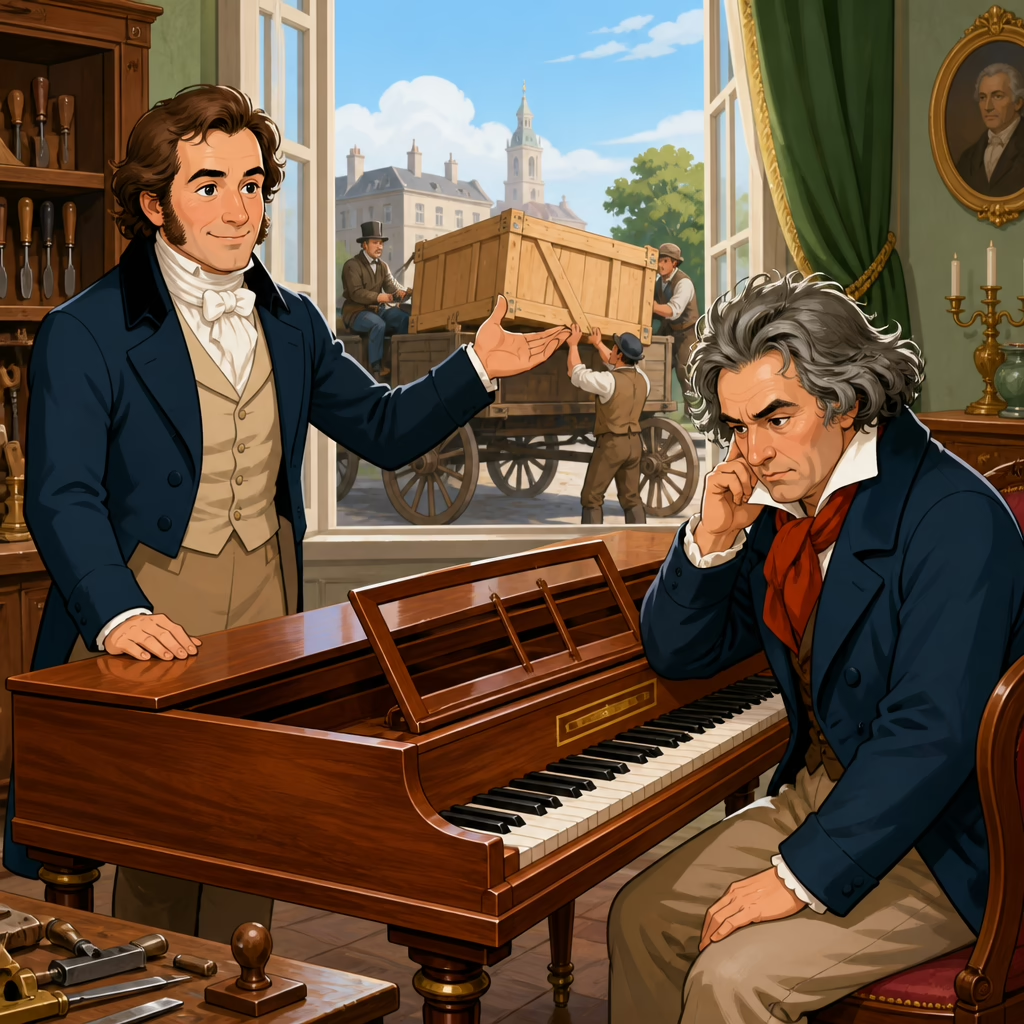
John Broadwood and the Piano Sent to Beethoven
John Broadwood’s gift of a grand piano to Ludwig van Beethoven in 1818 stands as one of the most revealing encounters between instrument making and musical imagination in the early nineteenth century. The episode was more than a polite gesture from a successful London manufacturer to Europe’s most formidable composer. It connected industrial craft, international admiration, and Beethoven’s late style at a moment when his hearing was largely gone, his social life was difficult, and his artistic ambitions were expanding beyond the capabilities of many Viennese instruments. To understand why the Broadwood piano matters, it helps to define the central figures and terms. John Broadwood was the head of the Broadwood firm, the leading English piano manufacturer of its era, known for robust grand pianos with a powerful tone, wider compass, and heavier construction than many continental rivals. The instrument sent to Beethoven was a six-octave grand, dispatched from London through a subscription organized by admirers, and delivered to Vienna after a complicated journey. Beethoven, by then already celebrated across Europe, did not simply receive another keyboard. He received a machine embodying a different national school of piano building.
Why does this specific piano still matter? In practical terms, it shows what composers needed from instruments as musical language changed. English pianos like Broadwood’s offered a deeper bass, stronger frame, and more sustaining sonority than the lighter Viennese action associated with makers such as Walter and Streicher. Those qualities aligned with Beethoven’s preference for dynamic contrast, orchestral textures, and expanded harmonic weight. In historical terms, the gift illustrates how reputation traveled in an age before recording. Broadwood’s workshop understood that sending an instrument to Beethoven had symbolic value, but the gesture was not merely commercial. It acknowledged that Beethoven had become the composer whose judgment could validate the frontier of piano making. I have worked through inventories, letters, and surviving instrument specifications often enough to know that the details matter here: the pedal arrangement, stringing, and case dimensions are not trivia. They explain why the piano became part of the story of Beethoven’s late works, even if it did not magically transform his output overnight.
The Broadwood firm and the English piano sound
By the time Beethoven received the instrument, Broadwood and Sons had spent decades refining a distinctly English approach to piano construction. The firm grew from the work of Burkat Shudi, a Swiss-born harpsichord maker in London, and John Broadwood, who married into the family and gradually steered the company toward pianos as the market shifted away from the harpsichord. English grands generally emphasized volume, durability, and tonal breadth. Their action was heavier than the Viennese mechanism, but they rewarded a strong hand with a powerful attack and a more sustained singing line. That difference is essential. When pianists today describe the contrast between English and Viennese instruments of the period, they often speak of the latter as quicker and more transparent, while the former sounds broader, darker, and more orchestral.
Broadwood’s reputation rested not only on craftsmanship but on measurable innovation. The firm expanded keyboard compass earlier than many rivals and standardized design improvements that answered the demands of larger rooms and public performance. Surviving Broadwood instruments from the 1810s show substantial casework, heavier stringing, and a sonority that projects with unusual authority for the period. This was exactly the kind of instrument likely to attract Beethoven, whose keyboard writing had long tested the limits of available pianos. Anyone studying the line from his early sonatas to the “Waldstein,” the “Appassionata,” and the “Hammerklavier” can hear a composer repeatedly writing beyond the normal domestic keyboard. The piano sent from London did not create that tendency, but it affirmed it in wood, iron, and wire.
Why Beethoven was chosen
Beethoven was the obvious recipient because, by 1817 and 1818, he was the most revered living composer for the piano, even though his deafness had largely ended his career as a public virtuoso. Broadwood’s circle in London knew that presenting him with an instrument would resonate across Europe. The subscription reportedly involved notable musicians and admirers, including figures tied to London’s musical life. The act had prestige, but it also had genuine artistic logic. Beethoven had already shown sustained interest in the technical resources of pianos, and instrument makers followed his work closely. He was not a passive consumer. He evaluated mechanisms, complained when instruments disappointed him, and formed opinions about tone and resistance that reflected an experienced player’s priorities.
The choice also makes sense when placed beside Beethoven’s earlier formation. His keyboard sensibility did not emerge suddenly in Vienna; it grew from disciplined training, improvisation, and compositional study in Bonn. Readers wanting that background can trace it in the main guide on Christian Gottlob Neefe and Beethoven’s earliest training, which clarifies how early technique and keyboard literacy shaped the mature composer’s expectations of instruments. By the late 1810s, those expectations had become unusually demanding. Beethoven wanted clarity in counterpoint, force in bass lines, and the ability to sustain broad sonorities. Broadwood’s piano promised all three more convincingly than many Viennese models then available.
The gift, the journey, and the inscription
The instrument sent to Beethoven was not purchased casually off a showroom floor. It was prepared as a presentation grand and accompanied by an inscription that made the gesture explicit: it came from Thomas Broadwood and companions as a token of admiration. The transport from London to Vienna was lengthy and expensive, involving sea and land routes, customs, handling risks, and delays typical of the post-Napoleonic period. Large pianos were vulnerable cargo. Soundboards could crack, action parts could shift, and tuning stability could be compromised by climate changes. That the firm proceeded anyway indicates how seriously it took the symbolic and practical value of the gift.
Beethoven acknowledged the instrument with thanks, though the surviving correspondence also suggests the realities of his situation. He appreciated the gesture deeply, yet he was living with severe hearing loss and constant financial and domestic pressures. This matters because romantic retellings sometimes imply that the piano arrived as a perfect answer to his needs. The truth is more human. The Broadwood grand was a remarkable object entering an imperfect life. Beethoven valued it, used it, and kept it, but he could not hear it as fully as he once would have. Even so, touch, vibration, memory, and inner hearing remained central to his compositional process. For a deaf composer, the physical resistance and resonance of the keyboard still conveyed musical information.
How the Broadwood differed from Beethoven’s Viennese pianos
To grasp the significance of the gift, comparison is unavoidable. Beethoven knew Viennese instruments by makers such as Anton Walter, Conrad Graf, and the Streicher family. Those pianos generally had a lighter action and a more immediate response. Broadwood’s English grand offered different strengths, especially in tonal weight and sustain. In workshops and museums, when I have compared period actions side by side, the distinction is immediately tactile: the English mechanism asks for more arm weight but gives more mass back in sound.
| Feature | Broadwood English Grand | Typical Viennese Grand of the Period |
|---|---|---|
| Action feel | Heavier, resistant, suited to strong attack | Lighter, quicker, highly responsive to finger articulation |
| Tone | Broad, dark, sustaining, orchestral | Clear, bright, transparent, speech-like |
| Bass response | Stronger and weightier | Leaner but often more defined |
| Construction | More robust case and stringing | Lighter build with less sheer power |
| Best suited for | Large sonorities and dramatic contrast | Fast passagework and delicate nuance |
These differences affected repertoire. A pianist approaching Beethoven’s Op. 106 on an English grand encounters a scale of sonority that helps explain the score’s ambition, even if the Viennese action better illuminates certain textures. The Broadwood did not replace every advantage of Viennese instruments; it offered a different set of resources. That tradeoff is crucial. Beethoven’s writing thrives on both clarity and power. The English piano magnified the second quality while challenging the player to preserve the first.
Did Beethoven compose on the Broadwood?
The most responsible answer is yes, but with limits that must be stated plainly. Beethoven received the Broadwood in 1818, the period of the “Hammerklavier” Sonata, the late piano sonatas, and the years leading toward the Diabelli Variations and the Missa solemnis. Scholars generally accept that he used the instrument, and its compass and sonority fit the demands of his late keyboard imagination. However, it is too simplistic to claim that specific masterpieces were directly caused by the arrival of the Broadwood. Beethoven composed at several instruments, revised constantly, and often conceived music away from the keyboard. He also lived in conditions where maintenance could be inconsistent, and no single piano remained ideal for long.
Still, the timing is meaningful. The Broadwood arrived when Beethoven’s writing was pushing toward greater architectural span and sonorous extremity. Consider the late sonatas’ expanded registral thinking, the dense chordal rhetoric, and the sense that the piano is being asked to imitate an ensemble rather than merely sing as a salon instrument. English pianos supported that conception. Modern performers who try these works on restored Broadwoods or comparable English actions often report that certain bass textures and accented climaxes suddenly make physical sense. The instrument does not solve every interpretive problem, but it can reveal why Beethoven expected so much sustain and impact from the keyboard.
The gift as diplomacy, marketing, and respect
It would be naive to ignore the commercial dimension of the gift. Piano makers in the early nineteenth century competed in an increasingly international market, and association with Beethoven carried immense prestige. Sending him a grand from London could only enhance Broadwood’s standing. Yet reducing the event to marketing misses its tone and context. Instrument makers often cultivated elite patrons, but this presentation had the character of homage. Beethoven’s music represented the summit of seriousness. To place a Broadwood in his hands was to say that the firm wanted its workmanship tested by the highest artistic standard available.
That relationship between artistic authority and manufacturing ambition shaped piano history. Broadwood’s gift anticipated a modern pattern in which builders seek validation from leading performers and composers. The difference is that in 1818 the exchange retained a personal, almost ceremonial quality. The inscription, the subscriber list, and the effort of transport all turned the piano into a diplomatic object. London saluted Vienna; the English manufacturing elite saluted German musical genius. In a Europe rebuilding after war, the gesture also reflected how music crossed borders more gracefully than politics often could.
The piano’s later history and survival
The Broadwood did not vanish into anecdote. Beethoven kept it for the rest of his life, and the instrument survived long enough to become a documented relic of exceptional value. After Beethoven’s death in 1827, the piano’s provenance remained central to its importance. It eventually entered institutional care and is now associated with the Hungarian National Museum in Budapest, where it has been preserved as one of the most significant surviving Beethoven instruments. For historians, this survival matters because it allows direct inspection rather than reliance on legend alone. Measurements, materials, and wear patterns help reconstruct how the piano was built and used.
Surviving artifacts rarely answer every question. Restoration choices, missing original parts, and changes over time complicate conclusions. Even so, Beethoven’s Broadwood remains a primary witness. It confirms the physical reality behind countless references to his desire for stronger instruments. It also reminds us that late Beethoven belonged to a transnational network of builders, publishers, patrons, and admirers. The piano is therefore both object and document: a grand instrument, and evidence of how European music culture recognized Beethoven while he was still alive.
John Broadwood’s piano matters because it captures Beethoven at the intersection of fame, deafness, and technological change. The gift was not an isolated curiosity. It embodied the English piano tradition at the moment when Beethoven’s musical language demanded greater range, stronger bass, and a more orchestral sonority than many instruments could comfortably provide. Broadwood’s grand answered those needs with a heavier action, broader tone, and durable construction that reflected the leading edge of London manufacturing. Just as important, the presentation acknowledged Beethoven as the composer whose authority could confer meaning on an instrument beyond its price or mechanics.
The deeper lesson is that great music history often turns on physical tools as much as abstract ideas. Beethoven’s late style was shaped by inner hearing and imagination, but also by what keyboards enabled, resisted, or inspired. The Broadwood piano did not create his genius, and it should not be romanticized as the single source of the late sonatas’ power. What it did do was meet that genius with an instrument built for scale, gravity, and expressive force. If you want to understand Beethoven not as a myth but as a working musician confronting real materials, start with the Broadwood sent from London to Vienna. Then follow the evidence through the music, the letters, and the surviving instrument itself.
Frequently Asked Questions
Why did John Broadwood send a piano to Beethoven in 1818?
John Broadwood’s gift was both a tribute and a statement. By 1818, Beethoven was widely regarded as the most powerful musical mind in Europe, even though his deafness had become severe and his personal circumstances were increasingly difficult. Broadwood, the leading English piano manufacturer of the period, understood that sending an instrument to Beethoven would honor a composer whose music was reshaping what the piano could express. This was not simply commercial promotion or polite flattery. It reflected genuine admiration from a major builder who recognized that Beethoven’s artistic ambitions were outgrowing the limits of many available instruments.
The gift also reveals how international musical culture had become in the early nineteenth century. Broadwood was based in London, Beethoven in Vienna, yet the language of prestige, craftsmanship, and artistic respect moved easily across borders. The piano symbolized a relationship between maker and composer that was becoming increasingly important in modern music history: instrument builders were not just supplying tools, but actively participating in the evolution of sound. In Beethoven’s case, the arrival of a Broadwood grand linked English manufacturing excellence with the late creative world of a composer who continued to imagine music on a vast scale, even as hearing loss cut him off from ordinary listening.
What made the Broadwood piano different from the instruments Beethoven already knew?
The Broadwood grand offered a combination of power, resonance, and mechanical solidity that set it apart from many Viennese instruments Beethoven had previously used. English pianos of the period were often heavier in construction and capable of producing a broader, more robust sonority than their lighter Viennese counterparts. Broadwood instruments were especially admired for their strong bass, fuller tone, and sustaining capacity. For a composer like Beethoven, whose musical language increasingly demanded contrast, weight, and orchestral richness from the keyboard, these qualities were deeply significant.
This difference matters because Beethoven’s piano writing had been pushing beyond conventional expectations for years. He wanted instruments that could support dramatic dynamic range, sharply etched accents, singing melodic lines, and a sense of architectural scale. The Broadwood did not magically solve every practical problem, nor did it erase the limitations of early nineteenth-century piano technology. But it did offer tonal resources better aligned with Beethoven’s expanding imagination. Its more commanding sound and larger frame would have reinforced the kind of monumental thinking present in his late works, where the piano often seems to strive toward something symphonic, spiritual, and structurally immense rather than merely elegant or domestic.
Did Beethoven actually use the Broadwood piano, and did it influence his late music?
Yes, Beethoven did use the Broadwood piano, though the question of influence requires some nuance. Historical evidence shows that he received the instrument and valued it, particularly because it came at a time when suitable pianos mattered enormously to him. However, by 1818 his deafness was already profound, so his experience of the instrument was very different from that of a hearing pianist. He could not simply enjoy its sound in a normal way. Instead, he interacted with the piano through touch, vibration, memory, and the inner ear of a composer who continued to imagine music with astonishing intensity.
As for its effect on his late style, it is best to avoid overly simple claims. The Broadwood did not create Beethoven’s late music, which arose from decades of artistic development, personal struggle, and formal experimentation. Still, the instrument formed part of the environment in which that music was conceived. Beethoven’s late piano works, including the sonatas of his final period, ask for depth, power, and expressive reach that resonate strongly with the capabilities of a substantial English grand. Even when his hearing was gone, the physical presence of a more resonant and expansive instrument could support his compositional thinking. In that sense, the Broadwood belongs to the story of Beethoven’s late creativity not as a miracle cure or a single determining cause, but as an important material companion to a visionary musical mind.
Why is the Broadwood gift considered historically important?
The episode is historically important because it captures a pivotal moment in the relationship between technology and artistic ambition. Beethoven stands at the center of a major transformation in Western music: he inherited the Classical piano tradition, stretched it to its limits, and pointed toward the Romantic future. Broadwood, meanwhile, represents the rise of the modern instrument maker as a figure of international influence. When Broadwood sent a grand piano to Beethoven, the gesture embodied more than admiration. It showed that builders were closely watching composers and that composers, in turn, depended on advances in design, action, stringing, and tonal capacity.
The gift also has symbolic importance. Beethoven, isolated by deafness and often burdened by difficult personal circumstances, remained a figure of immense authority whose creative power commanded respect across Europe. Broadwood’s piano acknowledged that authority in tangible form. It was an offering from industrial craft to artistic genius, but also a recognition that the future of music was being shaped through collaboration, even if indirect, between workshop innovation and compositional imagination. Historians value the story because it makes visible a larger truth: great musical works do not emerge in abstraction alone. They are bound up with the physical tools available to composers and performers, and the Broadwood-Beethoven connection is one of the clearest examples of that dynamic in the early nineteenth century.
What does this story reveal about Beethoven’s life in his final creative period?
The Broadwood piano highlights the paradox of Beethoven’s late years. On one hand, his life was marked by profound isolation. His hearing was largely gone, conversation had become difficult, and many aspects of ordinary social and musical life were painful or inaccessible. On the other hand, these same years produced some of the most searching, innovative, and inwardly powerful music ever written. The arrival of an important new instrument in 1818 underscores the fact that Beethoven, despite physical limitations and personal strain, remained intensely engaged with the material world of composition. He still cared about the instrument, its capabilities, and the possibilities it opened for musical thought.
The story also reminds us that Beethoven’s late period was not detached from contemporary networks of admiration and support. Even in hardship, he was not forgotten. A leading manufacturer in London considered him worthy of a remarkable gift, and that recognition matters. It places Beethoven not just as a solitary genius suffering in silence, but as a central cultural figure whose influence crossed borders and professions. In practical terms, the Broadwood episode reveals how his final creative period was shaped by both deprivation and connection: deprivation through deafness and personal difficulty, connection through the continuing response of the wider musical world to his extraordinary imagination. That tension is one reason the story remains so compelling today.