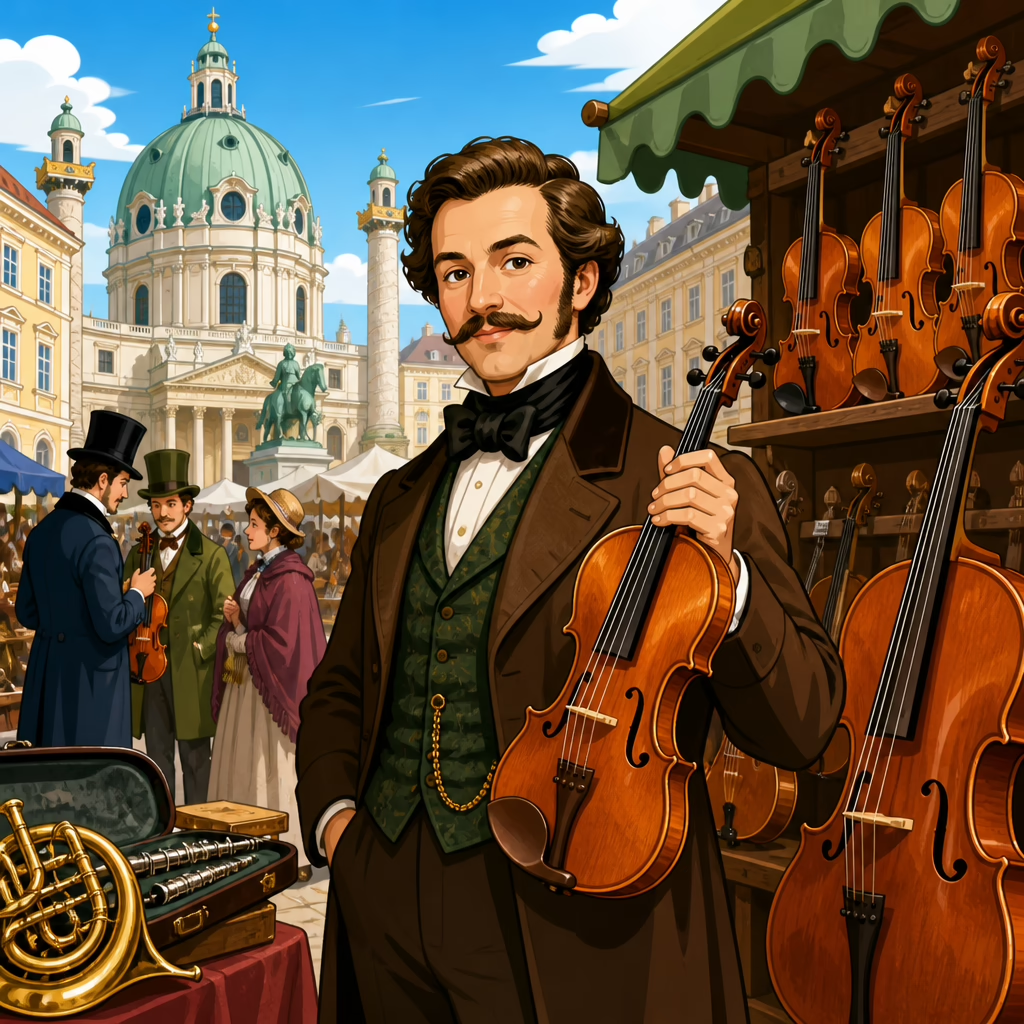
Conrad Graf and the Viennese Instrument Market
Conrad Graf and the Viennese instrument market cannot be understood separately, because Graf’s rise as a piano maker depended on the unusually competitive, style-conscious, and musically demanding economy of early nineteenth-century Vienna. In this context, the “Viennese instrument market” means the network of builders, wood suppliers, ironworkers, dealers, aristocratic patrons, concert organizers, publishers, teachers, and professional players who bought, compared, repaired, and promoted keyboard instruments across the Habsburg capital. Graf was not simply a gifted craftsman working in isolation. He was a shrewd manufacturer who recognized what Viennese pianists wanted, how public taste was changing, and where technical innovation could create a commercial advantage. His instruments became central to musical life precisely because they answered the needs of a city where domestic music making, public concerts, and celebrity virtuosity all expanded quickly after 1800.
When I have worked through surviving sales records, workshop reports, and museum instruments from this period, one point becomes consistently clear: Vienna rewarded makers who could balance clarity with power, elegance with durability, and artisanal reputation with scalable production. Graf did that better than most of his rivals. His pianos sat at the intersection of tradition and adaptation. They retained essential traits associated with the Viennese action, including a light touch and quick response, yet they also moved toward broader sonority, stronger framing, and more practical reliability for larger rooms and more forceful playing. That combination matters because the market itself was changing. The buyers of 1795 and the buyers of 1835 were not purchasing the same instrument for the same purpose, even if both called it a fortepiano.
Graf therefore matters not only as a respected builder linked with Beethoven, Schubert, Chopin, Clara Wieck, and Liszt, but as a case study in how a metropolitan market shapes design. His workshop illuminates how instrument making follows musical demand. To explain his importance accurately, the focus must stay on Vienna as a commercial ecosystem: who the competitors were, what features customers valued, how production was organized, why Graf gained prestige, and where his instruments fit within the city’s hierarchy of taste. Seen this way, Graf was one of the defining entrepreneurs of Biedermeier and Vormärz musical culture, and his success tells us as much about Viennese consumers as it does about his craftsmanship.
Vienna as a high-pressure market for keyboard makers
In the first half of the nineteenth century, Vienna was one of Europe’s most important centers for keyboard manufacture. The city supported court musicians, aristocratic salons, middle-class households with pianos in parlors, conservatory-style teaching networks, dance culture, and a steady flow of visiting virtuosi. Demand was broad rather than niche. Instruments were needed for composition, accompaniment, student practice, chamber music, and public performance. This range of use created a layered market with multiple price points. Some buyers wanted compact domestic pianos with elegant veneer and moderate tone. Others wanted instruments capable of projecting in increasingly public venues. A successful maker had to understand both.
Competition was intense. Established names such as Anton Walter had earlier defined high standards for Viennese fortepianos, while later builders including Nanette Streicher, Ignaz Bösendorfer, and Joseph Brodmann competed for elite attention. The market rewarded recognizable tonal identity. Viennese instruments were prized for transparent articulation, fast repetition, and a singing treble suited to the repertoire of Mozart, Beethoven, Hummel, and Schubert. Yet those virtues came with pressure to modernize. As composers wrote with wider dynamic range and audiences expected greater brilliance, makers had to reinforce cases, refine actions, and extend compasses. Vienna’s market was therefore conservative in touch but progressive in demand.
Another crucial factor was social geography. Instrument buyers did not encounter pianos only in workshops. They heard them in salons, saw them in advertisements, discussed them with teachers, and judged them by association with celebrated performers. Reputation spread through visible use. If a maker supplied a respected pianist or secured imperial recognition, that prestige could convert directly into sales. Graf understood this mechanism exceptionally well and cultivated it carefully.
How Conrad Graf entered and mastered the trade
Conrad Graf, born in 1782 in Riedlingen, did not come from the oldest Viennese dynasties of keyboard making, which may have helped him think more flexibly about business. After arriving in Vienna, he entered the trade through practical workshop experience rather than inherited brand power. He eventually took over the workshop of Joseph Brodmann and expanded it into one of the city’s most productive piano enterprises. That transition was decisive. Brodmann had already built instruments respected by musicians, but Graf pushed beyond the scale of a small artisan shop. He developed a workshop system that preserved quality while increasing output, an essential advantage in a city where demand was widening beyond noble households.
From a business perspective, Graf’s genius was operational as much as acoustical. He employed trained workers, standardized parts where possible, and managed production to serve different segments of the market. Surviving evidence suggests that by the 1820s and 1830s his workshop was producing instruments in substantial numbers for the time, far more than a one-master shop could manage alone. That capacity allowed him to meet demand without surrendering the prestige associated with hand craftsmanship. In modern terms, he scaled a luxury manufacturing business before industrial standardization fully dominated piano making.
His timing was excellent. Vienna’s middle classes were investing in musical literacy and domestic culture, while elite musicians still sought instruments with distinction. Graf offered both aspiration and practicality. Buyers could acquire a piano from a maker associated with major artists, and they could do so in forms suited to apartments, salons, and teaching studios. This flexibility explains why Graf became not merely famous but commercially central within the Viennese instrument market.
What customers wanted from a Viennese piano
Viennese buyers judged pianos by touch, tone, appearance, price, and status. The action mattered because the local playing tradition emphasized control of articulation and nuance. A light, responsive mechanism let players shape ornaments cleanly and project melodic lines without the heavier resistance later associated with many English and modern concert instruments. Tone mattered just as much. Customers expected clarity across registers, a speaking bass rather than a booming one, and treble capable of cantabile phrasing. Furniture value also counted. These instruments occupied prominent domestic spaces, so veneers, inlay, and cabinet design influenced purchasing decisions.
Graf recognized that no single specification served every client. Some pianists preferred intimacy and delicacy for Lieder accompaniment or chamber music. Others wanted more power for bravura repertory and larger rooms. Rather than treating these needs as contradictions, Graf treated them as market segments. He offered variations in size, compass, and finish while maintaining a recognizable tonal profile. That strategy helped his brand remain coherent even as customer expectations shifted.
| Market demand in Vienna | How Graf responded | Commercial result |
|---|---|---|
| Light, precise action for nuanced playing | Refined Viennese action with quick response | Strong appeal to teachers and skilled amateurs |
| Greater volume for larger salons and concerts | More robust construction and broader sonority | Relevance beyond purely domestic settings |
| Prestige tied to famous musicians | Association with leading composers and virtuosi | Enhanced brand authority and demand |
| Attractive furniture for bourgeois interiors | Elegant cabinetry and polished finishes | Appeal to status-conscious household buyers |
| Reliable supply in a growing market | Expanded workshop organization | Higher output without losing reputation |
This alignment between product design and customer expectation is the clearest reason Graf succeeded. He did not invent demand; he read it accurately and built for it.
Graf’s instruments as products of musical change
The most revealing feature of Graf’s pianos is that they document transition. Early nineteenth-century Vienna still valued the transparent sonority associated with classical fortepianos, but composers and players increasingly tested the limits of that sound world. Beethoven’s later keyboard writing demanded stronger contrasts, wider compass, and greater sustaining potential. Schubert’s textures often relied on color differentiation and lyrical continuity. Visiting virtuosi brought showier repertory and expected instruments to carry in crowded spaces. Graf responded by building pianos that preserved quick articulation while moving toward fuller resonance and sturdier construction.
This does not mean his instruments were prototypes of the late nineteenth-century concert grand. They were not. Their sound remained fundamentally distinct from modern Steinway-based expectations. But within their own historical frame, Graf pianos represented a sophisticated compromise between established Viennese taste and emerging performance pressures. Features such as expanded keyboard range, improved structural support, and carefully managed tonal balance made them unusually adaptable. That adaptability is why so many major musicians encountered them.
For readers studying Beethoven’s world more broadly, this focused market story connects usefully with pedagogical and cultural networks discussed in the main guide on Christian Gottlob Neefe and Beethoven’s earliest training. The link is not that Neefe shaped Graf directly, but that Beethoven’s developmental environment eventually fed into the performance culture that makers like Graf had to serve. Instrument markets always reflect the music that players are taught to value.
Prestige, patronage, and artist endorsement in Vienna
Graf’s reputation grew because influential musicians actually used and praised his instruments. Beethoven received a Graf piano in 1825, a fact often cited because it places the maker near the center of Viennese musical authority. That association should not be romanticized into a simple endorsement, yet it mattered commercially. In Vienna, proximity to Beethoven conferred seriousness. Graf’s instruments were also known to Schubert’s circle, and later to Clara Wieck and Chopin during their Viennese encounters. Franz Liszt reportedly admired their responsiveness. Each association extended the brand into a different musical constituency: composers, salon performers, pedagogues, and public virtuosi.
Imperial recognition amplified this artistic prestige. Graf served as a piano maker to the imperial court, which functioned as a powerful trust signal in the period’s economy. Court status did not guarantee universal supremacy, but it reassured buyers about quality, reliability, and social rank. In practical terms, a bourgeois family purchasing a Graf instrument bought more than wood, leather, and wire. They bought entry into a cultural hierarchy validated by elite use.
I find it important, however, not to reduce Graf’s market strength to celebrity alone. Endorsement could attract first interest, but repeat demand depended on product performance. Surviving Graf pianos show careful voicing, refined action geometry, and construction choices that explain why professionals respected them. Prestige opened doors; workmanship kept them open.
Limits, competition, and Graf’s long-term place in the market
Graf did not dominate an uncontested field. Viennese buyers had alternatives, and different makers excelled in different areas. Streicher instruments, for example, had passionate defenders who valued their tonal character and connection to Beethoven. Bösendorfer emerged as a formidable presence as piano design continued evolving toward greater sonority and durability. English-made instruments also exerted influence, especially where players preferred heavier action and more orchestral weight. Graf’s position, then, was strong but not absolute.
There were also technical limits to the broader Viennese tradition he represented. As concert halls grew and later Romantic repertory demanded sustained power, the lighter Viennese action and earlier construction logic became less dominant internationally. By the mid to late nineteenth century, the market increasingly favored designs better suited to larger spaces and denser textures. Graf retired from business in 1840, at a moment when the center of piano development was shifting noticeably.
Even so, his historical importance remains secure. He stands as the maker who most clearly translated the needs of Biedermeier Vienna into instruments of high quality and broad appeal. His pianos show how a market can reward responsiveness rather than radical rupture. They also remind us that instrument history is not a simple march toward modernity. Graf succeeded because he served actual musicians in actual rooms under specific social conditions. That is the right scale at which to judge him.
Conrad Graf’s place in the Viennese instrument market rests on a simple truth: he built the right pianos for the right city at the right moment. He understood Vienna’s layered demand better than most competitors, and he turned that understanding into a workshop model that joined artisanal refinement with meaningful production scale. His instruments answered the city’s central musical needs: clarity of touch, elegance of tone, visual sophistication, and enough structural development to meet changing repertory and performance settings.
Looking closely at Graf also sharpens the broader picture of early nineteenth-century musical culture. Pianos were not passive containers for notes. They were commercial objects shaped by pedagogy, class aspiration, room size, public taste, and artist influence. Graf prospered because he recognized that every technical decision had a market implication. Action design affected teaching. Case strength affected venue use. Associations with major composers affected buyer confidence. In Vienna, all of those factors interacted constantly.
The lasting benefit of studying Graf in this focused way is that it replaces vague hero worship with a clearer understanding of how musical life actually worked. Great makers succeed when craftsmanship, business judgment, and cultural timing converge. Graf achieved that convergence better than almost anyone in Vienna during his prime. If you want to understand the sound world surrounding Beethoven’s later years, Schubert’s domestic circles, and the city’s piano economy, start with Graf’s instruments and the market that made them indispensable.
Frequently Asked Questions
Why is Conrad Graf so closely tied to the Viennese instrument market?
Conrad Graf is closely tied to the Viennese instrument market because his success did not happen in isolation. He emerged in a city where piano building was already a highly visible, intensely competitive craft shaped by constant comparison among makers, musicians, and buyers. Early nineteenth-century Vienna was one of Europe’s most active musical capitals, and that meant instruments were not simply manufactured and sold; they were tested in lessons, salons, concerts, workshops, and private homes. Builders had to respond to the expectations of aristocratic patrons, professional pianists, teachers, dealers, and composers who all had strong opinions about touch, tone, durability, and visual style.
Graf’s rise depended on understanding that environment better than many of his competitors. He was working within a dense network that included wood suppliers, metalworkers, case makers, repairers, music publishers, and concert organizers, all of whom influenced what kinds of instruments could be built and how they would circulate. If a piano maker wanted to succeed in Vienna, it was not enough to produce a functional keyboard instrument. The instrument had to satisfy local taste, stand up to practical use, and compete in a market where consumers could compare one maker’s work directly against another’s.
That is why Graf and the Viennese instrument market are best understood together. Vienna gave him access to demanding customers and a culture of musical evaluation, while Graf contributed to that market by refining instruments that answered its needs. His pianos became important not only because of their craftsmanship, but because they embodied what the Viennese market valued: responsiveness, elegance, clarity, and adaptability to a broad range of musical settings.
What made the Viennese instrument market especially competitive in Graf’s time?
The Viennese instrument market was especially competitive because it brought together a large concentration of skilled builders and a musically sophisticated customer base in one city. Vienna was full of composers, performers, teachers, aristocrats, and cultivated amateurs who actively compared instruments before buying them. This was not a passive market in which customers accepted whatever was available. Buyers in Vienna often had clear preferences about keyboard action, tonal character, decorative appearance, and mechanical reliability, and makers had to respond quickly if they wanted to remain relevant.
Another important factor was the speed with which musical fashions could change. As piano music became more technically ambitious and public performance culture expanded, instruments were expected to do more. They needed to support expressive nuance, dynamic contrast, and repeated use in both domestic and semi-public spaces. Builders competed by adjusting actions, strengthening structures, improving tonal balance, and presenting their instruments as modern, refined, and suitable for leading players. Even small differences in responsiveness or sound could matter in such an environment.
The market was also competitive because it was supported by a broad commercial ecosystem. Suppliers provided woods and metals, craftsmen contributed specialized parts, dealers extended the reach of makers, and concert life gave instruments public exposure. Teachers and performers could influence reputation, and aristocratic patronage could elevate a builder’s status. In that sense, competition did not happen only at the workbench. It also took place through endorsements, visibility, repair networks, workshop organization, and the ability to meet the practical demands of a thriving musical city. Graf succeeded because he was able to navigate all of those pressures at once.
Who were the key participants in the Viennese instrument market besides piano makers?
The Viennese instrument market involved far more than piano makers alone. It included a wide network of people whose work and influence shaped how instruments were produced, sold, maintained, and valued. Wood suppliers were essential because the quality and availability of timber affected everything from case construction to soundboard performance. Ironworkers and metal specialists contributed hardware and structural components that helped makers respond to changing musical demands. Without these supporting trades, even the most talented builder could not produce instruments at a consistently high level.
Dealers and merchants also played a major role by connecting workshops to customers. They helped circulate instruments beyond the immediate workshop, broadened access to different social groups, and contributed to how certain makers were perceived in the marketplace. Repairers and technicians mattered as well, because pianos were expensive objects expected to remain usable over time. An instrument’s reputation depended not only on how it sounded when new, but on how well it could be maintained, adjusted, and restored after regular use.
Just as important were the cultural intermediaries: aristocratic patrons, concert organizers, publishers, teachers, and professional players. Patrons could provide prestige and financial support. Concert organizers and performers brought instruments into public view, where audiences and potential buyers could hear them in action. Teachers introduced students to particular instruments and often shaped buying decisions in households. Publishers helped circulate the music that would be played on these pianos, indirectly influencing demand for instruments capable of handling contemporary repertory. Together, these participants created an interdependent market in which Graf’s pianos gained meaning through use, recommendation, comparison, and continued visibility.
How did musical taste in Vienna influence the kinds of pianos Graf built?
Musical taste in Vienna had a direct influence on the kinds of pianos Graf built because local expectations were unusually refined and specific. Viennese musicians and listeners valued clarity, responsiveness, and a touch that allowed for nuanced articulation. This was a culture deeply invested in expressive control, not just raw volume. As a result, piano makers had to design instruments that could support subtle phrasing, clean passagework, and a wide range of dynamics. Graf’s instruments became admired in part because they addressed these demands with intelligence and consistency.
The influence of taste also extended beyond sound alone. Viennese buyers often wanted instruments that were visually elegant and appropriate for cultivated domestic interiors as well as performance settings. A piano was both a musical tool and a social object. It could signal education, refinement, and participation in elite or aspiring musical culture. Graf therefore had to meet expectations not only for tonal and mechanical quality, but for finish, craftsmanship, and presentation. In a style-conscious city, appearance and reputation reinforced one another.
At the same time, the repertory being played in Vienna was changing. As pianists explored more expressive and technically advanced music, instruments had to keep pace. Taste was not static; it evolved through performance, teaching, publication, and public discussion. Graf’s success reflects his ability to build pianos that worked within this shifting environment. He did not simply produce instruments according to personal preference. He built for a market that listened closely, judged critically, and expected instruments to serve the musical ambitions of one of Europe’s most demanding urban cultures.
Why does studying the Viennese instrument market help us better understand Graf’s historical importance?
Studying the Viennese instrument market helps us better understand Graf’s historical importance because it shows that his achievements were both individual and systemic. He was clearly a remarkable maker, but his significance becomes much clearer when we place him within the economic and cultural world that made his work possible. The market reveals what kinds of pressures he faced, what standards he had to meet, and why certain design choices mattered. Instead of seeing Graf as a solitary genius, we can recognize him as a builder who excelled in one of the most exacting musical environments of his age.
This wider perspective also explains why Graf’s instruments carried such authority. Their reputation did not come merely from workshop skill in the abstract. It came from surviving comparison in a city full of alternatives and from satisfying people who used pianos intensively: teachers, virtuosos, patrons, and serious amateurs. When a maker gained esteem in Vienna, that esteem had weight because it had been earned in a crowded field shaped by practical use and public judgment. The market therefore serves as evidence of the level at which Graf was operating.
Finally, examining the market helps historians connect instrument making to broader themes in music history, urban culture, and commerce. Graf’s pianos tell us about labor, supply chains, social aspiration, musical education, and performance practice as much as they tell us about craftsmanship. His historical importance lies not only in the instruments themselves, but in how those instruments participated in a network of production and musical life. Understanding that network gives a fuller, more accurate picture of why Conrad Graf became such a central figure in the history of the piano in Vienna.