Nannette Streicher and the Craft Behind Beethoven’s Sound
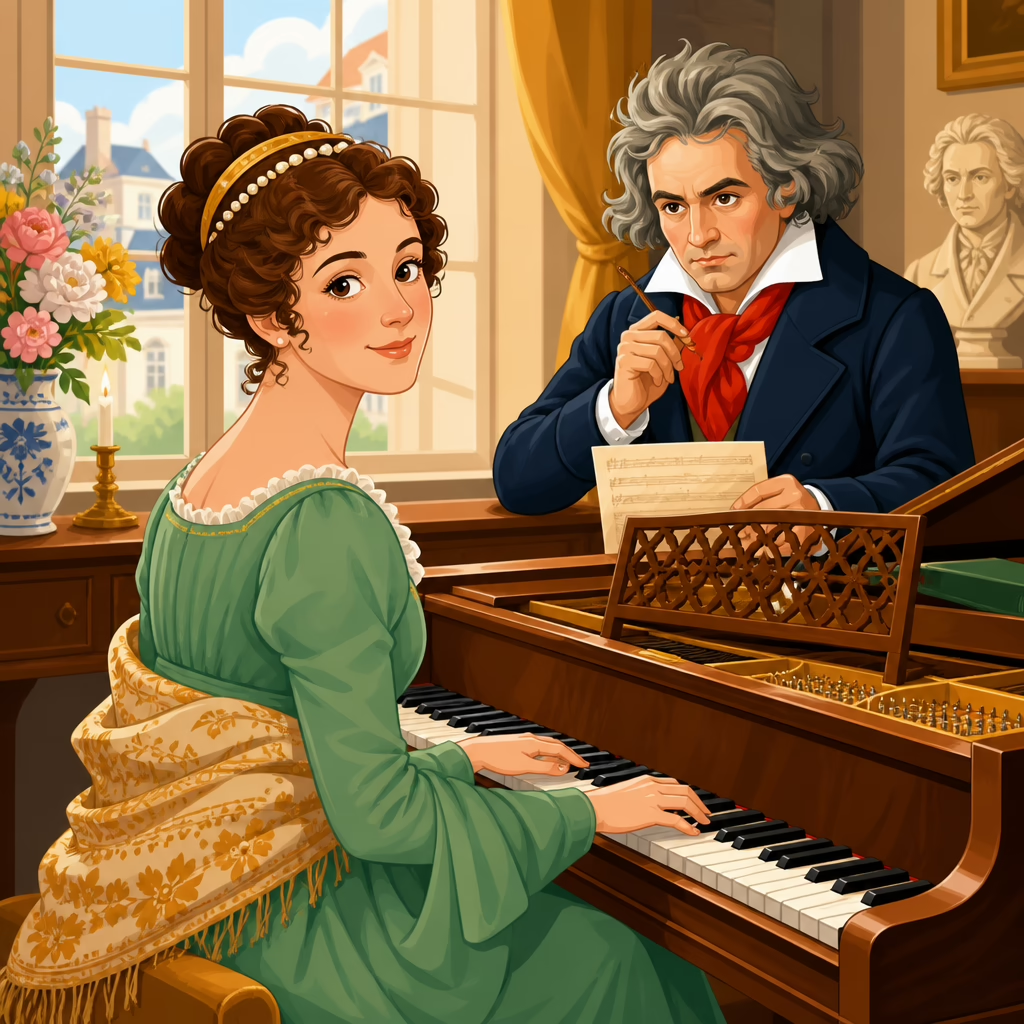
Nannette Streicher stands at the center of one of the most practical influences on Beethoven’s music: the piano itself. When listeners talk about Beethoven’s sound, they often mean bold harmony, muscular rhythm, or a new sense of scale, yet those qualities did not emerge in abstraction. They were shaped by wood, leather, wire, hammer coverings, key depth, action geometry, room acoustics, and the judgment of the maker who understood what the composer needed. In Vienna, that maker was Nannette Streicher, one of the most accomplished piano builders of her age and a rare figure whose role joined craft, business discipline, and direct personal support for Beethoven.
To understand why Streicher matters, it helps to define terms precisely. “Sound” here does not refer only to tone color. It includes touch, resistance, dynamic range, repetition speed, sustain, register balance, and projection. “Craft” means the practical decisions inside instrument making: scaling strings, regulating the action, voicing hammers, strengthening the case, and maintaining consistency over years of use. Streicher’s contribution lies in the way those decisions met Beethoven’s changing artistic demands during a period when the piano was evolving rapidly from a lighter Classical instrument into something more robust and orchestral in ambition.
Her importance also matters because Beethoven was notoriously hard on pianos. Contemporary accounts and surviving correspondence show a composer who pushed instruments beyond ordinary domestic use. He wanted power, clarity, and reliability. He needed an instrument that could survive emphatic attack while still speaking clearly in softer passages. Streicher did not merely sell him a piano and disappear. She and her workshop provided maintenance, adjustments, and a level of informed responsiveness that helped translate Beethoven’s ideas into audible reality. That practical relationship is easy to miss in composer mythology, but in my experience studying instrument history, it is exactly where musical style becomes materially real.
Nannette Streicher, born Anna Maria Stein, inherited more than a family trade. She came from the distinguished Augsburg piano-making circle established by her father, Johann Andreas Stein, a builder admired for the responsive Viennese action and praised by Mozart. After moving to Vienna with her husband Johann Andreas Streicher, she developed the business into one of the city’s leading piano firms. She was not a symbolic heiress attached to a famous surname. She ran production, protected quality, and built an enterprise respected by performers, aristocratic patrons, and serious composers. Beethoven’s association with her therefore connected him not to a convenient supplier, but to the top rank of Viennese piano manufacture.
Streicher’s Workshop and the Viennese Piano Tradition
Streicher’s instruments grew from the Viennese action tradition, prized for its sensitive touch, quick response, and articulate attack. Compared with many English pianos of the period, Viennese instruments often felt lighter and more immediate under the fingers. That does not mean they were weak. In capable hands, they offered precision, transparency, and a sharply profiled bass-to-treble character that suited Beethoven’s rhythmic writing and registral contrasts. Streicher’s workshop refined this tradition by balancing responsiveness with greater durability, a crucial issue for a composer who demanded force without muddiness.
Her pianos were known for an even, singing treble and a clean articulation that preserved inner voices. That matters in Beethoven because texture often carries argument. A repeated accompaniment figure, a syncopated inner line, or a sudden sforzando can disappear on a poorly regulated instrument. Streicher’s craftsmanship helped maintain differentiation between layers. In sonatas where texture is drama, not decoration, that distinction is everything. The instrument had to preserve contour when Beethoven wrote dense chords, abrupt accents, and dynamic extremes in rapid succession.
Vienna around 1800 was also a competitive piano market. Makers such as Anton Walter and later Conrad Graf shaped taste, and imported English models offered alternative ideals of sonority and strength. Streicher succeeded because her workshop combined pedigree with adaptation. She did not simply preserve her father’s methods unchanged. She adjusted designs as musical expectations expanded. Wider compass, stronger framing, and more robust construction all became increasingly important as composers asked the piano to fill larger rooms and support more forceful expression.
That context explains why her name belongs in any serious account of Beethoven’s mature working environment. If readers want the earlier educational foundation behind Beethoven’s development, the broader context begins with Christian Gottlob Neefe and Beethoven’s earliest training. Streicher’s role comes later, at the point where inherited skill met the practical realities of composition, performance, and instrument maintenance in Vienna.
Why Beethoven Needed More Than a Good Piano
Beethoven needed an instrument partner, not just an instrument. By the early nineteenth century, his hearing difficulties were advancing, yet his demands on the piano became more radical, not less. He depended on tactile feedback, physical resistance, and dependable regulation. A key action that felt uneven or sluggish could distort compositional judgment. When I compare reports about Beethoven’s playing style with the mechanics of period actions, the conclusion is straightforward: stability under stress mattered almost as much as tone.
His music exposes weak construction quickly. Large chordal attacks can throw regulation out of balance. Repeated octaves punish the action. Wide leaps and sudden dynamic shifts reveal inconsistent escapement or uneven voicing. Delicate slow movements demand control at the threshold of audibility. One reason Streicher matters is that her workshop could keep an instrument serviceable under this contradictory workload. Beethoven was not writing salon pieces that flattered a piano’s surface charm. He was probing structural limits.
Surviving letters indicate that Streicher also helped with household organization, reflecting a relationship built on trust. That personal support should not be romanticized, but neither should it be minimized. Composers work through routine: meals, schedules, deliveries, repairs, and interruptions. Beethoven’s life could be disorderly. A maker who ensured the instrument functioned, and who understood the seriousness of that need, became part of the working conditions behind the music. In practical artistic history, those conditions matter.
| Beethoven’s need | Craft response from a maker like Streicher | Musical result |
|---|---|---|
| Powerful attack without collapse | Stronger casework and careful regulation | Clearer fortissimo and fewer mechanical failures |
| Fast, articulate passagework | Responsive Viennese action setup | Sharper rhythmic definition |
| Balanced singing tone | Thoughtful hammer voicing and scaling | More distinct melody and inner voices |
| Reliability over time | Ongoing maintenance and adjustment | Consistent touch for composing and playing |
The Sound World Streicher Helped Make Possible
When people ask what a Streicher piano contributed to Beethoven’s sound, the shortest accurate answer is this: clarity with resistance. Her instruments could speak quickly, but they also gave the player enough physical engagement to shape attack deliberately. That combination supported Beethoven’s habit of making rhetoric out of contrast. A whispering opening could turn into a public declaration within a few measures, and the instrument had to preserve the logic of that transformation.
In practical tonal terms, Streicher pianos likely offered Beethoven a treble capable of cantabile line without losing edge, a middle register that projected structural harmony cleanly, and a bass that was firm rather than engulfing. Modern pianists raised on the long sustain and heavy iron-framed sonority of later concert grands sometimes miss how much Beethoven relied on attack profile and decay. On a period-style instrument, rests speak more sharply, accents bite sooner, and harmonic rhythm can feel more architectural. Streicher’s craftsmanship belonged to that world.
Consider Beethoven’s frequent contrasts between legato melody and sharply punctuated accompaniment. On an instrument with blurred response, the effect turns generalized. On a well-regulated Viennese piano, it becomes dramatic speech. The same is true of sforzandi. Beethoven’s accents are not generic loudness marks. They often function as structural signals. A builder who controlled voicing and key response helped those signals register with unusual vividness.
There is also the question of pedal use. Early nineteenth-century pianos interacted with dampers, resonance, and room acoustics differently from modern instruments. Streicher’s pianos would have shaped how much sound accumulated, how quickly it cleared, and how Beethoven judged harmonic color. That does not mean every marking can be explained by one manufacturer’s design, but it does mean the instrument’s response affected compositional decisions. Sound and writing developed together.
Beethoven, Durability, and the Limits of Period Technology
No account of Streicher should pretend that any Viennese piano fully solved Beethoven’s escalating demands. Period instruments were still constrained by lighter construction, lower string tension, and materials that wore under heavy use. Beethoven famously admired English pianos for their strength, and he also received instruments from other makers, including Broadwood. That broader pattern shows he was searching continually for power, range, and reliability. Streicher’s significance lies not in exclusive ownership of Beethoven’s loyalty, but in the quality of her answer to those needs within the Viennese tradition.
This tradeoff is important. English action pianos could offer greater sonorous weight and sustaining power, but many players found Viennese actions more nuanced and immediate. Beethoven’s music sits right on that fault line between intimacy and expansion. Streicher’s workshop responded by building instruments that retained speed and clarity while pursuing greater robustness. In historical terms, that is exactly the challenge the piano industry faced as repertoire outgrew late eighteenth-century assumptions.
From a maker’s perspective, durability is never one feature. It is a system. Stronger framing changes resonance. Heavier build can alter touch. Thicker strings require proportional decisions elsewhere. Hammer treatment affects both tone and wear. What impresses me most about Streicher’s reputation is that she managed these interdependencies without sacrificing artistic usefulness. That is the mark of a serious builder. It is easy to make a piano louder; it is much harder to make it stronger while preserving expressive control.
Beethoven’s relationship with pianos was therefore experimental in the fullest sense. He tested them physically, musically, and conceptually. Streicher’s craft gave him a dependable platform during a period when the instrument itself was in transition. That support did not remove technological limits, but it narrowed the gap between what Beethoven imagined and what the piano of his day could deliver.
Streicher’s Legacy in Beethoven Listening Today
For modern listeners, Streicher’s importance is not confined to biography. It changes interpretation. Hearing Beethoven on a restored or replicated Viennese instrument clarifies why articulation, register, and dynamic shock matter so much. Passages that can sound overpedaled or overblended on a modern grand often emerge with startling logic. The left hand punches without smearing. The treble sings but does not float free of the texture. Sudden silences become active elements. Those qualities are not incidental; they belong to the sound world makers like Streicher helped define.
Her legacy also corrects a persistent imbalance in music history. We still tell Beethoven’s story as if genius worked alone and technology merely followed. In reality, composition and instrument making formed a feedback loop. Builders responded to composers, and composers wrote toward what builders made possible. Streicher exemplifies that loop better than almost anyone in Beethoven’s orbit because she combined technical authority with sustained personal engagement. She was neither background figure nor ornamental patroness. She was a professional whose workshop shaped artistic outcomes.
That recognition matters beyond fairness to one historical figure. It sharpens how we hear Beethoven. Instead of imagining abstract heroism at the keyboard, we hear a composer in contact with material resistance: key travel, hammer bite, tonal decay, and mechanical limitation. Streicher’s craft turned those conditions into resources rather than obstacles. Her pianos did not simply carry Beethoven’s music; they helped define its attack, balance, and physical rhetoric.
The clearest takeaway is simple. If you want to understand Beethoven’s sound, study the maker who helped make that sound usable. Nannette Streicher brought discipline, design intelligence, and durable workmanship to one of music history’s most demanding creative relationships. Her role reveals Beethoven not only as a composer of ideas, but as an artist dependent on tools shaped by expert hands. Listen for clarity, tension, and controlled force in his piano writing, and you are already hearing part of Streicher’s achievement. Explore that connection further, and Beethoven’s music becomes more concrete, human, and compelling.
Frequently Asked Questions
Who was Nannette Streicher, and why is she so important to understanding Beethoven’s sound?
Nannette Streicher was one of the most respected piano makers in Vienna and a crucial figure in the practical world surrounding Beethoven’s music. While Beethoven is often discussed in terms of genius, style, and emotional intensity, Streicher helps explain how that musical imagination became audible. She did not simply build instruments in a general sense; she represented the kind of expert craftsmanship that directly affected tone, response, projection, and durability at a time when the piano itself was changing rapidly. In other words, if we want to understand what Beethoven heard under his hands, we have to understand makers like Streicher.
Her importance lies in the fact that Beethoven’s musical language developed alongside evolving piano technology. The forceful accents, broad dynamic range, dramatic contrasts, and orchestral textures associated with his keyboard writing were not produced in a vacuum. They depended on the capabilities and limitations of real instruments made of wood, leather, wire, and carefully engineered mechanical parts. Streicher’s pianos offered a particular combination of clarity, strength, and responsiveness that suited the increasingly ambitious demands of Beethoven’s music. She was part of the living infrastructure of his art: not just a supplier, but a craftsperson whose work shaped what was possible in performance.
Streicher also matters because she represents a broader truth about music history. Composers do not write only for ideas; they write for materials. Key depth, hammer resistance, action geometry, soundboard behavior, and room projection all influence musical choices. Beethoven’s sonorities, textures, and sense of scale were tied to those physical realities. Nannette Streicher stands at the center of that story because she embodied the expertise needed to translate artistic demand into a functioning instrument capable of carrying it.
How did Streicher’s piano craftsmanship influence the way Beethoven composed and performed?
Streicher’s craftsmanship influenced Beethoven by shaping the tactile and sonic environment in which he worked. A piano is not just a neutral tool. Its action determines how quickly notes can repeat, how much control a player has over attack, and how the hand experiences resistance. Its tonal design affects whether a melody sings, whether bass octaves thunder or blur, and whether dense chords remain intelligible. For a composer as physically engaged with the keyboard as Beethoven, these factors mattered enormously. They could encourage certain textures, certain gestures, and even certain formal ambitions.
One of the key areas of influence was dynamic range. Beethoven’s music often pushes toward extremes: sudden fortissimos, urgent accents, and passages that demand a sense of expansion beyond earlier Classical norms. An instrument built with strength and projection could support that vision more convincingly than one designed mainly for elegance or delicacy. Streicher’s pianos were associated with a robust Viennese sound world that still preserved clarity. That balance is important. Beethoven did not simply need loudness; he needed impact without losing definition. His writing often depends on sharply profiled rhythm and harmony, and a well-made instrument allowed those features to register clearly.
Her craftsmanship also mattered in more intimate ways. Beethoven’s slow movements and lyrical passages require nuanced control of touch, color, and sustain. The instrument had to respond not only to force but to gradation. A maker like Streicher provided a piano that could speak across a wide expressive spectrum, from intimate cantabile lines to commanding rhetorical statements. This kind of responsiveness likely reinforced Beethoven’s growing sense that the piano could serve as a medium of large-scale, symphonic thought while still retaining immediacy and subtlety. In that sense, Streicher’s work did not merely support Beethoven’s music after the fact; it helped define the sound world within which that music could be imagined and realized.
What specific features of early nineteenth-century pianos made such a difference in Beethoven’s music?
Several physical features of early nineteenth-century pianos had a direct impact on Beethoven’s sound, and understanding them helps explain why instrument makers like Nannette Streicher were so important. The first is the action, the mechanism connecting key movement to hammer strike. Action geometry affects speed, resistance, repetition, and control. Beethoven’s music often calls for sharply articulated rhythms, explosive accents, and quick changes of character, all of which depend on an action that is both reliable and expressive. A responsive action enables the player to shape phrasing with precision rather than merely striking notes harder.
Another major factor is hammer construction and covering material. Early pianos typically used leather-covered hammers rather than the denser felt coverings found on later instruments. This contributes to a more transparent, immediate attack and a different balance between brilliance and warmth. That clarity matters in Beethoven, whose textures can be thick but are rarely careless. Chords, tremolos, and running figures speak differently depending on how the hammer meets the strings. A maker’s decisions in this area influenced whether Beethoven’s writing sounded gritty, noble, singing, percussive, or all of those in carefully controlled proportions.
Stringing, case strength, and soundboard design were equally important. As composers demanded a broader compass and greater sonority, builders had to manage increased tension and projection without sacrificing stability. Bass notes needed depth, but they also needed focus. Treble needed brilliance without becoming thin. The instrument’s wooden structure, bridge placement, scaling, and resonance all contributed to how sound carried in a room. Key depth and touch weight also shaped the player’s bodily experience: how much effort was needed, how deeply one could lean into the key, and how articulation translated into tone. Beethoven’s music is inseparable from these mechanics because so much of its character lies in the physical drama of sound production. When we hear bold harmony and muscular rhythm in Beethoven, we are also hearing the result of design choices made at the workbench.
Did Streicher simply provide instruments, or did she play a larger role in Beethoven’s musical world?
It would be too small a view to imagine Streicher as merely someone who delivered pianos. In Beethoven’s Vienna, the relationship between composer and maker could be much more active and consequential. Instruments required maintenance, adjustment, repair, and sometimes adaptation to the player’s needs. A demanding musician like Beethoven, whose style and hearing changed over time, would have depended on skilled makers not only for access to quality instruments but for ongoing practical support. That meant the maker participated, in a very real sense, in the conditions of creation and performance.
Streicher belonged to a world in which musical production was deeply material and collaborative. A piano maker’s judgment could influence how an instrument responded to heavy playing, how well it survived use, how evenly it spoke across registers, and how effectively it projected in domestic or semi-public spaces. Those are not minor technical concerns; they affect composition itself. If a composer trusts an instrument to sustain large forms, withstand powerful sonorities, and articulate complex textures, that trust can encourage more adventurous writing. Streicher’s role therefore extends beyond craftsmanship into artistic enablement.
There is also a symbolic dimension to her place in Beethoven’s world. She stands for the network of artisans, technicians, and musical professionals who made great composition practically possible. Music history sometimes isolates the composer as if masterpieces emerge independently of tools and hands. Streicher reminds us that Beethoven’s sound was built as much as it was imagined. Her larger role was to bridge artistic aspiration and physical reality, ensuring that the piano could meet the demands placed upon it by one of history’s most transformative composers.
Why does Nannette Streicher still matter today for performers, scholars, and listeners?
Nannette Streicher still matters because she helps modern audiences hear Beethoven more intelligently. For performers, her significance lies in the reminder that Beethoven’s scores were written for instruments with different touch, sonority, balance, and resonance from the modern concert grand. That does not mean contemporary performances are invalid; it means interpretation becomes richer when informed by historical craft. Understanding the qualities associated with Streicher’s pianos can affect tempo decisions, pedaling choices, articulation, voicing, and the handling of dynamic contrast. A performer who knows how these instruments spoke can make more historically aware musical decisions, even on a modern piano.
For scholars, Streicher offers a way to connect biography, technology, and style. She helps move Beethoven studies beyond abstract analysis into the concrete realities of instrument building and sound production. Questions about why Beethoven wrote certain textures, how he expected them to project, or what kind of tonal response he valued become more answerable when we take makers seriously. Streicher’s career also illuminates Vienna’s musical economy, showing how craftsmanship, commerce, performance, and composition interacted in a rapidly changing cultural environment.
Listeners benefit as well, because Streicher’s story changes how Beethoven’s music is imagined. Instead of hearing “Beethoven’s sound” as a purely metaphysical idea, we begin to hear it as something physically made: the result of striking mechanisms, vibrating strings, resonant wood, and a builder’s refined decisions. That perspective does not diminish Beethoven’s genius. On the contrary, it makes it more vivid. It reveals how extraordinary musical ideas take shape through materials and through the expertise of people like Nannette Streicher, whose craftsmanship helped give Beethoven’s imagination a voice.