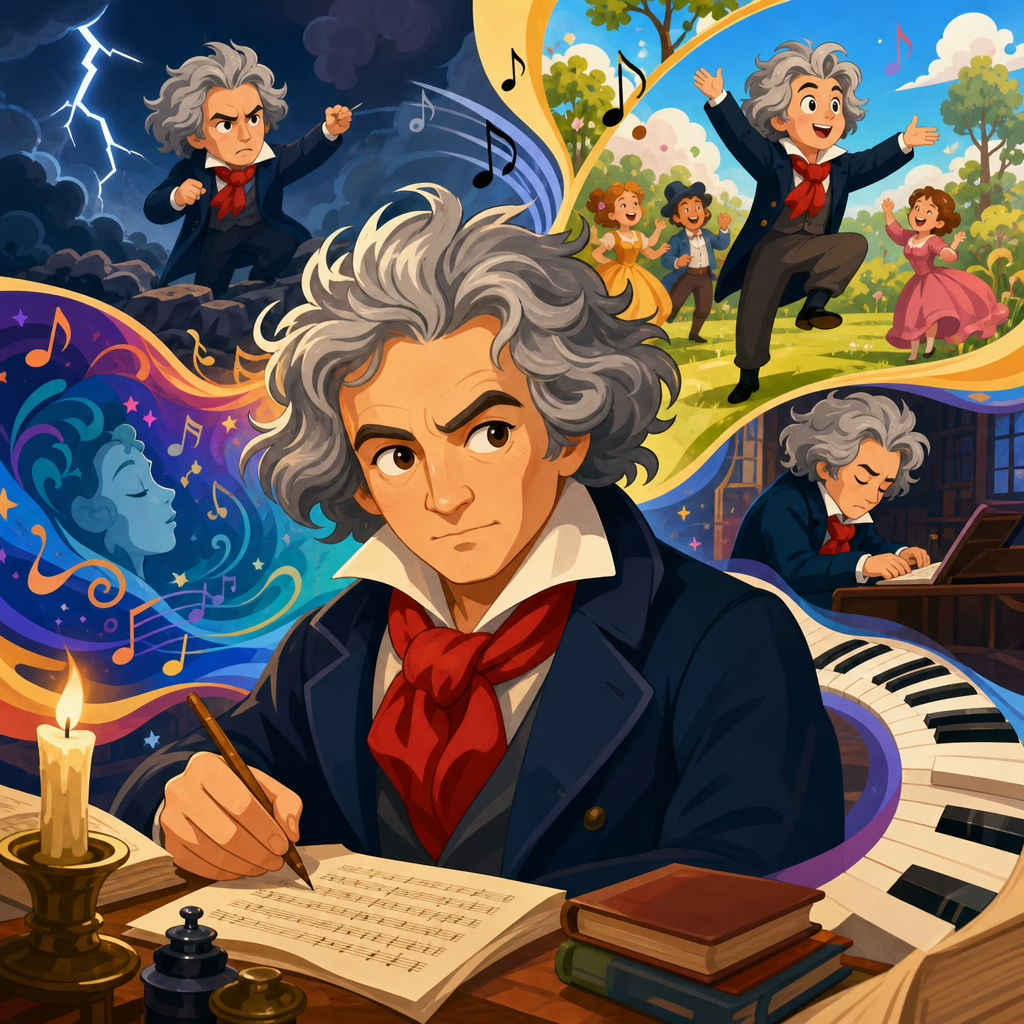
Beethoven in Animation: Creative Interpretations
Beethoven in animation reveals how a nineteenth-century composer became one of the most adaptable figures in visual storytelling. The phrase covers more than cartoons set to famous symphonies. It includes direct animated portrayals of Ludwig van Beethoven, narrative riffs on his life, visual interpretations of individual works, parody, educational shorts, advertising, television bumpers, anime references, and experimental films that use his music as structure, mood, or cultural shorthand. In a multimedia gallery, this miscellaneous hub matters because Beethoven appears across formats that do not fit neatly into concert film, biography, or children’s programming, yet together they show how animation translates canonical music into movement, character, and meaning for broad audiences.
I have worked with music-driven visual archives long enough to know that Beethoven is one of the first names animators, editors, and programmers reach for when they need instant recognition with emotional scale. A few notes from the Fifth Symphony can signal fate, drama, or comic exaggeration. The pastoral calm of the Sixth can anchor a landscape sequence. “Ode to Joy” can support sincerity, satire, triumph, or chaos depending on timing and framing. That flexibility explains his unusual durability in animated media. He is both a historical composer and a reusable visual language.
Key terms help organize the field. Adaptation means a substantial transformation of Beethoven’s life or compositions into an animated narrative. Interpretation refers to visual choices that assign imagery, pacing, and symbolism to preexisting music. Quotation describes brief use of recognizable themes for comedic or dramatic effect. Pastiche imitates the cultural aura around Beethoven without strict fidelity to any single work. Hub pages like this one are useful because “miscellaneous” is not a dumping ground; it is where cross-genre patterns become visible. When educational television, avant-garde shorts, and mainstream cartoons all reuse the same musical material, they reveal how animated culture teaches audiences what Beethoven is supposed to mean.
This article maps those patterns comprehensively. It shows which works appear most often, why animators favor them, how licensing and public-domain status shape usage, what visual techniques recur, and where interpretation becomes misleading or surprisingly insightful. It also points toward the kinds of related gallery pages readers usually seek next, from composer biographies in animation to music-synchronized abstract films. If you want a reliable overview of Beethoven in animation beyond a handful of famous examples, this hub provides the broader framework.
Why Beethoven Keeps Returning in Animated Media
Beethoven survives in animation because he offers three assets at once: name recognition, musical contrast, and expressive architecture. His best-known works have clear rhythmic identities that animators can synchronize with cuts, character motion, and visual gags. The opening motif of Symphony No. 5 is short, emphatic, and instantly legible. A director can match each note to a door knock, hammer strike, villain entrance, or exaggerated facial reaction. By contrast, longer lyrical passages from Symphony No. 6 or the slow movements of the piano sonatas let artists build atmosphere, landscape, and emotional release. Few composers provide such a broad usable range while remaining familiar to non-specialists.
There is also a practical reason. Beethoven’s compositions are in the public domain in most jurisdictions because of their age, which removes composition copyright barriers. That does not mean every recording is free to use. Studios still need rights to specific performances unless they commission new ones or use genuinely public-domain recordings. In archival review, I have seen many productions choose newly recorded Beethoven precisely because the underlying composition is free while the brand value is enormous. For independent animators, that balance is attractive. It allows classical prestige without the costs associated with many modern songs.
Culturally, Beethoven carries a dense package of associations: genius, struggle, deafness, intensity, revolution, refinement, and sometimes comic pomposity. Animation thrives on condensed signals, so a silhouette with wild hair at a piano can communicate “great composer” instantly. The image is especially useful in children’s media and parody, where visual economy matters. At the same time, that shorthand can flatten history. Real Beethoven was not simply a stormy mascot for genius. The best animated interpretations preserve some complexity by connecting the music to social context, hearing loss, patronage, or the changing public concert culture of early nineteenth-century Europe.
Common Modes of Interpretation Across Genres
Animated Beethoven tends to fall into several recurring modes. The first is synchronization comedy, where musical accents drive physical action. This approach descends from theatrical shorts and remains common because Beethoven’s dynamic contrasts support elastic timing. The second is biographical condensation, often reducing his life to key symbols: child prodigy, difficult temperament, deaf composer, heroic final legacy. The third is abstract visualization, in which animators translate rhythm, orchestration, and harmonic tension into shape, color, and motion without literal story. The fourth is citation and satire, using Beethoven as a cultural reference inside a broader narrative. The fifth is educational mediation, where hosts, talking animals, or classroom settings explain a work while animation demonstrates how instruments and themes interact.
Each mode solves a different storytelling problem. Comedy needs precise beats. Biography needs iconic scenes. Abstraction needs musical structure. Satire needs instant recognition. Education needs simplification without distortion. Problems arise when a production mixes these modes without control. For example, a cartoon may use the Fifth Symphony as a joke cue while also claiming to teach Beethoven’s life, leaving viewers with a caricature rather than understanding. Conversely, some of the most effective miscellaneous examples combine them carefully: a brief comic frame opens the door, then a more serious sequence explains the piece, and finally an abstract passage lets the music lead.
The visual toolkit is surprisingly consistent across decades. Animators exaggerate hair, brow, and hand movement to externalize intensity. They use storm imagery, cracking skies, or racing notes to represent inner struggle. Keyboard close-ups establish craftsmanship. Ear motifs, silence cuts, or muffled sound represent hearing loss. Crowds and concert halls indicate public triumph. Even in stylized anime or minimalist digital shorts, these symbols persist because they are readable across cultures. Their repetition is useful for a hub article because it helps viewers identify what an interpretation is doing, not just whether they like it.
Representative Formats and What They Usually Do With Beethoven
Because this hub covers miscellaneous material, the clearest way to compare examples is by format rather than by a single title list. In practice, format strongly predicts how Beethoven will be framed and what audiences will take away.
| Format | Typical Beethoven Use | Strength | Common Limitation |
|---|---|---|---|
| Theatrical cartoon short | Comic synchronization with Symphony No. 5, “Moonlight,” or “Für Elise” | Immediate entertainment and memorable timing | Turns complex works into gag signals |
| Educational TV segment | Condensed biography plus guided listening | Accessible entry point for children and families | Oversimplifies chronology and style |
| Feature animation sequence | Large-scale emotional or symbolic set piece | Strong image-music integration | Music can become background prestige |
| Experimental short | Abstract visualization of motif, form, and texture | Closer attention to musical structure | Less approachable for general viewers |
| Anime or serialized TV reference | Character coding, rivalry, or dramatic quotation | Fresh cultural reframing | Reference may be too brief for context |
| Advertising and promos | Borrowed authority, humor, or urgency | Instant recognition in seconds | Reduces Beethoven to a brand cue |
This comparison matches what I repeatedly find when cataloging media objects. The same music behaves differently depending on runtime, audience age, and production goal. That is why a miscellaneous hub should not treat all Beethoven animation as a single tradition. A public television explainer and a surreal gallery film may use the same movement yet teach radically different lessons about the composer.
Frequently Animated Works and Their Visual Logic
Not every Beethoven composition attracts animators equally. Symphony No. 5 is dominant because its four-note opening is one of the most recognizable motifs in Western music. It is easy to cut, parody, and vary. In animation, that means doors slam on the first notes, machines pulse with mechanical force, or villains appear with mock grandeur. Symphony No. 6, the “Pastoral,” invites landscape animation because it already suggests countryside, streams, peasant dancing, and storm. It supports panoramic movement better than the Fifth, which is more confrontational. Symphony No. 9, especially “Ode to Joy,” appears when creators want collective uplift or ironic overstatement. Its choral finality gives images a sense of culmination.
Piano miniatures and sonata excerpts are also common. “Für Elise” is useful in domestic or comedic scenes because audiences recognize it from beginner piano culture, music boxes, and ringtones. The “Moonlight Sonata” signals introspection, nighttime, melancholy, or gothic mood. The “Pathétique” and “Appassionata” can support more severe emotional arcs, though they appear less often in mass-market animation because they require longer attention spans and are less instantly identifiable to casual listeners. In educational shorts, the opening of the Violin Concerto or fragments of chamber music may appear to broaden the picture, but the center of gravity usually remains with the Fifth, Sixth, and Ninth.
Visual logic follows musical form. Strong motifs encourage repetitive visual units. Crescendos invite transformation sequences. Sudden sforzando accents match impact animation. Repeated harmonic tension supports chase scenes or escalating comedy. By contrast, variation form and longer developmental passages are harder to animate for general audiences because they demand sustained listening to appreciate structural change. Skilled experimental animators can do that beautifully, but mainstream productions often revert to the most obvious motifs. Recognizing this pattern helps viewers separate a work’s true musical complexity from the narrower slice selected by animation.
Biography, Myth, and the Problem of the “Tormented Genius”
Animated biographies of Beethoven usually rely on a compressed myth: a gifted but difficult man overcomes deafness and creates immortal music. The outline is not false, but it is incomplete. It can underplay his professional discipline, relationships with patrons and publishers, political disillusionment, and the long evolution of his style from Haydn-influenced early works to the formal daring of the late period. When animation simplifies too aggressively, deafness becomes a miraculous plot obstacle rather than part of a complicated lived reality involving conversation books, medical frustration, and changing social isolation.
The strongest biographical interpretations solve this by choosing a narrow frame instead of summarizing everything. A short focused on the Heiligenstadt Testament can show emotional crisis without claiming to tell his entire life. A sequence built around the premiere of the Ninth can explore public perception, performance conditions, and late-career legacy. A children’s episode can still be accurate if it distinguishes documented events from legend and explains that Beethoven did not compose in complete silence for his whole career. Precision matters. Audiences remember the first version they encounter.
In curatorial practice, I recommend treating animated biography as an invitation, not a final authority. It is valuable when it makes listeners care enough to seek recordings, letters, and historical context afterward. Used well, animation can humanize the composer and clarify chronology. Used poorly, it turns him into a permanent storm cloud with hair. This hub exists partly to help readers tell the difference.
Global and Cross-Media Reach
Beethoven in animation is not confined to European or North American traditions. Japanese animation and game-adjacent media frequently use classical references to signal discipline, rivalry, elite training, or emotional extremity. Beethoven’s image can appear in classroom comedies, music club dramas, or stylized fantasy settings where his works function less as historical documents than as shared cultural capital. That shift is important. Once Beethoven travels globally through school curricula, recordings, and media libraries, animators can deploy him as a transnational symbol. The meaning changes with context, but recognizability remains high.
Cross-media circulation reinforces the effect. A child may first hear “Für Elise” in an animated short, encounter the Fifth in a game trailer, then see Beethoven caricatured in a streaming series. Those layers accumulate into cultural memory. In gallery terms, miscellaneous material often captures this circulation better than prestige features do because it includes promos, interstitials, web shorts, and educational clips that viewers actually encounter frequently. Scholars of reception have long noted that canons survive not only through masterworks but through repetition in everyday media. Beethoven is a textbook case.
For readers exploring this subtopic further, the natural next stops are pages on composer caricature in cartoons, abstract music visualization, classroom animation about classical music, and soundtrack quotation in serialized television. Together, those related areas show how Beethoven operates both as music and as media shorthand.
How to Evaluate an Animated Beethoven Interpretation
A useful evaluation checklist is simple. First, ask which work is being used and whether the selection fits the scene beyond mere familiarity. Second, identify the mode: comedy, biography, abstraction, satire, or education. Third, notice whether the animation responds to musical structure or only to surface cues. Fourth, check historical claims against basic facts such as dates, hearing timeline, and premiere context. Fifth, consider what the piece asks the audience to feel about Beethoven: awe, sympathy, laughter, curiosity, or distance. Clear answers reveal whether the interpretation adds insight or only recycles clichés.
The best miscellaneous examples do something rare: they respect both newcomers and informed listeners. They remain visually readable without falsifying the music, and they use Beethoven’s fame as an entry point rather than a shortcut. That is the central benefit of studying this material as a hub. Once you see the recurring devices, you can appreciate inventive adaptations more sharply and dismiss lazy ones more confidently. Explore the related gallery pages, compare formats, and listen again with the visuals in mind. Beethoven in animation is not a novelty sidebar; it is a rich record of how modern media keeps remaking cultural memory.
Frequently Asked Questions
Why does Beethoven appear so often in animation?
Beethoven appears so often in animation because he is both instantly recognizable and remarkably flexible as a cultural symbol. His music carries strong emotional contours, dramatic contrasts, and memorable rhythmic patterns, which make it especially useful for animators who need sound and image to work together quickly and powerfully. Even viewers with little formal knowledge of classical music can often identify motifs associated with Beethoven, especially from works like the Fifth Symphony, the Ninth Symphony, and “Für Elise.” That familiarity gives creators a shorthand for grandeur, urgency, chaos, triumph, seriousness, or even comic exaggeration.
Animation also thrives on visual amplification, and Beethoven’s public image fits that style well. The wild hair, intense expression, stormy temperament, and reputation for genius are easy to stylize, parody, or mythologize. A single animated silhouette or exaggerated portrait can communicate “great composer” immediately. Because of that, he works equally well in educational programming, slapstick comedy, prestige animation, surreal experimental shorts, and commercial media.
Another reason is that Beethoven occupies a special place in the cultural imagination. He represents “high art,” but his music has circulated widely through film, television, advertising, and public performance for generations. That dual status makes him useful in animation as both a serious artistic reference and a playful pop-cultural signal. Creators can use Beethoven to elevate a scene, poke fun at cultural pretension, create irony, or connect modern animated storytelling to a longer artistic tradition. In short, Beethoven keeps reappearing in animation because his music is structurally expressive, his image is visually iconic, and his reputation is adaptable across genres, tones, and audiences.
Does “Beethoven in animation” only refer to cartoons set to his symphonies?
No. The phrase “Beethoven in animation” is much broader than the familiar idea of cartoons simply synchronized to a well-known symphony. It includes any animated work that engages with Beethoven as a historical figure, a musical source, a narrative inspiration, or a cultural reference point. Some projects directly depict Ludwig van Beethoven as a character, whether in biographical, comic, fantastical, or educational form. Others reinterpret episodes from his life, such as his deafness, his reputation for intensity, or the mythology surrounding his genius.
It also includes visual interpretations of specific compositions. An animated film might use a Beethoven piano sonata or symphonic movement not just as background music, but as the structural backbone of the visuals. In those cases, the animation may translate tempo, mood, orchestration, or formal development into movement, color, shape, and narrative rhythm. Experimental films often take this route, using Beethoven’s music less as illustration and more as a framework for abstract visual thinking.
Beyond that, Beethoven appears in parody, television bumpers, commercials, anime references, and hybrid forms that use his music or persona for symbolic effect. A joke about obsessive practice, a dramatic reveal underscored by the Fifth Symphony, or a caricatured conductor invoking Beethoven’s authority all fall under the broader subject. The key idea is that Beethoven in animation is not limited to one format or one intention. It spans homage, reinterpretation, satire, pedagogy, visual music, and cultural shorthand, showing how deeply embedded Beethoven has become in animated media.
How do animators creatively interpret Beethoven’s music on screen?
Animators creatively interpret Beethoven’s music by treating it as more than accompaniment. Instead of simply placing images over a soundtrack, they often respond to the music’s internal dynamics: its pulse, phrasing, contrast, repetition, suspense, release, and emotional architecture. Beethoven’s compositions are especially rich for this kind of work because they often move with strong dramatic logic. A sudden accent can become a visual gag, a crescendo can fuel a transformation sequence, a lyrical passage can slow movement into a dreamlike mood, and a turbulent development section can trigger visual chaos or rapid montage.
One common approach is synchronization. Animators align gestures, cuts, character actions, and environmental shifts with musical events. This creates a tightly integrated experience in which the music seems to drive the world itself. Another approach is translation rather than synchronization. Here, the animation captures the spirit of the music without literally matching every beat. Shapes may expand with orchestral intensity, color palettes may shift with harmonic changes, or narrative stakes may evolve in parallel with the composition’s emotional progression.
Creators also reinterpret Beethoven through genre and point of view. A solemn orchestral passage can be turned into parody by pairing it with absurd imagery. A familiar theme can become intimate and reflective when used in minimalist animation focused on memory or solitude. In educational shorts, visual devices may help explain musical form, instrumentation, or historical context. In experimental work, Beethoven’s compositions may inspire abstract movement, where line, texture, and spatial rhythm become the visual equivalent of musical thought.
What makes these interpretations effective is that Beethoven’s music is not emotionally flat or culturally neutral. It invites response. Animators can approach it narratively, symbolically, comically, abstractly, or analytically, and each method reveals something different. The best animated interpretations do not merely “use” Beethoven; they enter into a conversation with his music and allow visual storytelling to become another form of performance.
What makes Beethoven such a useful figure for parody, education, and cultural reference in animation?
Beethoven is unusually useful in animation because he functions on multiple levels at once. He is a historical person, a mythic genius, a symbol of classical prestige, and a familiar media icon. That combination gives animators a lot to work with. In parody, his seriousness can be exaggerated for comic effect. The public image of Beethoven as passionate, difficult, and transcendent lends itself naturally to cartoons that mock artistic ego, cultural solemnity, or the gap between “great art” and everyday life. A single flourish of famous music, paired with an overdramatic character reaction, can instantly create humor.
In educational animation, Beethoven is equally valuable because he offers a clear entry point into larger topics. His life opens discussions about music history, composition, the classical canon, deafness and creativity, patronage, performance culture, and the changing role of the artist in society. His music is prominent enough that educators can assume at least some audience recognition, which helps bridge the distance between nineteenth-century history and contemporary viewers. Animation, in turn, can make these subjects more accessible by visualizing abstract musical ideas or dramatizing historical context in vivid, memorable ways.
As a cultural reference, Beethoven works because he signals more than just one composer. He often stands in for the idea of “classical music” itself. That symbolic power can be used sincerely or ironically. An animator might invoke Beethoven to suggest authority, intensity, refinement, genius, old-world culture, or even comic overexposure. In anime, television, advertising, and internet-era visual media, Beethoven can appear as a shorthand reference that audiences decode almost instantly.
What keeps this from becoming repetitive is that Beethoven’s image is never completely fixed. Depending on the context, he can be heroic, ridiculous, human, intimidating, inspiring, or strangely modern. Animation is especially good at exploiting that range because it can shift register quickly, moving from reverence to satire, from biography to abstraction, or from lesson to spectacle without losing clarity.
What does studying Beethoven in animation reveal about visual storytelling and music history?
Studying Beethoven in animation reveals how a canonical composer can continue to evolve through media far removed from his original historical moment. It shows that music history is not just preserved in concert halls, scores, and academic writing; it is also actively reshaped by popular culture, mass media, and visual interpretation. When animators use Beethoven, they are not only borrowing familiar music. They are participating in a long process of reinterpretation that changes how audiences understand both the composer and the broader idea of classical music.
From a visual storytelling perspective, Beethoven’s presence highlights how sound can organize image. His music demonstrates the power of rhythm, contrast, thematic recurrence, and emotional pacing to structure animated action. Looking at Beethoven-based animation helps explain why certain compositions are so effective on screen: they create momentum, tension, and release in ways that can be mapped onto character movement, editing, visual metamorphosis, and scene construction. In this sense, Beethoven becomes a case study in audiovisual design.
From a cultural perspective, the subject also reveals how prestige and accessibility interact. Beethoven is often associated with elite art, yet animation repeatedly reintroduces him to broad audiences through humor, stylization, and reinvention. That tension is important. It shows how animation can democratize cultural heritage without flattening it. A cartoon, anime episode, avant-garde short, or advertising spot may simplify Beethoven, but it can also keep him alive in public memory and inspire curiosity that leads viewers back to the original music.
Perhaps most importantly, studying Beethoven in animation reveals that adaptation is not dilution by default. Creative reinterpretation can deepen meaning. Whether the result is comic, educational, reverent, or experimental, animated uses of Beethoven show how durable his cultural afterlife has become. They demonstrate that visual media do not merely illustrate the past; they actively remake it, giving old music new contexts, new audiences, and new imaginative possibilities.