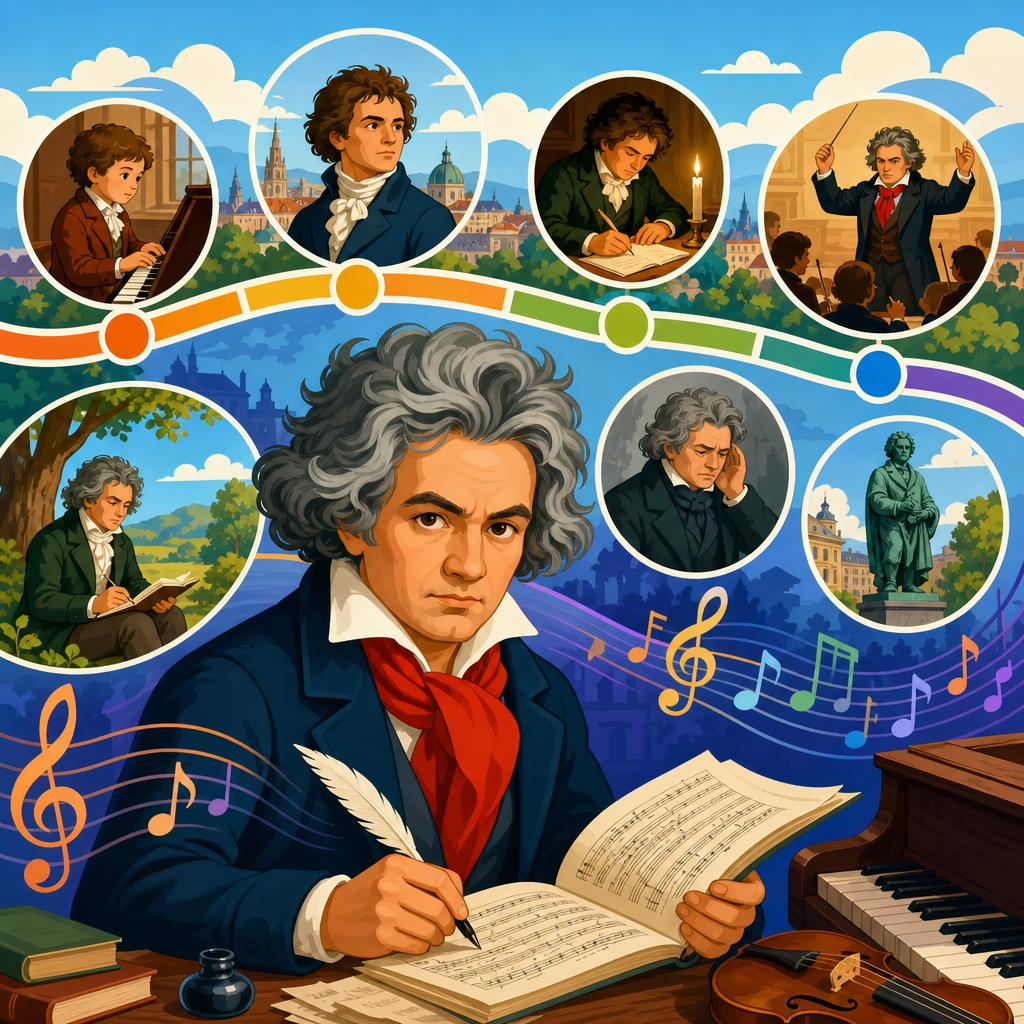
Interactive Timeline of Beethoven’s Life and Works
Interactive Timeline of Beethoven’s Life and Works brings Ludwig van Beethoven’s biography, compositions, influences, and legacy into one navigable format, making a vast subject easier to understand without flattening its complexity. An interactive timeline is more than a list of dates. It is a structured way to connect events, places, patrons, manuscripts, premieres, revisions, and historical context so readers can see how Beethoven’s life and works developed together. For a Multimedia Gallery hub page, that matters because Beethoven does not fit neatly into one category. He belongs to music history, performance practice, manuscript studies, cultural history, and digital storytelling at once. A well-built timeline helps readers move from a single curiosity—such as when he wrote the Fifth Symphony or how his hearing loss affected his work—to a broader understanding of his entire creative arc.
I have worked with music-history timelines, archive metadata, and program-note research long enough to know where readers usually get stuck. They often know isolated masterpieces but not the sequence that links them. Beethoven’s early Bonn years, his move to Vienna, his studies with Haydn, his crisis over deafness, his middle-period expansion of form, and his late-style experiments are frequently treated as separate stories. In practice, they are one continuous development. This article serves as a hub for that “Miscellaneous” territory within a Multimedia Gallery: the portraits, sketches, manuscript facsimiles, concert maps, instrument images, correspondence excerpts, and performance clips that illuminate the dates. It defines the key landmarks, explains why chronology matters, and points toward the kinds of related materials readers should expect across this subtopic.
Why Beethoven’s timeline is the best entry point
Beethoven’s life is unusually well suited to timeline-based exploration because his career aligns with major turning points in European culture. Born in Bonn in December 1770 and dying in Vienna in March 1827, he lived through the late Enlightenment, the French Revolutionary era, the Napoleonic Wars, and the restoration politics that followed. Those changes were not background decoration. They shaped patronage, publication, concert life, censorship, and ideas about the artist as an independent creative force. When readers encounter Beethoven in a gallery setting, they need chronology to make sense of the visual and audio material. A portrait from the 1790s communicates something different from a late engraving. A manuscript page from the Eroica period reveals a different compositional process than a late quartet sketch.
The timeline also clarifies a persistent misconception: Beethoven was not simply a bridge between Mozart and Romanticism. He was a working composer, pianist, improviser, teacher, negotiator, and businessman who adapted to changing conditions while pushing musical language forward. His output spans piano sonatas, string quartets, symphonies, concertos, chamber works, songs, a violin concerto, sacred music, incidental music, and one opera, Fidelio. He revised, repurposed, and struggled over many works. An interactive format lets readers compare dates of conception, publication, and premiere, which are often different. That distinction is crucial. The Ninth Symphony was first performed in 1824, but it belongs to a much longer late creative phase, just as Fidelio exists in multiple versions across years of revision.
Early years in Bonn and the move to Vienna
Any serious Beethoven timeline begins in Bonn, where he was born into a musical family connected to the electoral court. His grandfather, also named Ludwig van Beethoven, had been Kapellmeister, and that family standing mattered even though his father Johann’s alcoholism made Beethoven’s childhood unstable. By his teens, Beethoven was already active as a keyboard player and violist. Christian Gottlob Neefe, his teacher, recognized his ability early and helped him publish the Dressler Variations in 1783. Bonn exposed him to court music, opera, sacred repertory, and the intellectual currents of the University of Bonn circle. Readers often overlook this phase, but it explains why the young Beethoven arrived in Vienna with more practical experience than the legend of the “untamed genius” suggests.
The move to Vienna in 1792 marks one of the clearest milestones on any Beethoven timeline. Count Ferdinand von Waldstein famously predicted that Beethoven would receive Mozart’s spirit from Haydn’s hands, and while that line has become almost too famous, it captures contemporary expectation. Beethoven studied with Joseph Haydn, and later with Johann Georg Albrechtsberger and Antonio Salieri, absorbing counterpoint, composition, and vocal writing while also building a reputation as a formidable pianist. In the 1790s he was known especially for improvisation at the keyboard. The early piano sonatas, Op. 2, the piano trios, Op. 1, and the first piano concertos show him mastering Viennese forms while enlarging their scale and expressive charge. In gallery terms, this period connects beautifully with salon culture, instrument design, and the economics of subscription publishing.
The Heiligenstadt crisis and the emergence of a new style
By the late 1790s Beethoven’s hearing problems had begun to threaten both his profession and identity. The 1802 Heiligenstadt Testament, a letter to his brothers never sent during his lifetime, is one of the most important documents in any multimedia treatment of his life. It records despair, isolation, and his resolve to continue living for art. Readers often ask whether deafness “caused” greatness. The accurate answer is more careful. Hearing loss did not magically produce innovation, but it forced Beethoven to reimagine performance, communication, and composition under severe pressure. After Heiligenstadt, his music becomes more concentrated, bolder in architecture, and more willing to redefine inherited forms. The crisis matters because it reveals both vulnerability and discipline.
This transition is often called Beethoven’s middle period, though labels can oversimplify. What matters is the evidence in the works. The Third Symphony, Eroica, initially associated with Napoleon before Beethoven famously withdrew the dedication, expands symphonic length and dramatic ambition on a scale audiences had not heard before. The Waldstein and Appassionata sonatas transform the piano into a more orchestral instrument. The Razumovsky quartets widen the technical and expressive demands of chamber music. The Violin Concerto, Fourth and Fifth Symphonies, and the opera Fidelio demonstrate a composer testing every genre against his evolving sense of heroism, struggle, and release. In a timeline interface, readers should be able to see how these works cluster around years of extraordinary productivity between roughly 1803 and 1808 rather than appearing as isolated monuments.
Major periods, landmark works, and historical anchors
A practical timeline benefits from grouping Beethoven’s life into broad phases while preserving nuance. The table below gives readers a reliable framework for navigating the wider Multimedia Gallery and its related articles on manuscripts, portraits, instruments, and performances.
| Period | Approximate Years | Key Life Events | Representative Works | Why It Matters |
|---|---|---|---|---|
| Bonn formation | 1770–1792 | Court training, Neefe’s mentorship, early publications | Dressler Variations, early keyboard pieces | Shows professional grounding before Vienna |
| Early Vienna | 1792–1802 | Studies with Haydn and others, rise as pianist-composer | Op. 1 Trios, Op. 2 Sonatas, First Symphony | Establishes Beethoven within Viennese classicism |
| Transformative middle years | 1803–1814 | Heiligenstadt aftermath, growing deafness, public fame | Eroica, Fifth Symphony, Fidelio, Emperor Concerto | Redefines scale, drama, and artistic identity |
| Late period | 1815–1827 | Family turmoil, legal battles, near-total deafness | Missa solemnis, Ninth Symphony, Late Quartets | Pushes harmony, form, and introspection to new extremes |
This kind of structure helps answer common questions quickly. When did Beethoven become deaf? Gradually, with severe impairment documented from the late 1790s and near-total deafness later. When did he write his most famous symphonies? Mainly in the middle years, although the Ninth belongs to the late period. Did he keep evolving after public performance became difficult? Absolutely. In fact, some of his most radical music comes from the years when he could no longer function normally as a concert pianist. A good hub page must provide these direct answers while also encouraging deeper exploration through related media, because Beethoven’s dates mean more when paired with the objects and sounds attached to them.
Late Beethoven: inwardness, experiment, and legacy
After 1815, Beethoven’s life grew more difficult. His brother Kaspar Karl died, leading to the prolonged and painful custody battle over his nephew Karl. His finances were often strained, his health unstable, and his social interactions complicated by deafness. Yet these years produced works that continue to challenge performers, scholars, and listeners. The Piano Sonata Op. 106, known as the Hammerklavier, set a new benchmark for technical and structural ambition. The Missa solemnis united liturgical text with symphonic power on a monumental scale. The Diabelli Variations turned a modest waltz into one of the most intellectually dazzling sets of variations in Western music. Then came the Ninth Symphony, premiered in 1824, whose choral finale on Schiller’s “Ode to Joy” changed expectations of what a symphony could encompass.
The late string quartets, including Opp. 127, 130, 131, 132, 133, and 135, are indispensable in any complete Beethoven timeline because they reveal the furthest reach of his mature imagination. These works are not “difficult” merely because they are complex. They compress fugue, dance, prayer, variation, and abrupt contrast into forms that feel startlingly modern even now. Musicians still speak of them with a mixture of reverence and practical concern because every interpretive choice matters: tempo relations, articulation, bow distribution, voicing, and harmonic pacing can alter the listener’s grasp of the entire design. In a Multimedia Gallery hub, these quartets deserve links to score excerpts, performance comparisons, and manuscript images, since the visual evidence of revision is part of the story of how Beethoven thought.
How an interactive multimedia hub should organize Beethoven materials
Because this page serves as a sub-pillar hub for “Miscellaneous” within a Multimedia Gallery, breadth matters as much as chronology. Readers arriving here may be looking for portraits, maps, autograph manuscripts, audio excerpts, concert-program reproductions, instrument photographs, letters, or contextual essays. The best hub design organizes these materials by both time and type. For example, a user exploring 1804 should be able to see the Eroica in relation to Napoleon, patronage networks, surviving sketches, and Vienna’s concert culture. A user clicking 1824 should find the Ninth Symphony alongside premiere details at the Theater am Kärntnertor, contemporary responses, and later symbolic uses of the “Ode to Joy” theme, including its adoption by European institutions.
Accuracy in labeling is essential. Beethoven’s works frequently have opus numbers, nicknames, and alternate catalog identifiers, and a gallery should not confuse them. “Moonlight Sonata” is popular shorthand, but the formal title is Piano Sonata No. 14 in C-sharp minor, Op. 27 No. 2. “Emperor” Concerto is a posthumous nickname for Piano Concerto No. 5 in E-flat major, Op. 73. Fidelio exists in three overture-related forms connected to its revision history. Getting these details right builds reader trust and prevents the common problem of attractive but shallow music-history content. If this hub links onward to dedicated pages, each link should clearly signal whether it leads to a score-based study, a listening guide, a visual archive, or a historical explainer.
Another practical consideration is context around myth. Beethoven is often presented through dramatic anecdotes: shaking his fist at fate, sawing the legs off a piano, or existing as a solitary titan untouched by ordinary realities. Some stories have a basis in evidence; others have been exaggerated by nineteenth-century biography. A strong hub page neither strips away personality nor repeats legend uncritically. It notes that Anton Schindler, once influential as a source, is now treated cautiously because he manipulated evidence. It points readers toward more reliable scholarship, including work that uses sketch studies, letters, and documentary records. In my experience, audiences appreciate this honesty. It makes the surviving materials—conversation books, manuscript layers, publication records, and eyewitness reports—far more interesting than polished myth ever could.
Beethoven’s death on 26 March 1827 closes the timeline but not the story. The funeral in Vienna drew large crowds, and his posthumous reputation quickly expanded beyond the world of active musicians into national culture, education, recording, and film. Every generation remade Beethoven for its own purposes: Romantic hero, moral exemplar, political symbol, and benchmark of artistic seriousness. That afterlife belongs in a multimedia hub because reception history is part of the object record. Busts, memorial paintings, early editions, annotated scores, shellac recordings, LP cycles, and digital performances all show how later audiences encountered him. If readers use this page as their entry point, they should leave with a clear mental map of Beethoven’s life and works and with obvious paths to explore the gallery’s deeper resources. Start with the timeline, then follow the manuscripts, portraits, and performances that bring each date to life.
Frequently Asked Questions
What makes an interactive timeline of Beethoven’s life and works more useful than a standard biography?
An interactive timeline helps readers understand Beethoven as a developing artist rather than as a sequence of isolated masterpieces. In a traditional biography, major events and compositions are often discussed in separate chapters or themes, which can make it harder to see how his personal circumstances, professional relationships, and musical innovations unfolded together. A well-designed timeline places these elements side by side, allowing readers to follow how events such as his move from Bonn to Vienna, his studies with influential teachers, the onset of hearing loss, changing patronage, and shifting political conditions intersected with the creation of specific works.
This format is especially valuable because Beethoven’s career was marked by revision, experimentation, and gradual transformation. An interactive timeline can show not only when a piece was published, but also when it was first sketched, revised, premiered, or dedicated. That level of structure reveals patterns that a simple list of dates cannot. Readers can see, for example, how the so-called early, middle, and late periods emerge from real experiences, artistic risks, and practical constraints rather than from neat textbook labels alone. For a multimedia gallery, the timeline becomes even more effective because manuscripts, portraits, period maps, performance excerpts, and contextual annotations can be layered directly into the chronology, turning the study of Beethoven into a rich visual and auditory experience.
What key stages of Beethoven’s life should an interactive timeline include?
A strong timeline should begin with Beethoven’s early life in Bonn, where he was born in 1770 and received his first musical training within a courtly environment shaped by both opportunity and family pressure. This stage is important because it introduces the networks, repertories, and ambitions that formed his earliest musical identity. It should then trace his move to Vienna, the city that became the center of his mature career, where he built a reputation as a pianist, improvised brilliantly, studied composition, and entered aristocratic circles that supported his work.
From there, the timeline should clearly mark the growth of his public stature during the 1790s and early 1800s, the period in which he began to distinguish himself from the Classical models of Haydn and Mozart while still drawing on them. It should also highlight the crisis and significance of his hearing loss, including the emotional and artistic implications associated with the Heiligenstadt Testament. This is one of the central turning points in his life because it reframes his career not only as a story of success, but also as one of resilience and inward transformation.
The next stage should cover his middle years, when he produced many of his most famous works and expanded the scale, expressive range, and structural ambition of symphonies, sonatas, chamber works, and concertos. Finally, the timeline should trace his late period, characterized by intense formal experimentation, spiritual depth, and works that challenged both performers and audiences. His final years, legal struggles over the custody of his nephew, declining health, and death in 1827 should also be included, along with the immediate aftermath of his death and the growth of his legacy. By organizing these stages chronologically and thematically, the timeline helps readers see Beethoven not as a monument frozen in history, but as a person continually shaped by circumstance, intellect, and artistic purpose.
How can a timeline connect Beethoven’s compositions to the events and people that influenced them?
The most effective timelines do more than list compositions under a date. They show how each work emerged within a network of personal, artistic, and historical influences. For Beethoven, that means linking compositions to patrons who provided financial support, publishers who helped circulate his music, performers who inspired or premiered works, and fellow musicians whose ideas he absorbed, challenged, or transformed. It also means identifying the cities, salons, theaters, and private residences where music was composed, performed, revised, and heard.
For example, a timeline can connect his piano sonatas to his own reputation as a performer, his symphonies to Vienna’s concert culture, and his string quartets to the tastes and resources of aristocratic patrons. It can also show how political upheaval, including the Napoleonic era, formed part of the backdrop to works that audiences later heard as heroic, public, or dramatic. Just as importantly, the timeline can indicate that influence was rarely simple or one-directional. Beethoven learned from predecessors such as Haydn and Mozart, but he also recast their formal models in ways that expanded what instrumental music could express.
In a multimedia gallery setting, these relationships become easier to grasp. A user might click from a composition to a manuscript image, then to a dedication page, then to a map of Vienna, and then to a note explaining the patron or event connected to the work. This layered structure helps readers understand that Beethoven’s music did not emerge in isolation. It grew out of lived experience, artistic ambition, practical collaboration, and constant rethinking.
Why is historical context important when exploring Beethoven’s life through a multimedia timeline?
Historical context is essential because Beethoven’s life and works were shaped by the cultural and political world around him. Without that context, readers may recognize famous titles such as the “Eroica” Symphony, the Fifth Symphony, or the Ninth Symphony, but miss why those works carried such force in their own time. Beethoven lived during a period of revolution, war, shifting political power, changing social structures, and expanding public musical life. These developments affected patronage, publishing, concert activity, and the meanings audiences attached to instrumental music.
A multimedia timeline can place Beethoven within these broader currents without overwhelming the user. It can show how Vienna functioned as a musical capital, how aristocratic support coexisted with a growing public sphere, and how Enlightenment ideals, heroic rhetoric, and later introspective spirituality all touched his artistic world. Historical context also helps readers understand practical realities: why certain premieres mattered, why dedications could change, why publication timelines were irregular, and why revisions were often necessary.
For a multimedia gallery, context can be presented through maps, portraits, archival documents, concert announcements, letters, and carefully selected audio examples. These materials make Beethoven’s environment visible and tangible. They also prevent the timeline from reducing his life to a myth of solitary genius. Instead, they show him as a composer deeply engaged with the institutions, conflicts, expectations, and possibilities of his era. That fuller picture is more accurate, more compelling, and much more useful for readers who want to understand both the man and the music.
What should readers expect to discover in a multimedia gallery built around Beethoven’s timeline and legacy?
Readers should expect a gallery that makes Beethoven’s world easier to navigate while preserving its depth and complexity. At its best, this kind of resource allows users to move between biography, composition history, visual culture, and listening experience in a natural way. A visitor may begin with a major life event, such as his arrival in Vienna or the worsening of his hearing loss, and then follow links to related works, manuscript pages, correspondence, historical commentary, and performance materials. This approach supports both casual exploration and more focused study.
A multimedia gallery should also help readers compare different phases of Beethoven’s output. Someone interested in piano music might trace the evolution from the early sonatas to the late sonatas; someone focused on orchestral music might follow the trajectory from the First Symphony to the Ninth. Along the way, they can encounter premiere dates, revisions, dedications, sketches, and evidence of changing style. These details reveal how Beethoven’s legacy was built not only on inspiration, but also on craft, persistence, and continual reinvention.
Just as importantly, readers should discover that Beethoven’s legacy extends beyond a canon of famous works. An interactive timeline can show how later generations interpreted him, how his image as a heroic artist developed, and why his music remains central to concert life, scholarship, and cultural memory. In a gallery format, that legacy can be demonstrated through recordings, later portraits, reception history, and comparative references that show how enduring and adaptable his influence has been. The result is not simply an educational tool, but a dynamic framework for seeing how Beethoven’s life, works, and afterlife remain interconnected.