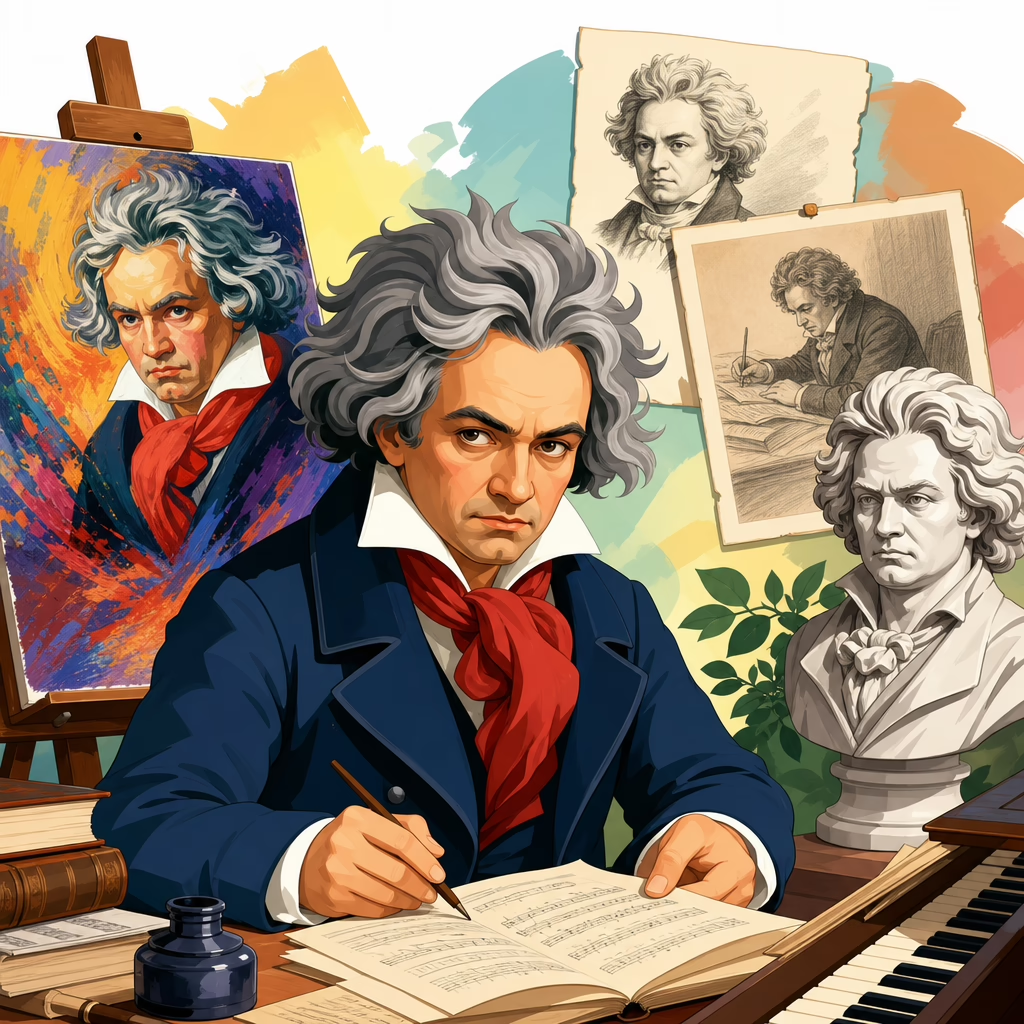
Visualizing Beethoven: Paintings, Drawings, and Sculptures
Ludwig van Beethoven has been heard more often than he has been seen, yet the visual record surrounding him is essential for understanding how posterity built the image of the composer as genius, struggler, celebrity, and cultural monument. In the Multimedia Gallery, “Visualizing Beethoven: Paintings, Drawings, and Sculptures” serves as the hub for miscellaneous visual materials that do not fit neatly into a single medium-specific discussion but together reveal how Beethoven’s face, body, clothing, gestures, and aura were observed, interpreted, copied, and mythologized. When historians speak about Beethoven iconography, they mean the full set of portraits, sketches, busts, medallions, prints, and later imaginative representations associated with him. That iconography matters because Beethoven lived at the moment when artistic fame became widely circulated through engravings, salons, publishers, and eventually public monuments. A score can tell us what he wrote; a portrait can show how he wished to appear, how patrons framed him, and how later generations projected ideals onto him.
I have worked with Beethoven image archives, museum catalogues, and facsimile collections long enough to know that no single likeness should be treated as the definitive Beethoven. Some images were made from life, some from memory, some after earlier models, and many were altered to suit commercial or commemorative needs. The practical question most readers ask is simple: what are the most important Beethoven paintings, drawings, and sculptures, and how reliable are they? The short answer is that the most valuable works are those closest to direct observation and securely dated, especially portraits by Joseph Karl Stieler, Ferdinand Georg Waldmüller, and early sculptural studies by Franz Klein and Hugo Hagen’s later monumental interpretations. Yet reliability is not the same as usefulness. Even idealized busts and romanticized prints tell us how nineteenth-century Europe wanted Beethoven to look. As a hub page for the miscellaneous branch of the Multimedia Gallery, this article maps the main categories, identifies landmark works, explains how scholars judge authenticity, and shows where each kind of object fits in the larger story of Beethoven reception.
What counts as a visual record of Beethoven
A visual record of Beethoven includes more than formal oil portraits. It encompasses painted portraits, pencil and chalk drawings, silhouette profiles, engraved reproductions, death masks, life masks where applicable, sculpted busts, commemorative statues, medallic portraits, manuscript-frontispiece illustrations, and even domestic objects decorated with his image. For a hub article, this broader definition matters because many readers arrive looking for “Beethoven portraits” but actually need guidance across media. A drawing made quickly from life may preserve expression more truthfully than a polished painting. A bust may capture cranial structure and posture in a way no engraving can. A print published after a popular portrait may spread a specific version of Beethoven to thousands of households, making it culturally influential even if it is several steps removed from the sitter.
The core distinction is between images made during Beethoven’s lifetime and those produced after his death in 1827. Lifetime images are primary witnesses, though not automatically accurate. Posthumous images are secondary constructions, often based on masks, earlier portraits, anecdotal descriptions, or national memory. Museums, auction houses, and catalogues raisonnés typically evaluate these objects using provenance, inscriptions, paper type, stylistic comparison, documented sittings, and publication history. If a drawing can be traced to Vienna in Beethoven’s circle and matches known facial asymmetries, hair pattern, and dress habits, it carries more weight than a later sentimental fantasy. This framework helps readers navigate the miscellaneous category without treating every familiar image as equal evidence.
Paintings that shaped Beethoven’s public image
The most famous painted likeness is Joseph Karl Stieler’s 1820 portrait, created for the piano manufacturer and patron Andreas Streicher and his wife Nanette. In this image Beethoven stands outdoors with wind-tossed hair, intense eyes, and a manuscript page of the Missa solemnis in hand. It is not merely a likeness; it is a manifesto of artistic seriousness. The red scarf, dark coat, and concentrated expression formed the template repeated in textbooks, record covers, and concert posters. Scholars value it because it was painted from life, but they also recognize Stieler’s intervention. The portrait sharpens the heroic mood and presents Beethoven as a visionary working in nature, aligning him with Romantic ideals.
Another significant contribution comes from Ferdinand Georg Waldmüller, whose 1823 portrait offers a different emotional register. Waldmüller’s Beethoven appears older, heavier, and more inward, with less theatrical stylization than Stieler’s celebrated image. When I compare reproductions side by side with students or curators, they immediately see the interpretive range: Stieler gives us the public monument in embryo, while Waldmüller gives us a more burdened, physically present man. Earlier painted portraits, including works linked to Christian Horneman and other artists active around Vienna, can be less secure in attribution or less widely reproduced, but they remain important because they document shifting perceptions before the late heroic image hardened into cliché.
Paintings also circulated through copies. In the nineteenth century, once one successful portrait gained approval from family, publishers, or the public, workshops and printmakers adapted it repeatedly. That multiplication is a key part of visualizing Beethoven. A copied image may not advance physiognomic accuracy, yet it expands cultural reach. For a Multimedia Gallery hub, this means related articles can branch from major paintings into print culture, domestic display, and commercial memory. The painting is only the beginning; its afterlife is often the larger story.
Drawings, sketches, and profile studies from life
Drawings are indispensable because they often preserve immediacy. Artists working in pencil, chalk, or wash could record Beethoven in conversation, at a sitting, or in brief observational sessions that did not require the formality of a painted commission. These works can appear modest beside finished oils, but they are frequently closer to living encounter. August von Kloeber, Louis Letronne, and other artists associated with Beethoven’s era contributed sketches or profile studies that scholars mine for details of bone structure, habitual expression, and aging. Even when a sketch is rough, the roughness itself can be informative. It may show the compressed mouth, forward thrust of the head, untamed hair, or heavy eyelids reported by contemporaries.
One reason drawings matter in the miscellaneous category is that they help resolve disputes created by idealized paintings and sculptures. If multiple independent sketches emphasize the broad forehead and irregular features, later busts that smooth those traits can be identified as commemorative rather than documentary. Drawings are also valuable for chronology. Beethoven in his thirties does not look like Beethoven in his fifties, and visual archives often collapse these stages into one timeless face. A dated study can anchor changing appearance to periods of illness, stress, or public recognition.
| Medium | Best use for researchers | Main limitation | Representative example |
|---|---|---|---|
| Painting | Understanding public image and patronage | Often idealized or revised | Stieler portrait, 1820 |
| Drawing | Capturing direct observation and aging | Can be fragmentary or lightly documented | Profile and chalk studies from Vienna circles |
| Sculpture | Showing structure, pose, and commemorative intent | Frequently posthumous and symbolic | Busts derived from death mask traditions |
| Tracing mass circulation and popular memory | Usually copied from earlier sources | Nineteenth-century engraved portrait editions |
For readers exploring linked gallery pages, drawings are often the best starting point if the goal is “What did Beethoven actually look like?” They are not infallible, but they usually reveal fewer layers of theatrical editing than state portraits or public monuments. In curatorial practice, I treat them as visual field notes: brief, partial, and sometimes the closest surviving witness.
Sculptures, busts, and monuments in three dimensions
Sculpture transformed Beethoven from famous composer into civic presence. Busts were especially important in the nineteenth century because they could be displayed in homes, conservatories, libraries, and theaters. A Beethoven bust on a piano signaled both musical aspiration and cultural seriousness. Some sculptors aimed for portrait fidelity, while others pursued emblematic grandeur. The distinction is crucial. A portrait bust tries to preserve recognizable anatomy; a commemorative bust seeks to embody genius through enlarged forehead, stern mouth, and elevated posture.
Franz Klein’s life mask and related sculptural efforts are central to this discussion because masks provided a direct physical index unavailable to painters. Beethoven’s death mask, taken shortly after his death, became a reference point for later artists attempting accuracy. Although masks are not expressive portraits, they establish proportions of the brow, nose, mouth, and jaw. Sculptors working after 1827 often claimed authority by aligning their work with mask evidence. Later public monuments, including the Beethoven-Haydn-Mozart memorial culture of the German-speaking world and the major Bonn statue by Ernst Julius Hähnel unveiled in 1845, did more than depict a man. They staged Beethoven as a national and transnational symbol.
That symbolic function intensified over time. In the concert-hall era, Beethoven sculpture became almost liturgical. Marble, bronze, and plaster versions placed him among lawgivers of art. The cost of that reverence is that many statues suppress bodily awkwardness and personal vulnerability. Still, these works are indispensable to the Multimedia Gallery because they document reception history. If a late nineteenth-century monument portrays Beethoven with commanding stillness and prophetic gaze, it tells us how institutions wanted audiences to approach his music: with awe, discipline, and historical consciousness.
How scholars assess authenticity and interpret differences
Readers often ask why Beethoven looks different from one image to another. The answer lies in method, purpose, and timing. An artist working from life during a short sitting might emphasize quick impressions. A commissioned painter might flatter. A sculptor producing a public statue decades later might combine several sources and adjust them to fit monument scale. Authentication therefore depends on layered evidence, not personal preference. Museums consult provenance records, correspondence about sittings, exhibition histories, signatures, technical analysis of pigments or paper, and comparisons with securely documented images. Institutions such as the Beethoven-Haus Bonn have built authority by cataloguing these materials systematically and distinguishing autograph works, workshop copies, later derivations, and doubtful attributions.
Interpretation also requires caution about familiar myths. Beethoven was not permanently frozen in one expression of stormy defiance. Contemporaries described him as animated, absent-minded, humorous, disheveled, intense, and at times socially awkward. A severe portrait may be accurate to one sitting and misleading as a total summary. The same applies to hearing loss and illness. These shaped his later appearance, but they should not erase the younger Beethoven visible in earlier studies. When I review image sets with collectors or editors, the most useful practice is comparative viewing: line up dated works, note recurring features, then separate anatomy from artistic narrative. That process prevents overreliance on one canonical image.
Using this hub within the Multimedia Gallery
As a sub-pillar hub under Multimedia Gallery, this miscellaneous page should orient readers toward deeper articles on individual objects, artists, and categories of reproduction. The best internal structure is practical. One branch can focus on famous painted portraits such as Stieler and Waldmüller. Another can cover sketches and drawings from life, including profile studies and notebook-adjacent materials. A third can examine busts, masks, and major public monuments. Additional linked pages can address engraved reproductions, decorative objects, modern reinterpretations, and museum collections with digitized holdings. This hub exists to connect those strands so readers understand the whole ecosystem of Beethoven imagery.
For educators, performers, and collectors, the benefit of that ecosystem is clarity. If you are selecting an image for a program note, album booklet, classroom slide, or exhibition label, medium and date should guide your choice. Use a lifetime drawing when discussing appearance, a major painted portrait when discussing public reputation, and a monument or bust when discussing canon formation. For general readers, the takeaway is equally straightforward: Beethoven’s visual legacy is not one face but a chain of interpretations, each reflecting a specific encounter, agenda, and historical moment. Explore the linked articles in this Multimedia Gallery hub, compare the images closely, and you will see not only Beethoven, but also the cultures that repeatedly reinvented him.
Frequently Asked Questions
Why does Beethoven’s visual legacy matter if his music is the primary source of his fame?
Beethoven’s visual legacy matters because it shaped how generations of listeners, scholars, patrons, and the general public imagined the composer long after his lifetime. Most people encounter Beethoven first as a cultural symbol rather than as a historical person, and paintings, drawings, prints, medals, busts, and sculptures played a major role in creating that symbol. These images did not simply record his appearance; they interpreted it. Artists emphasized certain features—his intense gaze, unruly hair, stern expression, heavy brow, and forceful posture—to align him with broader ideas of artistic genius, inner struggle, heroic individuality, and spiritual depth. In that sense, visual representations helped transform Beethoven from a working composer in Vienna into an international icon.
Visual materials are also essential because they reveal how posterity built and revised Beethoven’s public image over time. A portrait made during his life may attempt likeness, social status, or character, while a later sculpture may present him as a monument to national culture, universal art, or Romantic suffering. Looking across these objects allows viewers to see not one Beethoven, but many Beethovens: the professional musician, the difficult contemporary, the celebrity, the mythic genius, and the commemorated master. For historians, this visual record is invaluable because it documents changing tastes, values, and ideologies as much as it documents the man himself.
What kinds of visual materials are typically included in a gallery devoted to Beethoven beyond formal portraits?
A gallery like “Visualizing Beethoven: Paintings, Drawings, and Sculptures” usually brings together a wide range of objects that extend far beyond official painted portraits. It may include informal sketches, profile studies, miniatures, engravings, lithographs, death masks, life masks, medallions, busts, statues, commemorative monuments, and even images derived from earlier works through reproduction. Each type of object contributes something different. A quick drawing might capture an impression of Beethoven’s expression or body language in a way a polished oil portrait does not. A sculpted bust can translate his features into durable, idealized form. Reproductive prints often reveal how a particular image circulated widely and became standard in the public imagination.
These materials are especially useful when studied together because they reveal how Beethoven’s face, body, clothing, and presence were repeatedly interpreted across media. Even details such as hairstyle, coat, cravat, hand position, or the inclusion of music manuscripts can carry meaning. Artists and publishers often used these visual cues to communicate seriousness, intellect, passion, discipline, or turbulence. In a mixed-media gallery, viewers can compare how different forms balance realism and symbolism. This kind of comparison helps explain how visual culture constructed Beethoven not merely as a man who looked a certain way, but as a figure whose appearance became inseparable from ideas about creativity, authority, and enduring fame.
How accurate are paintings, drawings, and sculptures of Beethoven as records of his real appearance?
The accuracy of Beethoven’s visual representations varies considerably, and that is one of the most important things to understand when viewing them. Some works were created from direct observation during his lifetime and may preserve genuine details of his face, age, or bearing. Others were produced from memory, from secondhand descriptions, or by copying earlier images, which means they may be less reliable as strict likenesses. Even works made from life are not neutral documents. Every portrait involves artistic choices about pose, lighting, expression, costume, and emphasis. An artist may sharpen Beethoven’s features to suggest force of character, soften them to convey dignity, or dramatize them to fit a prevailing image of genius.
Sculptural works raise similar questions. A bust or statue may appear more concrete or objective, but it too can be shaped by idealization. In some cases, sculptors sought to create a monumental Beethoven rather than an exact one. Later nineteenth-century and modern representations often tell us as much about the era that produced them as they do about Beethoven himself. For that reason, scholars often read visual sources critically, asking when the image was made, who commissioned it, what audience it addressed, and what model it relied on. The goal is not simply to decide whether an image is “true” or “false,” but to understand what kind of truth it was trying to present—physical likeness, moral stature, emotional intensity, or cultural greatness.
Why do so many images of Beethoven emphasize struggle, intensity, and seriousness?
These qualities became central to Beethoven’s image because they fit the powerful narrative that emerged around him in the nineteenth century: the composer as heroic genius who wrestled with fate, suffering, and the limits of human experience. His biography encouraged that reading. His hearing loss, difficult temperament, independence from convention, and the perceived emotional force of his music all contributed to an image of extraordinary inner conflict and artistic determination. Visual artists responded by highlighting signs of mental concentration, physical tension, and emotional gravity. A furrowed brow, compressed mouth, windswept hair, or penetrating stare could signal not just personality, but the labor of genius itself.
This emphasis also reflects broader Romantic ideals. During and after Beethoven’s lifetime, European culture increasingly celebrated the artist as an exceptional individual whose works arose from profound inner necessity. Beethoven became one of the defining examples of that model. As a result, visual representations often moved away from the conventions of elegant social portraiture and toward more charged, expressive characterization. He might appear less as a court musician and more as a solitary creator, absorbed in thought and set apart from ordinary society. Over time, these features became so familiar that they turned into visual shorthand. Even viewers who know little about the historical Beethoven can recognize the message: this is not merely a composer, but a figure of monumental seriousness, endurance, and artistic power.
What can viewers learn by comparing different visual representations of Beethoven across time and media?
Comparing images across time and media allows viewers to see how Beethoven’s identity was constructed, repeated, and transformed rather than simply preserved. A drawing made during his life may suggest immediacy and observation, while a later painting may reinterpret those features through the lens of hero worship. A bust can distill his face into an emblematic form, and a public monument can elevate him into a civic or national symbol. By placing such works side by side, viewers begin to notice patterns: which features remain constant, which are exaggerated, which disappear, and which acquire symbolic weight. That process reveals how visual culture builds authority and familiarity through repetition.
This comparative approach also helps viewers distinguish between historical documentation and cultural memory. Some images aim to show Beethoven as a living person embedded in a social world, complete with clothing, age, and context. Others present him as timeless, almost abstracted from ordinary life. The shift from observed individual to monumental icon tells an important story about canon formation, celebrity, and commemoration. It shows how Beethoven became more than a composer whose works were admired; he became a figure onto whom societies projected ideals about art, intellect, perseverance, and heritage. In that sense, studying paintings, drawings, and sculptures together deepens our understanding not only of Beethoven, but of the historical cultures that needed him to look the way they imagined greatness should look.