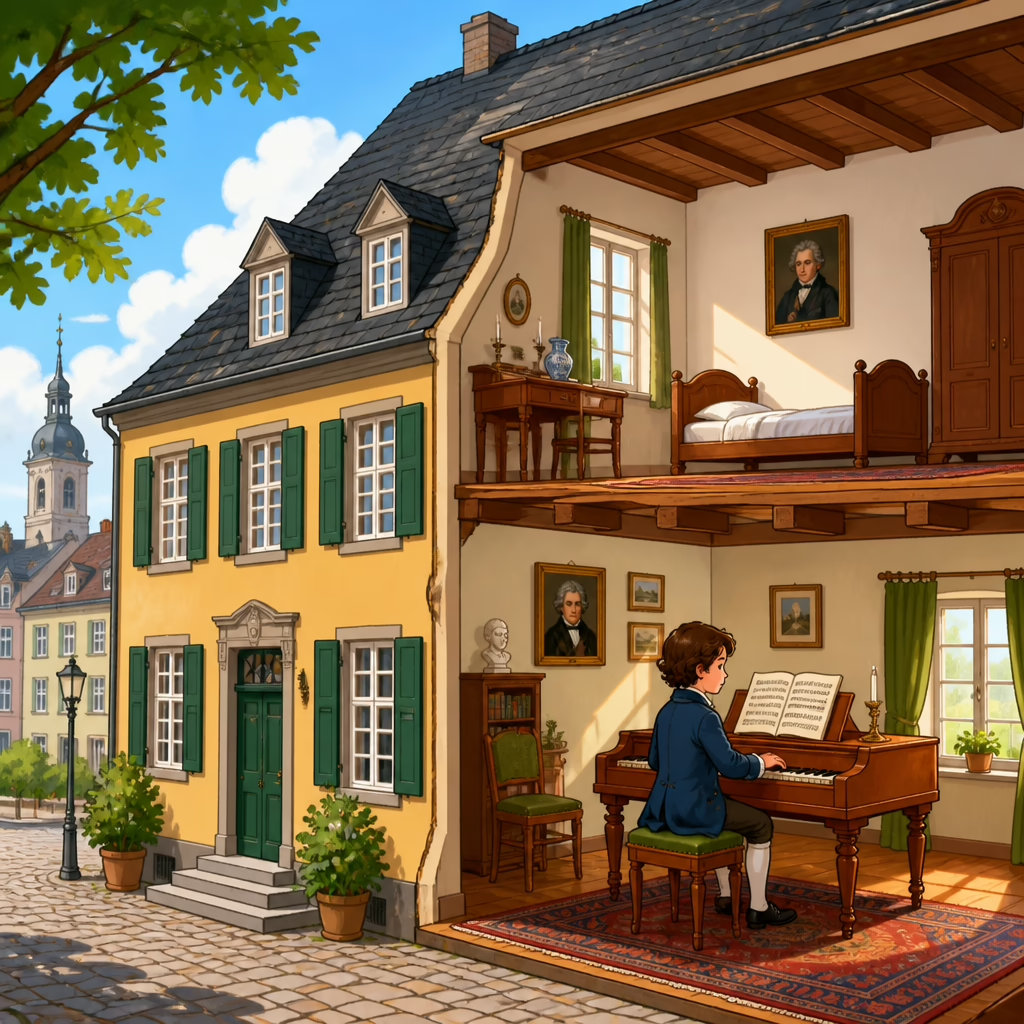
Inside Beethoven’s Childhood Home in Bonn
Inside Beethoven’s Childhood Home in Bonn, visitors encounter not a grand palace but a compact Rhineland townhouse that reveals how genius was shaped by family pressure, urban life, music education, and the practical realities of eighteenth-century Bonn. The house at Bonngasse 20 is widely known as Ludwig van Beethoven’s birthplace, yet its significance goes far beyond a commemorative address. It preserves the domestic setting in which one of history’s most influential composers spent his earliest years, and it helps explain the social world that formed him before Vienna, fame, deafness, and the late quartets entered the story. For anyone interested in biography, this home matters because it turns an abstract legend into lived space: rooms with low ceilings, narrow stairs, workaday furnishings, instruments, and archival objects that connect childhood experience to artistic development.
Understanding Beethoven’s childhood home begins with a few clear terms. “Birthplace” refers to the rear house within the property where Beethoven was born in December 1770. “Childhood home” is broader, covering the family environment associated with the Bonngasse residence and the surrounding neighborhood in the Electorate of Cologne. The current museum, operated by the Beethoven-Haus association founded in 1889, combines the historic structure with adjoining buildings to present manuscripts, portraits, instruments, and everyday artifacts. As someone who has worked through musician-house museums across German-speaking Europe, I find Beethoven-Haus unusually effective because it does not rely on myth alone. It uses architecture, documented family history, and material culture to show how a gifted child developed under conditions that were often unstable, ambitious, and emotionally demanding.
The importance of this site also lies in what it corrects. Many people imagine Beethoven emerging from a solemn shrine of pure inspiration. The real home suggests something messier and more human. His grandfather was a respected Kapellmeister, his father Johann was a court singer with serious ambitions for his son, and the family lived within a crowded urban household shaped by work, religion, status anxiety, and financial uncertainty. Seeing the house clarifies how close Beethoven was to the professional music world from birth, and how fragile that world could be. The museum therefore serves not simply as a memorial but as evidence. It anchors biography in place, and that makes every later triumph sound different.
The house itself: what survives and what visitors actually see
Beethoven-Haus stands on Bonngasse in Bonn’s old town, an area that in Beethoven’s day was densely built and socially mixed. The surviving complex includes a street-facing house and a rear building around an inner courtyard. The rear house is especially important because it is identified as the place of Beethoven’s birth. Architecturally, this is not a monumental residence. It is a typical bourgeois urban property of the eighteenth century, with constrained circulation, modest room sizes, and the layered use of domestic and service spaces common in Rhineland towns. That scale matters. It reminds visitors that the Beethoven family did not inhabit elite comfort, even though they were tied to the court’s musical establishment.
One of the strengths of the museum is its careful distinction between original fabric and later interpretation. No responsible curator claims that every room looks exactly as it did in 1770. Fires, renovations, nineteenth-century collecting habits, and the creation of the museum all changed the site. Yet enough survives to communicate proportion, atmosphere, and social setting with unusual force. The courtyard arrangement, the steep stairs, and the separation between front and rear structures help explain how families, tenants, and household labor coexisted. In practical terms, the house feels compressed. That physical compression is informative: Beethoven’s early life unfolded not in isolation but in close proximity to relatives, neighbors, teachers, and the street outside.
The museum’s interpretation also benefits from restraint. Rather than staging theatrical reconstructions, it combines period rooms with object displays and documentary context. Visitors move through spaces that evoke domestic life while also encountering authenticated items associated with Beethoven and his family. This balance is essential in a birthplace museum. Too much reconstruction risks fiction; too little interpretation leaves only empty rooms. At Beethoven-Haus, the architecture does part of the biographical work on its own, while labels and collections fill in the evidence.
Family life in Bonngasse and the pressures of upbringing
To understand the meaning of the home, it helps to understand who lived within its orbit. Beethoven’s father, Johann van Beethoven, worked as a tenor in the electoral court chapel. His mother, Maria Magdalena Keverich, came from a more modest but respectable background and is generally described in contemporary accounts as warm, gentle, and stabilizing. Beethoven’s grandfather, also named Ludwig van Beethoven, had risen to become Kapellmeister in Bonn and represented the family’s strongest model of professional achievement. In the house museum, this family structure is not decorative genealogy; it is the framework for Beethoven’s earliest emotional and musical environment.
Biographers have long emphasized the contrast between the grandfather’s reputation and the father’s frustrations. Johann recognized his son’s ability early and pushed him hard, apparently hoping to market him as a prodigy in the model of Mozart. That ambition had consequences at home. Reports from later sources describe rigorous practice, irregular discipline, and a childhood shaped by expectation as much as affection. The house makes those dynamics easier to grasp. In a compact residence, lessons, arguments, rehearsals, drinking, domestic tasks, and sleep would not have been neatly separated. The walls were thin in every social sense.
At the same time, the home should not be reduced to a story of hardship alone. Bonn offered Beethoven genuine opportunity. Court employment gave the family access to trained musicians, repertory, and instruments that many children would never encounter. Teachers including Christian Gottlob Neefe later played decisive roles in Beethoven’s education, introducing him to keyboard practice, composition, and the music of J.S. Bach. In other words, the childhood home reflects a dual reality: strain inside the household and a serious musical ecosystem just outside its door. That combination helps explain Beethoven’s resilience. He learned early that discipline could open doors, even when domestic life was unstable.
Objects that turn biography into evidence
The most compelling rooms in Beethoven-Haus are the ones where material objects bridge the gap between legend and documentation. Portraits of family members, period keyboard instruments, household items, and early printed editions provide a factual basis for interpreting Beethoven’s youth. Among the most famous images is the portrait of Beethoven’s grandfather, which the composer is known to have valued deeply throughout his life. In biographical terms, that portrait matters because it shows whom Beethoven regarded as a model of dignity and accomplishment. When a museum can connect an object to a remembered family relationship, the story gains weight.
Musical instruments are especially important here, but they must be read carefully. Not every keyboard in the museum was physically used in Bonngasse during Beethoven’s childhood. What matters is that the collection demonstrates the sound world and tactile world he knew: clavichords, harpsichords, early pianos, and string instruments built for eighteenth-century performance practice. For visitors, this is more than decorative context. Different keyboard actions required different touch, articulation, and dynamic control. Anyone who has worked with historical instruments knows that they shape thinking. Beethoven’s early training was grounded in that material reality, and the museum communicates it well.
Documents and manuscripts add another layer. Early publications, letters, and records of appointments situate the family within Bonn’s court culture and show how quickly Beethoven moved from talented child to working musician. These items answer a common question directly: can a childhood home really tell us anything precise about artistic development? In this case, yes. The combination of domestic spaces and documentary evidence demonstrates that Beethoven’s education was not accidental. It was structured by family ambition, professional networks, and institutional access.
How the museum explains Beethoven’s early musical formation
What did Beethoven actually learn during the years connected with Bonngasse? The museum’s best contribution is that it shows his development as cumulative rather than miraculous. He studied keyboard, violin, viola, figured bass, improvisation, and composition within a court-centered environment where practical versatility mattered. Young musicians were expected to read quickly, accompany, adapt, and serve liturgical or theatrical needs. Beethoven’s later originality did not emerge from nowhere; it grew from craft learned early and rigorously.
His connection to Christian Gottlob Neefe is crucial. Neefe, court organist and composer, recognized the boy’s unusual gifts and helped guide him beyond routine instruction. Under Neefe’s influence, Beethoven encountered Bach’s Well-Tempered Clavier, a foundational experience for any serious keyboard player. He also published early works, including variations and keyboard pieces, while still young. The home museum places these milestones close to the domestic setting that preceded them, making a subtle but important point: advanced artistic training can begin in ordinary rooms, provided the surrounding culture supplies standards, mentors, and expectations.
Another key insight concerns labor. Visitors sometimes imagine childhood talent as spontaneous brilliance. The Bonngasse story points instead to repeated practice under pressure. Beethoven played publicly as a child, served as an assistant organist in his teens, and absorbed the routines of professional music before adulthood. That apprenticeship model is visible throughout the museum’s interpretation. It helps explain later traits often treated as purely personal genius: his command of form, his fluency at the keyboard, and his ability to think compositionally through performance. The roots of those strengths lie in the disciplined environment reflected by the house.
| Feature in Beethoven-Haus | What it reveals about childhood | Why it matters biographically |
|---|---|---|
| Rear birth house | Modest domestic scale and crowded living conditions | Shows Beethoven did not come from aristocratic luxury |
| Grandfather’s portrait | Family memory centered on professional success | Explains Beethoven’s lifelong identification with that lineage |
| Period keyboard instruments | Hands-on world of eighteenth-century training | Connects technique to the tools available in youth |
| Archival documents | Court employment and educational networks | Demonstrates structured access to musical advancement |
What the house cannot tell us, and why that honesty matters
A serious visit to Beethoven’s childhood home also requires recognizing its limits. Birthplace museums are always vulnerable to overinterpretation. Rooms cannot preserve tone of voice, exact daily routines, or the emotional texture of every family interaction. Some popular anecdotes about Beethoven’s early suffering or precocity come from later reminiscences that scholars treat cautiously. Beethoven-Haus is strongest when it stays close to verifiable evidence, and that is precisely why it is credible. It distinguishes between documented fact, plausible context, and romantic legend.
This matters because the temptation to simplify Beethoven’s childhood is strong. One version turns him into a sainted prodigy; another turns him into a purely traumatized child forged by adversity. The house supports neither extreme. It suggests a talented boy raised in a musically privileged yet personally unstable environment, where opportunities and pressures were tightly intertwined. That is a more useful understanding because it respects both history and human complexity.
For visitors, this honesty improves the experience. Instead of leaving with a postcard myth, you leave with sharper questions. How did court culture shape ambition? How did domestic stress affect discipline? What does it mean for creativity to emerge from routine labor and family expectation rather than mystical isolation? A good biographical museum does not pretend to answer everything. It gives the evidence needed to think better. Beethoven-Haus does exactly that, and that is why it remains one of Europe’s most valuable composer museums.
Inside Beethoven’s Childhood Home in Bonn, the essential lesson is not that greatness can be contained in a single preserved room. It is that place can clarify biography when architecture, objects, and records are interpreted with discipline. Bonngasse 20 shows Beethoven at the beginning: a child of a working musical family, a resident of a cramped town house, a student formed by court culture, and a young artist pushed by both support and strain. The museum’s value lies in this precision. It helps visitors see how environment shaped temperament, skill, and aspiration long before Beethoven became a symbol of heroic genius.
The house also leaves a practical takeaway for anyone studying Beethoven seriously. Start with the early setting. Before analyzing the symphonies or debating the late style, look at the family hierarchy, the neighborhood, the instruments, and the educational networks visible in Bonn. They explain why Beethoven’s later independence rested on deep training rather than mythic spontaneity. If you are planning a biography-focused trip, put Beethoven-Haus at the center and spend time with the rooms, labels, and collections rather than rushing through for photographs. The reward is a clearer, more grounded understanding of the composer from the very place where his story began.
Frequently Asked Questions
Why is Beethoven’s childhood home in Bonn so important?
Beethoven’s childhood home at Bonngasse 20 matters because it offers something far more revealing than a simple birthplace marker. Rather than presenting Beethoven as an abstract musical genius detached from ordinary life, the house places him back into the intimate, crowded, and demanding world that shaped his earliest years. Visitors see a modest Rhineland townhouse, not an aristocratic residence, and that contrast is essential. It reminds us that Beethoven emerged from a working court-musician family whose ambitions, limitations, and daily routines influenced his development from the start.
The house is significant historically because it helps explain the environment in which Beethoven’s musical identity first formed. Family pressure, especially from his father, Johann van Beethoven, played a major role in his early training. The domestic setting also reveals how close together home life, music study, and social expectations could be in eighteenth-century Bonn. This was not a separate world of rehearsal halls and concert institutions as people might imagine today. Music education happened within the family, within the town, and within the structures of court service and urban life.
It is also important because it preserves the human scale of Beethoven’s beginnings. The site encourages visitors to think not only about the composer’s later fame, but about childhood, discipline, economic uncertainty, and aspiration. In that sense, the house is valuable both as a memorial museum and as a cultural document. It makes Beethoven’s story more concrete, more historically grounded, and ultimately more compelling.
What can visitors actually see inside Beethoven’s House in Bonn?
Inside Beethoven’s House, visitors encounter rooms and displays that aim to reconstruct the world surrounding the composer’s early life rather than simply present a shrine to celebrity. The building itself is one of the main attractions. Its proportions, layout, and domestic character immediately communicate the realities of urban middle-class life in eighteenth-century Bonn. The narrow townhouse setting helps visitors understand how closely family life, work, and artistic development overlapped.
The museum typically includes period rooms, historical interiors, and exhibitions devoted to Beethoven’s biography, family background, and musical career. Visitors can expect to see objects connected to the Beethoven family, portraits, documents, musical materials, and interpretive displays that place his childhood within the broader context of Bonn’s cultural life. These exhibits are especially valuable because they show that Beethoven’s upbringing was shaped not just by personal talent, but by a network of teachers, patrons, court institutions, and local traditions.
Another major part of the experience is the way the museum links the physical house to Beethoven’s later legacy. Rather than isolating childhood from adulthood, the displays often trace a line from his upbringing in Bonn to his emergence as a revolutionary composer. For many visitors, the most memorable aspect is precisely this contrast: the modest domestic setting versus the enormous global influence Beethoven would later achieve. The result is a museum visit that feels both personal and historically rich.
Did Beethoven really grow up in this house, and was it definitely his birthplace?
Bonngasse 20 is widely recognized as Beethoven’s birthplace, and that identification is central to the museum’s meaning. Historically, the house is closely associated with the Beethoven family and with Ludwig van Beethoven’s earliest years. When people visit, they are not stepping into a vague symbolic site; they are entering a place deeply rooted in the documented story of his beginnings in Bonn. That direct connection is one reason the house has such enduring importance in Beethoven scholarship and public memory.
At the same time, good historical interpretation goes beyond simply stating that he was born there. The value of the site lies in understanding what that birthplace represented in practical terms. This was a functioning family residence in a dense urban setting, not a romantic retreat designed for artistic inspiration. The house helps clarify the social world into which Beethoven was born: a family connected to music, dependent on steady work, and subject to both opportunity and pressure. That context is just as meaningful as the birthplace designation itself.
So yes, the house is recognized as Beethoven’s birthplace, but the deeper point is that it allows visitors to move from a commemorative fact to a fuller historical understanding. It turns a famous address into a lived environment, showing how Beethoven’s early years were shaped by home life, economic realities, and the expectations placed on a musically gifted child.
How does the house help explain Beethoven’s childhood and family life?
The house is especially powerful because it anchors Beethoven’s childhood in the realities of family dynamics and everyday domestic life. Visitors quickly see that he did not grow up in luxury. The home’s compact scale suggests a world in which privacy was limited, routine was structured, and family relationships would have been intensely felt. This setting matters because Beethoven’s early life was shaped by both encouragement and strain, especially through his father’s efforts to cultivate his talent.
Johann van Beethoven is often remembered as a demanding figure who pushed his son’s musical education hard, and the house helps visitors imagine how that pressure would have played out in daily life. Practice, instruction, correction, and ambition were not distant professional matters; they were woven into the home itself. That helps explain why Beethoven’s childhood can appear both productive and difficult. He received serious early training, but within conditions marked by expectation, discipline, and uncertainty.
The home also reflects the broader structure of eighteenth-century Bonn, where music was tied to court service, status, and livelihood. Beethoven’s family life cannot be separated from those practical concerns. The house therefore tells a larger story: not only of a gifted child, but of a family navigating work, aspiration, and social mobility through music. That context gives visitors a more mature understanding of Beethoven’s formative years, one that goes beyond myth and emphasizes the lived experience behind artistic greatness.
Is Beethoven’s House in Bonn worth visiting if you are not a classical music expert?
Yes, absolutely. Beethoven’s House is worthwhile even for visitors who know very little about classical music because its appeal extends well beyond composer biography. At its core, the museum is about childhood, family ambition, urban history, and the making of cultural memory. You do not need to read a musical score to understand the emotional and historical power of standing in the modest home where one of the world’s most influential artists began life.
For non-specialists, the museum works because it tells a human story first. It invites visitors to think about how talent develops under pressure, how families shape children’s futures, and how ordinary surroundings can produce extraordinary outcomes. The compact rooms and historical displays make Beethoven feel less remote and more real. Instead of encountering only a monumental figure from textbooks, visitors meet a child of Bonn whose life was shaped by household expectations, social structures, and the cultural life of his city.
Experts, of course, will appreciate the museum’s documentary and historical depth, but casual travelers often find it just as rewarding. It is one of those places where architecture, biography, and social history come together naturally. Even if Beethoven’s music is not your main interest, the house offers a vivid and memorable glimpse into eighteenth-century life and into the surprisingly humble beginnings of a world-changing artist.