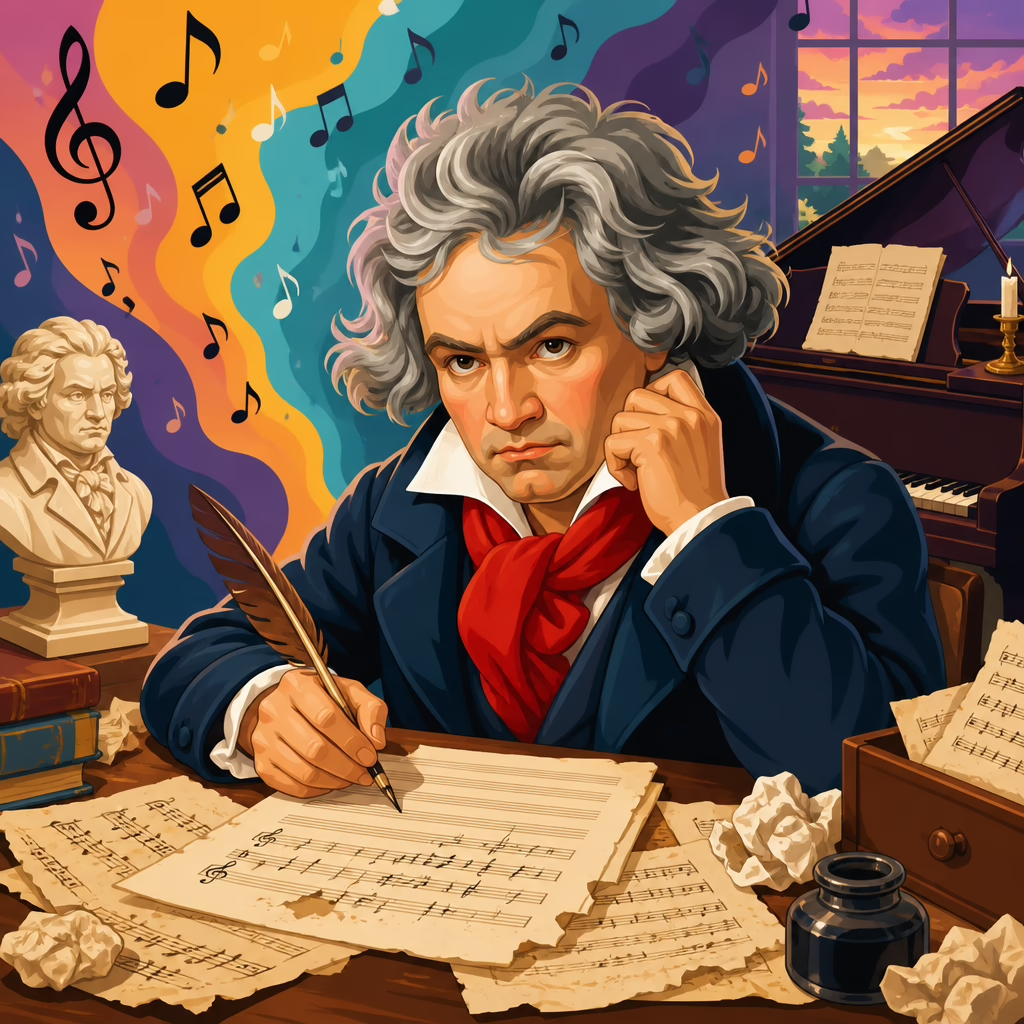
Beethoven Fragments and Unfinished Works Worth Knowing
Beethoven fragments and unfinished works reveal the composer at his most human: exploratory, restless, and often willing to abandon a promising idea when it no longer met his standards. In music history, a fragment is a surviving portion of a composition that was never completed, while an unfinished work may include substantial drafts, partial movements, or a score left incomplete at the composer’s death. These pieces matter because they open a direct window onto Beethoven’s working process, showing how themes were tested, discarded, revised, and sometimes transformed into better-known masterpieces. Having worked through autograph facsimiles, thematic catalogues, and modern performing editions, I have found that these remnants are not mere curiosities. They help listeners understand how Beethoven thought in sound, how he handled form under pressure, and how his ambitions often exceeded what a commission, a deadline, or his own changing artistic priorities would allow. For performers and serious listeners, knowing a handful of key fragments sharpens the ear. You begin to hear the difference between a complete argument and an experiment still in motion, and that distinction is central to appreciating Beethoven’s development.
Interest in unfinished Beethoven has also grown because editors, scholars, and performers now treat sketches more carefully than earlier generations did. Nineteenth-century publishers often polished rough material to make it marketable, but modern scholarship asks a better question: what can the source actually support? That shift has led to more honest reconstructions and more useful listening. Some unfinished works survive as a single movement in full score; others exist only in short score, thematic outlines, or disconnected pages. A few have inspired completions by later musicians, but the value of the original fragment remains independent of any reconstruction. It lies in what it documents: a compositional decision paused midstream. In Beethoven’s case, that is especially important because he composed through notebooks, sketch leaves, bifolios, and revised fair copies with exceptional intensity. His fragments show him wrestling with sonata form, variation technique, orchestral balance, and piano figuration in real time. They also correct a common myth that genius arrives fully formed. Beethoven’s surviving drafts show labor, revision, and strategic abandonment. If you want to know Beethoven more deeply through works that stand just outside the standard canon, these are the fragments and unfinished pieces worth knowing first.
Why Beethoven Left Works Unfinished
Beethoven did not leave pieces incomplete for one simple reason. In practice, several forces overlapped: self-criticism, shifting artistic aims, unstable finances, health problems, competing commissions, and the practical reality that he often recycled ideas into stronger works. From the late 1790s onward, his sketchbooks show a habit of testing multiple openings, modulatory plans, and thematic continuations before deciding which route deserved full development. When a project stopped, that did not necessarily mean failure. It often meant triage. Beethoven was managing a growing reputation, patrons with expectations, publication opportunities, and, by the early nineteenth century, increasing deafness. Under those conditions, some pieces became workshops for larger ambitions.
This is why fragments should not be judged by the standards of finished masterworks alone. A surviving torso may preserve a bold harmonic turn, an unusual keyboard texture, or a formal experiment that Beethoven later refined elsewhere. I have seen performers dismiss fragments as secondary until they encounter one on the page and recognize unmistakable fingerprints: compressed motivic work, abrupt dynamic contrast, and transitions already moving beyond Classical politeness. In other cases, incompletion reflects a practical break. A movement may survive without orchestration because Beethoven delayed scoring; a piano piece may stop after an exposition because he had not settled the developmental logic. Reading these sources reminds us that composing was not a straight line from inspiration to completion. It was a negotiated process, and Beethoven was ruthless about whether an idea earned its final form.
The Piano Sonatas That Never Fully Became Sonatas
Among Beethoven fragments, the unfinished piano sonatas are especially revealing because the piano was his primary testing ground. The most famous is the Piano Sonata in C major, Hess 15, often called the “Sonata in C major fragment” from around 1793. It survives as a substantial Allegro movement and reflects the young Beethoven still close to Haydn and Mozart, yet already pushing toward stronger contrast and denser motivic concentration. It is worth hearing not because it equals the published early sonatas, but because it shows how quickly Beethoven was learning to energize a conventional sonata texture from within.
Another important case is the Piano Sonata in F minor, Hess 48, generally dated to 1790–1792. This early fragment predates the mature sonata cycle but already points toward Beethoven’s taste for minor-mode urgency. Even in incomplete form, the thematic profile is more insistent than decorative. The interest here is diagnostic: you can hear Beethoven moving away from keyboard writing based mainly on surface elegance and toward thematic compression, where a small rhythmic cell drives the argument.
The late period offers an even more tantalizing example in the piano sonata movement in C major, catalogued as a fragment from the 1820s and associated by some scholars with ideas circulating near the time of Op. 109–111. These leaves matter because late Beethoven often composed in discontinuous bursts, and not every conceptual breakthrough found a final vessel. In such pages, one sees abrupt registral extremes, skeletal voice-leading, and harmony that seems to think ahead of the notation. For pianists, these fragments are worth studying alongside the published sonatas because they expose the late style before editorial smoothing.
Bagatelles, Album Leaves, and Short Piano Fragments
Short unfinished piano works may seem minor beside the sonatas, but they are indispensable for understanding Beethoven’s workshop. The bagatelle was not always a trivial form for him. In compact dimensions, he could test rhythm, character, and harmonic surprise with unusual freedom. Several unattached piano pieces, draft bagatelles, and album-leaf-like fragments survive in the Hess and WoO catalogues. Some are no more than a page long, yet they contain gestures recognizably linked to the world of Opp. 119 and 126: sudden silences, sharply etched accents, and concentrated motivic play.
These pieces matter even more if you already know Beethoven’s miniature writing. For context on the completed side of that repertoire, the main guide at https://lvbeethoven.com/a-complete-guide-to-beethovens-bagatelles/ is useful, because it clarifies how Beethoven treated small forms with the same seriousness he brought to sonatas and quartets. The fragments extend that picture. They show that his short piano works were often laboratories rather than leftovers. A turn figure in a draft may never reach publication, yet it demonstrates how he could build character from the smallest unit. Editors such as Willy Hess and later source scholars have done important work distinguishing standalone miniatures from mere sketch debris, and that distinction helps listeners approach the music without forcing false completeness onto it.
Unfinished Chamber Music and String-Based Projects
Beethoven’s chamber fragments often reveal his formal imagination even more clearly than the piano pieces because texture and dialogue are exposed. The String Trio in C minor, Hess 40, survives in incomplete form and deserves attention for its serious tone and the way it handles motivic exchange. C minor, of course, became one of Beethoven’s most charged tonalities, and even in an unfinished chamber work you hear the attraction of tension, propulsion, and rhetorical weight. The value of this fragment is not simply historical. It lets listeners hear Beethoven discovering how far a small ensemble could carry dramatic argument without orchestral mass.
There are also fragmentary quartet materials and isolated movements linked to Beethoven’s long engagement with string writing. Some survive only as partial drafts, but they document procedures later central to the late quartets: compression, abrupt juxtaposition, and lines that imply more than they state. I often recommend that listeners approach these materials less as “lost masterpieces” and more as evidence of continuity. Beethoven did not suddenly invent his late language. Fragmentary chamber works show him arriving there through trial, cancellation, and relentless revision.
One practical challenge is that chamber fragments vary widely in performability. Some can be edited into coherent concert items; others remain better suited to study than stage performance. That is not a weakness. The page itself can be the event. A violin line breaking off before cadence, or a viola entry that never receives its continuation, tells you where Beethoven had reached in the act of construction. Few documents make composition feel more immediate.
Stage and Vocal Works Left Incomplete
Not all unfinished Beethoven lies in instrumental music. His operatic and vocal projects include some of the most intriguing abandoned paths in his career. The best-known example is Vestas Feuer, an early opera project from 1803 on a libretto by Emanuel Schikaneder. Beethoven completed only portions before abandoning it, yet the project matters because material associated with it fed into Fidelio. This is a clear case where an unfinished work is not a dead end but a turning point. When listeners compare the surviving music with the dramatic discipline of Fidelio, they can hear Beethoven learning what kind of stage argument he actually wanted to sustain.
There are also isolated vocal movements, draft concert arias, and sacred materials that remain incomplete. In these, the key question is usually text setting. Beethoven could be magnificently direct in vocal declamation, but he was also exacting. If the text, structure, or occasion no longer convinced him, a project could stall. Unfinished sacred works are especially revealing because they show him balancing contrapuntal ambition with liturgical function. A sketch for chorus and orchestra may preserve the harmonic gravity of a completed mass movement without yet solving the pacing. For students of Beethoven’s vocal writing, these fragments are worth hearing and reading because they dispel the notion that he thought instrumentally first and only reluctantly adapted to words. In many draft pages, the verbal rhythm is driving the musical design from the outset.
| Work or Project | Type | Why It Matters |
|---|---|---|
| Piano Sonata in C major, Hess 15 | Early piano sonata fragment | Shows Beethoven absorbing Classical models while intensifying motivic logic |
| Piano Sonata in F minor, Hess 48 | Early piano sonata fragment | Reveals early minor-key urgency and compression of thematic material |
| String Trio in C minor, Hess 40 | Chamber fragment | Documents dramatic small-ensemble writing and emerging tonal rhetoric |
| Vestas Feuer | Incomplete opera project | Marks an abandoned stage path that helped lead toward Fidelio |
How to Listen to Fragments Without Overrating or Dismissing Them
The best way to listen to Beethoven fragments is to ask three direct questions. First, how finished is the surviving material? A movement in full score invites different expectations than a sketch line with bass figures. Second, what does the fragment reveal about Beethoven’s method? It may show thematic economy, harmonic risk, or formal uncertainty more vividly than a polished piece does. Third, did Beethoven reuse the idea elsewhere? If so, the fragment becomes part of a larger creative chain rather than an isolated relic.
There is a real danger in both extremes. Some listeners romanticize every scrap as a hidden masterpiece, while others dismiss unfinished works as marginal by definition. Both positions miss the point. A fragment is valuable precisely because it is incomplete. It preserves choices before they harden into canon. In teaching and in listening sessions, I have found that placing a fragment next to a finished neighboring work is the most illuminating method. Compare an early sonata fragment with Op. 2, or a short late keyboard draft with Op. 126, and the gains are immediate. You hear what Beethoven solved, what he set aside, and how severe his self-editing could be. That is knowledge you cannot get from completed scores alone.
Recordings and editions also matter. Reliable modern sources usually identify which bars are Beethoven, which are editorial completions, and where reconstruction begins. That transparency is essential. When performers or labels blur the line, they turn documentary evidence into fantasy. The most trustworthy encounters with unfinished Beethoven let the listener hear the edge where the composer stopped.
Beethoven fragments and unfinished works are worth knowing because they reveal process, not just product. The piano sonata torsos, short keyboard pieces, chamber remnants, and abandoned vocal projects all show a composer who tested ideas unsparingly and refused completion for its own sake. They deepen our understanding of the finished canon by showing what Beethoven rejected, postponed, or transformed. They also humanize him without diminishing him. Instead of the myth of effortless genius, we meet a working composer making hard decisions under artistic and personal strain.
If you want a sharper ear for Beethoven, spend time with these incomplete works in good editions and honest recordings. Listen for what is present, note what is unresolved, and trace connections to the music he did finish. That habit will make the published masterpieces sound even more purposeful. Start with Hess 15, Hess 48, the C minor String Trio fragment, and Vestas Feuer, then follow the sketches outward. Beethoven’s unfinished pages still have plenty to say, and they reward careful listening.
Frequently Asked Questions
What counts as a Beethoven fragment or unfinished work?
A Beethoven fragment is generally a surviving piece of music that was started but never carried through to a finished form. That can mean a few pages of a score, an isolated movement, a thematic sketch, or even a nearly complete section that lacks the final revisions Beethoven would have required before publication or performance. An unfinished work, by contrast, often suggests something more substantial: a sonata movement left incomplete, a projected symphony that survives in drafts, or a composition interrupted by changing priorities, dissatisfaction, illness, or death. In Beethoven’s case, the distinction matters because he worked intensely through sketches, revisions, and structural experiments, so a fragment is not merely “leftover material.” It often captures a live stage in the creative process.
These surviving materials are especially valuable because Beethoven was not a composer who simply wrote down a finished idea from start to finish. He rethought harmony, reshaped themes, tested transitions, and sometimes abandoned promising material if it failed to meet his artistic standards. That means fragments and unfinished works let listeners and scholars see the composer in motion rather than in polished retrospect. They reveal how a motive could evolve, how a movement might have been planned, and how Beethoven’s standards could be severe enough to stop even very strong ideas from becoming official works.
Why are Beethoven’s unfinished pieces worth knowing if he never completed them?
They are worth knowing because they show Beethoven at his most human and most revealing. Finished masterpieces can sometimes create the illusion that genius arrives fully formed, but Beethoven’s fragments tell a different and far more interesting story. They show experimentation, uncertainty, revision, and the willingness to discard material that did not fully satisfy him. For anyone interested in music history, composition, or Beethoven’s personality, these pieces offer direct evidence of how he thought through musical problems.
They also deepen our understanding of the works he did complete. A fragment may contain a harmonic turn, rhythmic profile, or dramatic gesture that later appears in a more developed form elsewhere. In that sense, unfinished music can act like a workshop view into Beethoven’s larger artistic world. Some fragments are fascinating because they suggest roads not taken: different formal strategies, unusual instrumentation, or emotional landscapes that never reached public form. Even when they are not concert staples, they help listeners hear Beethoven not only as a monumental figure, but as a restless working artist whose standards, curiosity, and self-criticism shaped everything he wrote.
Which Beethoven fragments and unfinished works are especially important or fascinating?
Several stand out for different reasons. One of the most famous is the unfinished Piano Concerto in D major, Hess 15, sometimes called Beethoven’s “Sixth Piano Concerto.” Only part of the first movement survives in a form substantial enough to suggest a major work in progress. It is compelling because it belongs to Beethoven’s mature period and hints at a concerto voice that might have extended beyond the five completed piano concertos. Another important example is the projected Tenth Symphony, known through sketches. Although Beethoven never completed it, the surviving materials have attracted generations of scholars and musicians because they suggest how he may have continued symphonic thinking after the Ninth.
There are also unfinished operatic and stage-related materials, abandoned chamber ideas, and individual movements or sketches connected to larger projects. Some early works survive in partial form and reveal the young Beethoven absorbing Classical models while already pushing against them. Other fragments from the late period are especially intriguing because they can seem compressed, searching, and structurally bold, much like the late quartets and piano sonatas. Not every fragment is equally substantial, of course, but the most important ones are those that either preserve a significant span of music or illuminate Beethoven’s compositional habits in a particularly vivid way. For listeners, the fascination often lies in hearing music that is unmistakably Beethovenian while also remaining open, provisional, and unresolved.
How do scholars and performers reconstruct Beethoven’s unfinished music?
Reconstruction begins with source study. Scholars examine autograph manuscripts, sketchbooks, loose leaves, partial scores, and any related documentary evidence to determine what Beethoven actually wrote, what order the material belongs in, and how far he intended to go. This process can be painstaking because Beethoven’s manuscripts are often dense with revisions, crossings-out, inserted ideas, and alternative passages. Establishing a reliable text may involve comparing multiple sources, identifying paper types and handwriting habits, and situating the material within a likely date and project.
From there, editors and performers make choices about presentation. In some cases, the surviving material is clear enough to be performed exactly as it stands, even if incomplete. In other cases, a completion or realization is attempted, especially when a draft is extensive but not fully orchestrated or not fully continuous. That is where interpretation becomes delicate. Responsible completions aim to remain transparent about what is genuinely Beethoven and what is editorial conjecture. The best modern practice does not pretend to “finish Beethoven” in any absolute sense. Instead, it offers a scholarly and musical proposal that helps audiences engage with the surviving material while preserving honesty about the gaps. For listeners, that distinction is important: a reconstruction can be illuminating, but it is never the same as a work Beethoven himself finalized.
How should listeners approach Beethoven fragments and unfinished works?
The best approach is to hear them not as failed masterpieces, but as documents of artistic discovery. A fragment does not need to be complete in order to be meaningful. In many cases, its value lies precisely in its incompleteness. Listening this way shifts the focus from “What is missing?” to “What does this reveal?” You may notice Beethoven testing a motif, building tension without yet resolving it, or moving toward a formal goal that remains just out of reach. That experience can be unusually intimate because it places the listener close to the act of composition itself.
It also helps to approach these works with some context. Knowing whether a piece is an abandoned draft, a partially completed movement, or a posthumously reconstructed score changes the way you hear it. Some fragments are best appreciated alongside completed works from the same period, since they can highlight shared techniques or contrasting directions. Others are rewarding on their own because they capture a rare sense of possibility. Rather than diminishing Beethoven’s reputation, these incomplete works often strengthen it. They remind us that artistic greatness is not only the result of inspiration, but also of rigor, revision, and the courage to leave something behind when it no longer met the highest standard.