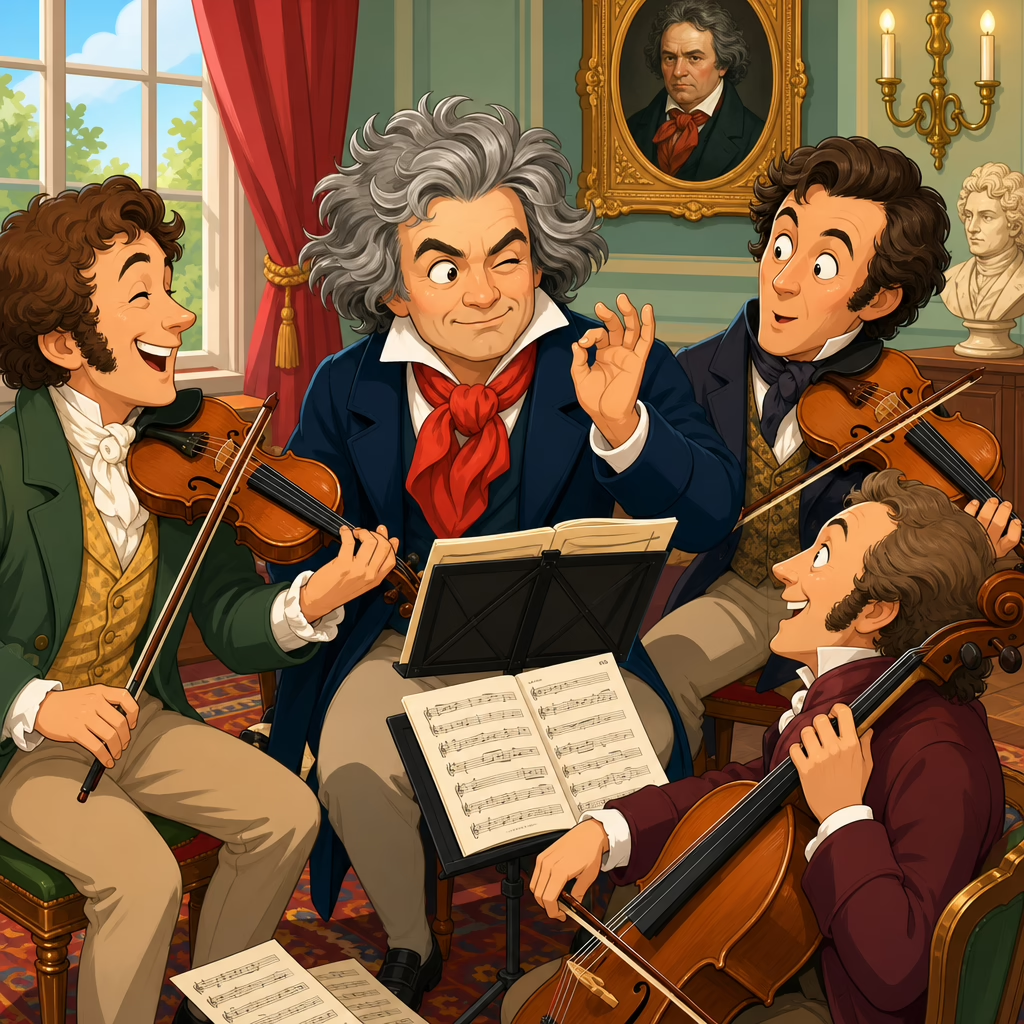
Humor and Wit in Beethoven’s Chamber Works
Humor and wit in Beethoven’s chamber works are easy to underestimate because the composer’s public image is so often dominated by struggle, heroism, and storm. Yet across his quartets, trios, sonatas, serenades, and divertimento-like pieces, Beethoven repeatedly used surprise, parody, rhythmic mischief, false endings, awkward pauses, and comic timing with the instinct of a master dramatist. In chamber music, those devices matter especially because the format is intimate: every gesture is exposed, every hesitation feels theatrical, and every player becomes part of the joke. By humor here, I mean not light entertainment alone, but a compositional strategy that manipulates expectation; wit is the sharper subset, where intelligence, compression, and timing create delight through contrast. Understanding this side of Beethoven changes how the music sounds and how it should be performed. It also helps listeners connect works often treated as academically serious with something more human: conversation, teasing, exaggeration, and delight in the unexpected.
I have found in rehearsal that players usually unlock these passages only when they stop treating them as neutral notes on a page and start reading them as social behavior. A sforzando can be a punchline. A silence can be a raised eyebrow. A sudden modulation can feel like someone interrupting a story with a perfectly timed aside. This article serves as a hub for the miscellaneous comic dimensions of Beethoven’s chamber music, linking ideas that run across genres rather than staying within a single opus. The goal is comprehensive orientation: what kinds of humor Beethoven used, where they appear, how they function structurally, and why they remain central rather than incidental to his style.
What Beethovenian Humor Sounds Like
Beethoven’s humor in chamber music usually falls into recognizable categories. First, there is disruption of symmetry: a phrase runs too long, stops too soon, or lands on the wrong accent. Second, there is dynamic overstatement, where a tiny idea is delivered with outsized force. Third, there is textural role play, with one instrument pretending to lead only to be undercut by another. Fourth, there are deliberate wrong-footings in harmony, meter, and form. These are not accidents of roughness. They are calculated comic mechanisms, comparable to setup, delay, and release in spoken wit.
Listeners searching for immediate examples can start with the scherzi of the Op. 18 quartets, the playful exchanges in the Septet in E-flat major, Op. 20, and the irreverent turns in the Serenade for string trio, Op. 8. The piano trios often show another kind of wit: keyboard brilliance is suddenly reduced to dry accompaniment, or a lyrical line is punctured by rhythmic insistence. Even in works not labeled humorous, Beethoven will make a cadence hesitate, repeat an obvious figure one time too many, or insert a general pause that invites a smile before the music resumes as if nothing happened.
Early Chamber Works: Social Comedy, Not Mere Charm
In Beethoven’s early chamber music, humor grows from inherited eighteenth-century models, but it is already more pointed than in much contemporaneous repertory. Haydn is the obvious predecessor, particularly in joke endings and phrase disruption, and Mozart offers a model for conversational elegance. Beethoven absorbs both, then hardens the edges. In the String Trios, Op. 9, and the String Quartets, Op. 18, one hears not only grace but friction. Motives interrupt one another. Cadences become argumentative. A seemingly polite minuet can acquire a stubborn accent pattern that makes the music feel half-dancing, half-debating.
The Serenade in D major, Op. 8, is a useful entry point because its lighter framework lets the jokes register clearly. The work uses courtly genres, march rhythms, and variation procedures associated with entertainment music, but Beethoven keeps unsettling them. In performance, these moments land best when players maintain rhythmic poise rather than exaggerating externally. The comedy is in the writing. A delayed answer, a brusque accent, or a line that seems too earnest for the material can be funnier when delivered straight.
The Septet, Op. 20, became one of Beethoven’s most popular works in his lifetime, partly because audiences responded to its ease and variety. Modern criticism sometimes treats that popularity suspiciously, as if accessibility reduced seriousness. That misses the craft. The Septet’s humor depends on formal control: returns are timed with precision, instrumental colors are used theatrically, and the rhetoric of serenade music is sharpened into character interaction. The bassoon can sound dryly observant; the violin can become impulsive; the clarinet can charm and deflect. Beethoven understood that comedy in chamber music often comes from personalities colliding inside a formal frame.
String Quartets as Laboratories of Wit
The string quartets show Beethoven’s comic imagination with particular clarity because the medium combines equality and tension. Four instruments can agree, contradict, imitate, or gang up on one another, and Beethoven exploits every option. In the Op. 18 set, the finale of No. 2 in G major is often called the “Compliment” Quartet because of its courtly grace, yet much of its charm comes from ironic delicacy. Tiny figures are tossed around with an almost exaggerated politeness that borders on parody. The joke is not broad; it lies in how carefully social manners are staged and slightly overperformed.
Op. 18 No. 6 contains the famous “La Malinconia” introduction to the finale, and even here Beethoven uses wit by juxtaposition. The gloomy slow preface gives way to bright motion so abruptly that the contrast feels theatrically extreme. He is not mocking sadness, but he is exploiting the shock of emotional displacement. I have seen audiences react with audible surprise when this transition is paced correctly, because the turn is both structurally logical and dramatically funny. Beethoven’s humor often works at that threshold where a bold contrast is too exact to be merely disruptive.
The middle quartets intensify this approach. The “Razumovsky” quartets, Op. 59, contain grand architecture, yet within that scale Beethoven keeps planting local surprises: obsessive fragments, metric ambiguities, rustic intrusions, and passages where propulsion seems almost too determined to be entirely serious. The Scherzo of Op. 59 No. 1 is a classic example of rhythmic mischief, while Op. 59 No. 3 turns velocity itself into a kind of comic exaggeration. Beethoven stretches decorum until intensity becomes wit.
Comic Devices Beethoven Uses Repeatedly
Across the miscellaneous chamber repertory, certain devices recur so reliably that they form a practical listening guide. These techniques help explain why a passage feels playful even when no program or nickname announces it.
| Device | How it works | Example in chamber music |
|---|---|---|
| False ending | A convincing close is followed by extra material that reopens the argument | Many finales and rondos, especially in early quartets and trios |
| General pause | Silence is inserted at a moment of momentum, creating suspense or comic recoil | Scherzo movements and transitional passages in quartets |
| Accent displacement | Strong accents fall where listeners do not expect them, unsettling dance patterns | Minuets and scherzi in Op. 18 and Op. 59 |
| Over-insistence | A small motive is repeated beyond normal decorum until it becomes funny | Finales, variation movements, and development sections |
| Role reversal | Accompaniment instruments seize the foreground or undercut the leader | Piano trios, Septet, and string trios |
These techniques are not decorative extras. They influence form, pacing, and memory. A false ending changes how a finale is proportioned. A displaced accent can recast an entire movement’s character. Repetition can become developmental logic, not only a joke. Beethoven’s gift was to merge comic effect with structural necessity so thoroughly that removing the joke would damage the architecture.
Piano Trios, Violin Sonatas, and Cello Sonatas: Conversation as Comedy
In chamber works with piano, Beethoven often builds wit out of hierarchy and resistance. The late eighteenth-century piano trio still carried traces of accompanied sonata style, with strings sometimes supporting the keyboard. Beethoven pushes against that model. In the Piano Trios, Op. 1, he gives the strings enough independence to create interruption, alliance, and contradiction. Humor emerges when one player seems to correct another, when a flourish receives an unexpectedly plain response, or when the rhetoric suddenly shrinks from grand to intimate.
The “Ghost” Trio, Op. 70 No. 1, is not usually filed under humor, yet even there the outer movements contain pointed turns of character. Beethoven liked to juxtapose seriousness with brusque gestures that keep the music from settling into one emotional stance. In the “Archduke” Trio, Op. 97, broader lyricism dominates, but moments of teasing exchange remain essential to the ensemble’s life. Wit in Beethoven is not limited to comic works; it often appears as the quick intelligence that prevents eloquence from turning sentimental.
The violin sonatas offer a similar field of study. In Op. 12, Beethoven repeatedly toys with Classical expectations through abrupt keyboard interjections, unexpectedly muscular accents, and dialogue that sounds almost competitive. Later sonatas grow more expansive, but the principle survives. The “Spring” Sonata, Op. 24, for instance, balances charm with subtle asymmetry. The “Kreutzer” Sonata, Op. 47, projects a larger public drama, yet its repartee still depends on timing and surprise. Beethoven understood chamber partnership as active conversation, and real conversation includes interruption, irony, and quick shifts of register.
The cello sonatas are especially revealing because Beethoven helped redefine the cello from bass support into equal partner. In the Op. 5 sonatas, scale and ambition already exceed salon convention. Comic effects arise when the instruments challenge each other’s expected roles: the piano launches material with orchestral breadth, then the cello answers with grave insistence or sly agility. In the Op. 69 Sonata, lyric nobility dominates, but Beethoven still inserts disarming turns that keep the discourse alive and unpredictable.
Late Style: Abruptness, Irony, and the Deepening of Humor
In Beethoven’s late chamber works, humor becomes stranger, more compressed, and sometimes inseparable from irony. The late quartets are full of abrupt contrasts that can sound baffling if approached only as metaphysical statements. They are profound, but they are also sharply theatrical. The Scherzo of Op. 127, the earthy episodes in Op. 130, and the compact, elliptical gestures of Op. 131 all show Beethoven using incongruity as a serious art. One moment can sound hymn-like, the next rustic, the next deliberately dry. The point is not randomness. It is coexistence.
The “Alla danza tedesca” from Op. 130 is a superb example. Its dance topic is treated with affectionate distance, as though Beethoven is remembering social music while also filtering it through late-style compression. The result is graceful and sly at once. Then there is the Grosse Fuge, originally the finale of Op. 130. Though often discussed in terms of severity, it also contains grotesque wit: extremes of register, obsessive countersubjects, and deliberate excess. Beethoven pushes learned style so hard that it acquires a startlingly physical, almost satirical force.
Late humor can also be tender. In rehearsal, what strikes me most is how often a supposedly transcendent passage is followed by something plainspoken, even earthy. Beethoven refuses one-dimensional sublimity. That refusal is itself witty because it punctures the listener’s desire for a single noble mood. The late works teach that humor is not the opposite of depth. It is one of the ways depth speaks honestly.
How Performers Bring the Wit to Life
Performing Beethoven’s humor requires discipline more than exaggeration. Tempo relations must be credible, because a joke lands through proportion. Articulation must be specific, especially where Beethoven contrasts legato rhetoric with dry, speech-like motifs. Dynamics should preserve hierarchy: if every accent is enormous, none will surprise. Ensemble timing is crucial in pauses, off-beat entries, and handoffs between instruments. The best groups treat these details like stage cues.
Historically informed performance practice has clarified some comic effects by restoring leaner articulation, brisker tempi, and sharper differentiation of rhetorical figures. But modern instruments can project the wit just as convincingly when players avoid over-romantic smoothing. Beethoven often writes edges into the music. Rounding them away weakens both structure and character. For listeners, a simple strategy helps: follow who has the motive, who interrupts, and whether a cadence actually finishes. Many jokes become obvious once the music is heard as dialogue rather than pure abstraction.
Why This Matters for the Beethoven’s Chamber Music Hub
This miscellaneous hub matters because humor and wit cut across the entire Beethoven chamber canon. They connect early serenade traditions to middle-period expansiveness and late-style compression. They also provide an organizing lens for related subtopic pages on specific quartets, piano trios, sonatas, scherzos, finales, and performance practice. If you are building a deeper understanding of Beethoven’s chamber music, this is one of the most useful threads to follow because it reveals continuity beneath stylistic change. The same composer who can sound monumental is constantly staging play, friction, mimicry, and surprise.
The key takeaway is simple: Beethoven’s chamber music is not only intense and noble; it is brilliantly funny in ways that are technical, dramatic, and profoundly human. His wit lives in rhythm, form, texture, and timing, not just in light subject matter. Hear the pauses, the overstatements, the interruptions, and the almost-finished endings, and whole movements come into focus. Explore the Op. 18 quartets, the Septet, the Serenade, the piano trios, and the late quartets with that perspective, then continue through the related articles in this sub-pillar. The reward is a fuller Beethoven: sharper, warmer, and more unpredictable than the stereotype suggests.
Frequently Asked Questions
Why is humor in Beethoven’s chamber works so often overlooked?
Humor in Beethoven’s chamber music is often missed because listeners tend to approach his music through a powerful biographical and cultural image: Beethoven as the embattled genius of struggle, defiance, and transcendence. That image is not wrong, but it is incomplete. It can make audiences listen primarily for weight, conflict, and heroic resolution, even in works where Beethoven is clearly enjoying himself. In chamber music especially, he frequently writes with a sense of theatrical timing that depends on quick shifts of mood, rhythmic jokes, sudden silences, and deliberately exaggerated gestures. If someone expects only grandeur, those moments can register as oddity rather than wit.
Another reason is that Beethoven’s humor is rarely superficial. He does not usually “tell jokes” in a simple or decorative way. Instead, he builds comedy into structure, pacing, and expectation. A phrase may seem headed toward a strong cadence and then collapse into hesitation. A movement may appear to settle, only to restart with impish insistence. An accompaniment pattern may become so obsessively repetitive that it feels knowingly exaggerated. Because these effects are deeply musical, they can pass unnoticed unless performers and listeners are alert to timing and character. In an intimate chamber setting, however, every player’s gesture is exposed, and Beethoven’s wit becomes easier to hear: the raised eyebrow, the fake conclusion, the awkward pause, the rhythmic nudge that turns high craft into something delightfully human.
What kinds of musical techniques does Beethoven use to create wit and comic effect in chamber music?
Beethoven’s comic language in chamber works is remarkably varied, and much of it comes from manipulating listener expectation. One of his favorite devices is surprise: a sudden accent in the “wrong” place, an unexpected dynamic, a phrase extension that feels almost too long, or a harmonic turn that momentarily sidesteps the obvious destination. He also uses false endings masterfully. Just when the music seems ready to conclude, he inserts a pause, a fragment, or a renewed burst of motion, creating the musical equivalent of a perfectly timed afterthought. These endings are funny not because they are random, but because they exploit the audience’s confidence that it knows what will happen next.
Rhythm is another major source of wit. Beethoven often creates mischief through syncopation, displaced accents, abrupt interruptions, and patterns that seem to trip over themselves without ever losing control. At times, he makes instruments appear to contradict one another, as though one player has become stubborn, overly serious, or teasingly uncooperative. He can also use repetition humorously, dwelling on a tiny motif long enough that it begins to feel exaggerated, almost parodic. In some pieces, he evokes older styles, popular manners, dance conventions, or decorous formulas only to distort them slightly. That is where parody enters: not broad caricature, but subtle mimicry with a twist. The result is a kind of musical wit rooted in proportion, interruption, and personality. Beethoven knows exactly how long to delay, how abruptly to pivot, and how to make listeners feel that the music has become self-aware for a moment.
Why does chamber music make Beethoven’s humor especially effective?
Chamber music gives Beethoven’s wit a uniquely sharp profile because the medium is intimate and conversational. In orchestral music, a comic gesture can be thrilling, but it may also be absorbed into mass and momentum. In chamber music, there is nowhere to hide. A pause feels more exposed, a misplaced accent more pointed, and a tiny exchange between instruments more like spoken banter. Beethoven takes full advantage of that environment. He writes as though each instrument were a character capable of interruption, imitation, provocation, or mock seriousness. The humor often comes not from a single line, but from interaction: one player insists, another hesitates, a third comments dryly, and suddenly the ensemble feels like a scene from a play.
This intimacy also makes timing crucial. Comic effect in Beethoven depends on precision: the exact length of a silence, the weight of an accent, the degree of exaggeration in a repeated figure, the speed with which a musical idea is contradicted. Chamber ensembles can shape those details with extraordinary clarity. When performed well, a quartet or trio can make a false ending land like a punchline and an awkward pause feel deliciously uncomfortable. Just as important, chamber music allows listeners to hear Beethoven’s humor as social rather than merely technical. The music becomes a living conversation full of feints, corrections, interruptions, and sly cooperation. That social dimension is one reason his wit feels so modern. It is not only compositional cleverness; it is dramatic intelligence enacted in real time by a small group of distinct voices.
Are there particular Beethoven chamber works that show his humorous side especially clearly?
Yes, and they appear across a surprisingly broad range of genres. Beethoven’s early and middle-period chamber works are full of high spirits, including music often labeled serenade-like, divertimento-like, or otherwise lighter in social function. Pieces such as the Septet, Op. 20, the Serenade, Op. 8, and various trio and sonata movements reveal his delight in playful pacing, elegant teasing, and sudden turns of character. Even when the overall tone is gracious, he often introduces little disruptions that keep the music alert and unpredictable. These works can be an excellent entry point for listeners who want to hear Beethoven’s wit without first having to reinterpret the more monumental public image attached to him.
The string quartets are especially rich territory. In the Op. 18 quartets, one often hears a young Beethoven testing how far conversational drama can be pushed within classical forms. Later quartets become even more daring, where humor can coexist with profundity rather than oppose it. A movement may sound rustic, gruff, or intentionally awkward; another may use abrupt contrasts or obsessive fragments in ways that feel brilliantly comic. The cello sonatas, violin sonatas, and piano trios also contain many instances of mock-seriousness, rhythmic play, and strategic surprise. What matters is not only which work one chooses, but how one listens. Beethoven’s humor is often embedded in transitions, codas, interruptions, and details of ensemble dialogue. Once listeners tune into those features, they begin to hear wit not as a side note in his chamber music, but as one of its defining expressive resources.
How should performers and listeners approach Beethoven’s chamber humor without trivializing it?
The key is to treat the humor as integral to the music’s intelligence rather than as something pasted on for entertainment. Beethoven’s wit is rarely cute, and it should not be played as if it were merely decorative charm. Performers need to understand the structure well enough to know why a surprise is funny, why a pause matters, and why a false ending works. In other words, the comedy comes from form and character. If players exaggerate every odd accent or every sudden silence, the effect can become crude. But if they smooth everything out in the name of seriousness, the music loses a vital part of its voice. The best performances find a balance: they preserve classical discipline while allowing the music’s mischief, stubbornness, and theatrical timing to register clearly.
For listeners, it helps to listen actively for expectation and interruption. Notice when Beethoven seems to promise a conclusion and then delays it, when a pattern becomes comically insistent, or when one instrument appears to challenge another. Pay attention to pacing. Humor often lies in the “when” as much as the “what.” It is also useful to let go of the assumption that profundity and comedy are opposites. Beethoven frequently combines them. A passage can be playful and sophisticated at once; a movement can sound joking on the surface while demonstrating formidable compositional control underneath. In that sense, hearing humor in Beethoven’s chamber works does not diminish his stature. It enlarges it. It reveals a composer who understood that surprise, irony, and comic timing are not secondary pleasures but essential parts of musical drama.