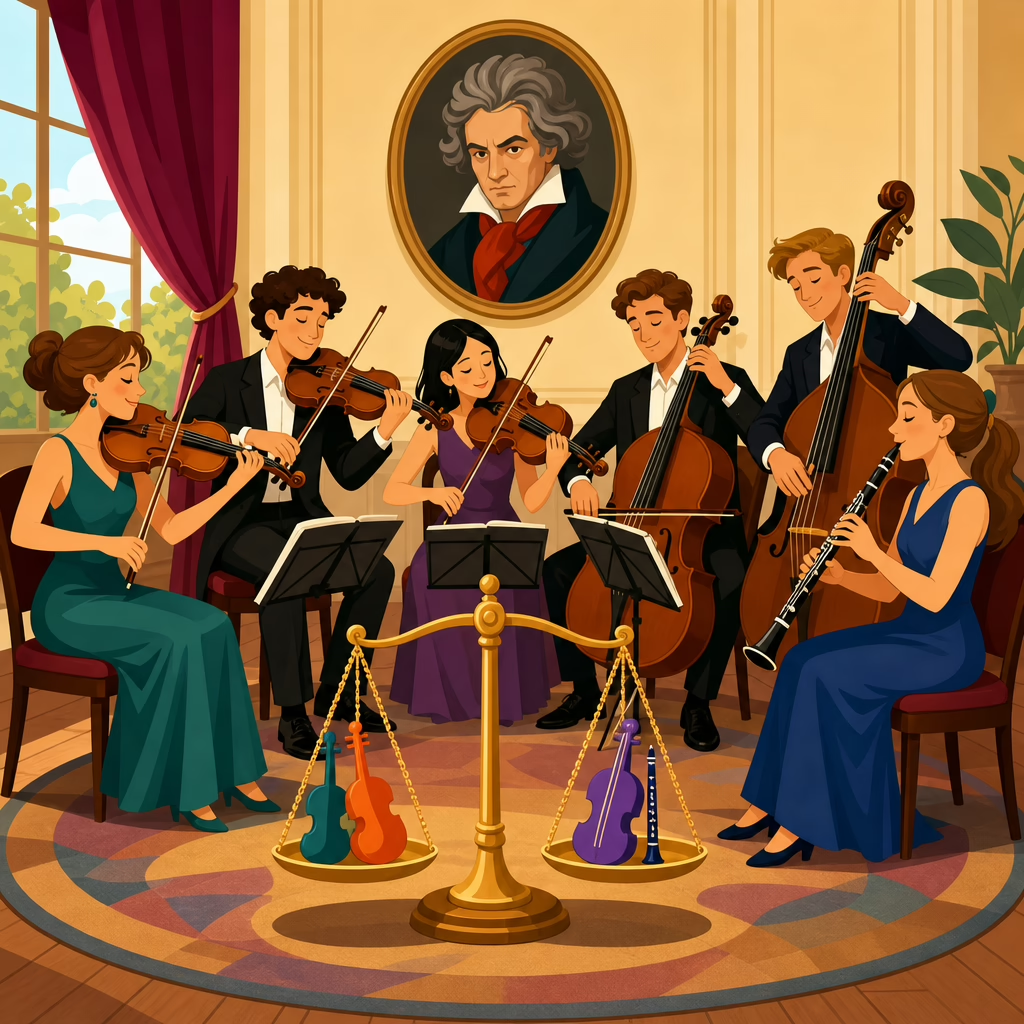
Ensemble Balance in Beethoven’s Quintets and Sextets
Ensemble balance in Beethoven’s quintets and sextets is the central question that makes these so-called miscellaneous chamber works far more revealing than the label suggests. In practical terms, ensemble balance means the proportion of sonic weight, thematic responsibility, rhythmic drive, and color assigned to each instrument at any given moment. In Beethoven, balance is never only about volume. It is about who carries the line, who supplies harmonic pressure, who mediates between registers, and who either stabilizes or destabilizes the group texture. I have found in rehearsal that these pieces expose balance problems faster than many quartets because their expanded scoring creates both richer resources and greater risks. For players, listeners, and students exploring Beethoven’s chamber music, the quintets and sextets offer a compact laboratory for understanding how he thought about dialogue, hierarchy, and instrumental character. They also matter because they connect several traditions at once: late eighteenth-century serenade writing, wind Harmoniemusik, string chamber conversation, and the more dramatic, motivic thinking associated with Beethoven’s mature style. Taken together, these works form a practical hub for the miscellaneous side of Beethoven’s chamber output, linking questions of instrumentation, form, performance style, and repertoire context in one place.
What Beethoven’s Quintets and Sextets Include
Under the miscellaneous heading, Beethoven’s quintets and sextets generally include the String Quintet in E-flat major, Op. 4; the String Quintet in C major, Op. 29; the String Quintet in C minor, Op. 104, Beethoven’s arrangement of the Piano Trio, Op. 1 No. 3; the Sextet in E-flat major, Op. 81b, for two horns and string quartet; and the Septet in E-flat major, Op. 20, often discussed alongside the sextet because of its serenade-like profile and unusually public success. Depending on editorial scope, scholars and performers also place the Wind Octet, Op. 103, and related wind ensemble materials nearby because they raise similar balance issues, especially between melody instruments and harmonic fillers. The reason these scores belong together is not that they share one instrumentation, but that they show Beethoven testing how an ensemble behaves once the clean equality of the string quartet is disturbed. Add an extra viola, add horns, or build a mixed group with clarinet and bassoon, and every assumption about projection, blend, and leadership changes. That is why this repertoire serves as a hub topic: each work points outward to more detailed discussions on individual pieces, instrumentation, and performance practice while also standing on its own as evidence of Beethoven’s evolving ensemble imagination.
How Beethoven Redistributes Musical Weight
Beethoven’s first balancing move in these works is redistribution rather than simple enlargement. In a classical string quartet, listeners usually expect first violin leadership, cello grounding, and inner voices that support and occasionally comment. In the quintets and sextets, Beethoven repeatedly breaks that expectation. In Op. 29, the added viola does not merely thicken harmony; it creates a broader middle register that can absorb thematic fragments, sustain tremolo tension, or bind the cello to the upper voices. This changes what balance means in performance. If both violas play like permanent accompanists, the texture goes flat. If they overproject, the first violin line loses contour. The real goal is a moving equilibrium in which the middle voices act as pressure systems.
In the Sextet, Op. 81b, the two horns create an even more specific challenge. Natural horns in E-flat carry heroic associations, but Beethoven often uses them structurally, not just ceremonially. They can announce, reinforce cadences, or color harmonic arrival, yet their timbre easily dominates the string quartet if modern players do not scale dynamics intelligently. When I have coached mixed ensembles in this work, the biggest issue has been not loudness alone but articulation length. Broad horn attacks can obscure string figurations even at moderate dynamic levels. Beethoven’s writing assumes differentiated rhetoric: strings articulate interior motion; horns crown and frame. Good balance therefore depends on agreeing which layer represents surface detail and which represents architectural punctuation.
The same principle appears in the Septet, Op. 20, where violin, clarinet, and horn can all claim melodic authority. Beethoven solves this by assigning contrast in character. The violin often brings brilliance, the clarinet suppleness, the horn nobility, the bassoon wit, and the lower strings propulsion. Balance emerges from contrast of function rather than equal sameness of presence. That is a hallmark of Beethoven’s larger chamber style and one reason these pieces remain so useful for studying ensemble roles.
Key Works and Their Balance Problems
Each major work in this group poses a distinct balance problem, and understanding those problems helps performers and listeners hear the repertoire more clearly.
| Work | Instrumentation | Main Balance Issue | Practical Listening Focus |
|---|---|---|---|
| Op. 4 | String quintet with two violas | Maintaining transparency in a thickened middle register | Notice how inner voices support cadences and transitions |
| Op. 29 | String quintet with two violas | Sharing thematic material without blurring texture | Track handoffs between first violin, violas, and cello |
| Op. 104 | String quintet arrangement | Converting piano-driven energy into distributed string momentum | Listen for how repeated figures replace keyboard attack |
| Op. 81b | Two horns and string quartet | Preventing brass color from overpowering string detail | Compare horn signals with string accompaniment patterns |
| Op. 20 | Clarinet, horn, bassoon, violin, viola, cello, bass | Balancing mixed timbres and public-style brilliance | Hear how melody shifts among violin, clarinet, and horn |
Op. 4, adapted from an early piano trio, can sound heavier than its material warrants if players treat the extra viola as constant reinforcement. The score works best when the ensemble emphasizes line separation and phrase hierarchy. Op. 29 is more integrated and sophisticated. Here Beethoven uses the second viola to create resonance and argument, not just density. Its Adagio is especially instructive because balance becomes a matter of sustaining long lines while allowing harmonic suspensions to register clearly in the inner parts.
Op. 104 presents a different issue. Since it reimagines a piano trio as a string quintet, performers must recreate the piano’s attack, sustain, and registral spread through collective means. If they fail, the music can feel undercharged. Strong rhythmic unanimity in repeated-note patterns and careful distribution of crescendos are essential. In Op. 81b, the challenge is obvious but subtle in execution: horns must sound integral rather than added on top. Historically informed groups using natural horns often achieve this through timbral blend, while modern valved-horn players must work harder to avoid a symphonic profile. In Op. 20, the best performances treat the ensemble almost like chamber theater, with each instrument entering as a character whose prominence rises and falls according to the movement’s rhetoric.
Instrumentation, Acoustics, and Historical Practice
Balance in Beethoven’s quintets and sextets cannot be separated from historical instruments and playing spaces. Gut strings, classical bows, narrower vibrato use, and natural horns all produce a more stratified but less saturated sound than modern equipment. That matters because Beethoven often writes textures that depend on registral distinction rather than constant force. On modern instruments, the middle register can become too upholstered, especially in string quintets with two violas. The result is a generalized warmth that obscures motivic edges. Historically informed performers counter this by lightening strokes, varying contact point, and preserving speech-like articulation. Even ensembles on modern setups can learn from that approach.
Acoustics also change perceived balance dramatically. In a dry studio, attacks separate clearly, making inner voices easier to hear, but sustained lines may seem undernourished. In a resonant hall, horns and lower strings can bloom so fully that accompanying figures cover important contrapuntal detail. Beethoven likely expected a range of aristocratic rooms and mid-sized halls, not vast modern auditoriums. That expectation explains why a fortepiano-era style of dynamic proportion often translates better in chamber venues than concert-hall projection modeled on orchestral practice.
There is also a notational point. Beethoven’s dynamic markings indicate local character, but they do not remove the performer’s responsibility to balance texture. A horn marked forte against strings marked piano does not automatically justify domination if the horn line functions as punctuation while the strings carry active material. Likewise, a violin melody does not always deserve the foreground if the dramatic event lies in syncopated inner suspensions. Experienced chamber players know that notation is only the starting framework. The actual balance must be solved by understanding form, harmony, and rhetorical function together.
What Listeners Should Hear Movement by Movement
For listeners approaching this repertoire as a hub within Beethoven’s chamber music, the most useful strategy is to hear balance as a moving process across a movement, not a fixed mix. In sonata-form first movements, ask who presents the primary idea, who energizes transition, and who redefines the theme in the development. Beethoven often shifts importance away from the obvious melody instrument during developmental passages, letting accompaniment figures become the true engine. In slow movements, listen for breathing room around sustained lines. Good ensembles create enough space for dissonance and resolution to register without sentimental overblending.
Minuets, scherzos, and variation movements show balance in especially clear ways. Dance movements test whether rhythmic profile survives added instrumental weight. If the ensemble overplays, the dance loses lift. In variation sets, Beethoven often changes balance deliberately by recasting the theme through color: a wind instrument may become primary in one variation, a lower string in the next. That is not decorative surface. It is Beethoven demonstrating that thematic identity can survive radical changes in instrumental perspective. Finals, meanwhile, often reveal whether the group understands cumulative balance. Brilliant closing pages should feel earned by previous gradations of weight and brightness. If everyone plays at maximum too early, Beethoven’s architecture collapses into excitement without shape.
This listening method also helps readers navigate related articles within the broader chamber music topic. A page on Op. 29 can focus on double-viola texture; one on Op. 81b can examine horn writing; one on Op. 20 can address mixed ensemble rhetoric. The hub value of the miscellaneous category is that it teaches the common principle first: Beethoven balances ensembles by assigning changing functions, not by keeping instruments equally busy or equally loud.
Why These Works Matter in Beethoven’s Chamber Music
These quintets and sextets matter because they show Beethoven working between inherited social genres and the concentrated argument of his major chamber masterpieces. They are often overshadowed by the Razumovsky quartets, the late quartets, or the great piano trios, yet they answer an essential question about Beethoven’s style: how does he handle abundance? In a quartet, scarcity drives invention; with extra instruments, the challenge is preventing surplus from becoming clutter. Beethoven’s answer is disciplined differentiation. He gives each added instrument a job, even when that job is temporary, disruptive, or deliberately modest.
That lesson reaches beyond historical interest. Performers can use these works to refine rehearsal method. Instead of asking only who has melody, ask who controls harmonic rhythm, who shapes the cadence, who projects the bass line’s direction, and who supplies the color that tells the ear where to listen. Students can use them to learn orchestration at chamber scale. Listeners can use them to hear Beethoven not simply as a composer of heroic themes but as a planner of sonic relationships. If you are exploring Beethoven’s chamber music systematically, this miscellaneous hub is worth revisiting alongside more famous works. Start with Op. 29 and Op. 20, compare how Beethoven balances similar brilliance in different instrumentations, then move to Op. 81b and Op. 104 to hear how he solves special technical problems. The reward is a clearer understanding of Beethoven’s ensemble thinking across his chamber output, and a sharper ear for balance wherever his music is played.
Frequently Asked Questions
What does “ensemble balance” mean in Beethoven’s quintets and sextets?
In Beethoven’s quintets and sextets, ensemble balance refers to far more than whether one instrument is simply louder or softer than another. It describes how Beethoven distributes musical authority across the group at any given moment: who carries the melody, who drives the rhythm, who provides harmonic density, and who connects contrasting registers and timbres into a coherent whole. In these works, balance is a living, shifting relationship among parts rather than a fixed hierarchy. A violin may present a theme, but a viola, horn, cello, or clarinet may be the real source of tension, momentum, or color underneath it.
This is one reason these pieces are so revealing. Beethoven uses mixed chamber ensembles to test how different instruments can share responsibility without losing clarity. He often avoids a simple “solo line plus accompaniment” model. Instead, he rotates thematic fragments, redistributes accents, thickens textures in one register while thinning them in another, and uses inner voices to shape the character of a phrase. The result is music in which balance must be understood as the proportion of sonic weight, thematic importance, rhythmic energy, and tonal color assigned to each player. Hearing these works well means listening for those changing functions, not just for prominence in volume.
Why are Beethoven’s quintets and sextets especially useful for understanding his chamber writing?
Beethoven’s quintets and sextets are especially valuable because their unusual instrumentations expose his compositional thinking in a very direct way. In a standard string quartet, listeners may expect certain roles: first violin as leader, cello as bass foundation, inner strings as support or counterweight. In mixed ensembles or expanded string groups, those expectations become less stable. Beethoven takes advantage of that instability. He can let a wind instrument cut through the texture with a distinctive color, ask an inner string to mediate between melody and bass, or spread harmonic pressure across several parts so that no single line tells the whole story on its own.
These works are often labeled “miscellaneous,” but that description can be misleading. Precisely because they do not always fit the canonical image of the Beethoven quartet, they reveal how alert he was to instrumental character and to the mechanics of dialogue. They show him experimenting with how textures breathe, how registers interact, and how contrast can be created without relying only on large formal gestures. In other words, the quintets and sextets give listeners a closer look at Beethoven as a practical dramatist of sound. They show how he balances personality and structure, color and argument, and individuality and ensemble cohesion.
How does Beethoven distribute thematic responsibility among the instruments in these works?
Beethoven rarely treats thematic responsibility as the exclusive property of one lead instrument for very long. Even when a melody is clearly introduced in a prominent voice, he often gives other instruments crucial thematic duties at the same time. An inner part may carry a compressed version of the theme, a bass instrument may turn a supporting figure into a source of propulsion, or a wind instrument may answer the main line with a contrasting gesture that changes how the material is heard. This constant sharing of thematic material is one of the main reasons ensemble balance becomes such an important issue in performance and analysis.
What makes Beethoven distinctive is that he often gives secondary lines structural significance. A repeated rhythmic cell, a syncopated accompaniment, or a passing imitation may seem decorative at first, but it frequently becomes central to the movement’s energy or development. In practical listening terms, this means the “main theme” may not fully explain what is happening. The real drama may lie in how the surrounding parts challenge, support, interrupt, or reinterpret it. In quintets and sextets especially, Beethoven uses instrumental contrast to make this redistribution audible. Color itself becomes part of thematic argument, with each instrument contributing not only notes but also a particular expressive weight.
What role do inner voices and lower instruments play in achieving balance?
Inner voices and lower instruments are essential to Beethoven’s sense of balance because they do much more than fill in harmony. Violas, second violins, cellos, and comparable middle-to-lower voices frequently regulate the texture from within. They can thicken the harmonic field, introduce cross-rhythms, stabilize transitions, or quietly shift the emotional center of a passage. Beethoven often relies on these parts to create tension before the listener fully recognizes it on the surface. A phrase may appear smooth in the upper voice, while the inner parts are already destabilizing it through syncopation, suspensions, or tonal pressure.
Lower instruments, meanwhile, are not merely foundational in the sense of providing bass notes. In Beethoven, the bass line often shapes character, articulation, and dramatic pacing. A cello or bassoon line can press a phrase forward, make a cadence feel heavier or more resistant, or set up a contrast between grounded pulse and freer upper-voice writing. Because of this, performers must think of balance vertically as well as horizontally. It is not enough for the melody to be audible; the supporting layers must also be proportioned so that their rhythmic and harmonic functions can be felt. Beethoven’s textures become fully intelligible only when those inner and lower roles are given their due expressive presence.
How should listeners and performers approach ensemble balance in Beethoven’s quintets and sextets?
Listeners should approach these works by asking not just “What is the melody?” but “Who is doing what right now?” That question opens up Beethoven’s chamber writing in a much richer way. Notice when a line leads by contour, when another leads by rhythm, and when a seemingly modest part controls the harmony or color. Listen for moments when instruments seem to negotiate rather than obey a hierarchy. In many passages, balance depends on hearing several simultaneous functions clearly: one part may state the theme, another may sharpen its profile through imitation, and a third may generate the urgency that gives the phrase its direction.
For performers, the challenge is to create transparency without flattening the music into equal politeness. True balance in Beethoven does not mean all parts are played with the same weight. It means each role is projected according to its function. A supporting figure may need unusual presence if it carries rhythmic drive; a melodic line may need restraint if the real tension lies in the harmony beneath it. Good ensemble balance therefore requires continuous adjustment of articulation, tone color, dynamic shading, register awareness, and timing. The goal is to let the listener hear the argument of the texture as Beethoven wrote it: a dynamic exchange in which leadership passes, layers interact, and the drama emerges from the relationship among all the instruments rather than from any single voice alone.