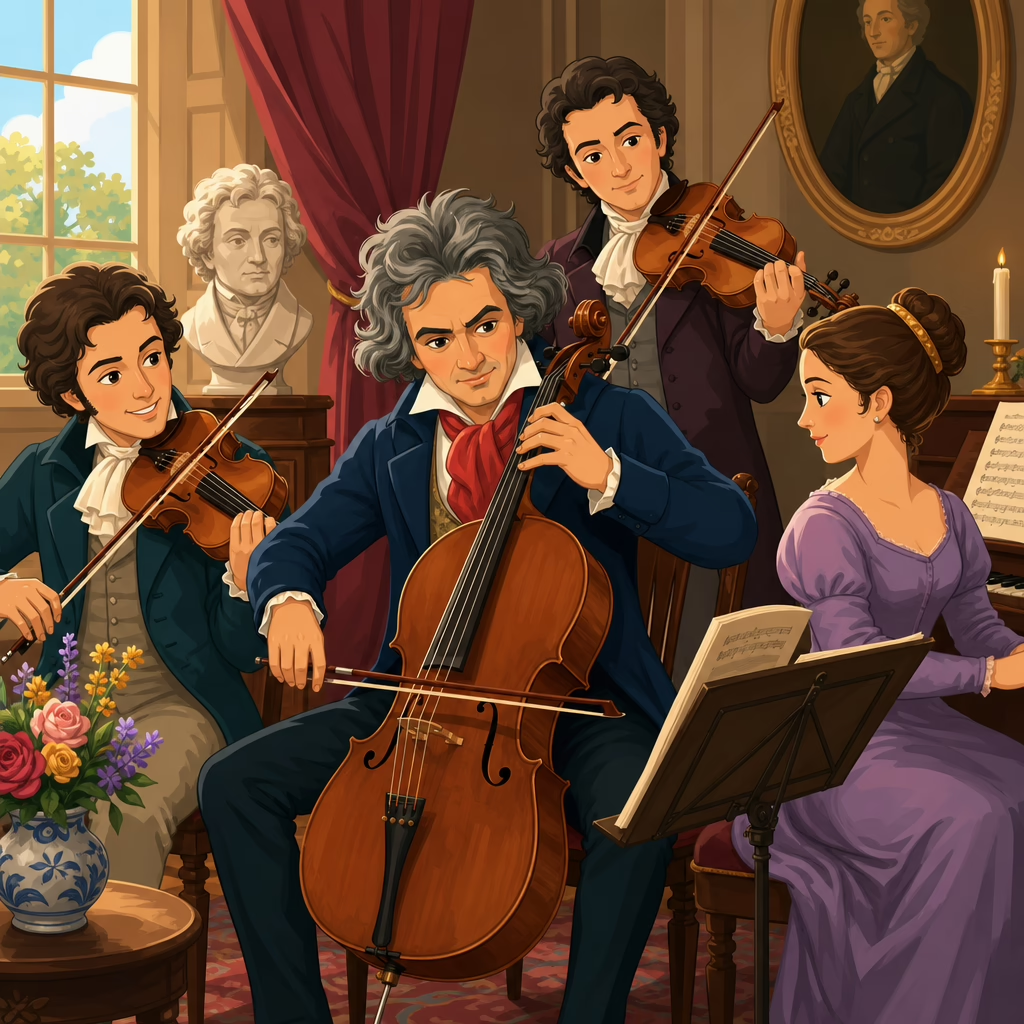
Beethoven’s Use of the Cello in Chamber Settings
Beethoven’s use of the cello in chamber settings traces one of the most important shifts in chamber music history: the instrument moved from a primarily supportive bass function to a voice capable of argument, lyricism, propulsion, and structural leadership. In this context, “chamber settings” means music written for small ensembles rather than orchestra, including string trios, quartets, quintets, mixed ensembles with winds or piano, and the duo literature where the cello’s role clarifies Beethoven’s larger thinking. Across these works, the cello is never just accompaniment for long. It grounds harmony, shapes rhythmic drive, doubles inner lines for weight, and, at decisive moments, steps forward with themes, counterthemes, and dramatic transitions. That matters because Beethoven inherited eighteenth-century conventions from Haydn and Mozart, yet consistently rebalanced ensemble texture toward greater equality. I have found, in score study and rehearsal rooms alike, that the cello often reveals his method more clearly than the first violin does: where the cello enters, how high it climbs, and when it breaks from bass duty often signal the emotional and architectural turning points of a movement. For listeners, performers, and students exploring Beethoven’s chamber music, the cello offers a practical key to hearing his style evolve from Classical poise to heroic expansion and late-period concentration.
From bass foundation to equal partner
In Beethoven’s early chamber works, the cello still reflects the eighteenth-century expectation that lower strings stabilize harmony and articulate meter, yet even there he presses beyond convention. The String Trios, Op. 9, already give the cello independent motives, registral contrast, and dialogic exchanges rather than unbroken continuo-like support. Instead of simply reinforcing cadences, the cello often sets up modulation by moving through sequential patterns or by introducing rhythmic cells that upper voices then develop. This is a crucial Beethoven trait: independence does not always mean melody in the foreground; it often means owning material that drives form from underneath.
The early string quartets, Op. 18, make this clearer. In performance, one quickly notices that Beethoven writes cello lines that must speak with articulation equal to the first violin’s phrase endings. The instrument anchors the tonal floor, but it also shapes rhetoric. In Op. 18 No. 1, for example, the cello contributes directly to motivic continuity rather than merely supporting violin cantabile. In Op. 18 No. 4, Beethoven uses the cello’s darker register to sharpen urgency, helping create the work’s minor-key tension. This redistribution of responsibility changed how chamber music sounded: balance became conversational rather than hierarchical.
Beethoven’s treatment of the cello also reflects practical knowledge of instrumental capability. He understood how resonance differs across strings, how thumb-position writing changes color, and how sustained lower-register tone can intensify expectation before a formal arrival. He does not exploit virtuosity merely for display. Instead, technical writing serves structural purpose. A leap upward can expose a theme; a pedal point can harden suspense; repeated detached notes can energize a transition. This integration of cello technique with compositional logic is one reason his chamber music remains central to conservatory training.
The cello in the string quartets
The quartets provide the richest evidence of Beethoven’s long-term reimagining of the cello. In the middle-period “Razumovsky” Quartets, Op. 59, the instrument becomes indispensable to scale and drama. These works are larger, more symphonic, and more texturally varied than Op. 18, and the cello helps create that expansion. Beethoven frequently pushes it into tenor register, thickening the middle of the texture while freeing the viola or second violin for independent motion. The result is not simply a deeper bass line but a more elastic four-part fabric.
Op. 59 No. 1 offers a telling example in the expansive first movement, where the cello’s thematic participation supports Beethoven’s broad harmonic pacing. The famous slow movement also depends on the instrument’s sonority: low-register support and carefully placed lyrical statements create the sense of suspended space that listeners often describe as otherworldly. In Op. 59 No. 2, the cello contributes to the work’s stark contrasts, moving from solemn underpinning to sharply etched figuration. In Op. 59 No. 3, Beethoven uses agile lower-string writing to energize fugato textures and propulsive finales.
The late quartets deepen this transformation. By Opp. 127, 130, 131, 132, 133, and 135, Beethoven treats the cello as an equal participant in highly compressed motivic discourse and unusually varied texture. It may sing in exposed high register, sustain long pedals beneath fractured counterpoint, or articulate abrupt gestures that disrupt surface continuity. In Op. 131, especially, the cello helps weld the seven linked movements into a continuous argument. In Op. 132, its role in the “Heiliger Dankgesang” is less about display than about vocal gravity and harmonic grounding. In the Große Fuge, Op. 133, the cello becomes part of a collective engine of rhythmic and contrapuntal force, demanding precision, stamina, and analytical awareness from the player.
Cello writing across Beethoven’s chamber genres
Looking beyond the quartets reveals how consistently Beethoven adapts the cello’s function to ensemble type. In mixed ensembles with piano and winds, he often uses the cello to mediate between percussive keyboard attack and sustained wind tone. In the Septet, Op. 20, for instance, the cello does much more than reinforce bass harmony. It contributes to the genial, public-facing style of the work by shaping transitions and lending warmth to tuttis and smaller conversational moments. The Septet became enormously popular in Beethoven’s lifetime, and its cello writing shows how he could remain accessible while still broadening instrumental roles.
The Piano Trios also illuminate his approach. Although the genre historically risked becoming keyboard-dominated, Beethoven increasingly emancipates the strings, and the cello in particular gains melodic and motivic agency. The “Archduke” Trio, Op. 97, is a peak example: the cello’s opening participation immediately announces equality, and throughout the work it alternates between foundation, lyrical partner, and rhythmic counterweight. In the “Ghost” Trio, Op. 70 No. 1, Beethoven uses the cello’s dark timbre to intensify the eerie atmosphere of the slow movement. In rehearsal, balance problems often disappear once players recognize that the cello is carrying narrative information, not just harmonic support.
Even in works where the cello appears less overtly prominent, Beethoven relies on it to define character. A dry, articulated bass line can make a scherzo bite; a broad legato line can lend nobility to a variation; a sudden ascent above the staff can alter the listener’s sense of instrumental hierarchy in an instant. This flexibility is central to Beethoven’s chamber style.
Representative works and the cello’s function
The following overview shows how Beethoven adjusts cello writing according to genre, period, and expressive aim.
| Work | Ensemble | Cello role | Why it matters |
|---|---|---|---|
| String Trios, Op. 9 | Violin, viola, cello | Independent bass, motivic initiator, registral contrast | Shows Beethoven moving beyond accompanimental cello writing early on |
| String Quartets, Op. 18 | String quartet | Rhetorical phrasing, thematic support, dramatic bass motion | Establishes the cello as a true participant in Classical conversation |
| Septet, Op. 20 | Mixed ensemble | Bass foundation plus connective lyrical material | Balances popularity and sophistication in ensemble texture |
| “Ghost” Trio, Op. 70 No. 1 | Piano trio | Coloristic depth, suspense, thematic exchange | Uses cello timbre to intensify atmosphere and drama |
| “Archduke” Trio, Op. 97 | Piano trio | Equal melodic partner, structural support, cantabile line | Represents Beethoven’s mature trio balance |
| “Razumovsky” Quartets, Op. 59 | String quartet | Expanded register, thematic prominence, symphonic weight | Transforms quartet texture and scale through active cello writing |
| Late Quartets, Opp. 127–135 | String quartet | Textural pivot, contrapuntal engine, expressive solo voice | Culminates Beethoven’s equal-voice ideal in chamber music |
The cello as a dramatic and structural tool
What makes Beethoven’s cello writing distinctive is not only equality but function. He uses the instrument to clarify form. In sonata movements, the cello may stabilize an exposition’s opening tonality, then become mobile at the exact moment harmonic tension increases. During development sections, fragmented cello motives often help generate momentum while preventing the texture from becoming top-heavy. In recapitulations, Beethoven sometimes reweights material so the return feels earned rather than merely repeated. The cello is part of that reweighting.
Rhythm is equally important. Beethoven knew the cello could articulate repeated notes and offbeat accents with extraordinary physical presence. Those gestures give scherzos their bite and finales their propulsion. Consider how often lower-string insistence creates pressure beneath syncopation above. That pressure is not decorative; it is structural energy made audible. The player’s articulation, bow distribution, and contact point therefore become interpretive issues, not just technical ones.
The instrument also serves Beethoven’s dramatic contrasts. A movement can pivot from intimacy to public declamation when the cello rises into a singing tenor register, effectively changing the ensemble’s center of gravity. Conversely, a return to open-string resonance in the low register can restore gravity after passagework or harmonic ambiguity. Beethoven exploits these shifts with remarkable economy. He often needs only a few bars to recast the cello from foundation to protagonist.
This is why analysts and performers often study the bass line first in Beethoven. It frequently contains the cleanest map of harmonic rhythm, phrase tension, and formal pacing. In chamber settings, the cello carries much of that burden, and hearing it actively transforms one’s understanding of the whole ensemble.
Performance, interpretation, and listening priorities
For performers, Beethoven’s chamber cello parts demand more than secure intonation and rhythm. They require strategic projection. A line that looks accompanimental on the page may be the motor of an entire passage. In rehearsals, I often hear ensembles improve simply by asking three questions: is the cello carrying harmonic direction, rhythmic impulse, or thematic identity here? Once that is answered, balance and articulation choices become much clearer. A whispering bass can be correct in one variation and disastrous in the next.
Historically informed performance has sharpened appreciation of these issues. Gut strings, Classical bows, and lower pitch standards can reveal speech-like articulation and transparency in Beethoven’s textures, especially in Op. 18 and Op. 59. At the same time, modern instruments bring sustaining power that can illuminate the long line in late Beethoven. Neither approach is automatically superior. What matters is understanding the rhetorical function of the cello’s line and adjusting sound accordingly.
For listeners, a useful strategy is to follow the cello at moments of transition: the start of developments, the lead-in to recapitulations, the underside of scherzo rhythms, and any sudden climb into higher register. These moments frequently explain why a passage feels tense, expansive, or strangely intimate. The cello is often the hinge. That is one reason this topic serves as a hub within Beethoven’s chamber music: it connects string writing, form, ensemble balance, and expressive character across nearly every genre he touched.
Beethoven’s use of the cello in chamber settings ultimately shows how he redefined musical conversation. He inherited an instrument associated with bass support and turned it into a decisive structural and expressive voice without sacrificing its grounding power. From Op. 9 and Op. 18 through the “Razumovsky” and late quartets, from the Septet to the piano trios, the cello becomes a guide to Beethoven’s broader compositional evolution. It supports harmony, launches ideas, deepens color, sharpens rhythm, and frequently reveals form more clearly than any other part. For anyone exploring Beethoven’s chamber music, listening to the cello is not a niche exercise; it is one of the fastest ways to hear how his ensembles actually work. Use this page as a starting point, then move outward to the quartets, trios, and mixed works with the cello line in mind.
Frequently Asked Questions
How did Beethoven change the role of the cello in chamber music?
Beethoven fundamentally expanded the cello’s function in chamber music by treating it as far more than a bass-line instrument. In earlier Classical practice, the cello often reinforced harmonic foundations, doubled bass lines, and provided structural support from below. Beethoven certainly continued to use the instrument in that traditional way when it served the music, but he also gave the cello independent thematic material, dramatic entrances, lyrical cantabile writing, rhythmic motives that drive momentum, and passages of genuine argumentative exchange with the upper instruments. That shift is one of the clearest signs of his broader rethinking of chamber texture.
What makes Beethoven especially important is that he did not simply add occasional solos for color; he integrated the cello into the logic of the composition. In his chamber works, the cello can introduce themes, answer them, undermine them, intensify them, or reshape their emotional meaning through register, articulation, and timing. In a quartet or trio, it often becomes a participant in a conversation rather than the floor beneath one. In his duo works with piano, that transformation becomes even more obvious, because the cello is asked to sing, debate, and carry long spans of musical argument. As a result, Beethoven helped establish the modern expectation that the cello in chamber settings should be a full expressive voice, capable of lyricism, propulsion, and structural leadership.
Why are Beethoven’s cello sonatas so important to understanding his chamber style?
Beethoven’s works for cello and piano are central because they present the cello without the masking effect of a larger ensemble. In these sonatas, listeners can hear with unusual clarity how Beethoven imagines the instrument: not as a passive accompanist to the keyboard, and not as a mere melodic guest, but as an equal partner in shaping form, tension, and expression. The early sonatas already show a bold departure from conventions in which a keyboard part dominated while a string instrument supplied decorative reinforcement. Beethoven instead creates genuine dialogue, with both instruments taking responsibility for thematic development and dramatic pacing.
These sonatas are also important because they span different periods of Beethoven’s creative life, allowing us to trace his evolving treatment of the cello. In the earlier works, the writing often emphasizes rhetorical contrast, athletic energy, and the novelty of equality between instruments. In the middle period, the cello becomes more expansive and heroic, capable of projection and muscular thematic presence. In the late sonatas, Beethoven explores concentrated expression, inwardness, and striking formal experimentation, giving the cello a voice that can be searching, austere, intimate, and transcendent. Taken together, the sonatas are not just masterpieces of the cello repertoire; they are a laboratory for Beethoven’s chamber thinking and one of the clearest demonstrations of how he elevated the instrument’s expressive and structural status.
How does Beethoven use the cello differently in string quartets, trios, and mixed chamber ensembles?
Beethoven adjusts the cello’s role according to the ensemble, but a common principle remains: the instrument is almost always treated as an active participant in the musical argument. In string quartets, the cello still carries crucial bass responsibilities, yet Beethoven continually animates that foundation. He gives it motives that energize the entire texture, rising lines that alter the balance of register, and thematic fragments that make the cello sound like a speaking presence rather than a background support. In many quartets, the expressive impact depends on the listener noticing how the cello destabilizes expectations, deepens the sonority, or suddenly comes forward as an equal interlocutor.
In string trios, the cello’s role can feel even more exposed, because there are fewer instruments sharing the texture. Beethoven uses that openness to highlight the instrument’s dual identity: it can anchor the harmonic structure, but it can also project melody and articulate strong rhythmic character. In quintets and mixed ensembles with piano or winds, he often uses the cello as a hinge between worlds: it can bind together the bass and middle registers, reinforce ensemble cohesion, or emerge as a warm, humanizing lyric voice amid brighter instrumental colors. This flexibility is one of Beethoven’s great strengths. He understood not only what the cello sounded like on its own, but how its register, timbre, and articulation could rebalance an ensemble from within.
What musical qualities made the cello especially useful to Beethoven in chamber settings?
The cello offered Beethoven an ideal combination of depth, flexibility, and expressive range. Its lower register could provide weight, authority, and harmonic grounding, which was essential in chamber music where every line matters. At the same time, its tenor and upper registers allowed it to sing with an almost vocal intensity, making it capable of warmth, tenderness, tension, and noble declamation. That broad compass gave Beethoven a unique expressive tool: one instrument could move from structural support to lyrical prominence without sounding unnatural.
Just as important was the cello’s capacity for rhythmic definition and dramatic attack. Beethoven was deeply interested in motivic development and in the way small rhythmic figures can generate large-scale form. The cello, with its articulate bow strokes and resonant body, could launch patterns that feel both grounded and urgent. It could press forward with propulsion, darken a harmony, intensify a transition, or suddenly transform the emotional climate by stepping into a higher register. In Beethoven’s hands, the cello became invaluable because it could do multiple jobs at once: sustain, propel, sing, argue, and unify. That combination made it one of the most powerful agents in his chamber language.
What should listeners pay attention to when hearing Beethoven’s cello writing in chamber music?
A good place to start is with musical conversation. Rather than hearing the cello only as “the lowest instrument,” listen for moments when it initiates ideas, answers another instrument, interrupts the texture, or changes the emotional direction of a phrase. Beethoven often builds chamber movements through exchanges of short motives, and the cello is frequently essential to that process. If you focus on who presents a motive, who transforms it, and who gives it weight or urgency, you will hear how central the cello is to the drama.
It is also worth listening for register and character. Beethoven uses the cello’s low register for gravity and momentum, but when he pushes it upward, the effect can be strikingly vocal, intimate, or urgent. Notice how the cello can thicken a cadence, sharpen a conflict, or suddenly emerge as the most human-sounding voice in the ensemble. Finally, pay attention to structure: the cello often helps articulate transitions, stabilize harmony, and prepare climaxes, even when it is not obviously in the spotlight. That is one of Beethoven’s great achievements. He makes the instrument matter not only in solos or lyrical episodes, but in the deep architecture of the music. Once you begin listening in that way, Beethoven’s chamber writing reveals a cello voice that is indispensable, intelligent, and dramatically alive.