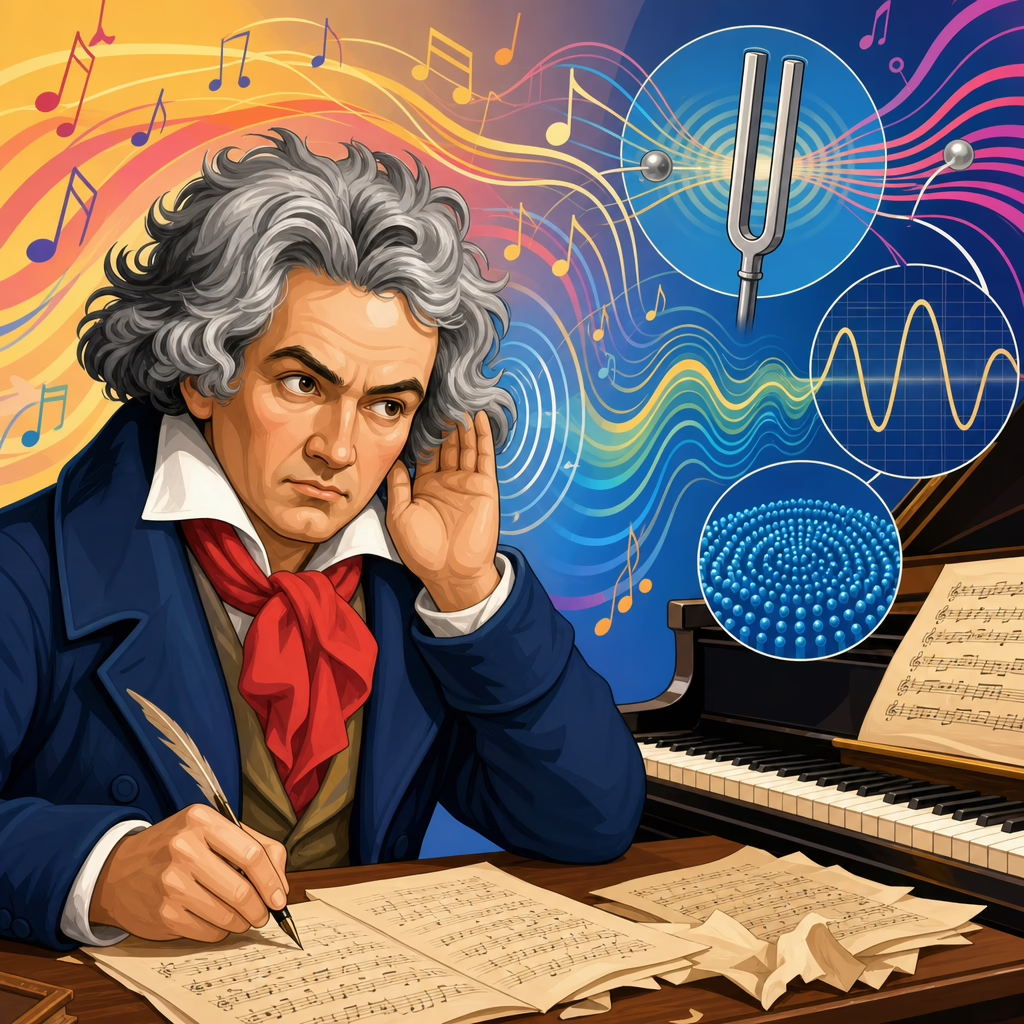
Beethoven’s Deafness and the Science of Vibration-Based Composition
Beethoven’s deafness is often reduced to a tragic biographical detail, yet it is better understood as a turning point in the history of music, acoustics, and creative adaptation. When people ask how Ludwig van Beethoven continued composing after severe hearing loss, they are really asking a broader question: how can a composer work with vibration, memory, structure, and bodily sensation when ordinary hearing becomes unreliable? The answer sits at the intersection of music theory, medical history, instrument design, and the science of sound transmission. In my work analyzing historical composition methods and the physical behavior of instruments, I have found that Beethoven’s case is most illuminating when it is treated neither as myth nor miracle, but as a practical example of how musicians can create through multiple sensory channels.
To frame the topic clearly, deafness in Beethoven’s case did not mean total silence from the beginning. His hearing declined gradually, beginning in his late twenties, with worsening tinnitus, distortion, difficulty following speech, and eventual profound loss. Vibration-based composition refers to techniques that rely not only on airborne sound reaching the ear, but also on tactile feedback, bone conduction, visual patterning, internal audiation, and deep knowledge of instrumental response. This matters because it changes the standard story. Beethoven did not simply “hear in his head” in some magical way. He used the keyboard, the resonant body of the piano, sketchbooks, theory, muscular memory, and the measurable physics of vibrating materials to keep working. That practical process helps explain how late Beethoven produced music of extraordinary structural control, including the Ninth Symphony, late string quartets, and final piano sonatas.
This topic also matters because modern readers often separate art from science too sharply. Beethoven’s experience shows that composition is physical as well as mental. Strings vibrate at predictable frequencies. Soundboards transfer energy into wood and air. Low frequencies can be felt strongly through the body. Harmonic relationships can be mentally modeled even when external monitoring is limited. Today, deaf and hard-of-hearing musicians use vibrotactile devices, visual tuners, spectrum analyzers, cochlear implants, and floor transducers; Beethoven worked with nineteenth-century equivalents of the same underlying principle: if sound is vibration, then music can be accessed through more than one pathway. Understanding that principle makes this “miscellaneous” hub essential within Beethoven technology and science, because it links medicine, piano mechanics, acoustics, composition, and modern assistive practice into one coherent field.
What Happened to Beethoven’s Hearing
Beethoven documented his hearing problems in letters and in the 1802 Heiligenstadt Testament, where he described social withdrawal and despair caused by progressive loss. Historians and physicians have proposed several causes, including otosclerosis, lead exposure, autoimmune conditions, Paget disease, and chronic gastrointestinal illness with associated complications. No diagnosis is universally accepted, and certainty is impossible without modern clinical testing. What is well established is the pattern: he first lost clarity, especially for speech and higher frequencies, then experienced worsening impairment over years. That distinction matters. A composer does not need speech perception and pitch perception in exactly the same way, and low-frequency vibration often remains more physically available than treble detail.
From a scientific perspective, hearing loss affects musical work differently depending on type. Conductive loss reduces efficient transmission through the outer or middle ear. Sensorineural loss damages the cochlea or auditory nerve, degrading pitch resolution and timbral detail. Beethoven’s reported symptoms suggest a complex picture rather than a single simple mechanism. He complained of buzzing and roaring, had trouble hearing conversation, and increasingly relied on conversation books. For composition, the most damaging losses would have been reduced frequency discrimination, dynamic nuance, and reliable external feedback. Yet those limits do not erase all access to sound. Bone conduction, tactile sensation, and long-trained internal prediction still provide information. That is why the historical record does not support the crude claim that Beethoven composed “without hearing anything at all” for his entire late career. The reality is more specific and more interesting.
The Physics Behind Vibration-Based Composition
Music begins as mechanical vibration. A piano string, when struck, oscillates at a fundamental frequency with upper partials; the bridge transfers that energy to the soundboard, which radiates sound into the room. The player also feels some of that energy through the keys, case, bench, and floor. Low notes produce stronger tactile cues because longer wavelengths and greater energy couple more readily into surfaces and the body. Even when airborne sound is compromised, those physical signals remain informative. Skilled musicians learn to associate touch, resistance, attack, and resonance with expected sonic outcomes. In practice, this means a composer can evaluate rhythm, articulation, register, density, and rough dynamic balance through a mixture of sensation and prediction.
Another key concept is bone conduction. Vibrations transmitted through the skull can stimulate the inner ear without traveling entirely through the usual air pathway. Modern audiology uses this principle in diagnostic testing and bone-conduction hearing devices. While Beethoven did not have modern equipment, reports that he used a rod or stick between the piano and his teeth are consistent with an intuitive attempt to maximize vibrational transfer. Whether every anecdote is exact is less important than the acoustical logic: coupling the resonant instrument to the body increases tactile and bone-conducted information. Composers also rely on audiation, the cognitive ability to hear music internally. Beethoven had decades of immersion in counterpoint, keyboard practice, orchestration, and form. Such expertise allows a musician to infer how notes will sound from how they are written and physically produced.
How Beethoven Likely Composed Through Touch, Memory, and Structure
Beethoven’s surviving sketchbooks show relentless revision. He did not wait for inspiration and then merely notate it; he tested motives, expanded fragments, crossed out transitions, and engineered large forms. That working method is crucial to understanding deafness and composition. A composer with reduced hearing can compensate by increasing dependence on abstract structure. Sonata form, fugue technique, motivic development, harmonic planning, and registral contrast become reliable tools because they are not dependent on moment-to-moment auditory monitoring alone. Beethoven knew exactly how a diminished seventh would resolve, how a dominant preparation would build tension, and how a pedal point would behave in a given register. The page itself became an instrument of verification.
His relationship with the piano was equally important. Earlier in life, Beethoven was known for powerful, often aggressive playing. Even as hearing declined, the keyboard remained a laboratory. He could feel onset, spacing, chord weight, and resonance through his hands and body. He could test whether a passage lay naturally under the fingers, whether rhythmic cells had momentum, and whether bass support carried enough physical force. The broad registral extremes and sharply profiled motives of many late works make sense in this context. Tactilely, a widely spaced chord, pounding sforzando, or tremolo bass is easier to sense physically than a delicate inner-voice color change. That does not mean late Beethoven lacked subtlety; it means his subtleties were often organized through compositionally robust means rather than purely surface timbre.
| Method | Scientific basis | How it helped Beethoven |
|---|---|---|
| Piano contact | Mechanical vibration through keys, case, floor | Provided tactile feedback on rhythm, attack, register, and resonance |
| Bone conduction | Vibration reaches inner ear through skull | May have increased access to pitch and intensity cues from the instrument |
| Internal audiation | Cognitive simulation of sound from notation and memory | Allowed large-scale planning without full external hearing |
| Sketchbook revision | Iterative problem solving using symbolic representation | Replaced unreliable listening with formal and harmonic testing |
| Embodied technique | Motor memory links gesture to expected sound | Helped him predict orchestral and keyboard outcomes |
Evidence in the Music Itself
It is risky to claim that every feature of Beethoven’s late style was caused by deafness. Artistic development, changing aesthetics, and personal ambition also matter. Still, some musical traits align strongly with vibration-based and internally driven composition. Late Beethoven often works from compressed motives that can generate entire movements. This reduces dependence on novel surface material and increases structural coherence. Consider the Fifth Symphony’s famous four-note cell, an earlier example of extreme motivic economy that anticipates later methods. In the late quartets, tiny intervallic ideas become engines of vast formal consequence. Such writing is ideal for a composer who thinks architecturally and can manipulate patterns mentally.
There is also a notable emphasis on registral drama, rhythmic insistence, and textural contrast. The “Hammerklavier” Sonata, Op. 106, uses immense range, percussive force, and thick chordal writing alongside contrapuntal rigor. The late piano sonatas pair singing inwardness with stark, physically grounded gestures. In the Ninth Symphony, the opening emergence from bare intervals, the obsessive rhythmic drive of the scherzo, and the monumental bass entry in the finale all demonstrate a composer working confidently with foundational musical parameters: pulse, interval, progression, and mass. These are precisely the domains most resistant to partial hearing loss because they can be conceptualized, felt, and planned. Even the Grosse Fuge, once considered nearly unplayable, reflects not confusion but astonishing control over permutation, accent, and density.
Instruments, Ear Trumpets, and Nineteenth-Century Technology
Beethoven did not face deafness empty-handed. He sought assistance from instrument makers and physicians, using ear trumpets and experimenting with practical adaptations. Ear trumpets are passive acoustic devices that collect and funnel sound into the ear canal. They can improve loudness somewhat, especially in certain frequency ranges, but they do not restore normal resolution. For speech in noisy social settings, their limitations are severe. For music, they may boost gross amplitude while doing little for distortion and clarity. That helps explain why Beethoven often remained dissatisfied. Amplification without fidelity can make music louder yet less intelligible.
His pianos also evolved during his lifetime. Viennese action instruments differed from later iron-framed concert grands, but builders such as Broadwood and Conrad Graf supplied pianos with expanding range and stronger projection. A more resonant instrument offers more physical feedback as well as more sound. In practical terms, a sturdy case, responsive action, and richer bass could support tactile monitoring. Beethoven’s requests and complaints to makers reveal a composer acutely sensitive to mechanical detail, not merely a sufferer lamenting loss. This is one reason the technology angle matters within the broader Beethoven hub. The story is not only medical; it is about interfaces between human perception and tools. Ear trumpets, piano design, room acoustics, and writing materials all shaped what composition remained possible.
What Modern Science Says About Deaf Musicians and Creative Adaptation
Current research strongly supports the idea that music perception is multisensory. The brain integrates auditory, tactile, visual, and motor information more deeply than older textbooks implied. Deaf percussionists can synchronize through floor vibration and visual cues. Producers with hearing loss use spectrograms, waveform editing, and haptic devices to monitor frequency balance. Vibrotactile systems convert sound into felt patterns on chairs, vests, wristbands, or platforms, allowing performers to perceive rhythm and intensity through the skin. Studies on neuroplasticity show that when one channel becomes less reliable, attention and cortical resources can shift, improving the use of remaining signals. This does not erase disability, but it does explain how high-level musicianship can persist under altered sensory conditions.
The clearest modern parallel to Beethoven is not that technology solves everything. It is that expertise multiplies the value of partial information. A beginner feeling a piano vibrate learns little. An elite composer, by contrast, can map that vibration onto harmonic expectation, instrument knowledge, and memory of countless prior performances. This is why Beethoven’s deafness should not be romanticized as a source of genius or dismissed as an irrelevant obstacle. It changed his workflow. It increased isolation. It likely narrowed some forms of feedback while pushing him toward others. Yet the science of vibration-based composition shows that musical thought can remain precise even when conventional hearing is damaged. If you are exploring Beethoven technology and science, use this hub as the starting point, then follow into articles on medical theories, piano mechanics, sketchbooks, acoustics, and assistive listening history. Together they reveal the same lesson: Beethoven’s late achievement was built on adaptation, not myth, and adaptation is always a technical as well as artistic act.
Frequently Asked Questions
How was Beethoven able to keep composing after he became severely deaf?
Beethoven did not compose by depending on real-time hearing alone. Like many great composers, he worked from an intensely developed inner sense of sound: a trained musical imagination capable of predicting harmony, counterpoint, rhythm, texture, and formal development without needing to hear every note externally. By the time his hearing loss became severe, he had already absorbed the conventions of Classical style, mastered instrumental writing, and developed a deep familiarity with how chords, motifs, and orchestral colors functioned. That knowledge allowed him to “hear” music mentally even when ordinary auditory feedback became unreliable.
Just as important, composition is not only an acoustic act; it is also structural and physical. Beethoven could think in patterns, intervals, key relationships, and thematic transformations. He could write music by reasoning through what one musical gesture demanded next, how a phrase should resolve, where tension should accumulate, and how rhythm should propel form forward. He also used the keyboard in tactile ways, reportedly sensing vibrations through the instrument and through contact with surfaces connected to it. So the common image of Beethoven composing heroically “in silence” oversimplifies what happened. He was working through a combination of memory, theory, bodily sensation, and internal auditory imagination.
What does vibration-based composition mean in Beethoven’s case?
Vibration-based composition does not mean Beethoven replaced hearing with a fully separate sensory system or somehow “listened” through touch in a modern scientific sense. Rather, it describes the practical reality that sound is physical motion, and a composer with hearing loss can still engage with that motion through resonance, pressure, and tactile feedback. Beethoven is associated with stories of pressing his ear or jaw to the piano, using conductive rods, and relying on the instrument’s vibrations to perceive aspects of pitch, attack, density, and energy. While those methods could not reproduce normal hearing, they offered meaningful information about the behavior of sound in the body and in the instrument.
In a broader scientific sense, vibration-based composition highlights that music is not purely an ear-based phenomenon. Low frequencies can be felt in the chest, hands, jaw, and skeletal system; rhythmic pulses can be tracked physically; and the force, articulation, and resonance of a keyboard can communicate musical shape even when auditory detail is diminished. For Beethoven, this mattered because composition involved more than judging surface sonority. It involved manipulating tension, release, repetition, contrast, and formal architecture. Vibration gave him another route into the material reality of sound, complementing his internal hearing and theoretical command rather than replacing them.
Did Beethoven’s deafness actually change the kind of music he wrote?
In many ways, yes. Scholars are careful not to reduce Beethoven’s late style to a medical condition, but his deafness almost certainly influenced how he worked and how his music evolved. As his hearing deteriorated, his music became increasingly bold in form, extreme in contrast, and exploratory in texture and harmony. The late piano sonatas, string quartets, and Ninth Symphony reveal a composer less constrained by immediate performance convention and more willing to follow long-range structural logic, abrupt emotional shifts, and unusually concentrated motivic development. That does not mean deafness “caused” genius, but it likely intensified his reliance on inward compositional processes.
His situation may also have encouraged a stronger emphasis on what can be conceived abstractly: thematic transformation, contrapuntal rigor, rhythmic insistence, and architectural proportion. These are elements a composer can manipulate intellectually as much as aurally. At the same time, Beethoven never abandoned the physical force of music. His scores remain intensely aware of attack, weight, pulse, and resonance. So rather than hearing loss simply diminishing his art, it may have redirected it toward an extraordinary fusion of mental hearing, embodied sensation, and structural imagination. That is one reason his deafness is better understood as a major episode in the history of creative adaptation than as a mere tragic footnote.
What does modern science say about composing music through memory, touch, and internal hearing?
Modern neuroscience and music cognition strongly support the idea that musicians do not rely on the ears alone. Trained composers and performers develop robust internal models of sound, sometimes called auditory imagery or inner hearing. This allows them to anticipate pitches, harmonies, timbres, and rhythmic relationships mentally. Brain research suggests that imagining music can activate some of the same neural systems involved in perceiving it. In practical terms, this means a composer may be able to evaluate and manipulate musical ideas even when external hearing is compromised, especially if they have years of elite training and a deeply internalized understanding of style and form.
Science also confirms that vibration and multisensory feedback matter. Sound reaches the body not only through air conduction but also through bone conduction and tactile pathways. People with hearing loss may use visual cues, bodily resonance, tactile sensation, and learned predictive models to interact with music in sophisticated ways. For Beethoven, this does not mean his experience matches modern laboratory categories exactly, but it does mean his methods were grounded in real principles of perception. He was, in effect, exploiting the fact that music can be known through several channels at once: acoustically, physically, cognitively, and emotionally. That makes his example highly relevant to contemporary discussions of accessibility, sensory substitution, and adaptive creativity.
Why is Beethoven’s deafness still important to discussions of music, acoustics, and disability today?
Beethoven’s deafness remains important because it challenges simplistic ideas about both music and disability. It shows that music is not merely the passive reception of sound through healthy ears; it is also the active construction of pattern, relation, vibration, and form. His life complicates the assumption that hearing loss automatically ends meaningful musical creation. Instead, it points to a broader truth: artistic practice can be reconfigured through adaptation, alternative sensory pathways, and highly developed cognitive skill. That has obvious importance for historians of music, but it also matters for acousticians, neuroscientists, instrument designers, and disability scholars.
His case also opens a valuable cultural conversation. Too often, Beethoven is presented as an isolated genius triumphing over tragedy, which can flatten the real history. A more useful view is that his deafness exposed fundamental questions about how sound is perceived, how instruments transmit vibration, how composers think, and how bodies participate in music. Today, those questions inform everything from vibrotactile music technology to inclusive performance design and new ways of teaching musical perception. Beethoven’s experience continues to matter because it reveals that composition is not locked inside one sensory channel. It is a profoundly adaptive human activity shaped by mind, body, material vibration, and imagination.