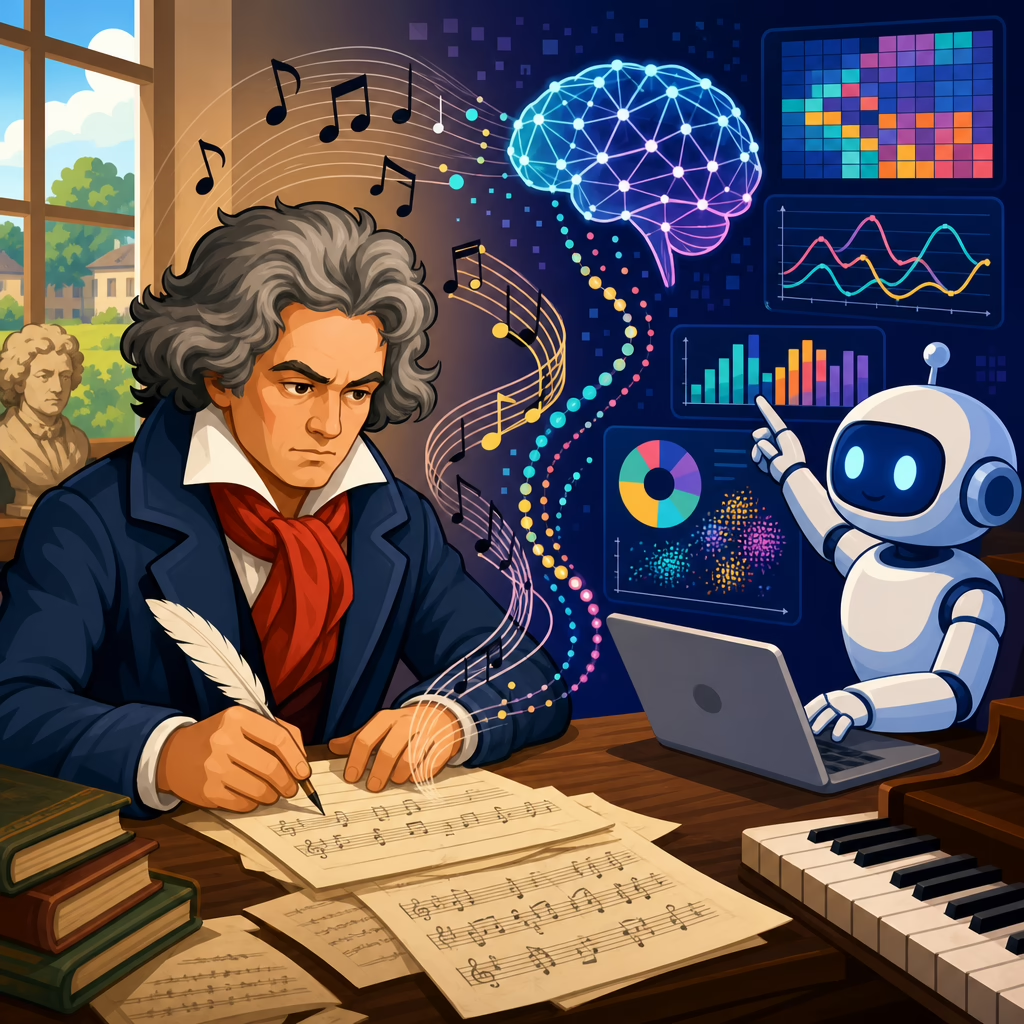
How Machine Learning Analyzes Beethoven’s Compositional Style
Machine learning is changing how scholars, performers, and listeners study Ludwig van Beethoven by turning large collections of scores, sketches, recordings, and historical data into measurable patterns. In this context, machine learning means computer systems that learn from examples rather than following only hand-coded rules, while Beethoven’s compositional style refers to the recurring choices he made in melody, harmony, rhythm, form, texture, motivic development, orchestration, and expressive pacing across works such as the piano sonatas, string quartets, symphonies, concertos, masses, and bagatelles. This matters because Beethoven sits at the crossroads of Classicism and Romanticism, and his music is both highly structured and richly unpredictable, making it ideal for computational analysis. I have worked with symbolic music datasets and score-encoding tools, and Beethoven consistently stands out as a composer whose style can be modeled, tested, and compared in ways that sharpen rather than replace human interpretation. For a technology and Beethoven hub, this miscellaneous guide brings together the core methods, questions, and practical uses that connect specialized articles on notation, audio analysis, authorship, creativity, pedagogy, and digital archives.
A good starting point is the distinction between symbolic and audio data. Symbolic data includes note events, durations, key signatures, articulations, and formal annotations extracted from MusicXML, MEI, MIDI, or Kern files. Audio data includes waveform recordings, performance timing, dynamics, and spectral information. Machine learning can work on both, but the research questions differ: symbolic models ask how Beethoven wrote, while audio models often ask how Beethoven is performed. Another key term is feature extraction, which means converting music into numerical representations such as interval distributions, chord transitions, rhythmic cells, phrase lengths, and texture density. Newer deep learning systems can learn representations directly, but feature design remains crucial when interpretability matters. Because this article serves as a hub, it focuses on the full analytical landscape: identifying fingerprints of style, tracing Beethoven’s evolution, comparing him with Haydn, Mozart, Schubert, and Brahms, testing disputed attributions, studying sketch materials, and supporting performance and education with evidence drawn from data.
What data machine learning uses to study Beethoven
The quality of any Beethoven style model depends first on the corpus. Researchers typically combine digital scores from projects such as the OpenScore initiative, music21-ready encodings, Humdrum files, MEI archives, and publisher editions that have been normalized for analysis. For Beethoven, corpus design is especially important because the works span early, middle, and late periods, multiple genres, revisions, and incomplete materials. A model trained only on the symphonies will learn a very different profile from one trained on the piano sonatas or late quartets. In practice, I begin by deciding whether the unit of analysis is the note, bar, phrase, movement, or whole composition, because that choice determines what the system can actually learn.
Metadata also matters more than many people assume. Opus number, date of composition, instrumentation, movement tempo, key, source edition, and revision history can all influence the apparent style signal. If those variables are ignored, the model may confuse genre conventions with Beethoven’s personal language. For example, slow introductions in orchestral works create harmonic and rhythmic profiles that differ sharply from scherzo movements, so a classifier may appear accurate while simply separating movement types. Careful researchers therefore stratify training data, balance genres, and document editorial decisions. Established toolkits such as music21, jSymbolic, partitura, and pretty_midi make this process faster, but the scholarly judgment behind the dataset still determines whether the results are meaningful.
How algorithms detect Beethoven’s stylistic fingerprints
Machine learning analyzes Beethoven’s compositional style by identifying recurring patterns that appear often enough to be distinctive yet flexibly enough to survive variation. In classical supervised learning, a researcher extracts features from scores and trains a model such as logistic regression, support vector machines, random forests, or gradient boosting to distinguish Beethoven from other composers. Typical features include interval n-grams, pitch-class distributions, cadence types, harmonic rhythm, syncopation rates, register span, motivic repetition, and phrase asymmetry. Beethoven is unusually suitable for this work because his music often transforms short motives across large spans, creating measurable signatures in repetition and development that simpler melody-based models miss.
Unsupervised learning adds another layer by grouping works without preassigned labels. Clustering can reveal that late piano sonatas share textural or harmonic traits with late quartets, or that middle-period works form subgroups around rhythmic drive and enlarged formal rhetoric. Topic modeling and embedding methods can place movements in a shared stylistic space where proximity reflects learned similarity. Neural sequence models, including recurrent networks and transformers, can predict likely next notes or chords in Beethoven-like contexts, and the prediction errors themselves become analytical evidence. If a model repeatedly finds a passage surprising compared with Beethoven’s broader corpus, that may point to an exceptional formal turn, an unusual modulation, or a localized borrowing from established convention. Used carefully, these systems do not reduce Beethoven to statistics; they highlight where the statistics reveal habits, innovations, and departures.
Which musical features reveal the most about Beethoven
Not all features are equally informative. In my experience, the strongest signals often come from relationships rather than isolated notes. Motivic cells, intervallic contour, rhythmic compression and expansion, off-beat accents, sequential treatment, and long-range tonal planning generally tell us more about Beethoven than raw pitch frequency. Harmonic analysis is central because Beethoven’s style depends heavily on tension management: delayed resolutions, intensified dominant preparation, sudden mediant relationships, and strategic use of diminished seventh sonorities all create patterns that can be encoded. Roman numeral analysis, key-finding algorithms, and functional harmony labels give machine learning systems musically meaningful inputs rather than generic note counts.
Form is another high-value feature set. Beethoven’s sonata forms are famous not simply for obeying textbook structures but for pressurizing them through expanded codas, developmental persistence, and recapitulatory reinterpretation. A model that tracks section boundaries, cadence placement, thematic return points, and texture changes can quantify these tendencies. Rhythmic features are equally revealing: obsessive reiteration, sforzando placement, hemiola-like displacement, and propulsion through repeated accompaniment figures often distinguish Beethoven from Mozart’s smoother phrase balance or Schubert’s more song-driven periodicity. When researchers combine harmonic, rhythmic, formal, and motivic features, classification performance usually improves because Beethoven’s style emerges from the interaction of these dimensions, not from one trait alone.
| Analytical area | Typical machine learning features | What they can reveal in Beethoven |
|---|---|---|
| Melody and motive | Interval n-grams, contour patterns, repetition rates, transposition classes | Economy of material, motive transformation, thematic cohesion across movements |
| Harmony and tonality | Chord transitions, Roman numerals, modulation frequency, harmonic rhythm | Tension building, remote key motion, delayed resolution, dramatic tonal design |
| Rhythm and meter | Syncopation scores, onset density, accent displacement, duration variance | Drive, instability, scherzo energy, propulsion through repeated figures |
| Form and structure | Cadence spacing, section lengths, thematic return timing, coda expansion | Compression versus expansion, sonata-form pressure, large-scale narrative pacing |
| Texture and instrumentation | Voice count, register spread, doubling patterns, orchestral density | Contrast between chamber intimacy and symphonic weight, developmental thickening |
Tracing Beethoven’s evolution across early, middle, and late periods
One of the most productive uses of machine learning is periodization. Music history often divides Beethoven into early, middle, and late phases, but those labels are broad and sometimes blunt. Computational analysis can test whether the divisions appear in the data and where transitional works actually sit. When models measure harmonic adventurousness, phrase irregularity, contrapuntal density, and formal expansion, they often show gradual drift rather than abrupt rupture. The Eroica Symphony, Waldstein Sonata, and Razumovsky Quartets tend to cluster as high-energy middle-period landmarks, while the late quartets and Op. 111 exhibit denser contrapuntal behavior, stronger textural contrast, and less predictable tonal pacing.
These findings are useful because they turn style change into a measurable continuum. Instead of saying only that late Beethoven is introspective or experimental, researchers can specify that cadence spacing becomes less regular, fugue-like textures become more central, and local phrase expectations are more frequently denied. Chronological modeling can also identify outliers. Some early works already contain Beethovenian compression and motivic insistence, while some occasional pieces remain closer to inherited Classical norms. This matters for the broader Technology and Beethoven topic because it connects computational analysis with biography, reception history, and editorial study. The machine is not replacing stylistic history; it is helping map exactly how style shifts over time.
Comparing Beethoven with other composers and testing attribution
Style analysis becomes sharper when Beethoven is compared with near neighbors. Models trained on Haydn, Mozart, Beethoven, Schubert, and Brahms can reveal where Beethoven is most statistically distinct and where he overlaps with shared conventions. In keyboard music, for example, Beethoven often shows greater motivic insistence and dynamic contrast than Mozart, while Haydn may share wit and structural surprise but differs in certain rhythmic and phrase-level distributions. Schubert can overlap harmonically in adventurous regions yet tends to sustain lyric expansion differently. By quantifying similarities and differences, machine learning helps answer questions that traditional analysis has long discussed qualitatively.
Attribution studies are another practical application. When a doubtful piece is encoded and tested against a composer corpus, the model can estimate whether its stylistic profile resembles Beethoven strongly enough to warrant further investigation. No responsible scholar treats algorithmic output as a final verdict. Attribution depends on manuscripts, provenance, watermarks, paper type, copyists, and historical context. Still, computational evidence can be valuable when used alongside source criticism. A disputed set of variations, for instance, might look Beethovenian in motivic treatment but uncharacteristic in cadence behavior and texture, suggesting either imitation, heavy revision, or misattribution. This balanced use of evidence is where machine learning is strongest: not as a courtroom judge, but as a rigorous analytical witness.
From sketches to performances: broader applications in the Beethoven ecosystem
Beethoven left an extraordinary sketch tradition, and machine learning opens new ways to study it. Sequence alignment can connect sketch fragments with completed passages, helping researchers trace how motives were revised, recombined, or expanded. Pattern-mining methods can identify recurring developmental procedures across notebooks, revealing that ideas Beethoven appeared to invent spontaneously in finished works were often tested through multiple drafts. This directly supports scholarship on creative process, one of the richest miscellaneous areas in the technology-and-Beethoven field. It also helps digital archives organize materials that would otherwise remain difficult to search at scale.
Performance analysis extends the picture further. Audio-based machine learning can track tempo rubato, articulation timing, pedaling proxies, vibrato behavior in string recordings, and dynamic shape across many interpretations of the same movement. Comparing recordings of the Fifth Symphony or the Moonlight Sonata can show how conductors and pianists respond to the same notated structure with different expressive timing strategies. These models do not tell performers how Beethoven must sound, but they can reveal performance traditions, historical shifts, and outlier readings with unusual clarity. In education, these tools support score-following, annotated listening, and composition pedagogy by making abstract stylistic concepts concrete. A student can hear and see how a small rhythmic cell drives an entire movement, then test that pattern computationally.
Limits, risks, and what good Beethoven analysis requires next
Machine learning is powerful, but it has real limits in Beethoven studies. First, symbolic scores are abstractions; they capture notation, not the full embodied experience of sound, touch, instrument response, room acoustics, or nineteenth-century performance practice. Second, editions can distort the signal through editorial normalization, missing articulations, or inconsistent slurs. Third, small datasets remain a challenge. Beethoven’s output is substantial, yet once the corpus is segmented by genre, movement type, and reliable encoding quality, the amount of training data can shrink quickly. Deep models may then overfit and produce impressive-looking but fragile conclusions.
The solution is methodological discipline. Researchers should publish corpus definitions, encoding assumptions, evaluation metrics, and error analyses. They should test models against baselines, use cross-validation, and ask whether the musical interpretation follows from the evidence or from prior expectation. The best future work will combine explainable models with richer corpora, including manuscripts, letters, historical editions, and aligned recordings. That approach keeps the humanistic question in view: what do these patterns tell us about Beethoven’s decisions, constraints, and expressive aims? Machine learning analyzes Beethoven’s compositional style most effectively when it is treated as a partner in inquiry. Explore the related articles in this hub to go deeper into score encoding, audio analysis, authorship testing, sketch studies, and digital Beethoven archives.
Frequently Asked Questions
What does machine learning actually analyze when studying Beethoven’s compositional style?
Machine learning can examine a remarkably wide range of musical evidence to identify patterns in Beethoven’s writing. At the score level, models can track melodic contour, interval choices, rhythmic figures, harmonic progressions, cadential behavior, phrase length, formal layout, texture, register, orchestration, and the way small motives are transformed across a movement. In Beethoven’s case, that is especially important because his style is often defined not just by isolated themes, but by how he develops short ideas through repetition, fragmentation, sequence, inversion, rhythmic displacement, and dramatic tonal movement.
Researchers also use machine learning to study materials beyond published scores. Sketchbooks, revisions, early drafts, and alternate versions can be compared to finished works to understand Beethoven’s compositional decision-making process. Audio recordings add another layer, allowing systems to analyze tempo flexibility, articulation, dynamics, phrasing, and performance traditions associated with Beethoven’s music. Historical metadata, such as date, genre, instrumentation, publisher information, and geographic context, can further help scholars map stylistic change over time.
The key advantage is that machine learning can process large corpora consistently and at scale. Instead of relying only on a scholar’s close reading of a few works, a model can compare dozens or hundreds of movements at once and detect recurring tendencies that may be too subtle, too complex, or too widely distributed to notice manually. This does not replace traditional music analysis; rather, it gives scholars a powerful way to test claims about Beethoven’s harmonic language, motivic economy, formal experimentation, and stylistic evolution with measurable evidence.
How do scholars train machine learning models to recognize Beethoven’s musical fingerprints?
Training usually begins with building a dataset of encoded musical materials. Scores may be converted into symbolic formats that represent notes, durations, rests, dynamics, articulations, key areas, chord labels, and structural divisions in a form a computer can process. In some projects, researchers annotate pieces manually, identifying motives, phrases, modulations, thematic returns, or formal sections. In others, algorithms learn directly from the symbolic data by finding statistical regularities without heavy human labeling.
Once the data is prepared, scholars choose a modeling approach based on the question they want to answer. Supervised learning is used when examples are labeled in advance, such as training a system to distinguish Beethoven from Haydn or Mozart, or to classify passages by period, genre, or formal function. Unsupervised learning is useful when researchers want the model to discover clusters or hidden structures on its own, such as grouping movements with similar developmental techniques or harmonic profiles. Sequence models can capture how one event leads to another over time, which is particularly valuable in music because Beethoven’s style often depends on long-range relationships rather than isolated gestures.
Validation is a crucial step. Scholars test whether the model’s conclusions hold up against known musical knowledge and whether the features it identifies make analytical sense. If a system claims to recognize Beethoven primarily by one surface trait, that result may be less convincing than a model that reflects deeper features such as motivic transformation, tonal planning, metric tension, or textural pacing. In strong research, computational outputs are interpreted alongside historical scholarship, score study, and stylistic expertise, ensuring that the model identifies meaningful musical fingerprints rather than merely exploiting quirks in the dataset.
Can machine learning explain how Beethoven’s style changed over the course of his career?
Yes, and this is one of the most exciting uses of machine learning in Beethoven research. His output spans multiple stylistic phases, and computational methods can help track how his musical language develops from early works shaped by Classical conventions to increasingly individual, experimental, and structurally daring later compositions. By measuring recurring features across time, scholars can identify shifts in phrase design, harmonic boldness, thematic compression, rhythmic intensity, contrapuntal density, and formal unpredictability.
For example, a machine learning system might detect that certain interval patterns, accompaniment textures, or cadential formulas are more common in early piano sonatas, while later works show greater motivic concentration, more abrupt contrasts, more adventurous modulations, and more complex interactions between local gestures and large-scale form. It can also compare genres, revealing whether similar stylistic tendencies appear in the quartets, symphonies, sonatas, and sacred works at the same historical moment. This matters because Beethoven did not evolve in a simple straight line; some traits appear early, disappear, and return in transformed ways.
Importantly, machine learning can help quantify change without reducing it to a simplistic narrative. Instead of saying only that Beethoven became “more dramatic” or “more innovative,” researchers can point to measurable developments in rhythmic irregularity, harmonic distance, formal asymmetry, registral expansion, or developmental density. These findings become even richer when combined with sketches and revisions, which can show not only what changed across his career, but how he actively reworked material during composition. In that sense, machine learning offers a more precise way to study Beethoven’s artistic evolution while still respecting the complexity of his creative voice.
Is machine learning accurate enough to distinguish Beethoven from other composers or identify influence and authorship questions?
Machine learning can be very effective at stylistic classification, but its accuracy depends on the quality of the data, the features selected, and the scope of the question. In many cases, models can distinguish Beethoven from close contemporaries by analyzing combinations of harmonic behavior, motivic treatment, rhythmic patterns, phrase structure, and formal design. Because Beethoven’s music often relies on intense motivic development and distinctive large-scale tension building, models that capture relational and developmental features tend to perform better than those focused only on surface details.
That said, authorship and influence are more difficult than simple composer identification. A model may correctly classify a work as “Beethoven-like” without proving that Beethoven wrote it. Stylistic resemblance can result from shared conventions, imitation, editorial intervention, or genre expectations. Likewise, detecting influence is not the same as proving direct borrowing. If an algorithm finds that a later composer shares certain rhythmic or harmonic tendencies with Beethoven, scholars still need historical evidence to determine whether that similarity reflects influence, coincidence, broader stylistic fashion, or common training.
For this reason, machine learning is best understood as a decision-support tool rather than a final judge. It can flag anomalies, test hypotheses, and reveal statistically significant resemblances or differences. In attribution studies, it may help narrow possibilities or show that a disputed passage differs sharply from Beethoven’s usual practice. But responsible researchers combine computational evidence with source criticism, manuscript study, performance history, and stylistic analysis. Used carefully, machine learning can sharpen authorship debates and influence studies, but it works best when its findings are interpreted within a broader musicological framework.
How does machine learning help performers, educators, and listeners understand Beethoven more deeply?
For performers, machine learning can highlight structural and expressive patterns that influence interpretation. By comparing many scores and recordings, a system can show where Beethoven tends to intensify rhythmic drive, delay resolution, redistribute motivic emphasis, or create tension through dynamics, register, and texture. That information can support decisions about pacing, articulation, phrasing, pedaling, balance, and long-range architecture. In Beethoven especially, where a tiny motive can shape an entire movement, computational analysis can help performers understand how local details contribute to larger expressive goals.
Educators benefit because machine learning can make abstract analytical ideas more concrete and comparative. Instead of describing Beethoven’s motivic development in general terms, teachers can present visualizations, similarity maps, or pattern studies showing how a figure recurs and transforms across sections or across different works. Students can better grasp how Beethoven builds coherence, creates contrast, and manipulates expectation when those techniques are supported by both traditional analysis and data-driven evidence. This also encourages a more interdisciplinary understanding of music, connecting theory, history, cognition, and digital humanities.
For listeners, machine learning opens new ways of hearing familiar music. It can reveal why a passage feels unstable, why a return sounds especially powerful, or how a simple opening idea generates an entire movement. Recommendation systems, interactive listening tools, and annotated recordings can use machine-learned insights to guide attention toward motivic links, harmonic surprises, and formal turning points that might otherwise go unnoticed. The result is not a colder or more mechanical understanding of Beethoven, but often a richer one. By turning recurring stylistic choices into visible and audible patterns, machine learning helps modern audiences appreciate more fully the intelligence, discipline, and expressive force behind Beethoven’s compositional style.