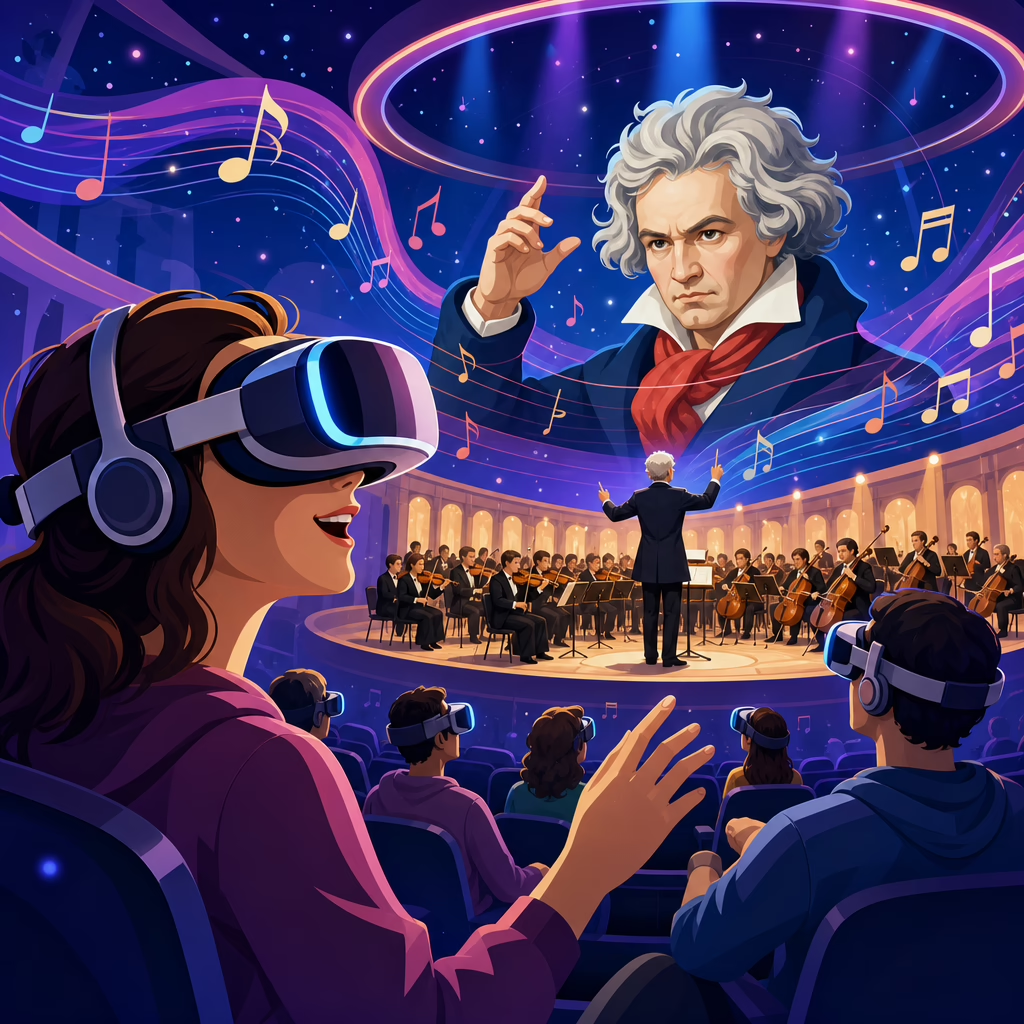
Virtual Reality Concerts Featuring Beethoven’s Works
Virtual reality concerts featuring Beethoven’s works are reshaping how audiences encounter a composer long associated with concert halls, conservatories, and carefully observed listening rituals. In this context, virtual reality means an immersive digital environment viewed through a headset such as Meta Quest, HTC Vive, or Apple Vision Pro, often paired with spatial audio that places instruments around the listener in three-dimensional space. A virtual reality concert can be a live-streamed performance captured with 360-degree cameras, a fully computer-generated reconstruction of an orchestra, or a hybrid production combining real musicians, game-engine visuals, and interactive educational layers. Beethoven’s music is especially suited to this format because it is structurally dramatic, emotionally legible, and widely recognized across generations.
I have worked on digital performance projects where the central challenge was not whether famous music could be moved into a headset, but how to preserve musical integrity while using the tools of immersive media well. That distinction matters. A Beethoven symphony is not improved merely because the listener can look around. It succeeds in virtual reality only when visual design, camera logic, latency control, and acoustic modeling support the phrasing, dynamics, and formal architecture already present in the score. When done carefully, these concerts broaden access, create new educational entry points, and offer cultural institutions a way to reach younger and geographically distant audiences without reducing Beethoven to novelty.
This hub article covers the miscellaneous landscape around virtual reality concerts featuring Beethoven’s works: the technologies that make them possible, the performance formats now in use, the educational and commercial opportunities, the legal and artistic constraints, and the reasons some projects fail. It also serves as a gateway topic within the wider intersection of technology and Beethoven, because immersive concerts touch recording, restoration, gaming, museum design, accessibility, and digital preservation at once. Anyone asking what a Beethoven VR concert actually is, how it works, whether it sounds convincing, and who benefits will find direct answers here.
How virtual reality changes the experience of Beethoven
A traditional concert fixes the audience in one seat and asks attention to move inward. Virtual reality changes that by making attention partly spatial. The listener may stand beside the conductor during the opening of the Fifth Symphony, sit inside the second violins during the Scherzo of the Ninth, or move through an abstract visual environment synchronized to the “Moonlight” Sonata. That change is not superficial. Beethoven’s music depends on contrasts of tension and release, foreground and background, mass and intimacy. Spatial audio engines such as Dolby Atmos production workflows, Ambisonics, and binaural rendering can externalize those contrasts so that horns seem to answer from behind, low strings anchor the room, and choral climaxes expand above eye level.
The best projects use immersion to clarify musical relationships. In one effective format, viewers can switch between audience perspective, conductor perspective, and sectional perspective. During the Eroica Symphony, hearing the development section from inside the orchestra reveals how Beethoven layers rhythmic propulsion across strings and winds. In chamber works, the effect can be even stronger. A VR rendering of the String Quartet Op. 131 lets listeners understand conversational phrasing because each player occupies an identifiable sonic location. This is valuable for general audiences and students alike. It turns abstract listening advice—follow the inner voices, notice motivic transformation—into something intuitively perceptible.
There are limits. Headsets can cause fatigue, and badly mixed spatial audio often collapses into gimmick. Beethoven also wrote for acoustic spaces with natural reverberation, so over-processed environments can flatten articulation or exaggerate bass response. The most convincing experiences I have seen keep visual movement restrained, respect tempo relationships, and allow the score to remain primary. Virtual reality adds context and perspective; it should not compete with the music for dominance.
Production models, platforms, and core technical choices
Virtual reality concerts featuring Beethoven’s works generally fall into three production models. First, there is volumetric or 360-degree capture of real performers in a hall or studio. Second, there are fully animated productions built in Unreal Engine or Unity, often using motion capture to reproduce conducting and instrumental gestures. Third, there are hybrids that combine filmed soloists with digitally modeled spaces, archival imagery, subtitles, and interactive program notes. Each model serves different goals. A filmed Fidelio excerpt may prioritize realism and singer presence, while an animated Pastoral Symphony may visualize weather, landscape, and motif in ways impossible on a physical stage.
The platform shapes nearly every creative decision. Standalone headsets impose limits on polygon count, texture size, and battery duration, so designers simplify environments and compress assets aggressively. PC-tethered systems support richer scenes and lower latency but reduce convenience for schools and public installations. WebXR can expand reach because users enter through a browser, though audio precision and graphical fidelity may be lower. For live events, bandwidth and synchronization are critical. If the audio stream drifts even slightly from the visual beat pattern of a conductor, credibility collapses immediately.
Several technical factors determine whether Beethoven translates well in VR. Resolution matters because orchestral detail is part of immersion; muddy visuals make bows, breath, and ensemble cues unreadable. Head tracking must be stable to avoid motion sickness. Most important, audio must be captured and rendered with care. Higher-order Ambisonics, close miking blended with room microphones, and head-related transfer function tuning help preserve instrumental localization. Conducting motion captured at high frame rates improves the naturalness of downbeats and cueing. Subtitles, libretti, and contextual overlays should be optional, not forced, especially in works where concentration is essential.
| Production format | Best use for Beethoven | Main advantage | Main limitation |
|---|---|---|---|
| 360-degree live capture | Symphonies, concert overtures, choral performances | Authentic performer presence and venue realism | Limited viewer movement and editing flexibility |
| Volumetric capture | Solo piano, chamber music, educational close-ups | Greater depth and positional realism | High capture cost and heavy processing needs |
| Fully animated VR | Programmatic works like the Pastoral Symphony | Creative visualization of form and theme | Risk of distracting from the score |
| Hybrid interactive experience | Opera scenes, museum installations, guided listening | Combines performance with learning tools | Complex design and rights management |
Which Beethoven works translate best to immersive performance
Not every Beethoven composition benefits equally from virtual reality. Works with strong dramatic pacing, clear textural contrasts, and broad cultural recognition usually perform best. The Fifth Symphony is an obvious candidate because its opening motive is instantly identifiable and its narrative arc from conflict to triumph aligns naturally with visual progression. The Sixth, or Pastoral Symphony, works for different reasons: its movement titles invite environmental design, from flowing brook imagery to storm simulation, without inventing meanings alien to the music. The Ninth Symphony is attractive because choral participation and massed forces create an overwhelming sense of scale in spatial audio, though it is technically difficult to stage convincingly.
Piano music can also excel. The “Appassionata,” “Pathétique,” and “Moonlight” sonatas allow for intimate, close-range listening impossible in a large hall. In headset-based recitals, users can observe pedaling, hand crossings, and body mechanics from a pianist’s shoulder line, which is tremendously useful pedagogically. Chamber music offers another strong fit. The late quartets, though less commercially obvious than the symphonies, reward immersion because their internal dialogue becomes physically mappable. Even the Missa Solemnis, often considered daunting, can gain accessibility when viewers receive synchronized translations, movement guides, and sectional positioning that clarifies where themes and vocal entries originate.
The weaker candidates are usually pieces that need little added framing or are undermined by visual overload. A simple bagatelle can become trivial if surrounded by excessive graphics. Conversely, a work like Fidelio can gain from VR if the production respects operatic timing and uses immersive staging to heighten confinement, freedom, and moral tension. The central rule is practical: choose a format that reveals something about the composition that standard video or audio alone cannot show as effectively.
Audience access, education, and institutional value
One reason organizations invest in virtual reality concerts featuring Beethoven’s works is access. A regional orchestra can reach international viewers without touring. A museum can create a permanent installation around Beethoven’s life and reception. A university can let students compare historically informed performance practice with modern symphonic interpretation inside the same immersive lesson. For audiences who feel intimidated by classical concert etiquette, VR offers a lower-pressure entry point. They can pause, replay, change perspective, and use guided annotations without fearing they are breaking a social rule.
Educational use is where I see the most durable value. In a classroom, a teacher can place students inside an orchestra and ask them to identify who carries the main theme, who supports harmony, and how rhythmic motives migrate between sections. That turns passive appreciation into active listening. Institutions can also layer archival materials into the experience: autograph manuscript excerpts, metronome controversies, period instrument comparisons, or maps of Vienna tied to Beethoven’s working life. This makes the miscellaneous side of the topic especially rich, because VR concerts naturally connect to archives, music theory, performance studies, accessibility design, and public humanities.
Accessibility benefits are significant but often underreported. Viewers with mobility limitations may attend an immersive concert from home. Captions and multilingual text can be integrated elegantly. Some projects include adjustable sensory settings, seated mode, contrast controls, and simplified navigation. These are not minor add-ons. They determine whether immersive Beethoven becomes a broad cultural tool or remains a niche luxury product. Institutions that measure success only by headset sales miss the larger opportunity: deeper engagement, stronger educational outcomes, and extended relevance for canonical music in a digital environment.
Business realities, rights, and the challenges ahead
Beethoven’s compositions are in the public domain, but a virtual reality concert still involves many rights layers. Specific editions may have rental terms. New recordings carry master rights. Performers, conductors, orchestras, stage directors, animators, and software developers all contribute protectable elements. If a project includes a modern scholarly edition, archival images, or venue branding, additional permissions may apply. This complexity surprises organizations that assume public-domain repertoire means frictionless production. In practice, contract design is as important as artistic planning.
Commercial viability depends on matching format to audience and budget. Premium headset-exclusive experiences can attract press but limit scale. Museum installations may generate steadier returns because the hardware is controlled and the experience can run for years. Subscription platforms can bundle Beethoven with broader classical programming, improving discoverability. Sponsorship is common, especially when educational or heritage goals are emphasized. Still, costs remain high: multi-camera capture, ambisonic recording, postproduction, app maintenance, and user testing add up quickly. A weak interface can sink even a beautifully played performance.
The future will likely favor flexible ecosystems rather than one-off experiments. Expect more mixed-reality overlays in concert halls, more companion educational modules for schools, and more AI-assisted localization for translation, indexing, and recommendation. Yet the core standard should remain unchanged: the music must lead. If a VR project cannot explain why immersion serves Beethoven better than a superb stereo recording or a high-quality film, it does not justify its own expense.
Virtual reality concerts featuring Beethoven’s works matter because they can expand access, deepen listening, and connect classical repertoire to contemporary digital culture without diluting artistic standards. The strongest experiences use spatial audio, thoughtful staging, and restrained visual design to illuminate structure, emotion, and performance practice. They work best when the chosen composition fits the medium, the technical execution respects acoustics and latency, and institutions build educational and accessibility features into the design from the start.
As a hub within the broader technology and Beethoven landscape, this topic touches nearly every related article a reader might want next: immersive audio, digital archives, interactive notation, museum installations, remote performance, music education technology, and rights management. That is why the miscellaneous label is useful here. It gathers the practical questions that do not fit neatly into one narrow box but shape whether immersive Beethoven succeeds in the real world. The field is past the novelty stage. Audiences now expect clarity, comfort, and artistic purpose.
If you are evaluating, producing, or simply exploring a Beethoven VR project, start with one question: what musical insight becomes clearer in immersive space than in a standard recording? Build from that answer. When the technology serves the score, virtual reality does not replace the concert hall; it extends Beethoven’s reach into places the nineteenth century could never imagine.
Frequently Asked Questions
What is a virtual reality concert featuring Beethoven’s works?
A virtual reality concert featuring Beethoven’s works is an immersive digital performance that lets audiences experience music such as the Fifth Symphony, the “Moonlight” Sonata, or the Ninth Symphony inside a three-dimensional virtual environment rather than a traditional concert hall. Using a headset like Meta Quest, HTC Vive, or Apple Vision Pro, listeners can enter a simulated venue, performance space, or even a creatively designed world inspired by Beethoven’s music. Instead of watching from a fixed seat, they may be able to look around freely, shift perspective, and feel visually and sonically surrounded by the orchestra, soloist, or chamber ensemble.
What makes these events especially compelling is the use of spatial audio. In a well-produced VR concert, the violins may seem to come from one side, brass from another, and percussion from behind or farther back, creating a more dimensional sense of musical placement than standard stereo playback. Some experiences recreate the atmosphere of a formal concert hall, while others take a more interpretive route, pairing Beethoven’s compositions with visual storytelling, historical settings, or abstract environments that respond to the emotional intensity of the music. In either case, the goal is not just to hear Beethoven, but to encounter his work in a way that feels present, immersive, and newly accessible to modern audiences.
How do virtual reality concerts change the way audiences experience Beethoven compared with a traditional concert hall?
Virtual reality changes the Beethoven listening experience by shifting audiences from passive observation to active presence. In a conventional hall, listeners usually remain seated at a distance from the performers, following established etiquette and relying on acoustics shaped by architecture. In VR, the experience can be much more intimate and flexible. A viewer might stand near the conductor, sit among the string section, or move to a vantage point that would be impossible in a physical venue. This alters how people perceive orchestration, ensemble interaction, and the dramatic structure of Beethoven’s music.
Another major difference is the blend of education, access, and interpretation. Traditional performances often emphasize historical formality, while VR concerts can provide contextual layers without interrupting the music. For example, an experience might include visual cues about the score, historical notes about Beethoven’s life, or guided transitions that help newcomers understand the significance of a motif or movement. This can make complex works feel more approachable without diminishing their seriousness. At the same time, VR offers expanded access for people who cannot easily attend live performances due to geography, cost, mobility limitations, or sold-out venues. Rather than replacing the concert hall, virtual reality opens an additional path into Beethoven’s world, one that can be both respectful of classical tradition and innovative in presentation.
What technology do you need to attend a VR concert of Beethoven’s music?
To attend a VR concert of Beethoven’s music, you typically need a compatible virtual reality headset and access to the platform hosting the event. Standalone devices such as the Meta Quest are often the most convenient because they do not require a separate computer for many applications. Other setups, including HTC Vive and some high-end PC-connected headsets, may offer more advanced graphics and tracking depending on the production. Apple Vision Pro can also support immersive media experiences, though compatibility depends on the specific app or service presenting the concert.
Beyond the headset, a stable internet connection is essential for live-streamed events, especially if the concert includes real-time rendering, high-resolution visuals, or interactive audience features. Headphones or integrated audio systems that support spatial sound are highly recommended because audio quality is central to the experience of Beethoven’s orchestration. Some concerts may also be available in less immersive formats, such as 360-degree video on a desktop or mobile device, but the full effect is usually designed for headset viewing. Before attending, it is wise to check technical requirements, supported devices, event timing, and whether the experience is live, on-demand, or interactive. A little preparation can make the difference between a frustrating setup and a truly transporting musical event.
Are virtual reality Beethoven concerts designed only for classical music experts?
No. One of the strongest advantages of virtual reality Beethoven concerts is that they can serve both seasoned classical listeners and complete beginners. Experts may appreciate the ability to study orchestral layout, conductor interpretation, and spatial relationships within a performance in unusual detail. They may also value historically informed visual design, analytical enhancements, or the opportunity to compare different digital stagings of the same work. For this audience, VR can provide a fresh lens on familiar masterpieces without sacrificing musical depth.
At the same time, these experiences can be especially welcoming for newcomers who may feel intimidated by traditional concert culture. Virtual environments often reduce the social pressure associated with concert etiquette and can introduce Beethoven’s music in a more intuitive, visually engaging format. A newcomer who might not immediately connect with a symphonic performance in a formal hall may respond strongly when the music is paired with immersive environments, guided narration, or dramatic visual interpretation. In this sense, VR does not simplify Beethoven so much as translate access to him. It creates an entry point that is contemporary, interactive, and often easier to explore at one’s own pace, which can help broaden interest in classical music far beyond its usual audience.
Can virtual reality concerts preserve the emotional power and artistic integrity of Beethoven’s works?
Yes, they can, but the outcome depends heavily on how thoughtfully the concert is produced. Beethoven’s music is built on structure, contrast, momentum, and emotional force, and those qualities can come through powerfully in virtual reality when the technology supports rather than distracts from the performance. High-quality spatial audio, sensitive visual design, and strong musicianship are the foundation. If the environment enhances the listener’s focus, highlights the architecture of the music, and respects the pacing of the work, VR can deepen engagement in ways that feel artistically meaningful.
That said, not every immersive production succeeds equally. If visuals become overly busy, historically careless, or disconnected from the music’s emotional arc, they can compete with Beethoven rather than illuminate him. The best VR Beethoven concerts understand that the technology is a medium, not the main event. They use immersion to reveal details, intensify presence, and make the listener feel closer to the performance, not to overwhelm the composition with novelty. When done well, virtual reality can preserve the seriousness and expressive depth of Beethoven’s works while also showing that masterpieces associated with tradition can thrive in new formats. It is not a compromise of artistic integrity by definition; in many cases, it is a carefully crafted extension of how great music can be experienced in the digital age.