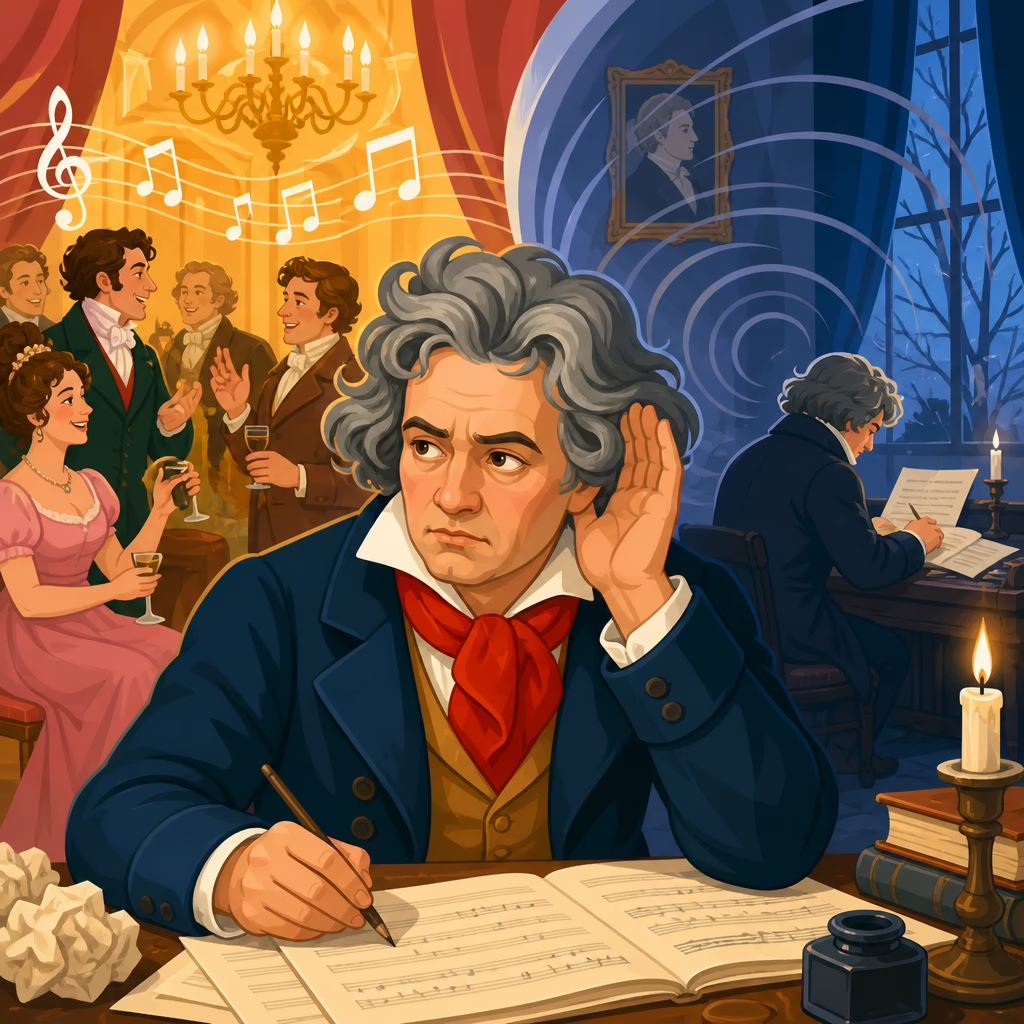
How Deafness Changed Beethoven’s Social World
Ludwig van Beethoven’s deafness did not simply alter how he composed; it transformed his social world, changing how he spoke with friends, navigated Vienna, depended on patrons, and understood himself in relation to other people. In this focused biography deep dive, “social world” means the network of family, patrons, colleagues, servants, publishers, students, and acquaintances that shaped his daily life, reputation, and emotional stability. Deafness, in Beethoven’s case, was progressive hearing loss that began to trouble him seriously in his late twenties and deepened over the following decades. The change mattered because Beethoven lived in a culture built on conversation: salons, rehearsals, dinners, café talk, negotiations with aristocrats, and the quick social wit expected in elite Viennese circles. As his hearing declined, ordinary exchanges became exhausting, embarrassing, and increasingly unreliable.
What makes Beethoven especially revealing is that the evidence is unusually rich. We have the 1802 Heiligenstadt Testament, letters to friends and publishers, reports from contemporaries, and, in his later years, conversation books used by visitors who wrote down remarks so Beethoven could follow discussions. Taken together, these sources show that deafness did not make him withdraw in one simple movement from sociable artist to isolated genius. The process was uneven. He still sought friendship, still quarreled, still negotiated business, and still needed audiences. Yet every layer of contact changed: intimacy became more fragile, public appearances more stressful, misunderstandings more common, and dependence on written mediation far greater. His deafness therefore belongs not only to the history of music or medicine, but to the history of social adaptation, stigma, and survival in modern European urban life.
I have worked through Beethoven’s letters, conversation-book excerpts, and biographies often enough to see that the most important question is not whether deafness isolated him, but how it rearranged the terms on which connection remained possible. He learned new habits, leaned harder on trusted intermediaries, and developed defensive manners that many contemporaries read as rudeness. At the same time, some relationships deepened precisely because they had to move beyond effortless talk. To understand how deafness changed Beethoven’s social world, it is necessary to examine the stages of hearing loss, the shift in his public behavior, the remaking of his friendships, and the practical mechanics of communication that structured his final years.
Early hearing loss and the beginning of social strain
Beethoven did not announce his hearing problems immediately, and that secrecy shaped the first social consequences. Around the late 1790s he began noticing tinnitus, difficulty hearing high frequencies, and trouble following speech in groups. For a pianist and improviser whose reputation depended on responsive musical exchange and quick interpersonal command, admitting hearing loss carried obvious professional risk. Vienna valued brilliance performed in real time. Beethoven had won admirers partly through dazzling social musicianship: he could improvise at gatherings, accompany, debate, and command a room. Once hearing became uncertain, the same room became threatening.
The result was concealment. He avoided saying openly that he could not hear, asked people to speak louder without explaining why, and withdrew from situations where failure might be noticed. This is the context for the famous emotional crisis expressed in the Heiligenstadt Testament. The document is often quoted for its despair, but socially it is just as important for its account of shame. Beethoven explains that he seemed hostile when in fact he was avoiding the humiliation of revealing an infirmity. In plain terms, deafness made simple sociability feel dangerous. If someone heard a flute or shepherd’s song that he could not, the gap was exposed in public. Such moments were not abstract medical symptoms; they were social injuries.
That dynamic helps explain the reports that Beethoven became more abrupt and suspicious. People encountering him in these years may have seen irritability without recognizing the constant labor behind it. Hearing loss forces guesswork. Guesswork breeds mistakes. Mistakes in a proud and status-conscious artistic world can quickly become resentment. Beethoven, already strong-willed, had to spend energy deciphering speech and monitoring whether others noticed. That pressure changed not only his comfort but his timing, ease, and spontaneity with other people.
From salon culture to selective presence
Before deafness became severe, Beethoven thrived in a culture of musical houses and aristocratic salons. These spaces were central to Viennese artistic advancement. Patronage was sustained through repeated presence, charm, recommendation, and performance before cultivated listeners. Deafness did not remove him from this world instantly, but it reduced his ability to function within it on conventional terms. Group conversation became the hardest form of interaction because several voices, background noise, and rapid topic shifts made lip-reading or contextual inference ineffective. The more prestigious the gathering, the less he could control conditions.
As a result, Beethoven’s social pattern grew more selective. He preferred smaller meetings, familiar companions, and one-to-one exchanges where context helped him compensate. He also developed the habit of walking with friends, a format better suited to focused communication than crowded interiors. The image of Beethoven striding through Vienna or the countryside is not only romantic iconography; it reflects practical adaptation. Outdoor walks lowered the burden of salon performance and allowed pauses, repetition, and intensity without the formal expectations of aristocratic rooms.
This change mattered for status as well as comfort. In salon culture, absence could be interpreted. Repeated withdrawal risked being read as arrogance, instability, or ingratitude. Beethoven’s social position remained strong because of his fame and supporters, but deafness narrowed the settings where he could maintain those relationships smoothly. The shift from broad participation to selective appearance did not sever him from Vienna’s elite, yet it changed the texture of his visibility.
Friendship, misinterpretation, and emotional volatility
Deafness altered Beethoven’s friendships by making misunderstanding routine. Friends had to repeat themselves, write things down, tolerate sudden offense, or decode his responses when he had only partly understood what was said. In my reading of the correspondence, this is where the social cost appears most humanly. Relationships were no longer sustained mainly by mutual affection or shared taste; they required patience as a daily technique. Those who remained close often did so because they accepted unusual demands.
Beethoven could be deeply loyal and deeply difficult. Hearing loss intensified both tendencies. He cherished trusted friends such as Stephan von Breuning and others in his circle, yet quarrels erupted easily when he suspected neglect, deceit, or disrespect. Partial hearing is socially treacherous because fragments of conversation can sound like slights. Delayed comprehension can make ordinary remarks feel staged or mocking. Beethoven’s pride then turned uncertainty into accusation. Some contemporaries concluded that he was impossible. Others recognized a man under relentless strain.
The emotional volatility recorded in letters should therefore be read partly through the mechanics of disability. Deafness did not create his temperament from nothing, but it amplified defensiveness. It also complicated reconciliation. Repairing a damaged friendship usually depends on tone, timing, and candid talk; all were harder for Beethoven. Written communication helped, yet letters can harden conflict because they preserve grievance without the softening effect of voice. His social world became one in which trust had to survive repeated friction.
For readers seeking reliable biographical context on Beethoven’s early life and documentary record, the broader guide at this pillar article is useful background, but the social effects of deafness emerge most clearly in the middle and late periods of his life rather than in childhood sources.
Patrons, dependence, and dignity
Beethoven’s deafness also changed how he managed aristocratic patronage. He depended on noble supporters including Archduke Rudolph, Prince Lobkowitz, and Prince Kinsky, yet he fiercely guarded personal dignity. Hearing loss increased this tension. On one hand, he needed loyal advocates more than ever because public performance and ordinary networking became harder. On the other, dependence risked humiliation if he appeared pitiable or socially diminished.
What is striking is that Beethoven did not respond by becoming meek. He negotiated, complained, and asserted equality with high-ranking patrons in unusually direct language. Some of this reflected his character and the broader shift toward the autonomous artist, but deafness sharpened the stakes. If he could no longer dominate society through conversational brilliance and pianistic immediacy as before, then written contracts, fixed annuities, and formal recognition became more important. His famous 1809 annuity agreement can be seen partly in this light: it offered a structure of support less dependent on constant salon maintenance.
Yet patronage remained relational. Aristocrats were not abstract funding bodies; they were people whose favor had to be renewed. Deafness made that renewal less fluid. Misheard remarks, social fatigue, and uneven attendance could all damage rapport. Beethoven managed this through reputation, correspondence, and the sheer authority of his music, but the social labor behind patronage grew heavier as hearing declined.
How Beethoven communicated as deafness advanced
By the 1810s and especially the 1820s, Beethoven’s social life increasingly relied on compensatory tools and routines. Ear trumpets were tried with limited success. Writing became indispensable. Most famously, conversation books allowed visitors to record questions or remarks while Beethoven answered aloud, wrote occasionally, or responded from context. These books are invaluable historical evidence because they show social interaction under altered conditions: practical, fragmented, sometimes intimate, sometimes comic, often tense.
The conversation books reveal that deafness did not end sociability; it changed its medium. Visitors still brought gossip, business, artistic debate, domestic concerns, and requests. Beethoven still joked, instructed, scolded, and planned. But every exchange now had material constraints. Written prompts slowed rhythm. Nuance could be lost. Side comments vanished unless someone bothered to note them. Confidentiality weakened because servants, secretaries, or companions might be present to facilitate communication.
| Area of social life | Before severe deafness | After severe deafness |
|---|---|---|
| Public gatherings | Active pianist, improviser, conversational presence | Selective attendance, fatigue, difficulty following groups |
| Friendships | Maintained through speech, visits, shared music-making | Dependent on patience, repetition, notes, and trusted routines |
| Business dealings | Negotiated in person with flexibility | More reliance on letters, intermediaries, and written records |
| Domestic life | Direct spoken instruction possible | Frequent conflict with servants and household disorder |
| Self-presentation | Commanding virtuoso identity | Greater defensiveness, privacy, and concern over misunderstanding |
These adaptations carried costs. Written mediation can preserve information, but it exposes vulnerability. Anyone entering the room could see that ordinary hearing had failed. In a society that often associated disability with decline, Beethoven had to conduct his private and professional life through conspicuous workaround methods. That reality helps explain why later acquaintances often described encounters with him as intense, awkward, or unpredictable rather than simply tragic.
Household conflict, family life, and the limits of intimacy
Some of the sharpest social effects of deafness appeared inside Beethoven’s household. He changed lodgings frequently, complained about servants, and often seemed unable to sustain domestic order. Not all of this resulted from hearing loss; he could be exacting and disorderly at once. Still, deafness plainly made everyday management harder. Instructions had to be repeated, bells and knocks might go unheard, and irritations multiplied when communication failed over small tasks. Social historians rightly note that disability often becomes most visible in routine dependence, not only in public crisis. Beethoven’s domestic frustrations fit that pattern.
His relationship with his nephew Karl shows an even more painful dimension. Beethoven’s long custody struggle and later guardianship involved legal conflict, emotional possessiveness, and inconsistent tenderness. Deafness intensified the imbalance. Communication with Karl was burdened by authority, anxiety, and surveillance. Beethoven wanted loyalty and moral control, yet his disability made direct, relaxed intimacy difficult. The relationship often moved through notes, admonitions, or third parties rather than open, easy exchange. Karl experienced not just a famous uncle, but a household atmosphere charged by miscommunication and pressure.
Romantic intimacy remains harder to document securely, but the pattern is suggestive. Courtship and sustained partnership depend heavily on reciprocal conversation, social ease, and confidence in shared futures. Beethoven’s hearing loss undermined all three. The “Immortal Beloved” mystery aside, the broader point is clear: deafness narrowed the emotional pathways through which companionship could deepen. It increased self-consciousness, reduced spontaneity, and made him fear burdening others. In social terms, that is not mere solitude; it is the shrinking of imaginable intimacy.
Late reputation: isolation, authority, and a different kind of presence
In Beethoven’s final years, deafness produced an apparent paradox. Personally, he was more isolated from ordinary spoken life than ever. Publicly, he became an almost monumental figure. Visitors came not because he was easy company, but because he was Beethoven. This changed the social meaning of encounters. He no longer needed to charm in the old way; reverence could bridge what conversation could not. His authority, secured by works such as the late piano sonatas, the Missa solemnis, and the Ninth Symphony, created a new kind of social presence based less on participation than on stature.
Still, authority did not erase loneliness. The famous image of Beethoven at the 1824 premiere of the Ninth Symphony, unable to hear the applause and needing to be turned toward the audience, captures both sides at once. He was publicly exalted and privately cut off from the very sound of collective response. That is the clearest emblem of how deafness changed his social world. It did not simply remove him from society; it separated him from immediate reciprocity while leaving admiration intact.
By the end of his life, Beethoven inhabited a social environment structured by mediation: notebooks, letters, intermediaries, selected visitors, legal documents, and the immense credibility of his art. The losses were real, but so were the adaptations. He remained socially consequential even when ordinary conversation was largely inaccessible. That distinction matters because it rescues his biography from cliché. Deafness neither reduced him to heroic suffering nor left his relationships untouched. It reshaped the mechanics, risks, and meanings of human connection around him.
Beethoven’s deafness changed his social world by turning communication from a natural social flow into a managed, effortful practice. It strained friendships, narrowed salon participation, altered patronage, complicated household life, and made intimacy harder to sustain. At the same time, it pushed him toward written exchange, selective companionship, and forms of authority less dependent on conversational ease. The result was not simple isolation, but a social existence reorganized around compensation, pride, misunderstanding, and resilience.
The deepest lesson is biographical rather than sentimental. Beethoven’s hearing loss mattered because society ran on hearing, and every adaptation exposed both his vulnerability and his determination to remain fully present as an artist and person. If you want to understand Beethoven more accurately, read his deafness not as a side note to genius, but as a force that changed the terms of nearly every relationship he had. Explore his letters, the conversation books, and contemporary accounts with that question in mind, and his life becomes sharper, sadder, and far more human.
Frequently Asked Questions
How did Beethoven’s deafness change his everyday relationships with friends and acquaintances?
Beethoven’s progressive hearing loss deeply altered the way he interacted with the people around him. In earlier years, he had been socially active in Vienna’s musical and aristocratic circles, where conversation, quick wit, and piano performance all reinforced a person’s standing. As his hearing declined, ordinary exchanges became strained. He often misunderstood remarks, missed nuances in group settings, and found the noise and unpredictability of social gatherings exhausting. This made encounters that had once been natural feel humiliating or risky.
Over time, deafness encouraged withdrawal. Beethoven did not simply become “antisocial” by temperament; he was reacting to a world that had become harder to navigate. Friends sometimes experienced him as abrupt, suspicious, or emotionally distant, but those traits were often intensified by the stress of not hearing clearly and by his fear of embarrassment. He could no longer participate with ease in the spontaneous back-and-forth that sustains friendship. That loss mattered because social life in Vienna depended heavily on in-person contact, salon culture, and personal recommendation.
At the same time, his friendships did not disappear. Instead, they changed form. He relied more heavily on trusted individuals who were patient, loyal, and willing to adapt to his communication needs. Later in life, conversation books became a crucial social tool, allowing visitors to write their side of exchanges while Beethoven responded aloud, in writing, or in gestures. These books reveal that he remained engaged with politics, art, household matters, health, and gossip. So his deafness narrowed his social ease, but it did not erase his desire for connection. It transformed friendship from something relatively fluid into something more selective, effortful, and emotionally charged.
What were conversation books, and why were they so important to Beethoven’s social world?
Conversation books were notebooks used especially in Beethoven’s later years to help facilitate communication when his hearing loss became severe. Visitors, friends, students, business associates, and family members would write down questions, comments, or news so that Beethoven could follow the discussion. These books became essential because they allowed him to remain involved in daily human exchange even when ordinary speech had become inaccessible.
Their importance was practical, social, and psychological. Practically, they helped Beethoven manage routine life: arranging meals, discussing money, handling legal concerns, speaking with publishers, coordinating travel, and directing household affairs. Socially, they gave structure to encounters that otherwise might have failed. Instead of relying on repeated shouting, awkward guessing, or isolation, he and his visitors had a method for continuing conversation. This made it more possible for him to preserve friendships, maintain professional relationships, and participate in intellectual life.
Psychologically, the conversation books mattered because they show Beethoven still trying to remain in the world rather than retreat entirely from it. They testify to his dependence on literate, cooperative companions and to the adaptation of his circle around his disability. At the same time, the need for such books underscored how different his social reality had become. Communication was slower, less spontaneous, and more mediated. Jokes, emotional tones, and fleeting remarks could be lost or flattened. Yet the very existence of the books demonstrates resilience: Beethoven’s world did not end when hearing failed; instead, he and those around him built alternative pathways for social contact.
Did deafness affect Beethoven’s relationships with patrons, publishers, and professional colleagues?
Yes, profoundly. Beethoven’s career depended not only on talent but also on relationships with patrons, publishers, performers, and fellow musicians. In Vienna, success required negotiation, reputation management, and constant personal interaction. Deafness made all of that more difficult. Meetings could become awkward, misunderstandings more frequent, and his already forceful personality could appear even harsher when shaped by frustration and insecurity.
With patrons, deafness complicated the delicate balance between dependence and independence. Beethoven valued artistic freedom and resisted being treated like a servant, yet he also needed financial support from aristocratic sponsors. Because deafness made public performance and smooth sociability harder, these patronage networks became even more important. He could not rely as easily on the dazzling social and pianistic presence that had first helped establish him in Vienna. Instead, his reputation rested more heavily on his compositional authority and on the loyalty of supporters willing to accommodate his changing circumstances.
With publishers and colleagues, communication barriers could intensify disputes over contracts, editions, deadlines, and performances. Beethoven was already known for being demanding and exacting. Deafness increased his dependence on letters, intermediaries, and written clarification, which could sharpen tensions or delay agreements. Rehearsals and collaborations also became more complex as his ability to hear performers diminished. Even so, his professional world did not collapse. If anything, his deafness made his network of assistants, copyists, advocates, and informed friends more essential. His social world became less casual and more structured around trusted channels of mediation.
How did Beethoven’s deafness influence his sense of identity and emotional life within society?
Beethoven’s deafness was not merely a medical condition; it became central to how he understood himself in relation to other people. Hearing loss threatened the very abilities on which his public identity had been built. He had risen partly as a brilliant pianist-improviser and as a commanding presence in elite circles. As deafness advanced, he had to confront a painful mismatch between his inner self, his public image, and other people’s perceptions of him.
This produced a powerful emotional tension. Beethoven feared pity, misunderstanding, and social exposure. He was acutely aware that deafness could isolate him not just physically but morally and psychologically, making him feel cut off from ordinary companionship. Evidence from his writings shows periods of despair, shame, anger, and loneliness. He often struggled with the fact that others could move effortlessly through a world of sound and conversation while he could not. That gap affected how he interpreted social interactions, and it likely contributed to episodes of irritability, mistrust, and emotional volatility.
Yet deafness also reshaped his identity in another direction: it intensified his self-conception as a serious, even heroic artist set apart from ordinary society. This did not make his suffering less real, but it did help frame it. Rather than seeing himself only as diminished, he increasingly occupied a role in which artistic purpose could coexist with social estrangement. In that sense, deafness changed not only how society received Beethoven, but how Beethoven imagined his place within society. He became, in his own life, both more vulnerable to human disconnection and more determined to find meaning beyond conventional sociability.
Why is it accurate to say Beethoven’s deafness transformed his “social world,” not just his music?
It is accurate because deafness affected every layer of Beethoven’s human environment, not only his artistic method. “Social world” includes the web of family, servants, patrons, students, publishers, doctors, landlords, colleagues, and acquaintances who shaped daily life. Progressive hearing loss altered how Beethoven moved through that web. It changed how he communicated, whom he trusted, how often he socialized, how he handled conflict, and how much he relied on written rather than spoken exchange.
Within the household, deafness increased his dependence on others while also heightening tensions around control, privacy, and frustration. With family members, especially in already difficult relationships, communication barriers could magnify strain. In public and professional settings, deafness made navigation harder, because reputation in Vienna depended on participation in a dense interpersonal culture. The simple act of attending dinners, rehearsals, salons, or street encounters carried new risks of confusion and embarrassment.
Most importantly, deafness changed the emotional architecture of Beethoven’s life. Social stability became more fragile. Reliable companions mattered more. Misunderstandings carried greater cost. Isolation was not an abstract theme but a daily possibility. At the same time, his network adapted around him through letters, intermediaries, and conversation books, proving that social life did not end but was reorganized. To focus only on what deafness meant for his compositions misses how thoroughly it reshaped the lived experience of being Beethoven among other people. His deafness was social as well as sensory: it transformed connection, dependence, authority, intimacy, and belonging.