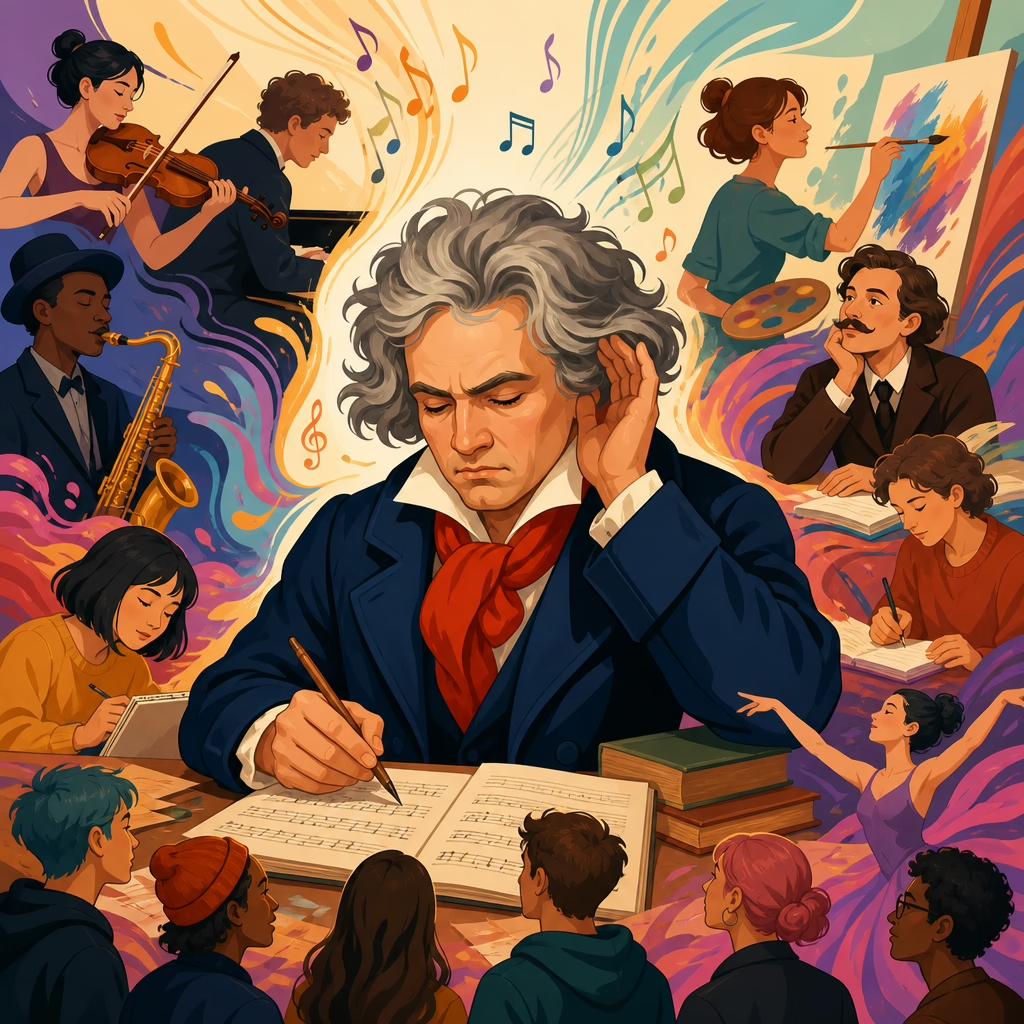
How Beethoven’s Deafness Inspired Generations of Artists
Ludwig van Beethoven’s deafness is one of the most discussed facts in music history, but its lasting power lies in more than biography: it became a model for artistic endurance, reinvention, and creative authority. In practical terms, Beethoven’s hearing loss reshaped how later artists understood discipline, adversity, and the relationship between inner imagination and public performance. When people ask how Beethoven’s deafness inspired generations of artists, they are really asking why one composer’s private struggle became a shared cultural symbol across music, literature, painting, film, and modern disability discourse. The answer begins with the facts. Beethoven started noticing hearing problems in his late twenties, likely in the 1790s, and by the final decade of his life he was profoundly deaf. Yet during those years he produced works that remain central to the Western canon, including the “Eroica” Symphony, the Fifth Symphony, the late piano sonatas, the Missa solemnis, and the Ninth Symphony.
That timeline matters because it overturns a lazy assumption that great art depends on ideal conditions. Beethoven’s deafness did not simply coexist with genius; it changed the conditions under which his genius operated. As someone who has worked closely with Beethoven scholarship, program notes, and performance history, I have seen how often artists return to his example when describing their own obstacles. They cite not only the drama of hearing loss but the methods behind it: conversation books, ear trumpets, relentless sketching, and a growing reliance on internal hearing. This article serves as a hub for the broader miscellaneous dimensions of Beethoven’s inspirations and influence. It explains the historical reality of his deafness, the myths that grew around it, the ways artists in different fields adopted his story, and the limits of turning suffering into legend. Understanding that full picture reveals why Beethoven continues to inspire creators who face physical barriers, social isolation, mental strain, or the simple challenge of making original work under pressure.
What Beethoven’s Deafness Actually Meant
Beethoven was not born deaf, and he did not lose his hearing overnight. Contemporary letters, medical reports, and accounts from friends indicate a gradual decline marked by tinnitus, difficulty hearing speech, and increasing withdrawal from social settings. The 1802 Heiligenstadt Testament, a letter to his brothers never sent in his lifetime, is the key document. In it Beethoven confessed despair, embarrassment, and thoughts of suicide, then declared that art held him back from ending his life. That statement has inspired artists for two centuries because it names a problem plainly: when identity and vocation collide with physical loss, work can become both refuge and duty.
For working musicians, his deafness also had technical implications. Conducting became harder. Public improvisation, once a major source of his fame in Vienna, became less practical. Communication with performers required more effort, and by the 1810s conversation books helped visitors exchange thoughts with him in writing. Yet the decline also pushed Beethoven further toward composition as an inward act. He increasingly trusted structural imagination, motivic development, and memory rather than immediate auditory feedback from live performance. Later composers, from Brahms to Shostakovich, admired this inward rigor. They saw in Beethoven proof that artistic hearing is not identical to physical hearing.
How Beethoven Turned Limitation Into Artistic Method
The most useful lesson artists draw from Beethoven is not vague resilience but process. His surviving sketchbooks show intense revision. A famous four-note cell in the Fifth Symphony did not arrive as polished destiny; it was developed, tested, and transformed. That matters because the romantic image of Beethoven as a storming genius can obscure how methodical he was. Pain did not automatically produce masterpieces. Persistent craft did. When artists cite Beethoven today, they often mean that disciplined work can outlast unstable circumstances.
His late style deepened this lesson. The late string quartets, especially Op. 131 and Op. 132, depart from conventional forms, shift abruptly in mood, and create spaces that feel introspective, private, even visionary. Many listeners and creators have connected this music to Beethoven’s isolation. While scholars rightly caution against reducing style to medical condition, there is no doubt that his separation from ordinary hearing and social exchange changed his artistic world. He no longer composed mainly for salon approval or virtuoso display. He wrote with extraordinary freedom, often ahead of public taste. Modern artists facing marginalization or incomprehension frequently recognize themselves in that stance.
| Aspect of Beethoven’s deafness | Practical challenge | Artistic lesson later creators drew |
|---|---|---|
| Gradual hearing loss | Declining performance confidence | Identity can evolve when old strengths fade |
| Use of sketchbooks | Need to refine ideas internally | Craft matters as much as inspiration |
| Social withdrawal | Isolation from audiences and peers | Original work may emerge outside approval |
| Conversation books | Communication barriers | Artists can adapt tools to stay engaged |
| Late-period experimentation | Writing beyond audience expectation | Limitation can encourage bold innovation |
Why Musicians Kept Returning to Beethoven’s Example
Composers after Beethoven inherited more than forms and harmonic procedures; they inherited a narrative of moral seriousness. Richard Wagner treated Beethoven as a turning point in music history, especially in his essays on the symphony. Johannes Brahms felt the burden of Beethoven so strongly that his First Symphony was long called “Beethoven’s Tenth” by admirers. Gustav Mahler studied Beethoven’s symphonic logic and his sense of struggle resolved, or at least transformed, through form. In each case, deafness amplified the image of Beethoven as a creator who answered hardship with greater depth rather than retreat.
Performers also found inspiration in specifics. Pianists who lose dexterity, singers recovering from injury, and conductors navigating physical limitations often invoke Beethoven because his example legitimizes adaptation. The point is not that every obstacle leads to greatness; many do not. The point is that artistic authority can survive bodily change. This is why conservatories, orchestras, and chamber ensembles continue to program Beethoven in contexts that emphasize perseverance. The Ninth Symphony, premiered in 1824 when Beethoven could not hear the applause behind him, remains the emblematic scene. The story is famous because it condenses a hard truth into one image: a composer can speak to a public even when direct sensory contact has broken down.
Beethoven’s Deafness Beyond Music
Poets, novelists, painters, and filmmakers seized on Beethoven because deafness gave his life dramatic clarity. E.T.A. Hoffmann wrote about Beethoven’s instrumental music as opening a realm beyond ordinary expression, helping establish the idea that he accessed something inward and immense. Later writers used him as a symbol of solitary creation. Thomas Mann, for example, engaged Beethoven’s legacy while exploring the burdens and costs of genius in German culture. In visual art, portraits often emphasize the intense gaze, the disordered hair, and the sense of inward concentration, reinforcing the link between sensory deprivation and visionary power.
Film and popular culture simplified this image further. Movies, documentaries, and classroom narratives often present Beethoven’s deafness as a neat triumph story: artist suffers, artist transcends, world applauds. That version is emotionally effective but incomplete. The real Beethoven was irritable, financially entangled, medically unwell, and often difficult in relationships. Artists who take deeper inspiration from him usually do so after moving past the simplified legend. They see that his power came not from purity of suffering but from sustained work amid contradiction. That makes his example more credible, not less. Real creators rarely feel heroic while making difficult work; Beethoven’s actual life confirms that excellence often looks messy from the inside.
Disability, Representation, and the Risk of Mythmaking
Any serious discussion of how Beethoven’s deafness inspired generations of artists must address disability with care. For much of the nineteenth and twentieth centuries, commentators framed deafness mainly as tragedy redeemed by genius. That approach can unintentionally turn disability into a narrative device whose purpose is to elevate a non-disabled audience. More recent scholarship and disability studies ask different questions. How did Beethoven adapt? What social barriers made his life harder? Why does culture celebrate disabled people most when they perform extraordinary achievement? These questions matter because they shift attention from sentiment to structure.
In my experience working through historical reception, the most responsible way to present Beethoven is neither to minimize deafness nor to romanticize it. His hearing loss was devastating. It affected work, intimacy, and mental health. It also forced practical innovation and sharpened his authority as a composer. Later disabled artists have responded to Beethoven in varied ways: some find empowerment in his persistence, while others reject the expectation that disability must be overcome through exceptional productivity. Both responses are valid. The strongest influence Beethoven offers is permission to create on altered terms, not a demand to become superhuman.
Examples of Artists and Movements Shaped by the Story
The influence of Beethoven’s deafness appears in direct statements, artistic homages, and broader cultural habits. Bedřich Smetana, who also experienced hearing loss, is frequently discussed alongside Beethoven because his String Quartet No. 1, “From My Life,” includes a high sustained note associated with tinnitus. The comparison shows how composers used biography to frame listening. In the twentieth century, Dmitri Shostakovich’s public image as a composer under pressure often invited Beethoven parallels, especially around moral struggle embedded in symphonic form. Jazz and rock musicians have invoked Beethoven less for formal models than for the emblem of pushing through limitation. Songwriters facing chronic illness, deaf performers working with vibration and visual rhythm, and multidisciplinary artists using assistive technology still reference him as a historical anchor.
The story also shaped institutions. Museums mount exhibitions around Beethoven and adversity. Music education programs use his life to discuss hearing, silence, and imagination. Advocacy efforts around accessibility in the arts sometimes cite Beethoven to challenge assumptions about who can compose, perform, or lead. Even where the historical analogy is imperfect, the symbolic value is clear. Beethoven’s deafness created a durable cultural language for discussing adaptation, artistic identity, and the difference between bodily impairment and creative capacity. That language has reached far beyond classical music.
What Modern Artists Can Learn From Beethoven Now
For contemporary creators, the most practical lesson is to separate tools from purpose. Beethoven lost one essential channel of feedback, yet he kept refining his underlying craft: thematic economy, formal balance, contrast, pacing, and emotional architecture. Today’s artists may face different disruptions—hearing damage from touring, repetitive strain injuries, burnout, financial instability, algorithmic pressure, or chronic illness. Beethoven’s example suggests that when one mode of working collapses, the answer is to rebuild process deliberately. That may mean dictation software, collaborative notation, therapy, hearing devices, revised schedules, or smaller but more sustainable output.
His story also clarifies that private conviction and public recognition do not move on the same timetable. Several late works confused early listeners before becoming central repertoire. Artists navigating niche audiences or experimental forms can take this as a realistic encouragement. Immediate approval is not the sole measure of value. At the same time, Beethoven does not excuse neglect of audience or craft. He revised obsessively and cared deeply about reception, publication, and performance standards. The enduring inspiration is therefore balanced: trust your inner ear, but test your work rigorously.
Beethoven’s deafness inspired generations of artists because it gave creative struggle a form people could recognize without reducing art to mere autobiography. His life demonstrates that limitation can alter artistic method, deepen seriousness, and force innovation, but it also shows that endurance is never simple. He suffered, adapted, withdrew, argued, revised, and kept working. That complex example has mattered to composers seeking structural courage, performers facing bodily change, writers exploring solitude, and disabled artists demanding fuller representation. It remains powerful precisely because it is not a fairy tale.
As a hub within Beethoven’s inspirations and influence, this topic connects outward to discussions of his late style, the Heiligenstadt Testament, disability in music history, the Ninth Symphony’s cultural afterlife, and the many artists who reinterpreted his image. The central takeaway is clear: Beethoven’s deafness did not create his genius, but the way he responded to deafness changed how later generations understood what an artist can be. If you want to explore Beethoven’s influence more deeply, continue with the related articles in this subtopic and trace how one composer’s altered silence reshaped artistic ambition across centuries.
Frequently Asked Questions
How did Beethoven’s deafness change the way artists think about creativity?
Beethoven’s deafness changed artistic thinking because it shifted attention away from creativity as a purely external, performance-based act and toward creativity as an inner discipline. As his hearing declined, Beethoven could rely less on direct auditory feedback and more on memory, structure, imagination, and a deeply internal sense of musical form. Later artists in music, literature, painting, dance, and film recognized in his example a powerful idea: great work does not depend only on ideal conditions. It can also emerge from limitation, adaptation, and intense concentration. That lesson has had enormous influence because it challenges the assumption that talent disappears when the body becomes unreliable. Instead, Beethoven came to symbolize the possibility that artistic vision can become even more focused under pressure.
For generations of artists, this was not just an inspiring life story but a practical model. Beethoven demonstrated that creativity could be rooted in rigorous craft rather than convenience. He continued composing by trusting his technical mastery and inner hearing, showing that imagination could function independently of normal sensory experience. That example helped later creators see adversity not as something to romanticize, but as something that can force reinvention. In that sense, Beethoven’s deafness became a lasting symbol of artistic resilience, not because suffering automatically produces genius, but because he transformed a devastating personal loss into a new understanding of what creative authority looks like.
Why is Beethoven often seen as a symbol of artistic resilience rather than simply a tragic figure?
Beethoven is often remembered as a resilient artist because his deafness did not end his ambition, his experimentation, or his authority as a composer. Many historical figures endure hardship, but Beethoven occupies a special place because the hardship struck at the very center of his profession. A composer and pianist losing his hearing seems, on the surface, like an impossible contradiction. Yet instead of withdrawing entirely from artistic life, he continued to produce some of the most influential music in Western history. That fact transformed his biography into something larger than personal tragedy. It turned him into evidence that artistic identity can survive even when the conditions that first supported it begin to collapse.
Artists have returned to Beethoven’s story because it speaks to a universal fear: the fear of losing the very ability that defines one’s work. His life offers a counterargument to despair. He adapted his methods, deepened his commitment to composition, and embraced a more inward mode of creation. This is why later generations did not remember him only as a victim of misfortune. They saw him as a figure who redefined strength. His legacy suggests that resilience is not denial, and it is not heroic simplicity. It is the difficult, ongoing work of continuing to create in altered circumstances. That is a message that artists across disciplines have found both credible and deeply motivating.
In what ways did Beethoven’s deafness influence later musicians and composers?
Beethoven’s deafness influenced later musicians by changing the cultural meaning of what it means to be a composer. Before him, musical authority was often tied closely to performance, patronage, and visible mastery in public settings. Beethoven’s later career emphasized something else: the composer as an autonomous creative mind whose deepest work might emerge from inner necessity rather than immediate public approval. Later composers, especially in the nineteenth and twentieth centuries, drew strength from this model. They saw in Beethoven a precedent for trusting personal vision, even when it was difficult, misunderstood, or detached from conventional expectations.
His example also encouraged musicians to take artistic discipline more seriously. Beethoven’s continued output despite severe hearing loss reinforced the idea that composition is not merely inspiration but construction, revision, and intellectual rigor. Composers who struggled with illness, isolation, or professional setbacks often found in Beethoven a powerful ancestor. His story suggested that technical knowledge, structural thinking, and inner imagination could sustain creative work even when direct performance became limited. More broadly, musicians inherited from him a new narrative about originality: that some of the most enduring art can come from confrontation with limits rather than freedom from them. This helped shape the modern image of the artist as someone who transforms difficulty into form.
Did Beethoven’s deafness directly improve his music, or is that too simplistic?
It is too simplistic to say that Beethoven’s deafness directly improved his music, because that kind of statement risks turning a painful condition into a romantic myth. Deafness was a profound hardship for him personally and professionally. It brought frustration, isolation, and emotional strain. There is no responsible way to claim that suffering automatically makes art better. At the same time, it is fair to say that his hearing loss changed the conditions under which he worked, and those changed conditions influenced how later listeners and artists interpreted the music. As Beethoven became less dependent on public performance and more immersed in internal composition, his work increasingly appeared to embody extraordinary concentration, scale, and imaginative independence.
What inspired later artists was not the idea that deafness itself was a gift, but the fact that Beethoven refused to let loss define the limits of his creativity. His music came to represent the triumph of inner vision over external constraint. That distinction matters. Artists have been moved by the way he adapted, not by the hardship in isolation. In other words, Beethoven’s deafness is meaningful in artistic history because it reveals how creative practice can evolve under pressure. The inspiration lies in his response: his persistence, his trust in form, and his willingness to continue making demanding, original work when the ordinary relationship between sound and composition had been permanently altered.
Why does Beethoven’s story still resonate with artists outside of music today?
Beethoven’s story still resonates far beyond music because it speaks to creative identity at its most fundamental level. Writers, painters, actors, choreographers, filmmakers, and designers all recognize the underlying drama in his life: a creator confronting a devastating barrier and refusing to surrender authorship. His deafness has become a broader metaphor for any condition that interrupts the expected path of artistic work, whether that means illness, disability, exile, financial struggle, aging, or radical career change. What makes the story enduring is that it does not offer easy optimism. It acknowledges loss while still insisting on the possibility of meaningful creation.
Modern artists also respond to Beethoven because his life raises timeless questions about where art really comes from. Is creativity dependent on ideal tools and circumstances, or can it survive through memory, intellect, emotion, and inner conviction? Beethoven’s example suggests that the creative act is deeper than performance alone. That idea remains powerful in every field where artists must navigate uncertainty, criticism, or personal upheaval. His legacy endures not simply because he overcame adversity, but because he redefined artistic authority as something grounded in inner vision and disciplined practice. That is why his deafness continues to inspire generations of artists: it represents not the erasure of limitation, but the possibility of making enduring work in full awareness of it.