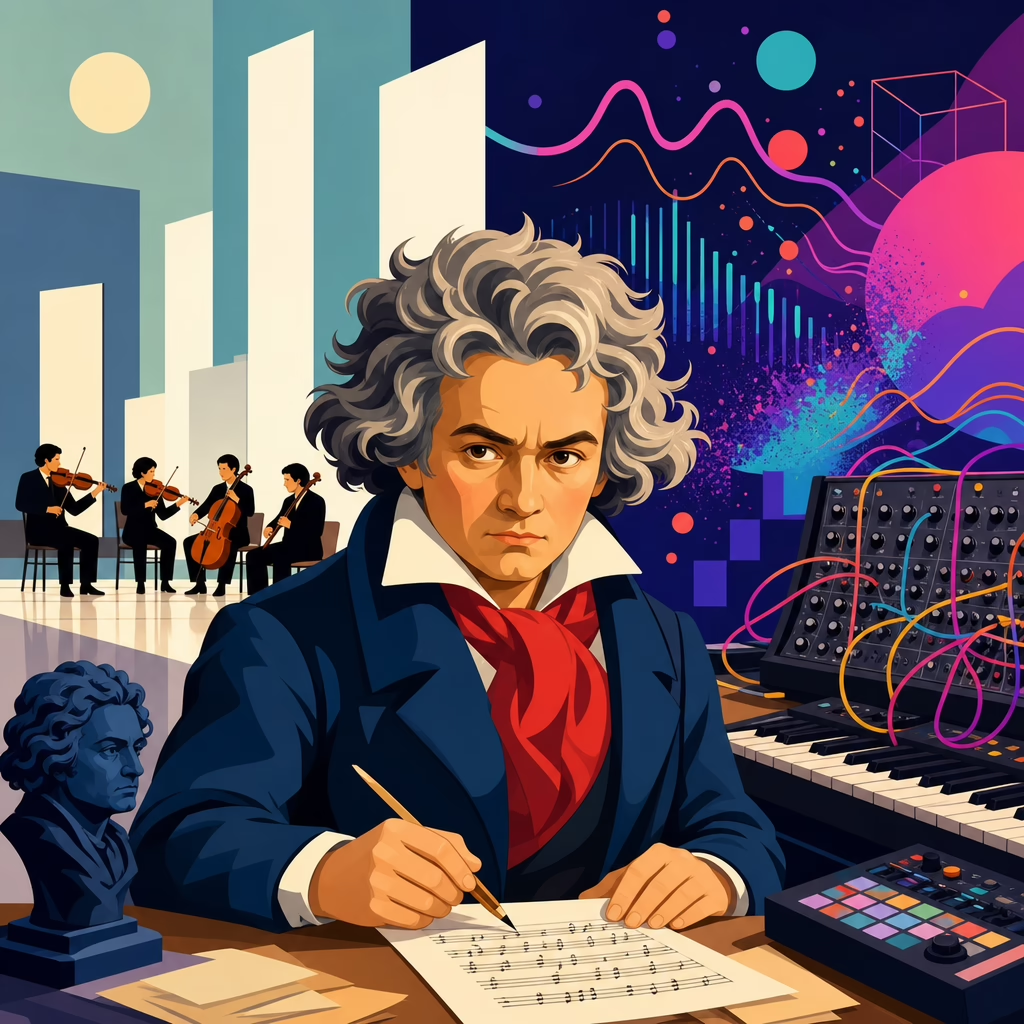
Beethoven’s Legacy in Modern Minimalist and Experimental Music
Beethoven’s legacy in modern minimalist and experimental music is broader than many listeners realize, reaching far beyond concert hall reverence into the structural DNA of twentieth- and twenty-first-century composition. When people hear Ludwig van Beethoven discussed, they usually think of symphonies, sonatas, heroic struggle, and the transition from Classical balance to Romantic intensity. Yet the same composer also pioneered obsessive motivic development, radical formal compression, extreme repetition, disruptive silence, and expanded notions of musical time—ideas that later became central to minimalist and experimental music. In this context, minimalist music refers to works built from limited materials, repetition, gradual change, and perceptible processes, as heard in composers such as Steve Reich, Philip Glass, Terry Riley, John Adams, and Arvo Pärt. Experimental music, by contrast, is a wider field that values novel procedures, unconventional sound sources, indeterminacy, and new listening habits, associated with figures such as John Cage, Morton Feldman, La Monte Young, Pauline Oliveros, and Karlheinz Stockhausen. I have spent years tracing how modern composers talk about Beethoven in rehearsals, program notes, and compositional choices, and one pattern is unmistakable: even artists who reject his aesthetic inheritance often define themselves against him, which still confirms his central influence. This matters because Beethoven remains a live force in contemporary creativity, not a museum artifact. Understanding that force helps listeners hear continuity between a late string quartet and a process piece, between the opening motif of the Fifth Symphony and a phase pattern, or between the suspended time of the late piano sonatas and the durational focus of postwar sound art. This hub article maps those connections and points toward the wider miscellaneous terrain of Beethoven’s inspirations and influence.
Why Beethoven Still Matters to Minimalist and Experimental Composers
Beethoven matters to modern minimalist and experimental music because he treated musical material as something to interrogate relentlessly rather than merely decorate. The famous four-note opening of Symphony No. 5 in C minor, Op. 67, is the clearest example. Instead of presenting a long, lyrical theme in the eighteenth-century manner, Beethoven builds an entire movement from a tiny cell. Minimalist composers would later use a similarly reduced vocabulary, though often with steadier pulse and less harmonic drama. Reich’s early tape works and ensemble pieces rely on short patterns whose significance emerges through repetition and transformation. Glass often develops music through additive processes from compact modules. The family resemblance is not superficial. In both cases, a small idea becomes architecturally decisive.
Beethoven also normalized intensity through process. In the first movement of the Eroica Symphony, Op. 55, and in the development sections of many middle-period works, tension grows because listeners can track how motives are pushed, fragmented, displaced, and recontextualized. That legibility of process became foundational for postwar composers seeking alternatives to dense serial complexity. Riley’s In C makes process audible in real time. Reich explicitly valued music whose unfolding can be heard. Although Beethoven’s rhetoric is more dramatic and goal-oriented than classic minimalism, the principle that structure should arise from comprehensible treatment of limited material links them strongly.
Silence, interruption, and discontinuity are equally important. Beethoven’s late works, especially the late string quartets and Piano Sonata No. 32 in C minor, Op. 111, often break expected continuity through sudden pauses, registral gaps, and shifts of character. Experimental composers heard permission in these ruptures. Feldman’s fragile forms, Cage’s rethinking of silence, and even certain aspects of Helmut Lachenmann’s disrupted instrumental surfaces extend a question Beethoven posed with unusual force: what if form is shaped as much by absence, suspension, and fracture as by thematic continuity?
Motivic Economy, Repetition, and the Minimalist Inheritance
The most direct bridge from Beethoven to minimalism is motivic economy. Beethoven repeatedly proved that a composition does not need abundant themes to achieve large-scale power. The Fifth Symphony, the Seventh Symphony’s rhythmic fixation, the Diabelli Variations, Op. 120, and many piano sonatas demonstrate that insistence can be expressive, not merely mechanical. Minimalist composers adopted a different surface style, but they inherited the courage to trust a narrow musical vocabulary. In practical terms, that means a listener can hear how a pattern behaves rather than constantly chase new material.
Repetition in Beethoven is rarely literal for long. He repeats to intensify, destabilize, delay, or transform expectation. In the scherzo of the Ninth Symphony, Op. 125, rhythmic recurrence drives momentum while accents and orchestration keep the material alive. That distinction matters when evaluating minimalist music, because strong minimalism also depends on change within sameness. Reich’s Music for 18 Musicians is full of recurring figures, yet breath cycles, timbral shifts, and harmonic pivots prevent stasis. Adams, especially in Harmonielehre and Shaker Loops, draws a line between Beethovenian drive and repetitive modern texture by pairing pulsed cells with long-range symphonic narrative.
I have found that performers often unlock this connection by focusing on articulation instead of style labels. A Beethoven repeated figure dies if played with dead uniformity; a minimalist repeated figure also dies if performers ignore contour, timbre, and microscopic variation. Good ensembles know that repetition is never the same twice. That interpretive truth is one reason Beethoven belongs in this conversation.
| Beethoven trait | Modern parallel | Representative example |
|---|---|---|
| Motivic compression | Limited-cell construction | Symphony No. 5 and Reich’s Clapping Music |
| Rhythmic insistence | Pulsed repetition | Symphony No. 7 and Glass’s ensemble writing |
| Variation from small material | Gradual process change | Diabelli Variations and Riley’s In C |
| Formal disruption | Open or non-teleological form | Late quartets and Feldman’s late works |
| Suspended time | Durational listening | Op. 111 Arietta and La Monte Young’s drones |
Beethoven’s Late Style and the Experimental Imagination
If Beethoven’s middle-period works anticipate minimalism through compression and process, his late works speak even more directly to experimental music through their strangeness. The late quartets—Opp. 127, 130, 131, 132, 133, and 135—remain radical because they challenge inherited form from within. Op. 131 unfolds in seven connected movements, refusing standard segmentation. Op. 132 places the “Heiliger Dankgesang” at the emotional center, suspending momentum in favor of contemplative modal stillness. The Große Fuge, Op. 133, sounds even today like a work arguing with the future: dissonant, fiercely contrapuntal, structurally uncompromising.
Experimental composers repeatedly returned to these works because they model artistic risk. Cage admired music that changed listening itself, and Beethoven’s late style does exactly that by making expectation unstable. Feldman’s elongated time spans and delicate nondevelopment can seem anti-Beethovenian on the surface, yet Feldman shared Beethoven’s willingness to let form emerge from highly specific local decisions rather than generic templates. Young’s sustained tones and just-intonation environments may feel remote from tonal quartet writing, but the slow transcendence of Beethoven’s late adagios opened a path toward music experienced as duration rather than event sequence.
The late piano sonatas offer similar evidence. In Op. 111, the Arietta variations dissolve conventional meter and gesture into trills, floating rhythms, and a sense of temporal expansion that many modern listeners hear as uncannily forward-looking. Analysts have long noted how this movement destabilizes ordinary teleology. That is precisely the territory later explored by composers interested in sonic states, recursive time, and meditative attention. Beethoven did not invent experimental music, but he legitimized the idea that a major work could leave behind familiar narrative pacing and still command authority.
Form, Process, and the Question of Time
One of Beethoven’s deepest influences lies in how he reshaped musical time. Classical forms before him often balanced contrast with proportion; Beethoven intensified them into journeys. Developments grew larger, codas became structural events, and transitions carried unprecedented psychological weight. Modern minimalism and experimental music responded to this inheritance in two distinct ways. Some composers extended Beethovenian process into new repetitive systems. Others rejected teleological drive and instead explored static or slowly changing duration. Both responses remain tied to Beethoven because he made time itself a compositional subject.
Take Reich’s concept of audible process. In works such as Piano Phase and Drumming, listeners perceive not only sound but the mechanism of change. Beethoven often does something analogous within tonal rhetoric: he lets us hear a motive worked through sequences, fragmentation, inversion, and registral migration. The syntax differs, but the compositional confidence is similar. The listener is trusted to follow transformation. On the other side, Feldman and Oliveros respond more to Beethoven’s capacity for suspended attention. The “Heiliger Dankgesang” and the final pages of several sonatas ask for concentrated listening to sonority and spacing, not just destination. That mode of listening became central to experimental practice.
There is an important limitation here. Beethoven almost always aims toward resolution, even when he delays it dramatically. Many minimalist and experimental works deny climax, closure, or harmonic necessity altogether. Recognizing this difference prevents lazy comparisons. Still, the modern break from nineteenth-century narrative would have been less legible without Beethoven first stretching that narrative to its limits.
Influence on Specific Composers, Performers, and Contemporary Practice
Steve Reich rarely sounds like Beethoven, yet his reliance on small units, structural audibility, and cumulative transformation invites meaningful comparison. John Adams is more overtly connected. He has spoken and written about symphonic momentum, and pieces like Harmonielehre reveal how repetitive patterns can coexist with large-scale dramatic arcs that recall Beethoven’s command of tension and release. Philip Glass, especially in his symphonies and operas, often filters repetitive procedure through gestures of monumental architecture that Beethoven helped define for Western art music.
Arvo Pärt’s tintinnabuli style offers another path. Pärt does not derive technique from Beethoven directly, but his search for spiritual concentration resonates with late Beethoven’s inwardness. The slow movement worlds of Op. 132 and Op. 111 established a precedent for sacred stillness within mainstream concert repertoire. Morton Feldman’s relationship is more oblique, yet I have heard programmers pair late Beethoven with Feldman to powerful effect because both composers demand an ethics of listening: patience, surrender, and attention to proportion.
Performers and ensembles also keep this influence active. The Kronos Quartet, Arditti Quartet, and major period-instrument groups regularly place Beethoven beside contemporary works, making audible the shared concerns of texture, pulse, and formal experiment. Festivals and conservatories use Beethoven as a reference point when teaching variation technique, motivic development, and structural hearing. In composition lessons, I have repeatedly seen teachers ask students to study a Beethoven movement not to imitate style, but to understand how much can grow from one idea. That lesson remains essential across genres, including ambient composition, electroacoustic work, post-minimalism, and hybrid experimental practice.
How This Hub Connects the Miscellaneous Subtopic
As a hub for the miscellaneous branch of Beethoven’s inspirations and influence, this article should guide readers toward a wide range of related questions. One branch concerns cross-genre adaptation: how Beethoven’s motives, harmonic tensions, and formal strategies appear in film scoring, electronic production, and modern chamber crossover. Another concerns aesthetics: why late Beethoven became a model for artistic seriousness, autonomy, and risk among avant-garde composers. A third concerns listening practice: how Beethoven trained audiences to hear recurrence, delay, rupture, and transformation, preparing them for music that might otherwise seem difficult. Additional articles under this hub can examine Beethoven in drone music, conceptual performance, noise-informed composition, algorithmic variation, contemporary string writing, and the politics of canon formation.
This broader framing matters because influence is not the same as imitation. Some modern composers inherit Beethoven’s procedures directly. Others inherit his problems: how to sustain scale with little material, how to make repetition meaningful, how to fracture form without losing coherence, and how to command attention in a world saturated with sound. Even when experimental artists critique Beethoven as a symbol of the canon, they still work in a space his innovations helped create. That paradox is one of the most useful insights for readers exploring this subtopic in depth.
Beethoven’s legacy in modern minimalist and experimental music is therefore not a niche side note but a durable framework for understanding contemporary composition. His music showed that a tiny motive could generate a vast structure, that repetition could produce revelation, that silence and rupture could shape form, and that late style could challenge inherited norms without surrendering expressive force. Minimalist composers transformed those lessons into pulse, process, and gradual change. Experimental composers transformed them into new conceptions of time, listening, sonority, and formal openness. The results are not replicas of Beethoven, nor should they be. They are continuations, arguments, and reinterpretations.
For readers following the wider “Beethoven’s Inspirations and Influence” topic, this miscellaneous hub provides the connective tissue between canonical analysis and living musical practice. It shows why Beethoven belongs in discussions of Reich and Glass, why late quartets matter to Feldman and Young, and why contemporary performers still program Beethoven beside daring new work. The clearest takeaway is simple: Beethoven remains useful because he posed compositional questions that modern music still has not exhausted. Explore the linked articles in this subtopic with that idea in mind, and you will hear modern minimalism and experimental music with sharper ears, richer historical context, and a better sense of how influence really works today.
Frequently Asked Questions
How does Beethoven connect to minimalist and experimental music if his work sounds so different on the surface?
At first glance, Beethoven and modern minimalism can seem worlds apart. Beethoven is often associated with dramatic symphonies, emotional intensity, and the heroic sweep of nineteenth-century concert music, while minimalist and experimental composers are more commonly linked to repetition, reduced materials, altered perception, and nontraditional forms. But beneath those surface differences, there is a deep structural connection. Beethoven was one of the great masters of generating large musical worlds from very small units. A tiny rhythmic cell, a compact intervallic idea, or a brief motif could become the engine for an entire movement. That principle—building expansive form from limited material—is central to much minimalist thinking.
What makes Beethoven especially relevant is not simply that he reused motives, but that he treated them obsessively. He could subject a fragment to repetition, displacement, expansion, compression, and harmonic reinterpretation until listeners experienced musical time in a more concentrated way. Minimalist composers such as Steve Reich, Philip Glass, and John Adams obviously work in very different sonic languages, but they also rely on the cumulative power of pattern, recurrence, and transformation. In that sense, Beethoven’s legacy survives not as a matter of style but as a method: the idea that musical intensity can come from persistent focus rather than constant novelty.
Experimental music also inherits something important from Beethoven. His late works, in particular, challenged expectations about form, pacing, register, continuity, and expressive logic. He was willing to stretch inherited conventions to their breaking point. That spirit of formal risk-taking is fundamental to experimental practice. So even when a modern composer does not sound “Beethovenian” in melody or harmony, the underlying ambition—to rethink how music unfolds, how listeners perceive repetition and change, and how small materials can produce vast consequences—often has a strong Beethovenian ancestry.
What aspects of Beethoven’s compositional style most influenced modern minimalist composers?
The most significant influence is Beethoven’s approach to motivic economy. He showed that a piece does not need an abundance of themes to feel rich, complete, or monumental. Instead, a single motif can be developed so thoroughly that it creates unity across an entire movement or even a larger work. Minimalist composers embrace a related principle by limiting their musical vocabulary and exploring its possibilities in depth. Rather than presenting many contrasting ideas, they often dwell within a narrow set of pitches, rhythms, or patterns and let meaning arise through gradual process and accumulation.
Another major point of connection is Beethoven’s control of musical process. His music often gives listeners a strong sense that events are unfolding according to a powerful internal logic. Even when the music is surprising, it feels driven by necessity. Minimalism similarly depends on process, though usually in a more transparent way. In Reich, for example, phase shifting and pattern interaction become the compositional engine; in Glass, additive and cyclical procedures shape the musical surface; in Adams, repeating cells build momentum on a large scale. Beethoven’s example helped establish the idea that process itself can become expressive—that the unfolding of structure is not merely technical but dramatically meaningful.
Rhythmic insistence also matters. Beethoven was capable of turning repeated rhythmic figures into sources of extraordinary tension and propulsion. That kind of insistence anticipates the pulse-driven energy of much minimalist music. He also knew how to create suspense through prolongation: repeating, circling, delaying, and intensifying before release. Minimalist composers adapt that principle in their own way, often extending duration and inviting listeners to hear subtle changes over time. The result is not imitation, but lineage. Beethoven helped validate compositional concentration, structural rigor, and the expressive power of repetition—three pillars of minimalist thought.
Why are Beethoven’s late works often discussed in relation to experimental music?
Beethoven’s late works are frequently discussed alongside experimental music because they push so decisively against the norms of their own era. In the late piano sonatas, late string quartets, and the final symphonic works, Beethoven began to treat form as something elastic rather than fixed. Movements can feel fragmented, introspective, abrupt, or startlingly unconventional in their proportions. He juxtaposes fugue and lyricism, dance and austerity, extreme compression and expansive meditation. For listeners and composers alike, these works can feel less like the culmination of Classical style and more like a leap into unknown territory.
That quality is exactly what makes them so resonant for experimental traditions. Experimental music is not defined by one sound, but by a willingness to question assumptions: how time is organized, what counts as coherence, how continuity can be broken and rebuilt, and how a composition can create meaning outside predictable formulas. Beethoven’s late style does all of that. Some passages suspend forward momentum almost entirely, inviting a different kind of listening. Others proceed through sudden contrast or strange transitions that seem to disregard standard expectations of flow. These are not accidents; they are deliberate acts of compositional imagination.
Modern experimental composers and performers often admire Beethoven not because he anticipated every modern technique, but because he modeled artistic fearlessness. He demonstrated that a major composer could treat inherited forms as raw material rather than sacred boundaries. His late works often require listeners to tolerate ambiguity, fragmentation, and intensity without immediate resolution. That mode of listening is crucial in experimental music. In this way, Beethoven becomes less a historical monument and more a living precedent for radical formal thought.
Can Beethoven’s influence be heard in specific minimalist or experimental composers today?
Yes, although the influence is usually structural or conceptual rather than literal. In Steve Reich, for example, the connection lies in disciplined development from limited material. Reich’s music often begins with a small pattern and allows its implications to unfold systematically. That strategy echoes Beethoven’s ability to derive large-scale coherence from concise cells. Philip Glass also works with restricted material, using repetition and gradual variation to create continuity and momentum. While Glass’s harmonic language and surface style differ greatly from Beethoven’s, the commitment to extracting maximum consequence from minimal content reflects a related compositional mindset.
John Adams offers an even clearer bridge for many listeners because his music often combines minimalist procedures with large-scale dramatic architecture. In Adams, one can hear how repetition, pulse, and accumulation can coexist with symphonic breadth and dynamic contrast. That synthesis recalls Beethoven’s enduring lesson that structural drive and expressive force are inseparable. Beyond minimalism, experimental and post-minimal composers such as Morton Feldman, Helmut Lachenmann, and even certain strands of spectral and process-based composition engage Beethoven more indirectly, often through questions of duration, form, memory, and transformation rather than through direct stylistic quotation.
There are also countless examples in contemporary chamber music, installation-based sound art, and hybrid classical practice where Beethoven’s legacy appears in subtler ways. Composers may borrow the idea of relentless motivic focus, the use of formal disruption, or the willingness to let a tiny gesture reshape an entire piece. Some reinterpret Beethoven fragments explicitly; others inherit his methods without referencing him by name. That is often how real influence works. It moves from surface resemblance to deeper artistic DNA, shaping the way composers think about continuity, tension, repetition, and the architecture of listening itself.
What does Beethoven’s legacy in modern minimalist and experimental music tell us about his place in music history?
It tells us that Beethoven’s importance is far wider than the standard textbook image of a great symphonist standing between the Classical and Romantic eras. He is certainly that, but he is also a composer whose methods continue to speak powerfully to artistic movements that seem, at first, far removed from his sound world. His legacy is not limited to melody, orchestration, or the canon of masterworks. It extends to how composers conceive form, how they work with repetition, how they intensify small ideas, and how they challenge listeners’ expectations of musical time.
This broader perspective changes the way we understand music history itself. Instead of seeing Beethoven as a figure confined to a single tradition of concert-hall reverence, we begin to recognize him as a foundational thinker in the evolution of modern compositional practice. Minimalists, post-minimalists, and experimental artists may reject the rhetoric, harmonic language, or expressive conventions associated with Beethovenian grandeur, yet still inherit his concentration, his formal daring, and his belief that profound transformation can emerge from the smallest material. That makes his legacy unusually flexible and unusually durable.
Perhaps most importantly, it reminds us that innovation in music rarely happens through total rupture. New movements often grow out of older techniques that are reimagined in fresh contexts. Beethoven’s work offers a remarkable example of this continuity. His music remains historically central not only because later composers admired him, but because they found in his methods tools for making radically new art. In that sense, Beethoven is not just a monument of the past. He remains an active force in the logic of contemporary composition.