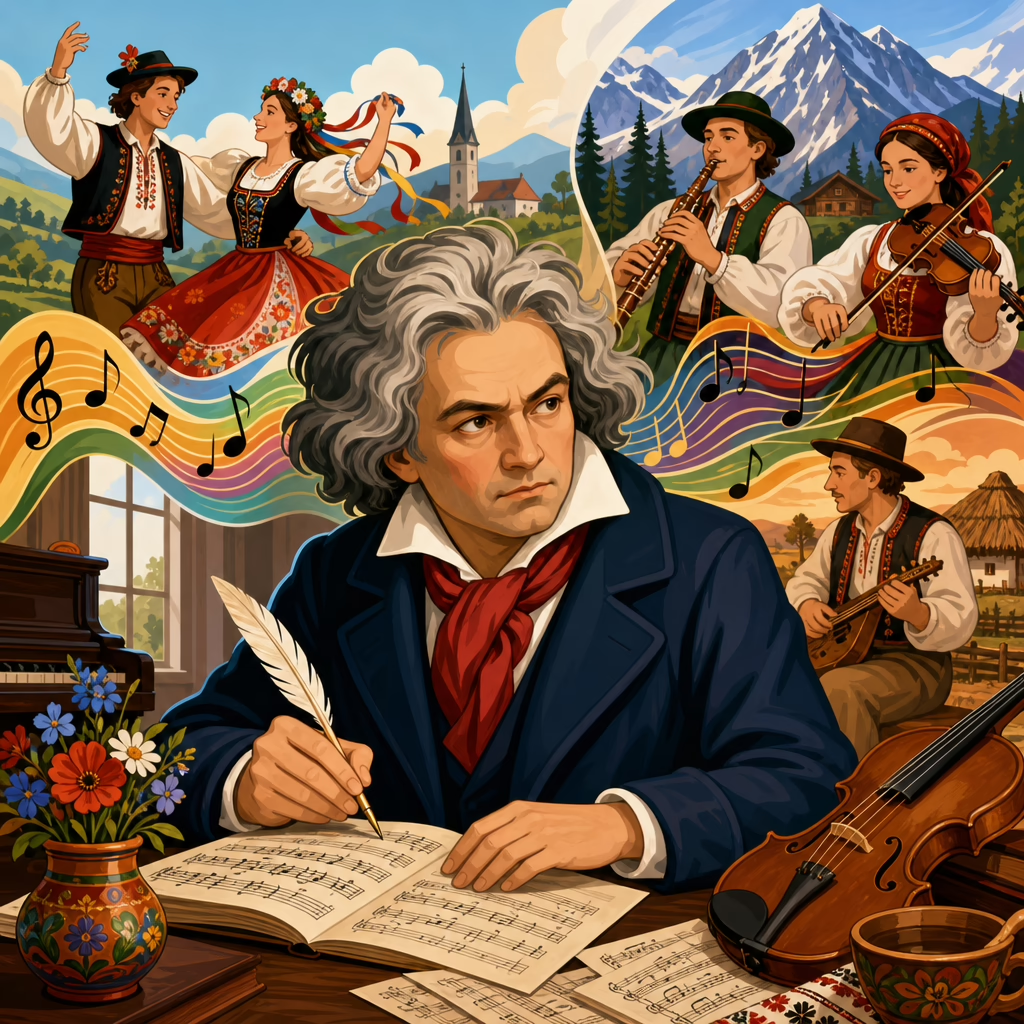
Influences of Folk Music in Beethoven’s Compositions
Folk music runs through Beethoven’s output more deeply than many listeners realize, shaping not only his published folk song settings but also the rhythmic drive, melodic contour, and expressive directness that define his broader style. In this context, folk music means vernacular song and dance traditions carried by ordinary people rather than court composers: tunes learned by ear, repeated in social ritual, altered across regions, and valued for memorability over formal sophistication. When we study the influences of folk music in Beethoven’s compositions, we are looking at more than a side project. We are tracing how a major classical composer absorbed popular idioms, adapted national styles, and translated simple materials into works of unusual durability. This matters because Beethoven stood at a turning point in European music, where local traditions, commercial publishing, salon culture, and concert music increasingly overlapped. In my own work comparing his song settings with his instrumental themes, I have found that the same instincts recur: strong periodic phrasing, drone-like accompaniments, compact motives, and dance patterns that feel rooted in communal practice. These features help explain why Beethoven can sound monumental and immediate at once. A clear view of this relationship also helps readers connect this hub article to related discussions of nationalism, popular culture, song arrangement, variation technique, and Beethoven’s wider network of inspirations.
What Folk Music Meant in Beethoven’s World
In Beethoven’s lifetime, folk music was not a museum category. It circulated in taverns, homes, military settings, village festivals, and urban entertainment, often crossing boundaries between oral and written transmission. Collectors, publishers, and arrangers increasingly sought Scottish, Irish, Welsh, Slavic, Tyrolean, and other regional repertories, partly from antiquarian interest and partly because a growing middle-class market wanted singable, domestic music. Beethoven engaged this market directly. His arrangements of British Isles songs for the Edinburgh publisher George Thomson are the clearest evidence, but they sit within a broader European fascination with “national airs.” These were sometimes genuinely traditional melodies, sometimes edited versions, and sometimes newly composed tunes presented in a folk-like manner. The distinction matters. Beethoven was not simply transcribing peasant music in ethnographic fashion; he was participating in an early nineteenth-century process that reframed vernacular material for cultivated audiences. Even so, his treatment shows close attention to what makes such music persuasive: balanced phrases, modal color, repetitive structure, and rhythms linked to dance and speech. Understanding this historical setting prevents two common errors. First, it avoids romantic myths that Beethoven discovered some untouched rural purity. Second, it avoids the opposite mistake of dismissing folk influence because the material reached him through print and patronage. In practice, printed collections, salon performance, and living tradition interacted constantly, and Beethoven worked inside that dynamic with unusual intelligence.
Beethoven’s Folk Song Arrangements as Direct Evidence
The most concrete proof of folk influence appears in Beethoven’s more than 170 arrangements of Scottish, Irish, Welsh, and other songs, composed largely between 1809 and 1820 for Thomson and related publishers. These works are often underestimated because they were written for commercial purposes, yet they reveal Beethoven making careful artistic decisions about how to preserve a tune’s identity while enriching it for domestic performance. Typically he scored the songs for voice, piano, violin, and cello, a combination flexible enough for amateur music-making but sophisticated enough to support expressive nuance. He generally left the melody recognizable and avoided overwhelming it with symphonic density. Instead, he used introductions, codas, harmonic coloring, and dialog between instruments to frame the tune. In “The Last Rose of Summer,” “Sunset,” and many Scottish airs, the accompaniments clarify phrase shape and emotional tone without destroying the song’s simplicity. I have always found these settings revealing because Beethoven restrains himself. He knew that folk-derived melody loses force if treated like operatic display material. His best arrangements respect cadence placement, regular stanzaic logic, and the tune’s original rhetorical pacing. That discipline tells us something important about his compositional ear: he recognized that vernacular melodies achieve power through concentration. For readers exploring this hub topic, these arrangements are the essential starting point because they provide direct contact with the repertories Beethoven encountered and show how he translated them into the language of art music.
Melody, Rhythm, and Dance Types in the Instrumental Works
Folk influence in Beethoven extends beyond arranged songs into instrumental writing, where it appears less as quotation than as stylized behavior. Many themes rely on short, sharply profiled cells that resemble dance tunes or communal songs in their economy. The finale of the Seventh Symphony is a famous case: its relentless dactylic motion, repetitive patterning, and cumulative propulsion evoke the energy of collective dance even though the movement is not a literal folk transcription. Similar vernacular vitality appears in scherzos, rustic finales, and variation movements throughout the piano sonatas, chamber music, and symphonies. The “Pastoral” Symphony includes drones, bagpipe-like effects, and peasant dance gestures that listeners of the period would have recognized immediately. In the scherzo of the String Quartet Op. 130 and in several piano variations, Beethoven uses stamping accents, open intervals, and phrase repetition to create a roughened, popular character distinct from courtly elegance. These details are not decorative extras. They affect form, because folk-like repetition invites accumulative development rather than elaborate melodic unfolding. They also affect listener memory. A compact tune built on triads, repeated notes, and square phrase lengths is easier to retain and transform. Beethoven repeatedly exploited that advantage. He could begin with a melody that feels almost commonplace and then generate enormous structural consequence from it, a process central to his middle and late styles. Folk influence, then, is not merely thematic. It informs his understanding of what kinds of materials can carry large-scale musical argument.
How Beethoven Adapted Regional Styles
Beethoven did not treat all folk materials the same way. He responded to different regional styles with different compositional strategies, and that selectivity is one reason the subject deserves careful study.
| Regional source | Common musical traits | How Beethoven typically responded |
|---|---|---|
| Scottish songs | Pentatonic flavor, lilting meters, balanced phrases | Clear harmonization, restrained introductions, support for lyrical line |
| Irish songs | Ornamental contours, modal inflection, expressive melancholy | Gentle chromatic shading, flexible accompaniment, emphasis on vocal declamation |
| Welsh airs | Noble melodic span, hymn-like dignity | Broader harmonic framing, ceremonial pacing, fuller instrumental commentary |
| Continental dance idioms | Drones, repeated basses, strong pulse | Rustic textures, open fifths, rhythmic insistence in scherzos and finales |
This pattern matters because it shows Beethoven listening for function, not simply surface novelty. A Scottish air intended for domestic singing benefits from transparent support, while an Irish lament can bear darker harmonic undercurrents. His sensitivity here counters the idea that he imposed one generic “classical” polish on everything. At the same time, he did regularize and refine. He often normalized phrase lengths, clarified tonal direction, and wrote accompaniments better suited to bourgeois interiors than village gatherings. That is the tradeoff built into his folk engagements: preservation through transformation. Readers moving through the broader subtopic of Beethoven’s inspirations should connect this section with questions of cultural mediation, publishing economics, and the changing meanings of national style in early nineteenth-century Europe.
Variation Technique and the Power of Simple Material
One of the strongest links between folk music and Beethoven’s mature art is variation technique. Folk melodies tend to survive because they are structurally sturdy: concise range, regular phrase organization, memorable rhythm, and harmonic implications simple enough to support many repetitions. Beethoven prized exactly these properties. His variation sets, from early keyboard works to the late Diabelli Variations, show an enduring fascination with transforming apparently modest themes into complex structures. Although Diabelli’s waltz is not a folk tune, Beethoven treats it as if vernacular simplicity were a compositional resource rather than a limitation. That same principle governs many folk song settings, where he alters accompaniment, texture, and emotional framing while preserving melodic recognizability. In practical terms, folk-like material gives Beethoven room to intensify contrast. A plain tune can become martial, comic, solemn, intimate, or ecstatic depending on register, articulation, meter, and harmony. I have seen students understand Beethoven’s style more quickly when they start from this point: he was not always searching for rarefied themes. He often wanted themes ordinary enough to be grasped immediately yet durable enough to withstand pressure. This is one reason his music travels so well across arrangements, public memory, and popular culture. Materials shaped by vernacular logic remain legible even when subjected to advanced compositional procedures. For a hub article, this is a crucial insight because it connects folk influence to Beethoven’s larger methods of motivic development, formal expansion, and audience communication.
Misconceptions, Limits, and Why the Influence Still Matters
Several misconceptions obscure the role of folk music in Beethoven’s compositions. The first is that folk influence belongs only to minor works and arrangements. In fact, the habits cultivated through those projects—economy, periodic phrasing, dance impulse, and respect for singable contour—appear across major instrumental works. The second is that any rustic-sounding passage must be a direct borrowing. Usually it is better to speak of stylization, where Beethoven composes in a vernacular manner without citing a traceable tune. The third is that these influences make the music somehow less sophisticated. The opposite is true. Beethoven’s achievement lies in proving that popular and local materials can sustain the highest levels of formal invention. There are limits, and they should be acknowledged. He was not a field collector in the modern sense, and some “folk” melodies he used had already been edited, urbanized, or commercially repackaged before reaching him. He also filtered them through Germanic harmonic practice and the expectations of elite and middle-class consumers. Yet those facts do not cancel the influence; they define its historical reality. Beethoven worked in a Europe where vernacular repertories were entering print culture and national consciousness. His contribution was to hear in those repertories not curiosities but compositional possibilities. That legacy shaped later composers from Schubert and Brahms to Dvořák, Bartók, and Vaughan Williams, each of whom pursued the relationship between art music and folk tradition differently.
The influences of folk music in Beethoven’s compositions are best understood as a spectrum, ranging from direct arrangement to deep stylistic absorption. His published settings of Scottish, Irish, Welsh, and other songs provide the clearest documentary evidence, showing how carefully he preserved melodic identity while adding harmonic and instrumental depth. Beyond those works, folk elements appear in dance rhythms, drone textures, repetitive phrasing, compact themes, and the transformation of simple materials into large forms. These traits help explain Beethoven’s unusual combination of structural rigor and immediate appeal. They also clarify his place within a wider European moment when vernacular traditions, domestic music-making, commercial publishing, and emerging national identities converged. For anyone studying Beethoven’s inspirations and influence, this miscellaneous hub matters because it links several adjacent subjects: variation form, pastoral style, nationalism, audience reception, and the border between popular and elite art. The main benefit of following this line of inquiry is practical as well as historical. You begin to hear Beethoven more accurately. Themes that once seemed merely forceful start to reveal roots in song and dance; arrangements once dismissed as occasional pieces become windows into his compositional priorities. Use this article as your starting map, then continue into the related pages on Beethoven’s broader inspirations, his engagement with national style, and the lasting influence of his folk-inflected musical language.
Frequently Asked Questions
How did folk music influence Beethoven’s compositions beyond his published folk song arrangements?
Folk music influenced Beethoven on a much deeper level than the separate category of songs he arranged for publication. While he did produce many settings of Scottish, Irish, Welsh, and other vernacular melodies, the more important point is that folk-like features also appear throughout his instrumental and vocal writing. One of the clearest signs is his use of strong, memorable melodic shapes that feel immediately singable, as if they could be learned by ear rather than studied from a score. Beethoven often favored themes built from compact motives, repeated notes, simple intervals, and balanced phrases, all of which resemble the directness of traditional song.
Rhythm is another major area of influence. Many Beethoven themes move with the grounded energy of dance, using repeated patterns, offbeat accents, stomping accompaniment figures, and propulsion that recalls communal music-making rather than aristocratic elegance. Even when the music is structurally sophisticated, the surface can project an earthy vitality that listeners often associate with folk traditions. This helps explain why some of his most famous themes sound both artful and strangely familiar: they are shaped by the same principles that give folk tunes their staying power.
There is also an expressive dimension. Folk music tends to communicate directly, without excessive ornament or abstraction, and Beethoven repeatedly sought that kind of emotional immediacy. He could be monumental, of course, but he was equally capable of writing passages that sound plainspoken, intimate, rustic, or communal. In that sense, folk influence in Beethoven is not just a matter of borrowed tunes. It is a matter of musical character, of how melody, rhythm, and expression are made to feel close to lived human experience.
Did Beethoven actually collect or arrange folk songs, and why did he do so?
Yes, Beethoven arranged a substantial number of folk songs, especially for publishers who recognized a growing market for domestic music-making in the early nineteenth century. These arrangements included British, Irish, Scottish, Welsh, and continental melodies, usually scored for voice with instrumental accompaniment. At first glance, these works can seem secondary beside the symphonies, sonatas, and quartets, but they are highly revealing. They show Beethoven engaging directly with vernacular repertories that circulated outside elite court culture and treating them as worthy of artistic attention.
He did this partly for practical reasons. Arranging songs for publication could provide income, and publishers actively commissioned such material. But it would be misleading to reduce the project to economics alone. The care Beethoven often brought to these settings suggests genuine interest in the melodic strength and expressive appeal of the tunes themselves. He did not simply harmonize them mechanically. He frequently crafted accompaniments that highlight the song’s mood, enhance its narrative quality, and preserve its accessible identity while adding layers of musical refinement.
These arrangements also illuminate Beethoven’s broader compositional values. Folk melodies offered models of concentration, memorability, and expressive clarity. In working with them, he encountered music that achieved powerful emotional effect with minimal means. That lesson is deeply compatible with his own style, especially his ability to generate large-scale drama from small thematic cells. So his folk song arrangements matter not just as curiosities, but as part of a larger artistic dialogue between cultivated composition and vernacular musical life.
What musical traits in Beethoven’s works can be described as folk-like?
Several recurring traits in Beethoven’s music can be called folk-like, though the term should be used carefully. It does not mean the music is simple in construction overall, nor does it mean every direct melody is literally borrowed from tradition. Rather, it refers to features associated with vernacular song and dance: clear melodic outlines, repetitive rhythmic patterns, symmetrical phrasing, drone-like accompaniments, modal coloring, and a preference for memorable gestures over ornate decoration.
One especially important trait is motivic economy. Folk tunes often depend on short, recognizable patterns that can be repeated and varied easily in oral tradition. Beethoven similarly built major structures from compact ideas. A seemingly modest rhythmic or melodic fragment can become the seed of an entire movement. That is not folk procedure in a strict ethnographic sense, but it reflects a shared respect for concentration and memorability. His themes often feel inevitable because they are shaped around essential musical facts rather than decorative excess.
Dance character is equally significant. Beethoven regularly employed rhythmic profiles that suggest country dances, marches, contredanses, Ländler, and other socially embedded movement forms. These rhythms bring a physical, communal quality into the music. Even in highly developed sonata-form movements, there can be moments of stamping insistence, rustic swing, or festive drive that evoke the world of collective dancing and popular entertainment. Add to that his occasional use of open intervals, pedal points, and rough-hewn accenting, and the result is a style that often channels the vitality of folk music without needing to quote a specific tune.
Are there particular Beethoven works where the influence of folk music is especially noticeable?
Yes, the influence is especially noticeable in several different corners of Beethoven’s output, though it appears in different ways depending on the genre. The most obvious place to begin is with the published folk song arrangements themselves, where the relationship is explicit. These works show Beethoven responding directly to vernacular melodies and demonstrate how seriously he took their expressive and musical possibilities.
Beyond that repertory, the influence becomes more stylistic. Many listeners hear folk-like energy in various dance movements, scherzos, finales, and theme-based works where compact melodies and rhythmic insistence dominate. Beethoven’s use of rustic humor, bagpipe-like drones, repeated-note figures, and peasant-dance momentum can make certain passages feel rooted in popular tradition. Some movements project a deliberately earthy tone, contrasting with more polished courtly idioms and reminding us that Beethoven’s musical world was not confined to aristocratic taste.
The influence is also noticeable in works where a tune’s simplicity becomes the foundation for large-scale development. Beethoven was unusually gifted at taking a theme that sounds plain, singable, and almost commonplace, then transforming it through variation, harmonic tension, and formal expansion. That procedure resonates strongly with the logic of folk material, where a melody’s strength lies in its capacity to endure repetition and reinterpretation. So while scholars may debate individual examples, the broader pattern is clear: Beethoven repeatedly drew on the expressive force of music that sounds communal, memorable, and grounded in shared musical habits.
Why is it important to understand the role of folk music when interpreting Beethoven’s style?
Understanding the role of folk music helps correct a narrow picture of Beethoven as only a monumental, abstract, high-art composer. He was certainly all of those things, but his music also depends on immediacy, bodily rhythm, songfulness, and communication with broad audiences. Recognizing folk influence reveals that some of the qualities listeners love most in Beethoven, such as the unforgettable themes, the physical drive, and the sense of emotional candor, are connected to vernacular musical values as much as to learned compositional craft.
This perspective also changes how we listen. Instead of hearing simplicity in Beethoven as merely a prelude to complexity, we can hear it as an artistic ideal in its own right. Folk-derived qualities bring focus, accessibility, and expressive honesty. They allow Beethoven to speak in a voice that feels collective as well as individual, rooted in shared human patterns of singing and dancing. That helps explain why his music can feel at once intellectually compelling and broadly approachable.
Finally, paying attention to folk influence places Beethoven in a larger cultural history. He did not compose in isolation from everyday musical life. He lived in a world where popular, social, and regional musics circulated constantly, and he absorbed that environment into his own language. Seeing this connection does not diminish his originality. It clarifies it. Beethoven’s genius lay partly in his ability to transform familiar, even humble, materials into works of extraordinary depth and power. The folk element is therefore not marginal to his style; it is one of the foundations of its lasting resonance.