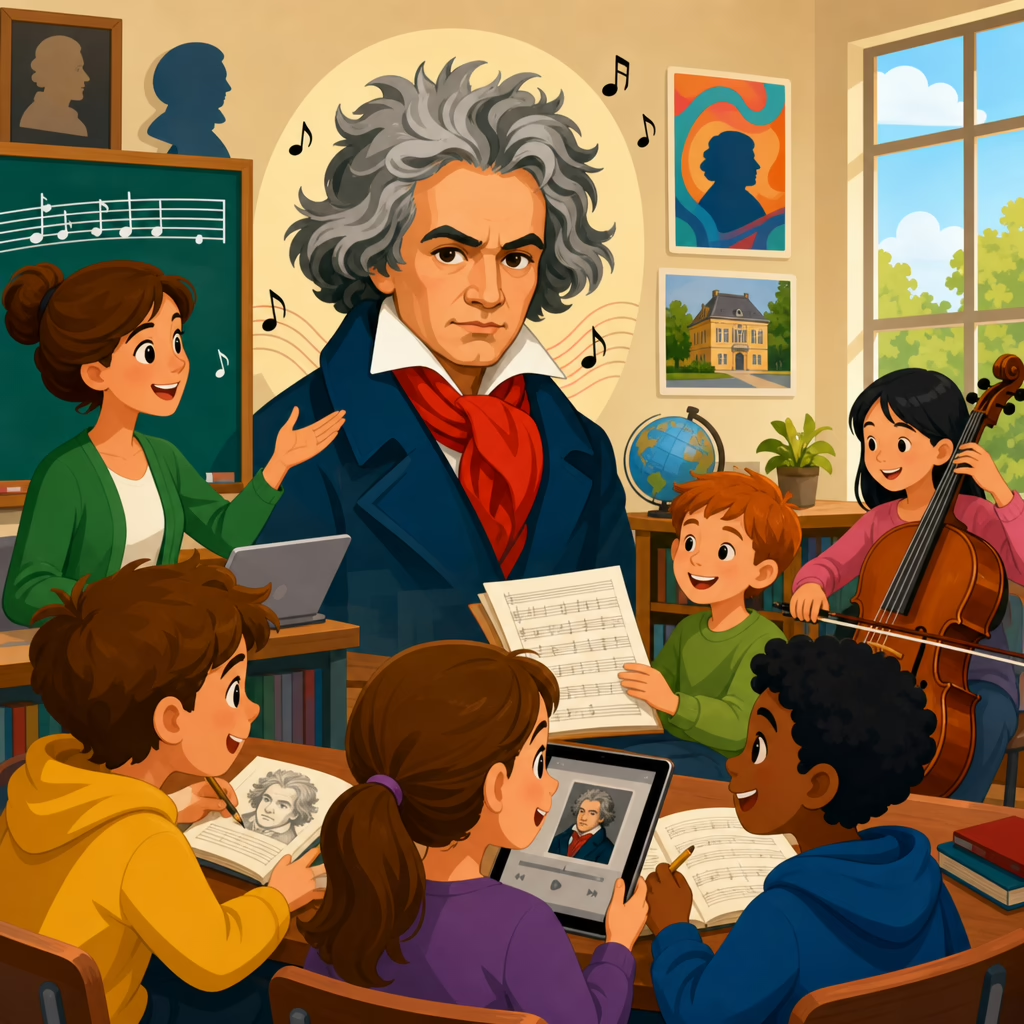
How Beethoven Is Taught in Today’s Music Classrooms
Beethoven remains one of the most frequently taught composers in today’s music classrooms because his work sits at the intersection of history, theory, performance, listening, and cultural debate. In practical teaching terms, “how Beethoven is taught” includes the repertoire students hear, the concepts teachers emphasize, the classroom methods they use, and the questions they ask about creativity, disability, legacy, and canon formation. Across elementary general music, middle and high school ensembles, Advanced Placement music theory, music appreciation courses, and university survey classes, Beethoven is rarely presented as only a biography. He is used as a case study for form, motive, orchestration, patronage, innovation, and the changing role of the composer in public life.
That broad classroom presence matters for a simple reason: Beethoven can connect beginners and advanced students to core musical ideas quickly. I have seen a fifth-grade class grasp rhythmic motive through the opening of Symphony No. 5 in under five minutes, while college students spent a full seminar comparing the formal disruption in the “Eroica” Symphony with earlier Classical expectations from Haydn and Mozart. Few composers work across that many instructional levels so effectively. His music is memorable enough for novice listeners, yet structurally rich enough to support serious analysis.
In current teaching practice, the Beethoven unit has also expanded beyond the old heroic narrative. Students still learn the familiar outline—born in Bonn in 1770, moved to Vienna, studied with major musicians, transformed symphonic and piano writing, and composed while dealing with progressive hearing loss—but many classrooms now add context that was once missing. Teachers discuss the political world of Napoleonic Europe, the economics of patronage and publishing, the role of amateur music making, and the difference between myth and document in stories about genius. They also use Beethoven to address larger educational goals, including close listening, evidence-based interpretation, historical empathy, and inclusive discussion about disability and identity.
As a hub topic within community and education, Beethoven teaching is especially useful because it links many “miscellaneous” classroom strands that are usually taught separately. A single Beethoven lesson can involve literacy, social studies, philosophy, auditory training, ensemble rehearsal, media criticism, and technology. Students might map sonata form, compare period-instrument and modern-orchestra recordings, examine a manuscript facsimile, or debate whether repeated canon programming narrows what audiences hear. In other words, Beethoven is not just content. He is a framework teachers use to show how musical understanding is built from listening, performance, context, and critical reflection.
What Students Learn First: Biography, Style, and Historical Context
Most classrooms begin with a concise biographical foundation, but the strongest teaching avoids reducing Beethoven to a list of dates. Students learn that he emerged during the late Classical era and helped define the transition toward Romantic expression. Teachers commonly explain this through concrete musical markers: longer formal spans, stronger dynamic contrast, expanded codas, sharper rhythmic profile, more independent wind writing, and a heightened sense of struggle and release. Instead of saying only that Beethoven was “emotional,” effective teachers point to what creates that impression in the score.
Historical framing is equally important. Beethoven’s career unfolded during the French Revolution, the Napoleonic Wars, and major changes in European public culture. In class, that means his music is connected to ideas of citizenship, heroism, public concerts, and the growing prestige of the individual artist. The “Eroica” Symphony is often used to show this shift. Students hear that the work was initially associated with Napoleon, then retitled after Beethoven’s disillusionment, and they connect that story to the music’s unprecedented scale and dramatic argument. Even when scholars debate parts of the anecdote, the classroom value remains: students see that titles, dedications, and politics shape musical meaning.
Teachers also now treat Beethoven’s hearing loss with more care than in older textbooks. Rather than presenting disability as a sentimental obstacle that “made him greater,” many classes examine the Heiligenstadt Testament and ask what it reveals about isolation, professional fear, and resilience. This approach helps students discuss disability as lived experience, not simply inspiration. It also prevents the simplistic claim that deafness made Beethoven completely unable to engage sound. Students learn the timeline was gradual, and that his compositional methods involved internal hearing, notation, revision, instruments, and trusted colleagues.
How Beethoven Is Used to Teach Listening and Musical Form
In school settings, Beethoven is one of the clearest entry points for active listening. Teachers often start with short, recognizable passages and ask students to identify recurring motives, contrasting themes, texture changes, and dynamic shape. The opening four-note motive of Symphony No. 5 is famous not because it is famous, but because it demonstrates how a tiny cell can generate an entire movement. I have used that excerpt with mixed-ability groups because students can hear the idea immediately, then track how rhythm and contour are transformed without needing advanced terminology at first.
Once students can hear recurring material, Beethoven becomes a practical gateway to form. Sonata form is commonly taught through first-movement examples such as the “Pathétique” Sonata, Symphony No. 5, or Symphony No. 3. Teachers define exposition, development, recapitulation, and coda, then show how Beethoven stretches each area for expressive effect. In many classrooms, the lesson moves from “where are the sections?” to “why does this section feel unstable?” That is a major shift in current pedagogy: form is not treated as a rigid diagram, but as an unfolding dramatic process.
Variation form is another area where Beethoven is especially teachable. Sets such as the “Diabelli Variations” in advanced courses, or simpler classroom excerpts from his piano works, help students hear how composers alter harmony, rhythm, texture, register, and character while preserving an underlying identity. The educational benefit is immediate. Students stop thinking of repetition as sameness and begin hearing change as the substance of musical thought. This skill transfers directly to ensemble rehearsal and composition assignments.
Teachers also use Beethoven to strengthen score-reading and ear-training. In secondary and college classes, students may follow a listening map while marking phrase lengths, cadences, instrumentation, and thematic return. Conductors often reinforce the same concepts in rehearsal by asking ensembles where the tension accumulates, which lines carry the motive, and how articulation changes formal clarity. That bridge between analysis and performance is one reason Beethoven remains central in classrooms instead of staying confined to lecture history.
Classroom Methods Across Grade Levels and Settings
Beethoven instruction changes significantly by age group. In elementary general music, teachers usually focus on recognition, contrast, and movement. Students may move to strong and weak beats, draw what they hear in programmatic passages, or identify instrument families in excerpts from the symphonies. The goal is not comprehensive mastery of Beethoven’s output. It is developing attentive listening and linking sound to pattern. Even simple activities can be rigorous when the teacher asks students to justify what they heard with musical evidence.
In middle and high school, the approach becomes more interdisciplinary. Band, choir, and orchestra directors use Beethoven to explain style, articulation, balance, and historical performance choices. General music and appreciation teachers add biography, social context, and criticism. In AP or IB level courses, students analyze phrase structure, harmonic function, chromatic intensification, and thematic development with far more precision. They may compare Beethoven with Mozart to understand continuity and departure, or examine how a sketch evolves into a finished passage. Digital tools such as Noteflight, MuseScore, SmartMusic, and DAW-based listening projects often support these lessons by letting students annotate, arrange, or recreate excerpts.
University classrooms tend to widen the discussion further. Survey courses still cover the symphonies, sonatas, quartets, and Ninth Symphony, but many instructors now pair canonical works with reception history. Students might ask how Beethoven became a symbol of artistic seriousness, why his image appears in civic and educational institutions, or how recordings by Wilhelm Furtwängler, Herbert von Karajan, Nikolaus Harnoncourt, and John Eliot Gardiner present different interpretive values. That comparison teaches an important modern lesson: Beethoven is not one fixed sound, but a repertoire continually shaped by institutions and performers.
| Classroom level | Common Beethoven focus | Typical method | Learning outcome |
|---|---|---|---|
| Elementary | Motive, dynamics, instrument recognition | Guided listening, movement, drawing responses | Students hear pattern and contrast |
| Middle school | Biography, era, famous themes | Listening journals, ensemble links, discussion | Students connect music and context |
| High school | Form, harmony, stylistic comparison | Score study, analysis, performance practice | Students explain how the music works |
| College | Reception, canon, interpretation, source study | Seminar debate, research, recording comparison | Students evaluate Beethoven critically |
Performance, Interpretation, and the Debate Around the Canon
One of the most effective ways Beethoven is taught today is through performance. Students do not only learn about him; they play, sing, conduct, and rehearse his music or arrangements of it. In ensemble settings, Beethoven teaches precision of rhythm, long-phrase shaping, accent hierarchy, and structural pacing. A high school orchestra working on an arrangement of the Seventh Symphony, for example, quickly learns that repeated rhythmic figures are not mechanically repetitive. Their energy has to be graded, and inner voices matter. The classroom lesson becomes embodied knowledge.
Interpretation is where current teaching has become more nuanced. Tempo debates based on Beethoven’s metronome markings are common in higher-level classes because they reveal a real scholarly problem: what should performers do when the indicated speed seems impractical or stylistically controversial? Students can compare period-instrument performances with modern symphonic recordings and hear differences in articulation, vibrato, orchestral size, timpani impact, and rhetorical pacing. This makes interpretation concrete rather than abstract. It also teaches that fidelity to a score involves judgment, not mechanical obedience.
At the same time, many educators are rethinking how often Beethoven dominates the curriculum. This does not mean removing him from music classrooms. It means teaching him transparently within a broader conversation about canon formation. Students may ask who was elevated in conservatories, concert halls, textbooks, and examinations, and who was marginalized. Placing Beethoven alongside composers such as Florence Price, Joseph Bologne, Fanny Mendelssohn Hensel, Clara Schumann, Samuel Coleridge-Taylor, or William Grant Still helps students understand that curriculum is shaped by institutions, not just by timeless merit.
That broader framing strengthens Beethoven teaching rather than weakening it. When students compare his innovations with those of other composers, they hear him more accurately. They also learn a civic lesson relevant to community and education: cultural inheritance should be studied critically, shared widely, and continually re-examined. For teachers building a miscellaneous hub of related topics, Beethoven works best when linked outward—to listening guides, composer comparison pages, disability studies resources, ensemble repertoire notes, and articles on inclusive curriculum design. The result is not hero worship. It is informed musical literacy.
Beethoven is taught in today’s music classrooms as a living educational tool, not a museum piece. Students encounter him through biography, listening, theory, rehearsal, historical context, performance practice, and debate about what belongs in the curriculum. The most effective teaching does three things at once: it explains how the music is built, shows why the works mattered in their own time, and invites students to question how traditions are carried forward. That combination is why Beethoven remains central across elementary rooms, secondary ensembles, and university seminars.
The key takeaway for educators and community readers is that Beethoven belongs in a broad, connected learning ecosystem. He can introduce form, motive, orchestration, and cultural history, but he should also open doors to wider repertories, more inclusive programming, and better questions about music education itself. When taught this way, Beethoven helps students become sharper listeners and more thoughtful participants in culture.
If you are building a classroom unit, curriculum map, or community education resource, use Beethoven as a hub rather than an endpoint: pair major works with guided listening, score study, performance comparison, and links to related composers and themes. That approach gives students depth, context, and a lasting framework for understanding music.
Frequently Asked Questions
How is Beethoven typically introduced in today’s music classrooms?
Beethoven is usually introduced as more than just a famous composer with recognizable melodies. In today’s music classrooms, teachers often present him as a central figure for understanding how music connects to history, emotion, structure, performance, and cultural influence. Students may first encounter Beethoven through well-known works such as Symphony No. 5, Symphony No. 9, Für Elise, the Moonlight Sonata, or excerpts from the Eroica Symphony. These pieces are frequently used because they are accessible entry points for listening activities and because they illustrate important musical ideas such as motive, contrast, dynamics, form, and expressive intent.
At the elementary level, Beethoven may be introduced through guided listening, movement, storytelling, and simple discussions about how music can communicate mood and character. In middle and high school settings, instruction usually becomes more analytical. Teachers may ask students to identify recurring rhythmic patterns, compare performances, trace the emotional arc of a movement, or connect Beethoven’s music to the social and political environment of late eighteenth- and early nineteenth-century Europe. In ensemble classes, students might study arrangements or perform repertoire influenced by Beethoven’s style, while in music appreciation or theory classes they may examine score excerpts and learn how he expanded Classical forms.
What makes Beethoven especially teachable is that his music supports many kinds of learning at once. A single lesson can include historical context, close listening, formal analysis, interpretation, and broader questions about why certain composers remain so prominent in the curriculum. That flexibility is one reason Beethoven continues to appear so often in contemporary teaching practice.
What musical concepts do teachers commonly emphasize when teaching Beethoven?
Teachers often use Beethoven to teach core musical concepts because his works make those ideas especially clear and memorable. One of the most common topics is motivic development. The opening of Symphony No. 5, for example, is frequently used to show how a small rhythmic and melodic idea can generate an entire movement. This gives students a concrete way to understand repetition, variation, cohesion, and large-scale musical architecture. Beethoven is also widely taught in relation to form, including sonata form, theme and variation, scherzo form, and symphonic structure. His music helps students hear how composers organize tension, contrast, and resolution over time.
Dynamics, articulation, texture, orchestration, and expressive marking are also central teaching points. Beethoven’s music offers vivid examples of sudden dynamic shifts, dramatic silences, energetic accents, and strong contrasts between instrumental groups. These features make his works useful in both listening instruction and performance rehearsal. Teachers may also highlight harmony and tonal direction, especially in upper-level classes, showing how Beethoven used modulation, dissonance, and harmonic surprise to intensify expression.
Just as important, many educators use Beethoven to demonstrate the transition between the Classical and Romantic eras. Students can hear Classical balance and structure in his early works while also noticing the greater emotional intensity, scale, and individualism that shaped later nineteenth-century music. In that sense, Beethoven is often taught not only as a composer in isolation, but as a bridge between styles, aesthetics, and historical periods. This makes him particularly valuable for helping students understand continuity and change in music history.
How do modern teachers address Beethoven’s deafness and personal life in the classroom?
In contemporary classrooms, Beethoven’s deafness is usually taught with greater care and nuance than it was in older, more simplistic narratives. Rather than presenting it only as a dramatic story of individual triumph, many teachers frame it as part of a broader conversation about disability, identity, adaptation, and the limits of historical mythmaking. Students may learn that Beethoven experienced progressive hearing loss over many years and that this deeply affected his professional and personal life. Teachers often discuss documents such as the Heiligenstadt Testament to help students understand his emotional struggles without reducing his identity to suffering alone.
Modern instruction also tends to avoid turning Beethoven into a one-dimensional “hero who overcame everything” figure. Instead, educators may ask more thoughtful questions: How did he continue composing as his hearing changed? What support systems, technologies, and strategies might he have used? How has society historically described disability, and how might those descriptions differ from more current perspectives? These questions help students engage with Beethoven’s life in a more responsible and human way.
His personal life is also often used to complicate the standard image of the isolated genius. Teachers may discuss his difficult relationships, health problems, changing residences, financial instability, and the social world in which he worked. The goal is not to sensationalize biography, but to show students that composers are shaped by real circumstances. In many classrooms, Beethoven’s life becomes a case study in how biography can illuminate music while also raising caution about oversimplified interpretations. This approach encourages students to think critically about the stories music history tells and why those stories endure.
Why does Beethoven remain so important in school music curricula today?
Beethoven remains important because his music serves multiple educational purposes at once. He is historically significant, his works are widely available in recordings and scores, and his compositions offer rich material for teaching listening, theory, history, and performance. Few composers appear so naturally across different classroom settings. A general music teacher can use Beethoven for movement and listening lessons, a theory teacher can use him for form and harmony, an ensemble director can reference him for style and interpretation, and a music history teacher can place him within larger cultural developments. That breadth makes him unusually useful in curriculum design.
He also remains important because his music has played a major role in shaping the Western classical canon. That status alone makes him difficult to ignore in formal music education. However, today’s classrooms increasingly teach Beethoven not just because he is canonical, but also because he offers an opportunity to examine how canons are built. Teachers may ask why Beethoven has been elevated so prominently, who benefited from that elevation, which composers were excluded, and how the curriculum can both acknowledge Beethoven’s importance and expand beyond a narrow historical tradition. In this way, Beethoven is not only a subject of study but also a lens for discussing representation, institutional history, and cultural values.
Another reason he remains central is that students can genuinely connect with the music. Even learners with little prior exposure often respond strongly to its drama, momentum, lyricism, and emotional directness. That immediate impact helps teachers engage students while also introducing sophisticated concepts. Beethoven endures in music classrooms because he is pedagogically effective, historically influential, and intellectually open to both traditional study and critical re-evaluation.
How is Beethoven taught differently across elementary, secondary, and advanced music courses?
The way Beethoven is taught changes significantly depending on students’ age, musical background, and course goals. In elementary classrooms, instruction is usually experiential. Students might listen for loud and soft contrasts, move to the pulse, draw what they hear, identify recurring patterns, or connect the music to stories and emotions. Teachers often choose short excerpts with clear contrasts and memorable themes. At this level, the emphasis is less on dates and detailed analysis and more on active listening, musical awareness, and curiosity about composers and instruments.
In middle and high school classes, Beethoven is typically taught with more historical and analytical depth. Students may compare different pieces, learn about the Classical and Romantic periods, identify formal sections, or explore how a motive develops across a movement. They might also discuss Beethoven’s place in European history, his public image, and the role of performance interpretation. In performing ensembles, students may not always play Beethoven directly, but directors often use his music to teach style, phrasing, balance, articulation, and long-line musical thinking. In piano, orchestra, band, or choir contexts, Beethoven can appear through direct performance, transcription, or stylistic comparison.
In advanced high school, college, and conservatory settings, teaching often becomes much more specialized. Students may study full scores, analyze harmonic and formal processes in detail, compare scholarly interpretations, and examine source material, historical editions, and performance practice debates. Courses may also address critical issues such as canon formation, reception history, disability studies, and the politics of cultural prestige. At these levels, Beethoven is not just taught as a master composer but as a complex historical figure whose music has been interpreted, celebrated, and contested in many different ways. That developmental progression—from listening and recognition to analysis and critique—shows why Beethoven remains adaptable across the full range of music education.