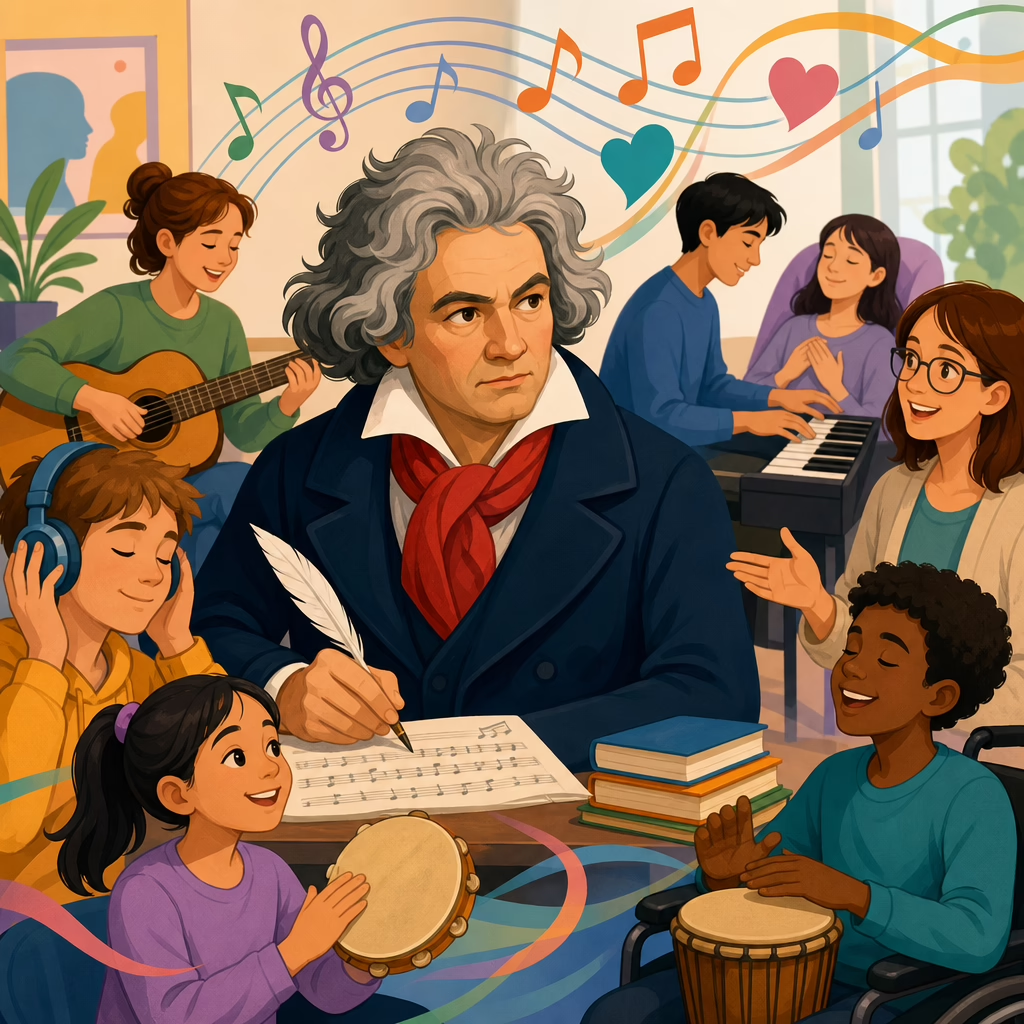
The Role of Beethoven in Music Therapy Education
Beethoven occupies a distinctive place in music therapy education because his music unites historical importance, emotional range, structural clarity, and lived experience with disability. In classrooms, clinical seminars, and supervised training, educators return to Ludwig van Beethoven not simply because he is famous, but because his works help students examine how music affects cognition, movement, mood, memory, identity, and human connection. Music therapy education refers to the academic and clinical preparation that trains students to use music purposefully within therapeutic relationships. That preparation includes psychology, neuroscience, musicianship, ethics, assessment, treatment planning, and cultural reflection. Within that broad curriculum, Beethoven serves as repertoire, case material, and a lens for discussing resilience, communication, and adaptation.
When I have taught or supported music-based learning modules, Beethoven has often been the point where theory becomes concrete. Students already know the opening of the Fifth Symphony, the “Moonlight” Sonata, or “Ode to Joy,” so engagement starts quickly. From there, educators can analyze tempo, motif, dynamics, harmonic tension, and form, then connect those musical features to therapeutic goals such as emotional expression, cueing movement, guided imagery, group cohesion, or reminiscence. Beethoven also matters because his progressive hearing loss raises important questions about disability, identity, accommodation, and artistic agency. In other words, he is not just a composer in a history survey. He is a practical teaching resource for the modern music therapy classroom.
As a hub within Community and Education, this article explains the role of Beethoven in music therapy education across curriculum design, clinical methods, ethics, inclusion, and related miscellaneous themes. It also points readers toward the kinds of linked subtopics that usually sit beneath this page: composer studies, accessible music education, historical case discussions, community singing, neurologic applications, and repertoire analysis. For students, educators, and community program leaders, understanding Beethoven’s role is useful because it clarifies how canonical music can be taught responsibly, adapted thoughtfully, and connected to diverse learners rather than treated as untouchable heritage.
Why Beethoven remains central in music therapy training
Beethoven remains central in music therapy training for four practical reasons. First, his music is widely recognizable, which lowers the barrier to participation. Second, his output spans solo piano, chamber music, song, concerto, and symphony, giving instructors material for many settings. Third, his compositions contain strong rhythmic and melodic identities that are easy to isolate for interventions. Fourth, his biography opens discussion about hearing loss, trauma, perseverance, and social meaning. These qualities make him unusually flexible across undergraduate surveys, graduate seminars, and continuing education workshops.
In educational settings, familiar repertoire has a measurable advantage. Students and clients often respond faster to known melodic material because recognition supports attention and prediction. A short excerpt from Symphony No. 5 can anchor a lesson on rhythmic entrainment; a phrase from “Ode to Joy” can demonstrate melodic accessibility in group singing; a slow movement from a piano sonata can support discussion of affect regulation. Educators can then compare responses: How does a repeated four-note motive affect anticipation? What happens when harmonic instability delays resolution? Why might a march-like pulse support gait training more effectively than rubato phrasing? Beethoven’s catalog provides clear examples for these questions.
His life story adds another educational layer. Beethoven’s hearing loss is often introduced carefully, not as inspiration theater, but as a historically documented reality that influenced communication, work habits, and social relationships. Students learn that disability does not erase artistry, and that clinical conversations about loss must avoid simplistic narratives. This framing is especially valuable in community and education contexts, where future practitioners need disability-informed language, respect for autonomy, and awareness of accommodations.
How Beethoven’s music is used in classroom and clinical teaching
Music therapy educators use Beethoven in both didactic instruction and applied skill development. In didactic courses, his works help teach musical analysis for clinical decision-making. Students may chart meter, phrase length, contour, dynamic contrast, and cadential timing, then predict how those elements could support interventions. In applied training, they may perform simplified arrangements, improvise on a Beethoven theme, or adapt excerpts for voice, guitar, piano, percussion, and assistive instruments. The point is not concert perfection. The point is to understand what musical features do in human interaction.
For example, in neurologic music therapy-informed teaching, a steady pulse from a Beethoven allegro can be used to discuss rhythmic auditory stimulation for movement. In older adult programming, “Ode to Joy” often appears in intergenerational singing because the melody is learnable, phrase lengths are manageable, and the text carries themes of unity. In mental health education, a teacher may compare the emotional arc of the “Pathétique” Sonata with client-reported affect shifts, helping students link musical tension and release to emotion processing. In palliative care seminars, slow Beethoven movements can prompt discussion about pacing, silence, and the ethics of imposing repertoire versus following patient preference.
| Educational use | Beethoven example | Therapeutic concept taught | Why it works |
|---|---|---|---|
| Rhythmic cueing | Symphony No. 7, second movement | Gait support, entrainment, timing | Clear pulse and repeated patterns make timing easy to track |
| Group singing | “Ode to Joy” from Symphony No. 9 | Cohesion, breath support, social participation | Memorable melody and accessible phrase structure |
| Emotion analysis | Piano Sonata No. 8 “Pathétique” | Affect identification, tension and release | Strong contrasts support discussion of mood shifts |
| Reminiscence | “Für Elise” | Autobiographical memory, familiarity | High recognition value across many generations |
| Adaptation practice | Theme from Symphony No. 5 | Simplification, accessibility, motif work | Short motive can be arranged for varied abilities |
One overlooked benefit is that Beethoven’s motifs adapt well to different skill levels. A beginning student can play the Fifth Symphony motive on one drum, while an advanced trainee can reharmonize it, transpose it, or use it in improvisation. That scalability is valuable in education because classes often include mixed instrumental backgrounds. It also mirrors real community practice, where facilitators must create inclusive musical experiences for participants with different abilities, ages, and goals.
Beethoven, disability, and inclusive education
Any serious discussion of Beethoven in music therapy education must address disability with precision. Beethoven’s hearing loss is historically significant, but it should not be romanticized. Good teaching emphasizes documented context: he experienced progressive hearing impairment, used ear trumpets and conversation books, withdrew socially at times, and continued composing. For students, this invites a richer conversation about communication access, stigma, occupational identity, and the difference between impairment and participation barriers. Those are central issues in community music and therapeutic education alike.
In practice, Beethoven’s story can help educators introduce inclusive design. If a composer of his stature required adaptation, then adaptation is not a sign of deficiency; it is a normal part of human participation. This point matters when training students to lead groups that include Deaf or hard-of-hearing participants, autistic learners, people with Parkinson’s disease, stroke survivors, or children using augmentative communication. Lessons can branch from Beethoven into captioning song texts, using visual conducting cues, providing tactile rhythm supports, lowering sensory load, or arranging music for limited range of motion. His biography becomes a bridge to accessibility rather than a museum anecdote.
There is also an ethical caution. Beethoven should not be used to suggest that every disabled person must overcome adversity through extraordinary achievement. Educators need to say plainly that support, accommodation, and respect matter more than heroic narratives. In my experience, students respond well when the discussion shifts from “genius despite disability” to “human creativity within real constraints.” That framing is more accurate and more useful for future clinicians.
Community and education applications beyond the clinic
Because this article sits under Community and Education, it is important to note that Beethoven’s role extends beyond formal therapy sessions. Community choirs, school inclusion programs, public library workshops, senior centers, hospital outreach, and museum education all use Beethoven-related repertoire and stories. These settings are not all music therapy, but they intersect with music therapy education because students often train in prevention, wellness, and community engagement alongside clinical treatment. Beethoven becomes shared cultural material that can support participation when used flexibly and respectfully.
Take intergenerational programming as an example. A facilitator may use “Ode to Joy” in a session that includes children, parents, and older adults. Younger participants can learn the melody through call-and-response, while older adults may contribute historical associations, lyrics, or personal memories. The educator can then discuss how shared singing supports belonging, how repetition aids memory, and how arranging for mixed abilities creates access. In school settings, Beethoven can anchor lessons that combine music history with social-emotional learning: students identify emotions in a sonata excerpt, reflect on perseverance, and create their own motif-based compositions.
This miscellaneous hub also connects to broader questions readers often ask. Can classical music support stress reduction? Sometimes, but preference matters more than prestige. Is Beethoven appropriate for every population? No; repertoire should match culture, identity, age, trauma history, and clinical goals. Does famous music automatically improve outcomes? No; therapeutic effectiveness depends on assessment, relationship, timing, and adaptation. Those direct answers belong in music therapy education because they prevent common misunderstandings before students enter practice.
Limits, controversies, and best practices for teaching Beethoven today
Beethoven is valuable, but he should never dominate the curriculum at the expense of culturally responsive education. One of the biggest mistakes I see in training is treating Western classical repertoire as neutral or universal. It is neither. Beethoven can be powerful in therapy education, yet many clients and communities will respond more strongly to gospel, hip-hop, folk traditions, film music, or songs tied to their own language and history. Responsible educators present Beethoven as one important resource among many, not the default standard of meaningful music.
Best practice starts with function. Ask what the music needs to do: cue movement, invite singing, regulate arousal, support reflection, stimulate memory, or strengthen rapport. Then choose repertoire accordingly. Sometimes Beethoven is the right choice because the pulse is clear, the melody is familiar, or the educational objective involves motif development. Sometimes he is the wrong choice because the associations are weak, the style feels alienating, or the intervention would be more effective with client-preferred music. This is a clinical and educational judgment, not a prestige decision.
Pedagogically, it helps to pair Beethoven with comparison. A teacher might place the Fifth Symphony motive next to a West African drumming pattern to discuss repetition and entrainment, or compare “Ode to Joy” with a contemporary protest song to explore communal singing and social meaning. That comparative method deepens learning and reduces the risk of a narrow canon. It also reflects standards-based training, where assessment, evidence, and client context outweigh personal taste. Organizations such as the American Music Therapy Association and the Certification Board for Music Therapists emphasize competencies in assessment, ethics, diversity, and evidence-informed practice; Beethoven fits within those competencies only when taught through that wider lens.
For educators building a subtopic hub, the practical takeaway is clear. Use Beethoven to teach structure, adaptation, disability awareness, and community participation, while linking outward to diverse repertoire studies, inclusive facilitation methods, neurologic approaches, school-based applications, and ethical case analysis. That is the real role of Beethoven in music therapy education: not a shrine to the past, but a working set of musical and human examples that help students learn how to listen carefully, choose purposefully, and serve people well. If you are developing curriculum or community programming, start with one Beethoven piece, define the goal, adapt it for your participants, and connect it to the broader learning pathway.
Frequently Asked Questions
Why is Beethoven so often included in music therapy education?
Beethoven is frequently included in music therapy education because his music offers a rare combination of artistic depth, emotional accessibility, and instructional usefulness. Educators use his works not only because he is one of the most recognized composers in Western music history, but because his compositions provide clear material for discussing how music influences attention, emotion, memory, movement, and interpersonal connection. In a teaching setting, that range matters. Students preparing for clinical work need examples that can support both musical analysis and therapeutic reflection, and Beethoven’s catalog does both exceptionally well.
His music also spans a wide expressive spectrum, from tension and struggle to calm, joy, reflection, and triumph. That makes it valuable for demonstrating how musical elements such as tempo, rhythm, phrasing, harmony, dynamics, and form can shape a listener’s internal state. For example, educators may use a Beethoven slow movement to explore emotional regulation and guided listening, while a rhythmic passage from a symphony or sonata can support discussions of motor entrainment, energy modulation, or group responsiveness. Because many students and clients recognize his name, his music also creates an accessible entry point into larger conversations about therapeutic process.
Another major reason is that Beethoven’s life invites important reflection on disability, identity, adaptation, and resilience. His progressive hearing loss is often discussed in music therapy programs not as a simplistic story of overcoming adversity, but as a way to help students think more critically about the lived experience of impairment, social attitudes toward disability, and the relationship between artistic expression and human agency. In that sense, Beethoven functions as more than a historical figure; he becomes a case study through which future therapists can examine empathy, ethics, and person-centered thinking.
How does Beethoven’s music help students understand core music therapy concepts?
Beethoven’s music helps students understand core music therapy concepts because it makes abstract therapeutic ideas easier to hear, observe, and analyze. In music therapy education, students must learn how musical structure relates to human response. Beethoven’s works are especially effective for this because they often feature strong motivic development, clear contrasts, memorable rhythmic patterns, and emotionally compelling formal design. These qualities help students identify how specific musical choices may influence arousal, attention, anticipation, emotional processing, and behavioral engagement.
For instance, a music therapy educator might use a Beethoven theme and variations movement to teach adaptability and transformation in music-based intervention design. Students can hear how a simple theme changes character through tempo shifts, texture changes, harmonic recontextualization, and rhythmic variation. That can lead into practical discussion about how a therapist might adapt a familiar musical idea for different clinical goals, such as increasing engagement, supporting communication, or matching and then redirecting mood. Similarly, Beethoven’s strong pulse and phrase structure in some works can be used to explore rhythm-based interventions tied to movement, coordination, and timing.
His music is also useful for illustrating the interaction between familiarity and complexity. In therapy, music that is too predictable may not sustain attention, while music that is too complex may overwhelm some clients. Beethoven often sits in a productive middle ground. Students can examine how repetition creates safety and recognition, while contrast and development maintain interest. This makes his work especially useful in teaching therapeutic listening, session planning, and clinical reasoning. Rather than treating music as background sound, students learn to hear it as an active therapeutic medium with measurable and meaningful effects.
What can music therapy students learn from Beethoven’s experience with hearing loss and disability?
Music therapy students can learn a great deal from Beethoven’s experience with hearing loss and disability, especially when that history is taught thoughtfully and responsibly. His life provides an opportunity to discuss how disability shapes identity, creativity, communication, and social participation. In music therapy education, this can help students move beyond simplistic narratives of tragedy or inspiration and instead develop a more nuanced understanding of how people live, adapt, and create meaning while navigating physical, sensory, or neurological differences.
Beethoven’s hearing loss is particularly relevant because it raises questions that are central to music therapy practice. How do people maintain connection to music when perception changes? How do changes in ability affect self-concept, roles, and relationships? What supports adaptation without reducing the person to a diagnosis? These questions matter in work with clients across settings, including rehabilitation, special education, mental health, hospice, and older adult care. Discussing Beethoven’s life can help students appreciate that disability is not only a medical condition but also a social and personal experience shaped by environment, stigma, support systems, and access.
At the same time, educators often use Beethoven’s story to teach ethical caution. It is important not to present him as a universal model for all disabled people or as evidence that suffering automatically produces greatness. Instead, his example can encourage students to listen more carefully to each individual client’s needs, strengths, limits, and preferences. That is one of the most valuable lessons in music therapy education. Beethoven’s life reminds students that human beings are complex, that artistic identity can persist through profound change, and that therapeutic work should honor dignity, autonomy, and lived experience rather than rely on stereotypes.
In what ways is Beethoven’s music used in music therapy training and classroom discussion?
In music therapy training and classroom discussion, Beethoven’s music is used as both a musical text and a clinical teaching tool. In academic courses, educators may analyze his compositions to help students understand musical form, tension and release, thematic development, and expressive contrast. These analytical skills are important because therapists need to know how music works internally before they can use it intentionally in practice. Beethoven’s works often make these relationships especially clear, allowing students to connect technical analysis with therapeutic application.
In clinical seminars, his music may be used to prompt discussion about emotional response, autobiographical memory, cultural familiarity, and therapeutic listening. A teacher might ask students to compare how different clients could respond to the same Beethoven excerpt depending on age, cultural background, musical history, diagnosis, sensory needs, or treatment goals. This helps future therapists avoid one-size-fits-all assumptions. It reinforces a foundational principle of music therapy: the effectiveness of music depends not only on the piece itself, but on the person, the context, and the relationship.
In supervised training, students may also learn how to adapt or reference Beethoven’s music in live or receptive methods. For example, a familiar motif could be simplified for use in a neurologic or developmental context, or a recorded excerpt could be selected for imagery, relaxation, reminiscence, or discussion-based interventions. Educators can then guide students in evaluating why that choice did or did not work. Was the tempo appropriate? Did the musical intensity help or overstimulate? Did the client connect with the style? In this way, Beethoven becomes part of a broader training process that teaches observation, flexibility, clinical judgment, and evidence-informed use of music.
Is Beethoven still relevant in modern music therapy education despite changing musical tastes and diverse client populations?
Yes, Beethoven remains relevant in modern music therapy education, but his relevance depends on how he is taught. He is not valuable because classical music should automatically be centered in all therapeutic work, and he is not appropriate for every client or every intervention. Rather, he remains relevant because his music provides rich material for teaching foundational clinical principles, and because his historical and personal significance continues to open important discussions about art, disability, human expression, and therapeutic meaning. In other words, Beethoven is most useful when he is approached critically, contextually, and alongside many other musical traditions.
Modern music therapy education emphasizes cultural humility, client preference, inclusivity, and responsiveness to diverse populations. Within that framework, Beethoven can still serve an important role. His music can help students practice formal listening, emotional mapping, intervention analysis, and historical reflection. It can also be used as a comparative tool. For instance, students may examine how rhythmic drive, expressive contour, or narrative arc function in Beethoven and then compare those same therapeutic principles in jazz, folk, pop, hip-hop, film music, or community-based traditions. This approach keeps the focus on transferable clinical understanding rather than narrow stylistic loyalty.
Ultimately, Beethoven’s ongoing place in music therapy education is less about preserving a canon and more about preparing thoughtful practitioners. When students study his music well, they are not simply learning about one composer; they are learning how to ask better clinical questions. What in the music is likely to affect a person’s body, mind, or emotions? How does history shape listening? How do identity and disability influence interpretation? How can therapists use music ethically and effectively? Those questions remain fully contemporary, which is why Beethoven continues to matter in the education of future music therapists.