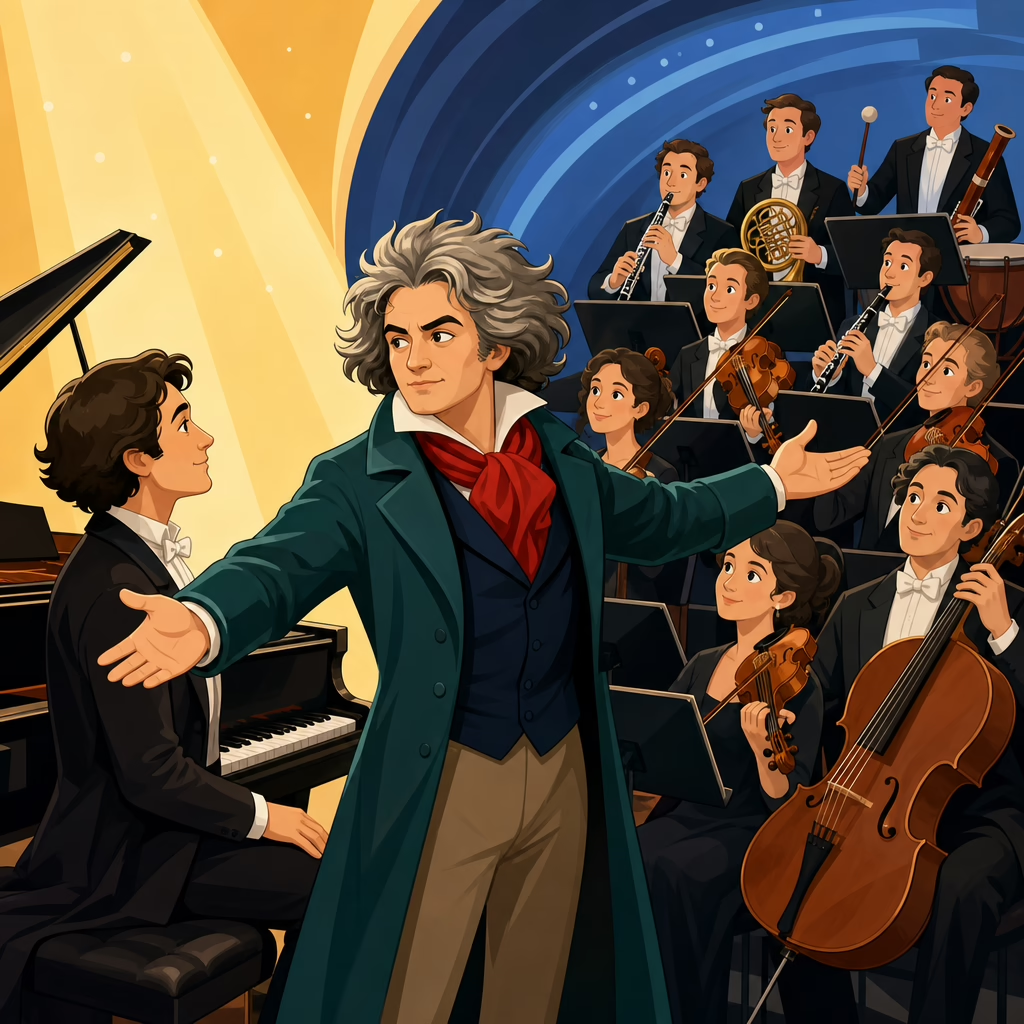
How Beethoven Changed the Relationship Between Soloist and Orchestra
Before Beethoven, the relationship between soloist and orchestra in the concerto was usually clear, stable, and hierarchical: the orchestra introduced material, established key and mood, and then yielded the spotlight to a featured player whose brilliance supplied contrast, elegance, and virtuoso display. Beethoven changed that balance. In his hands, the concerto became less a platform for decorative competition and more a site of dramatic negotiation, where soloist and orchestra could argue, collaborate, interrupt, and ultimately reshape one another. That shift altered not only how concertos were written, but how listeners understood agency, narrative, and power in instrumental music.
To understand the scale of Beethoven’s innovation, it helps to define the terms. A soloist is the individual instrumental voice set apart from the ensemble, most often a pianist or violinist in Beethoven’s concertos. The orchestra is the larger collective body that supports, frames, and responds to that individual line. In eighteenth-century practice, especially in many Classical concertos by Mozart and his contemporaries, the relationship often relied on a double exposition: the orchestra stated major themes first, then the soloist reentered to elaborate, modulate, and dazzle. The arrangement was not simplistic, and Mozart could make it psychologically subtle, but the underlying contract was intelligible. Beethoven inherited that model and then pushed against it from inside.
This matters because concerto form sits at the center of a larger musical question: how does an individual voice function within a community? In rehearsal rooms, score study sessions, and performance analysis, I have seen again and again that Beethoven’s concertos force musicians to answer that question in real time. The piano cannot simply float above the texture, and the orchestra cannot act as a neutral backdrop. Each side carries thematic responsibility. Each side can initiate action. Each side can resist the other. That redistribution of power became foundational for nineteenth-century concerto writing, influencing Mendelssohn, Brahms, Tchaikovsky, and beyond.
Beethoven’s changes were not abstract ideas detached from sound. They are audible in openings, transitions, cadenzas, and tuttis; in the way themes migrate between instrumental groups; in how technical brilliance serves structure rather than mere ornament; and in how the solo part becomes a participant in symphonic argument. His five piano concertos, the Violin Concerto, and the Triple Concerto each contribute evidence, but the most decisive transformations occur in the Third, Fourth, and Fifth Piano Concertos. Those works show Beethoven redefining the relationship between soloist and orchestra from ceremonial alternation into dynamic interdependence.
From display piece to dramatic partnership
In earlier concerto tradition, the soloist often functioned as an honored guest. The orchestra welcomed the listener into the movement, laid out themes, and prepared a controlled environment for individual display. Beethoven retained parts of that inheritance, especially in the first two piano concertos, but even there the solo writing presses toward greater structural consequence. By the time of the Piano Concerto No. 3 in C minor, Op. 37, the soloist is no longer merely embellishing orchestral ideas. The piano enters a drama already in motion and immediately deepens it through harmonic tension, motivic development, and rhetorical urgency.
The C minor concerto matters because Beethoven uses the key associated with some of his most intense public statements, including the Fifth Symphony and the “Pathétique” Sonata. The orchestra’s opening tutti is not just introductory material waiting to be improved by keyboard brilliance. It creates a charged symphonic field. When the piano enters, it does not dissolve that field into salon display. Instead, it engages it. The soloist extends motives, destabilizes expectations, and enlarges the emotional stakes. In performance, that means the pianist must think like a chamber musician inside a symphonic process, not like a virtuoso pasted onto it.
This is the core change Beethoven made: he turned the concerto into a dramatic partnership. Partnership here does not imply equality at every moment. Beethoven still values contrast, hierarchy, and moments of clear prominence. But prominence is no longer the sole purpose of the solo role. The soloist becomes a thinker, challenger, and coauthor of the movement’s argument. The orchestra, meanwhile, becomes more than accompaniment. It remembers, comments, interrupts, and sometimes withholds agreement.
How Beethoven transformed concerto openings
No single gesture announces Beethoven’s new approach more clearly than the opening of the Piano Concerto No. 4 in G major, Op. 58. Instead of beginning with a full orchestral exposition, the piano speaks first, alone, quietly, and with extraordinary authority. That opening would have startled early listeners because it reverses the expected order of public statement. The soloist does not wait to be introduced by the orchestra. The soloist initiates the discourse. Then the orchestra answers in a distant harmonic area, as if questioning or reframing what the piano has proposed.
This opening changes the relationship between soloist and orchestra in several ways at once. First, it gives the soloist thematic primacy from the first bar. Second, it makes the orchestra’s response something interpretive rather than merely supportive. Third, it creates dialogue before display. The listener is drawn not into a pageant of entry but into a conversation already charged with uncertainty. That is why the Fourth Concerto still feels modern: its first event is not power on display, but thought entering shared space.
The Piano Concerto No. 5 in E-flat major, Op. 73, often called the “Emperor,” transforms the opening in a different way. Here the orchestra strikes a commanding E-flat chord, but instead of proceeding through a conventional tutti, the piano immediately answers with expansive flourishes. These are not detachable ornaments. They are strategic interruptions that prevent the orchestra from monopolizing the narrative. Beethoven effectively collapses the distance between orchestral proclamation and solo response. The result is a concerto in which the soloist is present from the start as an equal force in public rhetoric.
These openings had lasting consequences. Later composers could no longer treat the orchestral introduction as a fixed, unquestioned ceremony. Beethoven had demonstrated that the first seconds of a concerto could redefine power relations instantly. For a broader view of how this kind of structural boldness connects to his larger orchestral thinking, see the main guide at https://lvbeethoven.com/how-beethoven-reinvented-the-symphony/.
Themes, motives, and shared ownership
Beethoven’s mature concertos distribute thematic authority across soloist and orchestra more aggressively than most earlier models. Instead of reserving memorable material for one side and figuration for the other, he lets themes migrate, fracture, and recombine. This matters because ownership of musical ideas determines status. If only the orchestra presents core themes, the soloist remains essentially reactive. If only the soloist carries memorable content, the ensemble becomes subordinate. Beethoven avoids both outcomes by making themes collaborative property.
In the Fourth Concerto, the opening piano phrase is simple, almost inward. Yet its significance grows because the orchestra absorbs and transforms its implications. The music develops less through alternation than through mutual reinterpretation. In the Violin Concerto in D major, Op. 61, the opening timpani rhythm and broad orchestral presentation establish a spacious world that the solo violin does not conquer through acrobatics. Instead, the violin enters as a voice moving through an already meaningful landscape, elaborating and revoicing what the orchestra has set in motion.
What Beethoven learned from symphonic composition is crucial here. Motives are not decorative units but engines of continuity. A short rhythm, interval, or gesture can bind the soloist and orchestra into one dramatic organism. That is why Beethoven’s concerto dialogues often feel inevitable rather than episodic. Even when the soloist seems to break free in passagework, the material usually grows from shared motivic substance. Virtuosity is therefore integrated into composition itself.
| Work | Traditional expectation | Beethoven’s change | Effect on soloist-orchestra relationship |
|---|---|---|---|
| Piano Concerto No. 3 | Soloist elaborates orchestral setup | Soloist intensifies symphonic conflict | Shared dramatic responsibility |
| Piano Concerto No. 4 | Orchestra opens and frames discourse | Soloist opens alone | Soloist gains immediate thematic authority |
| Piano Concerto No. 5 | Extended orchestral introduction before entry | Piano interrupts opening proclamations | Public rhetoric becomes collaborative |
| Violin Concerto | Solo line dominates through display | Violin unfolds within orchestral breadth | Dialogue replaces simple opposition |
Virtuosity with structural purpose
One of Beethoven’s most important innovations was to make virtuosity answer to form. In many eighteenth-century concertos, brilliance could function as pleasurable excess: scales, arpeggios, rapid passagework, and registral leaps displayed command and charm. Beethoven certainly writes difficult solo parts, and anyone who has rehearsed the Fourth or Fifth Concerto knows that the technical demands are formidable. But the difficulty usually serves architecture, pacing, and thematic pressure. The soloist’s brilliance must clarify the movement’s argument.
Take the first movement cadenza tradition. Earlier cadenzas often suspended the orchestra so the soloist could improvise or display before the closing tutti returned. Beethoven narrows the gap between cadenza and structure. In his works, especially when using his own written cadenzas, the cadenza does not feel like an optional exhibition detached from the musical logic. It becomes a point of concentrated reflection on prior material. The orchestra’s silence is not absence; it is tension. The soloist speaks for the whole movement, not just for personal glory.
This has practical consequences for performance. A pianist who treats Beethoven’s passagework as merely brilliant will often sound superficial. The runs need harmonic direction. The accents need rhetorical meaning. The orchestral players, likewise, cannot approach tuttis as generic support. Their entries often carry thematic reminders or structural pivots that shape how the solo line will be heard. Beethoven writes concerto texture with the precision of chamber music scaled up to orchestral dimensions.
Conflict, dialogue, and the new concerto drama
Beethoven also altered the emotional script of the concerto. Earlier works could certainly be dramatic, but Beethoven intensified the sense that soloist and orchestra inhabit a field of real conflict and negotiation. The most famous example is the second movement of the Fourth Piano Concerto, where stark orchestral statements are answered by quiet, pleading, or persuasive phrases from the piano. Many listeners have associated the scene with Orpheus taming the Furies, though Beethoven left no explicit program. Whether or not that interpretation is accepted, the musical fact remains: the movement stages confrontation through contrast in texture, register, articulation, and dynamic profile.
What makes this relationship new is not just opposition, but transformation. The orchestra begins severe and resistant. The piano responds with a different mode of speech, and over the course of the movement the orchestral stance softens. This is not accompaniment beneath melody. It is drama enacted through interaction. Beethoven shows that a concerto can present character, resistance, and change without words, and that these processes depend on the changing bond between individual and collective voices.
The Fifth Concerto develops a less intimate but equally consequential model. There the relationship is often ceremonial, expansive, and public. Yet even in its grandeur, the orchestra does not simply crown the soloist. The two forces co-produce majesty. The piano’s figurations animate orchestral mass; the orchestra legitimizes and amplifies the piano’s declarations. Beethoven thus expanded the concerto’s dramatic range, from inward persuasion to civic triumph, without reverting to empty display.
Why Beethoven’s model changed later concerto writing
After Beethoven, major concerto composers inherited a transformed genre. Mendelssohn’s Violin Concerto shortens the delay before the soloist enters and integrates the cadenza into the formal design. Brahms, especially in the Second Piano Concerto and Violin Concerto, treats the orchestra as a symphonic partner of immense weight. Tchaikovsky builds large-scale rhetorical conflict between soloist and ensemble, while still relying on memorable melody and virtuoso force. These composers differ greatly, but Beethoven made their solutions imaginable by proving that concerto form could support deep structural reciprocity.
The change also affected performers. The nineteenth-century soloist increasingly had to project more than dexterity. Interpretive intelligence, long-range architecture, and responsiveness to orchestral texture became central. Conductors, too, gained a different responsibility. In Beethoven, balance is not just acoustic. It is philosophical. If the orchestra overpowers the soloist, the dialogue collapses. If it retreats into passivity, the work loses its dramatic spine. The best performances preserve tension between independence and integration.
For listeners, Beethoven’s innovation remains immediately legible. Even without technical training, audiences sense when the soloist is not merely being featured but is actively shaping the course of events with the orchestra. That is the enduring legacy: Beethoven made the concerto feel like a living argument about individuality inside a larger musical society.
Beethoven changed the relationship between soloist and orchestra by rejecting the old assumption that the ensemble exists mainly to prepare and accompany virtuoso display. He recast the concerto as a dramatic structure of shared authority, where themes, momentum, and meaning pass continually between individual and collective forces. In the Third Concerto, the soloist deepens symphonic conflict. In the Fourth, the soloist claims the right to speak first and transform opposition through dialogue. In the Fifth, soloist and orchestra generate public grandeur together from the opening bars.
Those changes matter because they reshaped the concerto at its core. Beethoven made openings more unpredictable, thematic ownership more collaborative, virtuosity more structural, and dramatic interaction more psychologically rich. He did not erase contrast between soloist and orchestra; he made that contrast productive. The result is a genre in which brilliance serves argument, and accompaniment becomes active musical thought.
If you want to hear Beethoven’s innovation clearly, listen to the openings and slow movements of the Third, Fourth, and Fifth Piano Concertos, then compare how each work distributes power between pianist and orchestra. That comparison reveals why Beethoven remains the decisive figure in redefining the concerto’s central relationship.
Frequently Asked Questions
1. How did Beethoven change the traditional relationship between soloist and orchestra in the concerto?
Before Beethoven, the classical concerto usually followed a fairly stable social and musical order. The orchestra set the stage by presenting themes, establishing the tonal world, and defining the character of the movement. After that, the soloist entered as a brilliant guest—someone who elaborated, decorated, and intensified what had already been introduced. The contrast between collective ensemble and individual virtuoso was central, but it was also orderly. In many works by earlier composers, the soloist’s role was to dazzle within a framework that the orchestra firmly controlled.
Beethoven transformed that arrangement by making the relationship between soloist and orchestra far more dynamic, dramatic, and psychologically charged. Instead of treating the orchestra as an accompanist and the soloist as a decorative star, he often set them into active dialogue. They could challenge one another, interrupt one another, echo one another, or seem to push the music forward together as equal dramatic forces. This made the concerto feel less like a formal alternation of roles and more like a living argument or negotiation.
That shift matters because it changed the expressive purpose of the concerto. In Beethoven’s hands, virtuosity was no longer simply about graceful display or technical brilliance for its own sake. It became part of a larger musical drama. The soloist was not just there to embellish themes, but to participate in shaping the meaning of the piece. The orchestra, meanwhile, was elevated from a supportive backdrop into a fully engaged partner. This is one of Beethoven’s most important innovations: he gave the concerto a new sense of tension, equality, and seriousness.
2. Why is Beethoven considered so important in the evolution of the piano concerto?
Beethoven is considered pivotal because he expanded the concerto from a courtly or entertainment-oriented genre into one capable of profound symphonic thought and dramatic depth. Earlier piano concertos certainly contained beauty, wit, elegance, and impressive craftsmanship, but Beethoven pushed the form toward a larger scale and a more intense emotional range. He treated the concerto not merely as a vehicle for a solo performer, but as a major artistic statement in which soloist and orchestra jointly carry the structure and expressive weight.
One of the clearest signs of this importance is the way Beethoven integrated the solo part into the overall architecture of the work. In many earlier concertos, the soloist’s entrance could feel like the beginning of a new layer added onto orchestral material already presented. Beethoven often made that boundary more fluid and more consequential. His solo writing does not simply revisit what the orchestra has said; it responds to it, questions it, transforms it, and sometimes redirects the entire movement. That gives the concerto a level of organic unity and dramatic purpose that helped redefine the genre.
He also changed expectations for the orchestra itself. Rather than functioning primarily as harmonic support or formal framing, the orchestra in Beethoven’s concertos often has a strong thematic identity and a decisive role in shaping conflict and resolution. This symphonic seriousness influenced later composers immensely. The Romantic concerto as developed by composers such as Brahms, Tchaikovsky, and Rachmaninoff owes a great deal to Beethoven’s example. He proved that a concerto could be both virtuosic and intellectually substantial, both personal and symphonic, both theatrical and structurally rigorous.
3. In practical musical terms, what does “dramatic negotiation” between soloist and orchestra mean in Beethoven’s concertos?
“Dramatic negotiation” refers to the way Beethoven makes the soloist and orchestra behave like distinct but interdependent musical characters rather than fixed functions. Instead of the orchestra simply presenting and accompanying while the soloist ornaments and shines, both sides contribute to tension, development, and resolution. The music can feel almost theatrical, as though two forces are trying to define the direction of the piece together.
In practical terms, this happens through several compositional strategies. Beethoven often gives the orchestra substantial thematic material that retains its power even after the soloist enters. He also writes solo entrances that are disruptive, surprising, or immediately transformative rather than merely decorative. The soloist may introduce new energy, reinterpret previously heard material, or answer the orchestra in a way that changes the emotional stakes. Rhythmic insistence, sudden contrasts, and sharp changes in texture can all contribute to the impression of dialogue or confrontation.
Another important feature is that the orchestra does not disappear when the soloist becomes active. Instead, it continues to assert itself. It may challenge the soloist with forceful tutti passages, reclaim momentum at crucial moments, or participate in tightly woven exchanges where leadership shifts rapidly back and forth. This creates a sense that the concerto is unfolding through interaction rather than display alone. The result is music that feels more argumentative, more collaborative, and more dramatic than the older concerto model. Beethoven turns form into drama by making musical roles less predictable and more mutually dependent.
4. Which Beethoven works best demonstrate this new balance between soloist and orchestra?
Beethoven’s piano concertos as a group chart this development, but several works are especially revealing. The Third Piano Concerto already shows a heightened seriousness and a more forceful orchestral presence than was typical in earlier classical models. The dramatic tension between soloist and ensemble is stronger, and the music feels less like a polite exchange and more like a concentrated unfolding of large-scale ideas.
The Fourth Piano Concerto is often cited as one of the most striking examples of Beethoven’s innovation. Its opening is famous because the piano begins alone, quietly and unexpectedly, reversing the usual order in which the orchestra first establishes the terrain. That single decision says a great deal about Beethoven’s reimagining of concerto hierarchy. The soloist is no longer waiting to enter a pre-existing frame; instead, the concerto begins as if from the individual voice itself, with the orchestra responding. In the slow movement especially, many listeners hear a profound dramatic encounter between soloist and orchestra, almost like a scene of opposition and persuasion.
The Fifth Piano Concerto, often called the “Emperor,” offers another powerful example. Here the relationship is less about conflict in a narrow sense and more about grandeur, integration, and shared authority. The soloist enters immediately with commanding gestures, and the scale of the work makes clear that both piano and orchestra belong to the same heroic world. Beethoven also rethought conventions such as the cadenza, limiting the idea of an improvised showpiece in favor of tighter structural integration. Beyond the piano concertos, the Violin Concerto also demonstrates his expanded sense of orchestral and solo roles, showing that this rebalancing was part of a broader redefinition of the concerto as a genre.
5. How did Beethoven’s changes influence later composers and the future of the concerto?
Beethoven’s influence was enormous because he permanently raised expectations for what a concerto could be. After him, it became much harder to think of the genre as merely a polished showcase for technical display over orchestral support. He had demonstrated that the concerto could sustain symphonic breadth, emotional struggle, thematic transformation, and a genuinely reciprocal relationship between individual and collective forces.
Later composers built on this in different ways. Romantic composers often embraced the heightened drama Beethoven introduced, writing concertos in which the soloist appears not just as an ornamenting virtuoso but as a protagonist. The orchestra, likewise, became more than accompaniment; it could represent resistance, partnership, atmosphere, or even a larger world against which the solo voice defines itself. This dramatic concept is central to many nineteenth-century concertos, whether in the heroic expansiveness of Brahms, the lyric struggle of Tchaikovsky, or the sweeping emotional landscapes of later repertory.
Just as importantly, Beethoven influenced listeners’ expectations. Audiences came to hear the concerto not only as an occasion for brilliance, but as an artistic encounter between competing and cooperating musical identities. That legacy continues today. When modern performers and scholars talk about the concerto as dialogue, conflict, partnership, or dramatic exchange, they are often using a framework Beethoven helped establish. His achievement was not simply to make the soloist more important or the orchestra more powerful. It was to redefine their relationship so that the concerto could become one of the most expressive and intellectually rich forms in Western music.