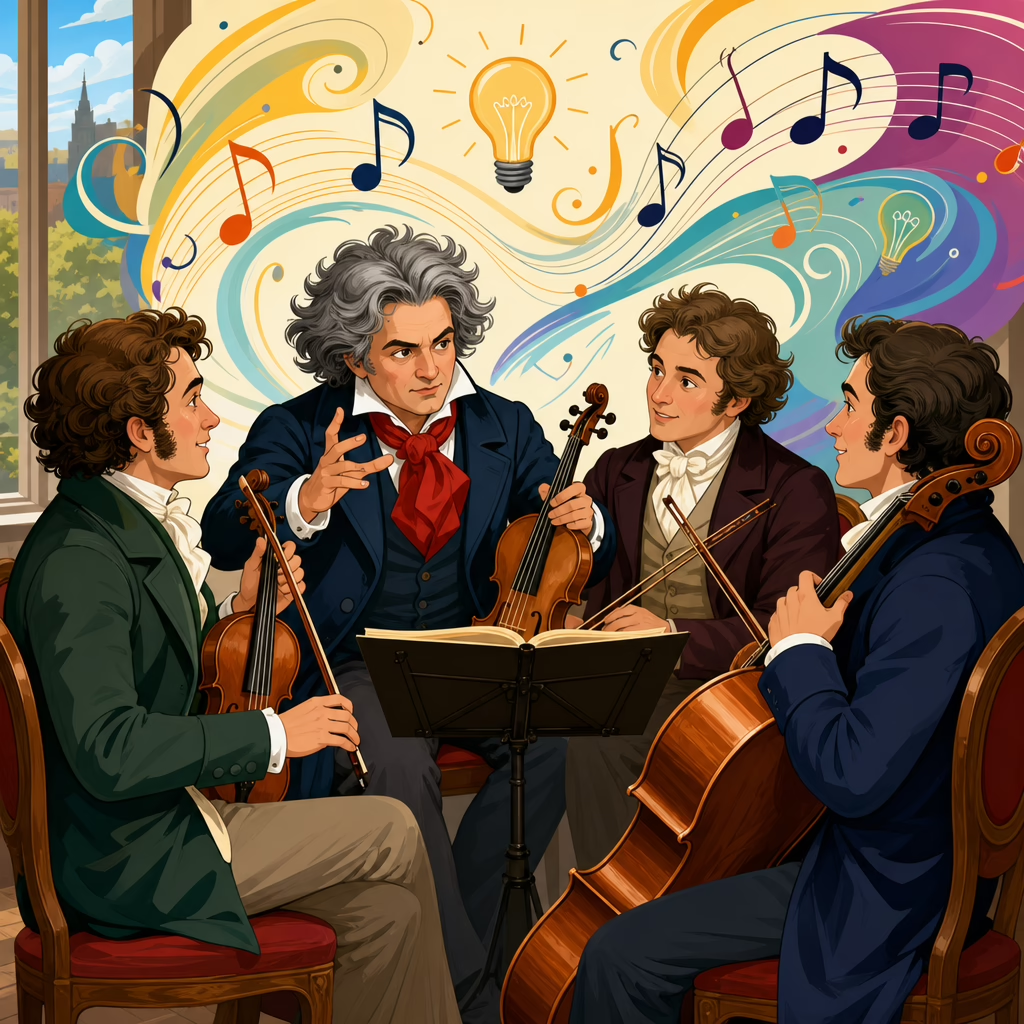
Beethoven’s Innovations in Quartet Conversation
Beethoven’s innovations in quartet conversation changed chamber music from a polite exchange into a living argument among four distinct musical personalities. In a string quartet, “conversation” means the way two violins, viola, and cello share themes, interrupt each other, support each other, and create meaning through timing, register, rhythm, and silence. Before Beethoven, Haydn and Mozart had already elevated the quartet into a sophisticated genre, but Beethoven pressed its conversational possibilities much further. He redistributed authority among the instruments, sharpened contrast, stretched continuity across movements, and made listeners hear dialogue as drama rather than decoration. That shift matters because the string quartet became his most concentrated laboratory for musical thought: nowhere else did he test intimacy, conflict, wit, and philosophical depth with such precision. Having spent years studying scores, rehearsals, and recordings of the quartets, I have seen how players still experience this writing as uncannily modern. A phrase passed from cello to viola to first violin can feel like a changing point of view in a novel. A sudden unison can sound like agreement won after dispute. A silence can land like a withheld answer. Beethoven’s quartet writing remains central to performers, scholars, and serious listeners because it reveals how musical form can emerge from interaction itself. Instead of treating four instruments as one blended sonority with occasional solos, he often lets each line think aloud. The result is not merely beautiful counterpoint; it is enacted reasoning, heard in real time.
From elegant exchange to dramatic speech
To understand Beethoven’s achievement, it helps to define what he inherited. In late eighteenth-century quartet style, especially in Haydn’s mature works, conversation already involved thematic sharing, motivic play, and conversational give-and-take. Mozart deepened lyric equality and harmonic richness. Yet the social model often remained balanced, urbane, and proportionate. Beethoven absorbed that language completely, then altered its stakes. In his hands, the quartet became less like salon discourse and more like debate under pressure. He did this not by abandoning classical clarity, but by intensifying it. Small motives became charged utterances. Accompaniments gained rhetorical force. Register shifts and accents could imply contradiction. Even apparently simple openings often contain latent conflict that later erupts.
A clear example appears in the Op. 18 quartets, where Beethoven works inside inherited forms but adds sharper edges to the interaction. In Op. 18 No. 1, the first movement’s material moves through the group with a tension uncommon in merely decorative imitation. The players must articulate not just correctness but stance: who leads, who resists, who echoes with support, and who reframes the thought. By Op. 59, the “Razumovsky” quartets, those possibilities expand dramatically. Themes are less self-contained, developmental passages more argumentative, and inner voices more assertive. The viola and cello no longer simply fill harmony; they redirect momentum. This is one of Beethoven’s defining innovations in quartet conversation: he made middle and lower voices rhetorically indispensable.
He also changed the listener’s perception of time. Earlier quartets often present ideas in balanced units that answer one another neatly. Beethoven frequently withholds closure, lets a motive persist past expected boundaries, or interrupts continuity with an unexpected texture. These strategies make the listener follow not just melody but interaction. In rehearsal, quartets often speak about “who has the word” or “who finishes the sentence” in Beethoven because the writing demands that exact sensitivity. His notation encourages a social reading of form. Crescendos, sforzandi, rests, syncopations, and phrase overlaps become tools of dialogue. The result is dramatic speech without text.
Equal voices did not mean equal roles
One common misconception is that Beethoven simply made the four instruments equal. The truth is more interesting. He did not flatten their differences; he exploited them. The first violin still often carries exposed material, but Beethoven constantly tests and destabilizes that privilege. The cello may begin a crucial idea, as in the opening of Op. 59 No. 2, where low-register material immediately broadens the field of attention. The viola may supply the pivotal rhythmic identity that gives the whole passage its bite. The second violin may become the hinge between foreground and background, binding the argument together. Equality in Beethoven is functional, not uniform. Every instrument matters because every instrument can alter meaning.
This approach depends on timbre and register as much as on counterpoint. Beethoven understood that the same motive sounds different when spoken by violin, viola, or cello. A phrase in the cello can sound grounded, resistant, or ominous; in the viola, inward or tensile; in the upper violin, incisive or exposed. He uses those associations compositionally. When a figure migrates between instruments, it does not merely repeat; it changes character. That is why performers cannot treat handoffs as neutral relay points. In Beethoven, a transfer often acts like reinterpretation.
The conversational logic becomes especially vivid in passages where one instrument shadows another at a distance of a beat or two. These delayed echoes resemble response, correction, or skepticism rather than simple imitation. In Op. 95, the “Serioso,” terse motives ricochet through the ensemble with unusual compression. The music feels crowded with intent. Each line seems to react under pressure, and the quartet’s famously concentrated design reinforces that sensation. Beethoven’s innovation lies partly in this psychological density. Four instruments can suggest a collective mind, but they can also suggest conflicting impulses within one mind. His quartets often do both at once.
Motivic argument as conversation
Beethoven’s most radical conversational tool was motivic economy. Instead of relying on long, self-sufficient melodies, he often builds large spans from tiny cells: an interval, a rhythm, a turn figure, a repeated note. Because these particles are compact, they can circulate quickly among the four players. That circulation creates audible argument. A motive can be proposed, fragmented, challenged harmonically, compressed rhythmically, or driven into a new register. Listeners do not need technical training to hear this process. They recognize that something said early keeps returning in altered form, as if the quartet cannot let the issue go.
The C-sharp minor quartet, Op. 131, offers a masterclass in this method. Its opening fugue is often discussed for contrapuntal mastery, but its deeper power comes from the way each voice enters with grave individuality while still belonging to a single unfolding thought. As the movement progresses, imitation becomes more than craftsmanship. It becomes a way of hearing subjectivity within order. No instrument is redundant, and no entry is generic. Later in the work, links across movements make conversation extend beyond local texture into the architecture of the whole piece. Beethoven teaches the listener to remember, compare, and reinterpret, which is exactly what conversation requires.
This is also where his quartet writing connects to his wider formal imagination, though the quartet remains uniquely intimate. Readers interested in that broader pattern can see a related transformation of musical discourse in his orchestral work through the main guide on how Beethoven reinvented the symphony. In the quartets, however, the mechanism is more exposed. With only four players, every motivic decision is audible. There is no orchestral mass to hide behind. That transparency makes the argumentative process feel immediate, almost tactile.
| Quartet | Conversational innovation | What listeners hear |
|---|---|---|
| Op. 18 No. 1 | Heightened rhetorical exchange within classical balance | Questions and replies that already carry tension |
| Op. 59 No. 2 | Cello and inner voices drive thematic authority | A broader field of leadership beyond first violin |
| Op. 95 | Compressed motives and volatile handoffs | Urgent, almost combative dialogue |
| Op. 131 | Continuous cross-movement memory and fugal individuality | Conversation that becomes an entire worldview |
Silence, interruption, and the rhetoric of surprise
Another major innovation in Beethoven’s quartet conversation is his use of silence and interruption. In earlier quartet practice, rests often clarify phrase structure or articulation. Beethoven certainly uses them that way, but he also turns them into rhetorical events. A pause can suspend an argument, erase expected momentum, or force the next instrument to speak into a charged emptiness. This technique is particularly potent because quartet texture is exposed. In an orchestra, silence may be cushioned by resonance. In a quartet, a rest can feel like eye contact.
He pairs silence with accentuation and fragmentation to create conversational friction. In Op. 130 and the Grosse Fuge, speech seems repeatedly broken open from within. Rather than presenting one stable topic elegantly passed around, Beethoven lets material collide with countersubjects, registral extremes, and disruptive rhythms. The effect is not chaos for its own sake. It is a dramatization of thought under strain. Players often describe these passages as requiring not just ensemble precision but a shared understanding of rhetorical timing. If the rests are too polite, the music loses its edge; if the attacks are merely loud, it loses intelligibility. Beethoven’s notation asks for articulate disagreement.
Humor also depends on interruption. In several middle-period scherzos, one instrument appears ready to conclude a gesture only to be undercut by another line entering sideways. These moments work because Beethoven understands conversational expectation. He trains the ear toward one outcome, then exposes the confidence of that expectation as premature. The joke is structural, not ornamental. That sophistication helps explain why his quartets reward repeated listening. Their wit is embedded in timing, role reversal, and strategic withholding.
Late style and the inward turn of dialogue
The late quartets push conversation beyond dramatic exchange into something more searching. By this stage, Beethoven no longer treats dialogue only as public argument; it becomes introspection distributed across four voices. The slow movements are crucial here. In the “Heiliger Dankgesang” from Op. 132, alternating sections create not just contrast but changing states of utterance. The modal chorale writing suggests communal speech, while the livelier passages feel like renewed bodily motion and responsive energy. The quartet converses not only among instruments but among conditions of being: illness, gratitude, weakness, recovery.
Op. 127 and Op. 135 reveal a different side of the same development. Variation form becomes a conversational engine because each return is also a reassessment. One instrument may preserve continuity while another destabilizes it with ornament, syncopation, or harmonic inflection. In performance, these pages demand intense listening within the ensemble. Balance is never merely acoustic. It is ethical in the musical sense: each player must know when to assert, when to yield, and when to let ambiguity remain unresolved. Beethoven writes that complexity directly into the texture.
The famous “Muss es sein?” idea in Op. 135 shows how little material Beethoven needs to create strong rhetorical identity. A short gesture can sound like a question because harmony, rhythm, spacing, and response pattern frame it that way. This economy is one reason his conversational innovations have endured. They are not dependent on programmatic explanation. The score itself generates intelligible relationships. Modern listeners, even without theoretical vocabulary, hear agency in these exchanges.
Beethoven’s innovations in quartet conversation endure because they changed both composition and listening. He expanded the role of every instrument, made motives behave like ideas under debate, used silence as rhetoric, and turned formal process into audible interaction. The string quartet after Beethoven could never return to being merely elegant discourse. Schubert, Bartók, Shostakovich, and countless others inherited a genre in which four players could embody conflict, memory, irony, and transcendence with unmatched concentration. For performers, these works remain a discipline of listening: intonation and rhythm are only the beginning, because the deeper task is to project relationship. For listeners, the reward is unusually direct access to musical thought. You do not just hear themes; you hear minds meeting, resisting, converging, and changing.
That is the lasting benefit of studying Beethoven at this level of focus. His quartet writing shows that innovation is not always about bigger forces or louder effects. Sometimes it comes from redefining how a few voices share space, time, and meaning. If you want to understand Beethoven’s originality in its most concentrated form, return to the quartets, follow who speaks when, and listen for how every answer changes the question. Then compare several recordings and watch the conversation come alive in different ways.
Frequently Asked Questions
What does “quartet conversation” mean in Beethoven’s string quartets?
In Beethoven’s string quartets, “conversation” refers to the musical interaction among the four instruments: first violin, second violin, viola, and cello. Rather than treating the ensemble as a melody with accompaniment, Beethoven increasingly wrote each part as if it belonged to a distinct musical speaker with its own perspective, timing, and rhetorical force. A theme might begin in one instrument, be challenged by another, interrupted by a third, and then reframed by the full group. This creates the impression of debate, cooperation, hesitation, persuasion, or even conflict.
What makes Beethoven’s approach especially important is that he expanded the expressive meaning of these exchanges. He used register, rhythm, articulation, accents, and silence to make the instruments seem to react to one another in real time. A cello line might suddenly become argumentative rather than supportive; an inner voice such as the viola might emerge with unusual authority; a pause might function like a moment of tension in speech. In this way, Beethoven turned quartet writing into a dramatic medium. The listener does not simply hear beautiful counterpoint; the listener hears relationships unfolding. That shift is central to his innovation.
How did Beethoven build on Haydn and Mozart while changing the nature of quartet writing?
Haydn and Mozart had already transformed the string quartet into a refined and intellectually rich genre. Haydn, in particular, helped establish the ideal of conversational interplay, where the instruments participate more equally than in earlier chamber music. Mozart deepened this equality with extraordinary lyricism, formal balance, and sensitivity to instrumental color. Beethoven inherited all of that, and he clearly understood their achievements at a profound level.
His innovation was to intensify the stakes of the conversation. Where earlier quartet writing often presents exchange as elegant, balanced, and sociable, Beethoven frequently makes it more unpredictable, more dramatic, and more psychologically charged. He pushes motifs harder, fragments them more aggressively, and allows ideas to collide rather than simply complement one another. He also gives inner parts and the cello greater structural and rhetorical importance, so the musical argument feels less hierarchical. Instead of a polished discourse among well-mannered participants, Beethoven often creates the sense of a living argument among four strong personalities. That change helped redefine chamber music as a space for serious thought, emotional risk, and formal experimentation.
What specific musical techniques did Beethoven use to make the quartet sound like a real conversation?
Beethoven relied on a wide range of compositional techniques to create conversational immediacy. One of the most important is motivic exchange: a short figure introduced by one instrument is quickly passed to another, altered, contradicted, or developed from a new angle. Because the material is compact and recognizable, the listener can follow the back-and-forth clearly, much as one follows recurring ideas in spoken debate. He also uses interruption as a structural device. Phrases do not always conclude neatly; instead, another instrument may cut in with a different rhythm, a sharper accent, or a destabilizing harmony.
Texture is equally important. Beethoven constantly varies who leads and who supports, and he often blurs that distinction altogether. The cello may carry a melodic idea in a high register, while the violins provide rhythmic insistence; the viola may become the crucial mediator between opposing gestures above and below. Rhythmic displacement, syncopation, dynamic contrast, and sudden rests all contribute to the sense that the music is thinking aloud. Silence, especially, becomes expressive: pauses can feel like hesitation, suspense, resistance, or a demand for attention. Through these methods, Beethoven makes ensemble interaction feel active and human rather than merely decorative or formally correct.
Why are Beethoven’s later quartets so often praised for their conversational complexity?
Beethoven’s late quartets are admired because they take the idea of musical conversation to an extraordinary level of subtlety, freedom, and depth. In these works, the relationship among the four instruments becomes less predictable and more layered. Voices enter from unexpected registers, fragments of thought appear and dissolve, and contrasts of mood can be abrupt yet deeply meaningful. The quartet no longer behaves like a neatly ordered classical discussion; it becomes a space where reflection, struggle, humor, tenderness, abstraction, and transcendence can coexist.
Part of what makes these works so compelling is that the conversation is not always about agreement. Beethoven allows discontinuity, ambiguity, and silence to carry structural weight. Instruments may seem to move together and apart within the same passage, creating a sense of simultaneous individuality and unity. This complexity invites listeners to hear each line as both independent and interdependent. For performers, that means the late quartets demand not only technical mastery but also unusual sensitivity to timing, balance, and character. For listeners, they offer an experience that can feel uncannily modern: four voices thinking, questioning, and transforming one another in real time.
Why does Beethoven’s innovation in quartet conversation still matter today?
Beethoven’s reimagining of quartet conversation still matters because it changed how composers, performers, and listeners understand chamber music. He showed that a small ensemble could sustain the intensity of a symphonic argument while preserving the intimacy of four individual voices. That model influenced generations of composers, from Schubert and Bartók to Shostakovich and beyond, all of whom explored the quartet as a medium for deep personal and structural expression. Beethoven established that the string quartet could be both conversational and monumental, both intimate and intellectually expansive.
His approach also continues to shape performance practice and listening habits. Modern quartet playing depends heavily on the kind of alert responsiveness Beethoven’s music demands: careful balance among parts, acute attention to timing, and a willingness to project character from every line, not just the top voice. For audiences, his quartets remain compelling because they dramatize communication itself. They let us hear cooperation, tension, interruption, persuasion, resistance, and reconciliation without words. In that sense, Beethoven’s innovations are not just historical milestones; they remain living artistic possibilities. His quartets still teach us how four instruments can speak as equals while revealing difference, conflict, and shared purpose.