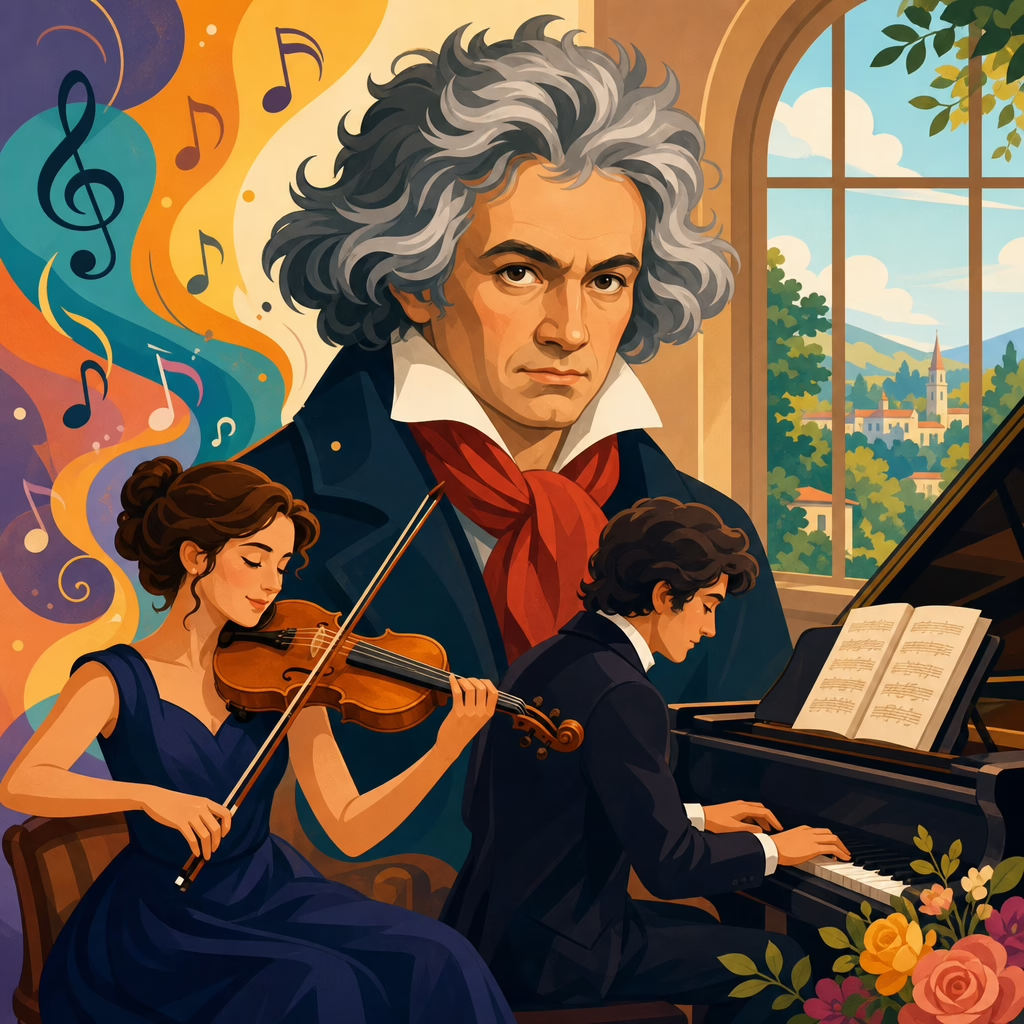
Exploring Beethoven’s Violin Sonatas
Beethoven’s violin sonatas form one of the most revealing journeys in chamber music, tracing his development from a gifted young composer working within Classical conventions to a master who reshaped the relationship between piano and violin with unprecedented dramatic force. In this hub on Exploring Beethoven’s Violin Sonatas, “miscellaneous” does not mean marginal; it means the essential context, patterns, listening strategies, and historical links that help readers move across the full set with understanding. The term violin sonata usually describes a work for violin and keyboard, but in Beethoven’s hands that label quickly became too small, because these pieces are true duos in which both players carry thematic argument, structural weight, and expressive tension. That matters for anyone studying Beethoven’s chamber music because the sonatas sit at the crossroads of his piano writing, string writing, improvisatory instinct, and emerging heroic style. I have worked through these sonatas in score study, rehearsals, and listening sessions with performers, and they consistently show how Beethoven tested ideas here before expanding them elsewhere. For listeners, they offer a practical entry point into his larger output: intimate enough to hear every gesture, yet ambitious enough to display the same architectural thinking found in the symphonies and quartets.
The ten published violin sonatas span roughly 1797 to 1812, from Op. 12 through Op. 96, with important variation works and a few lesser-known companion pieces broadening the picture. They are not a uniform set. Some are witty and Haydnesque, some overtly virtuosic, some lyrical and conversational, and some astonishingly concentrated. The famous “Spring” Sonata and “Kreutzer” Sonata attract most attention, but a complete view requires hearing how Beethoven handles sonata form, slow movements, scherzo-like episodes, variation technique, and tonal planning across all periods. This article serves as a hub for that broader exploration, outlining the major works, the historical context behind them, the central interpretive issues, and the best ways to listen. Whether you are building a study guide, planning internal links across Beethoven chamber music topics, or simply deciding where to start, the goal is straightforward: understand what makes these violin sonatas unique, how they connect to Beethoven’s wider chamber output, and why they remain foundational repertory for performers and listeners alike.
How Beethoven Changed the Violin Sonata
Before Beethoven, the violin sonata often functioned as a keyboard sonata with optional or subordinate violin accompaniment. Mozart elevated the genre significantly, creating genuine dialogue, but Beethoven pushed the partnership further. In the Op. 12 sonatas, dedicated to Salieri, he already treats the piano as more than accompaniment and the violin as more than decorative doubling. Themes are exchanged, rhythmic motives are contested, and cadences become sites of drama rather than routine punctuation. This shift is central to understanding the whole cycle: Beethoven did not simply write attractive melodies for violin over keyboard textures; he built a chamber conversation driven by conflict, balance, and transformation.
The evolution becomes unmistakable in the middle-period works. Sonata No. 5 in F major, Op. 24, later nicknamed “Spring,” expands lyric breadth and thematic generosity, while Sonata No. 9 in A major, Op. 47, the “Kreutzer,” explodes the scale of the genre altogether. That sonata was originally associated with the violinist George Bridgetower before being rededicated to Rodolphe Kreutzer, who reportedly never played it. Its huge opening Adagio, ferocious Presto, and symphonic rhetoric make clear that Beethoven conceived the violin sonata as a public, high-stakes medium. By the time he reached Sonata No. 10 in G major, Op. 96, written for Archduke Rudolph and Pierre Rode, he had refined that expansiveness into a more inward, flexible, and late-leaning style marked by subtle transitions and variation logic.
From a chamber music perspective, these works matter because they show Beethoven repeatedly redefining proportion. In rehearsal, one hears how often the piano introduces instability under a poised violin line, or how the violin cuts through a settled keyboard texture with syncopation or harmonic color. The result is not soloist plus accompanist but two agents shaping one argument. That principle links the sonatas to the piano trios, cello sonatas, and string quartets, making them indispensable within the broader chamber canon.
The Ten Sonatas at a Glance
A complete survey of Beethoven’s violin sonatas starts with chronology, because the stylistic shifts are easier to hear when the works are viewed as a sequence. The early Op. 12 set remains underestimated: No. 1 in D major is bold and extrovert; No. 2 in A major is more elegant and lyrical; No. 3 in E-flat major broadens the design with unusual weight. Op. 23 in A minor introduces a darker, leaner intensity, and Op. 24 in F major answers with openness and songful ease. Op. 30, a set of three, ranges widely: No. 6 in A major is brilliant and poised, No. 7 in C minor is one of the most dramatic sonatas before the “Kreutzer,” and No. 8 in G major blends warmth with structural command.
The two final landmarks, Op. 47 and Op. 96, stand apart for different reasons. The “Kreutzer” is theatrical, expansive, and technically punishing, with an opening that sounds almost improvised before the movement erupts into kinetic drive. Op. 96, by contrast, is a model of mature equilibrium. Its first movement is less about confrontation than nuanced exchange; its slow movement reaches depth through restraint; its finale uses variations not as ornament but as a method of rethinking character. For students and listeners, placing these works side by side reveals Beethoven’s range more clearly than relying on nicknamed favorites alone.
| Sonata | Key | Opus | Character in Plain Terms |
|---|---|---|---|
| No. 1 | D major | Op. 12 No. 1 | Bright, assertive, already conversational |
| No. 2 | A major | Op. 12 No. 2 | Graceful, balanced, melodically generous |
| No. 3 | E-flat major | Op. 12 No. 3 | Broader scale, stronger harmonic surprises |
| No. 4 | A minor | Op. 23 | Taut, stormy, concentrated drama |
| No. 5 “Spring” | F major | Op. 24 | Lyrical, open, famous for flowing warmth |
| No. 6 | A major | Op. 30 No. 1 | Elegant surface with muscular undercurrent |
| No. 7 | C minor | Op. 30 No. 2 | Large-scale tension, nearly symphonic weight |
| No. 8 | G major | Op. 30 No. 3 | Energetic, witty, tightly organized |
| No. 9 “Kreutzer” | A major | Op. 47 | Virtuosic, dramatic, monumental |
| No. 10 | G major | Op. 96 | Refined, inward, subtly profound |
Early, Middle, and Late Style in Plain Terms
Beethoven’s violin sonatas are often grouped into early, middle, and late periods, and in this repertory those categories are genuinely useful. The early sonatas, especially Op. 12, still engage the language of Haydn and Mozart, but they already show Beethoven’s tendency to stretch phrase lengths, emphasize rhythmic cells, and use accents as structural devices. The harmony can turn unexpectedly, and codas often feel more developmental than decorative. For a listener, the simplest way to hear the early style is to notice controlled disruption: the music seems polite on the surface, yet internal pressure keeps pushing against symmetry.
The middle-period sonatas deepen contrast and scale. This is where Beethoven’s so-called heroic manner enters chamber music with full force. Op. 23 and Op. 30 No. 2 in C minor carry the same urgency heard in works tied to that key elsewhere in his output. The “Spring” Sonata reveals another middle-period trait: lyric abundance anchored by strong structure. The “Kreutzer” then represents expansion to the limit, where virtuosity, rhetoric, and formal ambition converge. In performance, this period demands not only technique but a sense of long-span architecture, because climaxes are prepared across pages, not bars.
Op. 96 belongs to Beethoven’s late style in embryo rather than in full abstraction. It does not sound like the late quartets, yet it shares their interest in compression, fluid form, and variation thinking. Instead of blunt contrast, Beethoven uses subtle inflection. Instead of public struggle, he often favors inward transformation. This is one reason seasoned musicians return to Op. 96 repeatedly: its difficulty is not merely digital. The challenge lies in pacing transitions, balancing understatement with significance, and allowing small details to speak without exaggeration.
Essential Works Beyond the Sonatas
A hub on Beethoven’s violin sonatas should not stop at the ten numbered works. The set of variations for violin and piano illuminates how he handled partnership, ornament, and popular material in a less formally weighty context. The Twelve Variations on “Se vuol ballare,” WoO 40, and the Twelve Variations on “La stessa, la stessissima,” WoO 28, show a young Beethoven absorbing operatic melody and transforming it through texture, rhythm, and character. They are useful listening for anyone interested in how he builds variety from compact material.
The more substantial Kreutzer-era companion is the Sonata in F major, WoO 2, often called an early work, and the fragments and occasional pieces that survive from Beethoven’s Bonn and early Vienna years. These are not core repertory in the way Op. 24 or Op. 47 are, but they matter historically because they reveal experimentation before the canon settled. The same is true of transcriptions and arrangements associated with Beethoven’s circle, which remind us that domestic music making shaped the reception of these works as much as the concert hall did.
For readers exploring Beethoven’s chamber music systematically, these miscellaneous pieces also create bridges to adjacent topics: the variation sets connect naturally to Beethoven’s broader fascination with variation form, while the duo writing points toward the cello sonatas and piano trios. A well-built sub-pillar on violin sonatas should therefore link not only individual sonata analyses but also articles on Beethoven’s use of theme and variation, his collaboration with performers, and the performance culture of Vienna around 1800.
What to Listen for in Performance
Listening well to Beethoven’s violin sonatas means focusing on interaction rather than melody alone. The first question to ask is who has the argument at any given moment. Sometimes the violin sings while the piano destabilizes the harmony beneath it. Sometimes the piano states the thematic kernel and the violin intensifies it through articulation or register. In strong performances, these shifts feel inevitable. In weaker ones, one instrument dominates and the structure flattens. I have found that even experienced listeners hear more on a second pass when they track handoffs of motive instead of waiting for obvious tunes.
Tempo choice is another decisive issue. Beethoven’s metronome marks are limited in this repertory, so performers rely on style, articulation, room acoustics, and instrument setup. Historically informed performances on period instruments often reveal sharper contrast and lighter articulation, especially in Op. 12 and Op. 24, because the fortepiano’s quicker decay leaves more space for the violin line. Modern instruments can produce greater sustaining power and broader dynamic range, but they also risk making textures too thick if balance is not carefully managed. Neither approach is automatically superior; the best recordings make their priorities audible and coherent.
Articulation, vibrato, pedaling, and repeats also shape interpretation. In the “Kreutzer,” for example, the opening Adagio can sound like a rhetorical proclamation or an exploratory preface depending on bow speed, pacing, and harmonic tension. In Op. 96, discreet pedaling and flexible phrasing often matter more than overt drama. These are the details that separate a merely accurate reading from one that clarifies Beethoven’s design.
Recommended Paths for New and Returning Listeners
If you are new to Beethoven’s violin sonatas, start with three works that show distinct sides of the cycle: Op. 24 “Spring” for lyric openness, Op. 47 “Kreutzer” for scale and drama, and Op. 96 for mature subtlety. Then move backward to Op. 23 and Op. 30 No. 2 to hear how Beethoven handles tension in more concentrated forms. Only after that should you revisit Op. 12, because the early sonatas become much more interesting once you can hear the seeds of later developments inside them. This path helps listeners avoid treating the first sonatas as apprentice works when they are actually bold reworkings of inherited models.
For returning listeners, a better strategy is comparative listening. Hear multiple recordings of one sonata rather than one recording of many sonatas. Compare how different duos shape the first movement exposition of Op. 30 No. 3, or how they balance elegance and propulsion in Op. 24. Use the score if possible, even casually. Notice where Beethoven writes sforzandi, where he transfers material between instruments, and where transitions seem almost improvised. These observations turn passive listening into structural hearing, which is where these sonatas repay long-term attention most richly.
As a hub within Beethoven’s chamber music, this topic leads naturally outward. Readers can continue into dedicated pages on the “Spring” and “Kreutzer” sonatas, surveys of Beethoven’s chamber style, studies of variation movements, and comparisons with the cello sonatas and piano trios. The main benefit of exploring the violin sonatas in full is simple: they reveal Beethoven thinking aloud in chamber form, with every gesture exposed. Start with one sonata, follow the connections, and the larger Beethoven landscape becomes clearer.
Frequently Asked Questions
What makes Beethoven’s violin sonatas so important in the history of chamber music?
Beethoven’s violin sonatas are crucial because they document a major shift in what chamber music could be. Before Beethoven, many sonatas for keyboard and violin were still essentially keyboard-centered works with the violin in a supporting or decorative role. Across his ten violin sonatas, Beethoven gradually transformed that balance into a far more equal and dramatically charged partnership. The piano is no longer just accompaniment, and the violin is no longer limited to adding melodic color; instead, both instruments participate in argument, contrast, lyric reflection, and structural development.
These sonatas are also important because they trace Beethoven’s artistic evolution with unusual clarity. The early works still show the influence of Mozart and Haydn, especially in their elegance, formal clarity, and wit. Yet even there, Beethoven’s personality is unmistakable in the stronger contrasts, bolder gestures, and heightened sense of propulsion. As the cycle progresses, listeners hear him expanding scale, deepening emotional range, and testing the expressive limits of sonata form. By the middle and late sonatas, the relationship between violin and piano becomes more integrated, and the music often feels symphonic in ambition while still retaining the intimacy of chamber music.
Just as importantly, these sonatas serve as a kind of laboratory for Beethoven’s broader style. Many of the qualities associated with his orchestral and piano music—dramatic tension, motivic concentration, rhythmic drive, sudden shifts of mood, and profound lyricism—appear here in distilled form. That is why they are so revealing: they allow listeners to hear Beethoven thinking through large musical ideas in a conversational setting. For performers, scholars, and audiences alike, the violin sonatas are not side works or peripheral repertory. They are central documents in the development of Beethoven’s voice and in the history of the duo sonata as a serious, fully collaborative genre.
How do Beethoven’s violin sonatas reflect his development from Classical composer to musical revolutionary?
The sonatas provide one of the clearest ways to hear Beethoven’s movement from inherited Classical models toward a more personal and transformative style. In the earliest sonatas, especially the Op. 12 set, the foundations are still recognizably Classical: balanced phrases, transparent textures, and well-defined forms. Yet Beethoven is already stretching those conventions. He introduces sharper dynamic contrasts, more assertive rhythmic profiles, and a greater sense of dialogue between the instruments than many of his predecessors had attempted. These works do not reject the Classical style; rather, they intensify it from within.
In the middle period, Beethoven’s language becomes more expansive, dramatic, and architecturally bold. This is the period of works such as the “Spring” Sonata and especially the “Kreutzer” Sonata, where the scale of expression grows dramatically. The music becomes more urgent, emotionally wide-ranging, and structurally ambitious. Movements can feel almost orchestral in their breadth, and the technical demands on both players increase significantly. Beethoven is no longer simply writing graceful chamber pieces; he is redefining the sonata as a space for struggle, grandeur, and psychological complexity.
The later sonatas reveal another kind of development: concentration and inwardness. By this stage, Beethoven often says more with less. Themes may seem simpler on the surface, but they are handled with extraordinary subtlety. The interplay between violin and piano becomes less about overt display and more about deep integration, continuity, and expressive nuance. In hearing the cycle as a whole, one can trace Beethoven’s journey from a brilliant young composer mastering established forms to an artist who used those forms as vehicles for new kinds of emotional and structural thinking. That continuity is one of the great rewards of exploring the entire set rather than only the most famous individual sonatas.
Which Beethoven violin sonatas are the best starting points for new listeners?
For newcomers, a few sonatas are especially useful entry points because they showcase different sides of Beethoven while remaining immediately engaging. The Sonata No. 5 in F major, Op. 24, commonly known as the “Spring” Sonata, is often the most approachable place to begin. Its lyricism, warmth, and graceful melodic writing make it instantly attractive, yet it still reveals Beethoven’s gift for structural sophistication and instrumental balance. It is a sonata that feels generous and welcoming without being simplistic.
The Sonata No. 9 in A major, Op. 47, the “Kreutzer,” is another essential starting point, though for different reasons. It is far more intense, theatrical, and technically demanding. If the “Spring” Sonata shows Beethoven’s lyrical and expansive side, the “Kreutzer” reveals his dramatic force and his ability to turn a duo into something almost symphonic in impact. New listeners often find it exciting because the contrasts are so vivid and the sheer energy of the writing is impossible to miss. At the same time, it helps explain why Beethoven’s violin sonatas are considered a turning point in the repertoire.
Those who want a broader introduction should also hear one of the earlier sonatas, such as Sonata No. 1 in D major, Op. 12 No. 1, and one of the later ones, such as Sonata No. 10 in G major, Op. 96. The first shows Beethoven working from Classical models while already bringing unusual vigor and individuality to the genre. The last offers a more reflective, refined, and inward perspective. Together, these works create a useful listening arc: early brilliance, middle-period expansion, and late-style subtlety. For many readers and listeners, that combination provides the best way to understand the full range of Beethoven’s achievement in these sonatas.
What should listeners pay attention to when exploring the full set of Beethoven’s violin sonatas?
One of the most rewarding listening strategies is to focus on the evolving relationship between the piano and violin. Rather than hearing one instrument as leader and the other as support, pay attention to how Beethoven distributes musical responsibility. In some passages, the piano introduces key material and the violin responds; in others, the violin takes the lead while the piano shapes the harmonic and rhythmic drama beneath it. Very often, the real expressive power lies in the exchange itself: imitation, interruption, completion of each other’s phrases, and moments when both instruments seem to argue or cooperate in real time. This partnership is one of the defining features of the cycle.
It also helps to listen for Beethoven’s handling of contrast. He is a master of setting lyrical material against energetic or disruptive ideas, and these oppositions often drive the form of entire movements. A tender opening theme may suddenly be challenged by a burst of rhythmic insistence; a playful finale may conceal striking harmonic turns; a serene passage may gather surprising emotional weight. Listening for these shifts of mood, texture, dynamics, and register can reveal how Beethoven creates drama not only on a large scale but from moment to moment.
Another valuable approach is to notice continuity across the sonatas. Certain Beethoven fingerprints recur: compact motifs that generate long stretches of music, rhythmic cells that create momentum, bold accents, singing slow movements, and finales that range from witty to explosive. At the same time, each sonata has a distinct character. Some are sunny and open, others tense and rhetorical, others intimate and introspective. Hearing both the recurring patterns and the individual identities of the works helps listeners move intelligently across the set. In that sense, the “context” around the sonatas—the chronology, the performance traditions, the links to Beethoven’s piano writing and larger chamber output—is not incidental. It is what allows the full cycle to emerge as a connected artistic journey rather than a collection of isolated pieces.
How does the “Kreutzer” Sonata fit into the full cycle, and why does it receive so much attention?
The “Kreutzer” Sonata, Sonata No. 9 in A major, Op. 47, occupies a special place because it represents Beethoven at a point of extraordinary confidence, ambition, and expressive intensity. It is one of the most famous works in the violin-and-piano repertoire not merely because it is virtuosic, but because it dramatically enlarges the scale and stakes of the genre. From its imposing introduction through its fiery first movement, its set of variations, and its brilliant finale, the sonata projects a level of power and breadth that can feel closer to concerto or symphony than to salon chamber music. It is a landmark work that announces just how far Beethoven had pushed the duo sonata beyond earlier conventions.
Its reputation is also tied to the striking demands it places on both performers. The piano writing is formidable, the violin part is highly charged and technically taxing, and the coordination between the two players must be exceptionally sharp. Yet the sonata’s importance is not just athletic. It embodies Beethoven’s middle-period style at full stretch: extreme contrasts, relentless propulsion, strong rhetorical gestures, and the transformation of thematic material into sustained drama. In other words, the “Kreutzer” is not simply louder or faster than the other sonatas; it is a concentrated example of Beethoven’s broader artistic revolution.
At the same time, it should not overshadow the rest of the cycle. One of the most useful ways to understand the “Kreutzer” is to hear it in relation to the sonatas around it. The earlier works show how Beethoven built the foundations for this kind of instrumental equality and dramatic scope, while the final sonata,