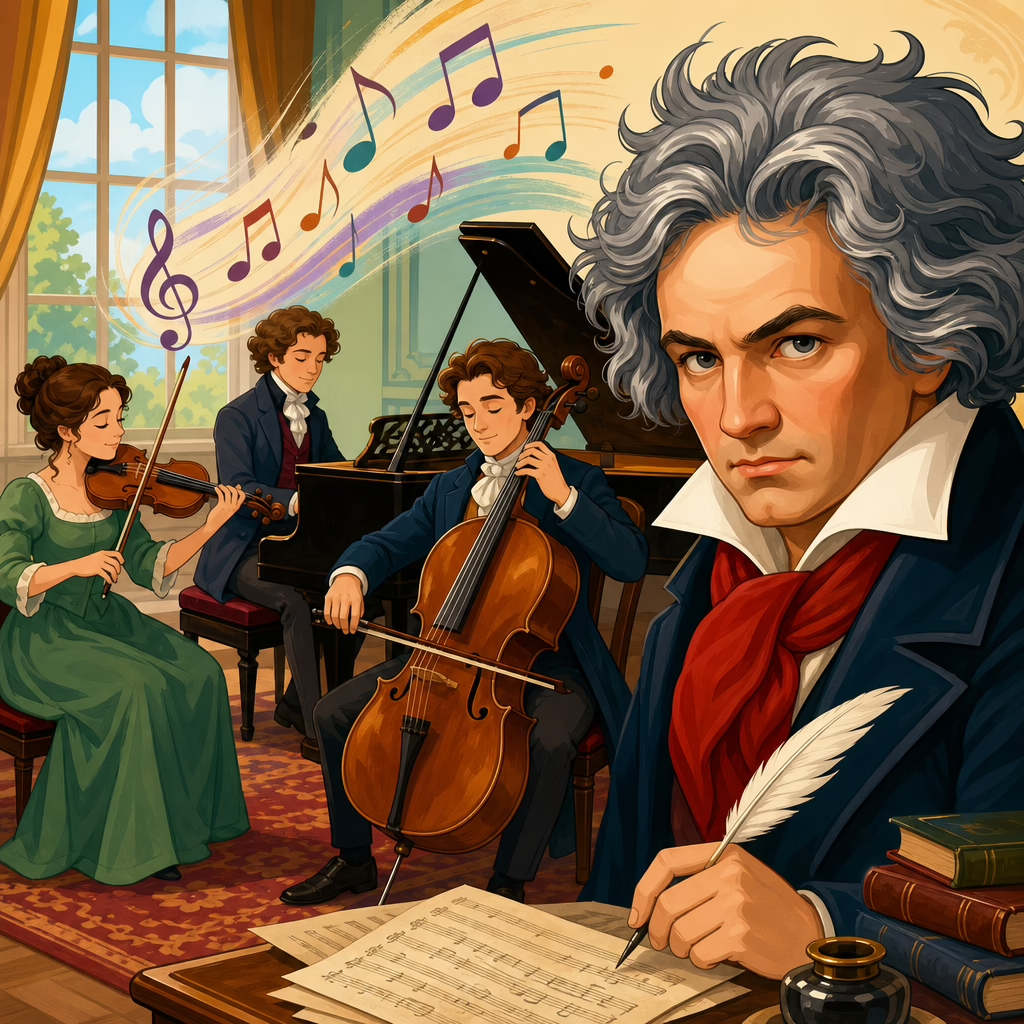
Beethoven and the Development of the Piano Trio Form
Beethoven transformed the piano trio from an elegant salon genre into one of the central vehicles of serious chamber music, and that development can be traced across his entire career. A piano trio, in standard Classical usage, is a work for piano, violin, and cello, but that simple scoring hides a long history of changing balance, texture, and formal ambition. Before Beethoven, many keyboard trios still treated the string parts as optional reinforcement, especially the cello, which often doubled the left hand. By the end of Beethoven’s output, the genre had become a forum for symphonic argument, intimate conversation, motivic concentration, and bold experiment. For anyone studying Beethoven’s chamber music, the piano trios are a crucial hub because they connect his early Classical inheritance, his middle-period expansion of scale, and his late concern with compression, memory, and expressive depth. They also illuminate related topics across this subfield: publication strategy, patronage, domestic music making, performance practice, variation technique, cyclic thinking, and the changing role of the piano itself in Viennese musical life.
I have worked through these pieces with players and scores often enough to know that their reputation as “early Beethoven” can be misleading. Even the first published trios show a composer testing how far inherited forms can stretch. The development of the piano trio form in Beethoven is not a straight line from simple to complex. It is better understood as a series of decisive redefinitions: first, the elevation of all three instruments into active participants; second, the enlargement of formal and emotional scale; third, the integration of variation, scherzo writing, and dramatic tonal planning into the genre. The key works are the Op. 1 set, the Trio in E-flat major Op. 70 No. 2, the famous “Ghost” Trio Op. 70 No. 1, and the expansive Archduke Trio Op. 97, with the early WoO 38 and the Variations Op. 44 providing important context. Together they show how Beethoven used the piano trio not as a minor side path but as a laboratory for chamber music innovation.
From accompaniment genre to serious chamber dialogue
To understand Beethoven’s achievement, it helps to start with the late eighteenth-century trio tradition he inherited from Haydn, Mozart, C. P. E. Bach, and lesser-known Viennese and London composers. In much keyboard chamber music of the 1760s through the 1780s, the piano dominated because buyers were often skilled amateur keyboard players in domestic settings. The violin might add melodic doubling or complementary lines, while the cello frequently reinforced bass notes already present in the keyboard part. Haydn’s later trios deepened the interplay and greatly enriched the genre, but even there the center of gravity often remained the keyboard. Mozart brought greater equality and expressive nuance, especially in works such as K. 496 and K. 542, yet the historical starting point was still a keyboard-led ensemble rather than the fully conversational medium Beethoven would build.
Beethoven absorbed these models and immediately pushed against them. In rehearsal and analysis, what stands out is not merely thicker texture or louder dynamics but a new insistence that thematic work belongs to the ensemble as a collective. Violin and cello are not decorative extensions of the piano; they become agents of argument. This matters because the piano trio sits at a structural crossroads in Beethoven’s output. It borrows the intimacy and contrapuntal responsiveness of the string quartet while retaining the harmonic weight and orchestral potential of the piano. As Beethoven’s pianos gained power and range, and as his own keyboard style became more forceful, he turned the trio into a place where chamber music could sustain public, almost symphonic seriousness without losing conversational detail.
Op. 1 and Beethoven’s public breakthrough
Beethoven’s three Piano Trios Op. 1, published in 1795 and dedicated to Prince Karl Lichnowsky, were his first major opus and a carefully managed public statement. They were introduced in aristocratic circles in Vienna, where Beethoven’s reputation as pianist and improviser was already growing. Haydn reportedly had reservations about publishing the C minor Trio, Op. 1 No. 3, perhaps because of its unusual boldness. Whether the anecdote is embellished or not, it captures something real: these trios announced a composer who understood convention and was already prepared to exceed it.
All three works expand the weight of the genre. They use four-movement plans instead of the more common three-movement layout associated with many earlier piano trios, importing symphonic breadth. The opening movements are not perfunctory sonata forms but tightly argued structures with strong contrasts and developmental energy. Slow movements become expressive centers rather than polite interludes. Finales are not merely light dismissals; they complete the dramatic profile. Most important, Beethoven redistributes function. The cello acquires independent melodic and rhythmic identity, and the violin participates in motivic exchange instead of hovering above the keyboard texture.
The differences among the three Op. 1 trios also show Beethoven thinking compositionally about character and market position. The E-flat major Op. 1 No. 1 opens with poised assurance, but its development sections already favor motivic logic over surface charm. The G major Op. 1 No. 2 is witty and agile, showing how Beethoven could energize a lighter tonal world through rhythmic play. The C minor Op. 1 No. 3 is the disruptive work: dramatic unisons, stormy drive, sharp dynamic contrasts, and a seriousness associated with the key that Beethoven would later use in the Pathétique Sonata, the Fifth Symphony, and the Coriolan Overture. In practical terms, Op. 1 redefined expectations for what audiences, patrons, and publishers could hear in a piano trio.
How Beethoven changed texture, form, and instrumental balance
Beethoven’s development of the piano trio form can be summarized through three technical advances: greater equality among instruments, denser motivic integration, and larger dramatic architecture. Equality did not mean identical roles. The piano still often carries the broadest harmonic span, but Beethoven writes with acute awareness of contrast in register, articulation, and instrumental color. He gives the cello singing lines in tenor register, uses the violin as both lyrical voice and rhythmic provocateur, and places the ensemble in constantly shifting pairings. A phrase may begin in the piano, be challenged by the violin, and resolved through the cello’s continuation. That is chamber dialogue in a modern sense.
Formally, Beethoven made the trio a site for high-level structural thinking. Developments grow longer and more consequential. Codas no longer simply confirm closure; they intensify and reinterpret earlier material. Scherzos replace or transform minuets, bringing asymmetry, propulsion, and muscular humor. Variation writing becomes more than ornamented repetition; it becomes a method for discovering latent possibilities inside a theme. These habits appear throughout his chamber music, but in the trios they are especially clear because the instrumentation is transparent enough to make every compositional decision audible.
| Work | Date | Contribution to the trio form | Example of innovation |
|---|---|---|---|
| Three Piano Trios Op. 1 | 1793–1795 | Established the trio as a major public genre | Four-movement design and stronger cello independence |
| Variations on “Ich bin der Schneider Kakadu” Op. 121a | Sketches early, completed later | Showed Beethoven’s dramatic use of variation form in trio texture | Weighty introduction before a comic tune |
| Six Variations Op. 44 | 1792 | Demonstrated ensemble color within variation technique | Character changes assigned across all three instruments |
| “Ghost” Trio Op. 70 No. 1 | 1808 | Brought large-scale drama and atmospheric innovation | Largo assai with eerie tremolos and remote harmonic tension |
| Trio in E-flat major Op. 70 No. 2 | 1808 | Expanded tonal subtlety and integrated lyric breadth | Complex transitions and unusually spacious middle movements |
| Archduke Trio Op. 97 | 1811 | Crowned the genre with symphonic scope and mature balance | Vast opening movement and profound variation slow movement |
Middle-period expansion: Op. 70 and the “Ghost” Trio
By 1808 Beethoven had already altered nearly every genre he touched, and the two trios of Op. 70 show the piano trio entering his middle-period world of scale, risk, and concentrated thematic work. These pieces were dedicated to Countess Marie Erdődy, one of Beethoven’s important patrons, and they belong to the same broad creative environment as the Fifth and Sixth Symphonies, the “Appassionata,” and the Razumovsky Quartets. That context matters because the trios now think on a larger dramatic horizon.
The D major Trio Op. 70 No. 1, nicknamed the “Ghost” Trio, is the more famous work because of its extraordinary second movement, Largo assai ed espressivo. Contemporary and later listeners associated its hushed tremolos, sparse melodic fragments, and uncanny harmonic atmosphere with ghostly or supernatural imagery. The nickname is not Beethoven’s, but it captures the movement’s effect. The sound world is radical for chamber music of its day: suspended time, unstable tonal direction, and an orchestral imagination reduced to three players. This is not a decorative slow movement. It creates psychological space on a scale comparable to Beethoven’s most daring orchestral writing.
The outer movements are equally important for the history of the form. The first movement combines breadth with motivic compression, while the finale releases tension through kinetic motion without trivializing what came before. In performance, the challenge is maintaining continuity between sharply differentiated sections; Beethoven’s writing assumes that contrast itself can generate unity. The companion work, Op. 70 No. 2 in E-flat major, is sometimes overshadowed, but it is essential to understanding Beethoven’s development. It is more elusive, more tonally exploratory, and less obviously theatrical. Its strengths lie in subtle transition, flexible phrase structure, and a highly refined sharing of material. If the “Ghost” Trio proves that the form can sustain extreme atmosphere, Op. 70 No. 2 proves that it can also support mature ambiguity and large-scale lyrical argument.
Variation, miscellaneous works, and the wider hub of the subtopic
A sub-pillar hub on Beethoven’s chamber music should not treat the canonical numbered trios in isolation. The miscellaneous works around them reveal how Beethoven tested the genre’s boundaries in less discussed formats. The Twelve Variations in E-flat major on “Ich bin der Schneider Kakadu,” Op. 121a, are especially revealing. Although published late, the work draws on earlier material and displays Beethoven’s delight in setting a comic tune against unexpectedly weighty framing. The solemn introduction changes the listener’s expectations before the theme even arrives. Then each variation explores new rhythmic profiles, textures, and instrumental relationships. This is a reminder that Beethoven’s trio writing developed not only through sonata-form masterpieces but also through variation cycles where character transformation becomes the main compositional engine.
The Fourteen Variations in E-flat major, Op. 44, on a theme from Dittersdorf, belong to Beethoven’s Bonn and early Vienna period and are often omitted from broad surveys. That is a mistake. They show him learning how to distribute interest across the ensemble and how to shape a sequence so that contrast accumulates rather than merely alternates. The youthful Trio in E-flat major, WoO 38, composed in 1790 or 1791, is another useful document. It still reflects Mozartian and Haydnesque precedent, yet one can already hear Beethoven probing denser textures and stronger transitions. For teachers, performers, and listeners using this page as a hub, these miscellaneous pieces matter because they fill in process. They show the workshop, not just the monuments, and they connect directly to related articles on Beethoven’s variation technique, early style, chamber genres, and publication history.
The Archduke Trio and Beethoven’s lasting legacy
The Trio in B-flat major Op. 97, known as the Archduke Trio after its dedicatee Archduke Rudolph, stands as Beethoven’s supreme statement in the genre. Completed in 1811, it belongs to the period after the “middle heroic” breakthrough but before the final late-style compression of the last quartets. Its scale is vast, yet its manner is not confrontational in the way of the C minor Op. 1 No. 3 or the “Ghost” slow movement. Instead, it projects spacious confidence, radiant sonority, and a remarkable calm command of form. The opening Allegro moderato unfolds with symphonic breadth, but every measure remains idiomatic for chamber music because the instrumental exchange is clear and breathable. Beethoven does not force grandeur onto the ensemble; he lets grandeur emerge from perfectly judged proportional writing.
The slow movement, a set of variations, is central to the work’s status and to Beethoven’s contribution to the trio form overall. Here variation becomes a path to transcendence. Each transformation deepens the theme’s expressive identity rather than disguising it. The scherzo brings rhythmic vitality and structural relief, and the finale links introspection to renewal through an expansive, finely controlled return to motion. Historically, the Archduke Trio also marks Beethoven’s final public appearance as pianist in 1814, a performance reportedly compromised by his advancing deafness. That moment gives the piece biographical resonance, but its importance goes beyond biography. Later composers inherited from Beethoven the idea that the piano trio could bear the same artistic seriousness as a quartet or symphony. Schubert, Mendelssohn, Schumann, Brahms, Dvořák, and Tchaikovsky all worked in a landscape Beethoven had redefined.
The main lesson is clear: Beethoven did not simply improve an existing genre; he rebuilt its premises. He gave the cello a true voice, made thematic development the core of ensemble conversation, expanded formal scale, and proved that the piano trio could carry wit, tragedy, mystery, and philosophical breadth. The miscellaneous works enrich that story by showing experimentation in variation form, early stylistic testing, and the practical contexts in which these pieces circulated. If you are exploring Beethoven’s chamber music, use the trios as a central map. Start with Op. 1, hear the leap to Op. 70, then live with the Archduke. From there, follow the surrounding variation works and related chamber pieces to understand how one composer permanently changed what three instruments could say together.
Frequently Asked Questions
What is a piano trio, and how was the genre typically understood before Beethoven?
A piano trio is traditionally a chamber work scored for piano, violin, and cello. In the later eighteenth century, however, that seemingly balanced three-part format often worked very differently in practice from what modern listeners expect. Many early keyboard trios were essentially piano sonatas with string accompaniment, meaning that the piano carried most of the thematic material, harmonic direction, and structural weight, while the violin often doubled or lightly embellished the keyboard line and the cello reinforced the bass. In some cases, publishers even treated the string parts as optional, which tells us a great deal about the genre’s social role and musical priorities before Beethoven’s intervention.
This earlier kind of trio belonged largely to the world of domestic music-making and aristocratic salon culture. It was elegant, refined, and often charming, but it was not always conceived as the most ambitious form of chamber composition. Composers such as Haydn and Mozart certainly elevated the medium, and both wrote works that moved well beyond mere accompaniment patterns. Even so, the inherited convention still tended to privilege the keyboard, especially because keyboard players often led these performances and because the fortepiano was increasingly central to musical life.
What Beethoven inherited, then, was a genre with real potential but an uneven history of instrumental equality. He did not invent the piano trio, nor was he the first to write serious works for the combination. What he did was push the medium toward a far more integrated conception, one in which violin and cello became indispensable partners in musical argument. Across his career, he helped transform the trio from a polite entertainment into a vehicle for large-scale structure, motivic development, dramatic contrast, and profound expressive range. That shift is one of the key reasons the piano trio became such an important chamber genre in the nineteenth century and beyond.
How did Beethoven change the role of the violin and cello in the piano trio?
One of Beethoven’s most important contributions to the piano trio was the rebalancing of the ensemble. In earlier works from the broader Classical tradition, the cello frequently served as a bass-line support, often doubling the left hand of the piano, while the violin might add melodic brightness without fully sharing in the structural argument. Beethoven increasingly resisted that hierarchy. He gave the strings more independent material, more conversational agency, and more responsibility in shaping the musical narrative.
This change can already be heard in his early trios, especially the Op. 1 set, where the parts are more animated, individualized, and dramatically responsive than many listeners would have expected from the genre at the time. Beethoven was clearly aware that chamber music could be built not just on decorative accompaniment but on genuine exchange. Themes pass between instruments, textures become more dialogic, and contrasts arise from interaction rather than from keyboard display alone. The cello, in particular, starts to emerge as something more than harmonic grounding. It participates melodically, helps articulate formal transitions, and contributes to the rhetorical force of the music.
As Beethoven matured, this equality became even more consequential. The point was not simply to distribute notes more fairly; it was to reconceive the trio as a site of shared thought. Each instrument could introduce ideas, challenge another line, intensify a climax, or help transform a motive through development. That kind of interdependence made the ensemble dramatically richer. It also changed the listener’s experience: instead of hearing a pianist supported by strings, one increasingly hears three players engaged in a serious musical conversation. That conversational ideal became foundational for later chamber music, and Beethoven’s trios played a major role in establishing it.
Why are Beethoven’s Op. 1 piano trios considered so important in the history of the genre?
Beethoven’s three Piano Trios, Op. 1, are often regarded as a landmark because they announced, from the very beginning of his published career, that he intended to treat the genre with unusual seriousness and ambition. These works were not casual apprentice pieces. They were crafted as bold public statements, and Beethoven chose to publish them as his first official opus number, which in itself suggests the importance he attached to them. In these trios, listeners encounter a young composer already expanding the scale, emotional range, and technical demands of the medium.
What makes Op. 1 so striking is the combination of Classical inheritance and Beethovenian force. The works still operate within recognizable formal norms, but they stretch those norms through greater dynamic contrast, stronger thematic definition, sharper motivic work, and a more assertive sense of dramatic architecture. The famous C minor Trio, Op. 1 No. 3, is especially significant because it points toward Beethoven’s lifelong fascination with tension, conflict, and tonal drama. Contemporary listeners reportedly found it unusually bold, and it helped establish Beethoven as a composer willing to test the limits of accepted style.
Just as importantly, the Op. 1 trios show Beethoven treating the piano trio as a medium worthy of sustained compositional thought. These are not miniature entertainments; they are extended chamber works with weight, direction, and individuality. The instrumental writing is more integrated than in many earlier examples, and the formal designs suggest that the trio could support the same kind of serious musical discourse that audiences associated with more prestigious genres. In that sense, Op. 1 does not merely represent a successful debut. It marks a turning point in the history of the piano trio by demonstrating how much expressive and structural depth the form could sustain.
How can Beethoven’s development of the piano trio form be traced across his career?
One of the most fascinating aspects of Beethoven’s output is that his piano trios provide a kind of compressed history of his artistic growth. His early works, including the Op. 1 trios, show him absorbing and intensifying Classical models. They are energetic, sharply profiled, and more ambitious than much earlier repertoire in the genre, yet they still retain strong ties to the styles of Haydn and Mozart. Even at this stage, however, Beethoven is already testing how far the trio can go in terms of scale, texture, and dramatic momentum.
In the middle period, the genre becomes even more expansive and expressive. Works such as the “Ghost” Trio, Op. 70 No. 1, reveal Beethoven using the ensemble for a broader emotional spectrum and a heightened sense of atmosphere. The famous slow movement of that trio is particularly revealing because it shows that the piano trio could sustain mystery, tension, and almost orchestral breadth without losing its chamber character. The “Archduke” Trio, Op. 97, then represents another stage altogether: grand, spacious, noble, and masterfully integrated, it stands as one of the supreme achievements in all chamber music. Here the trio is fully established as a major form capable of symphonic breadth while preserving intimacy and transparency.
Tracing these works across Beethoven’s career shows more than stylistic change. It reveals a persistent rethinking of what chamber music could do. The ensemble becomes more equal, the formal arguments more organic, the textures more varied, and the expressive aims more profound. Beethoven’s piano trios effectively map the movement from inherited Classical decorum to a new conception of chamber music as intellectually rigorous, emotionally searching, and structurally monumental. That is why they are so valuable not only as individual masterpieces but also as milestones in the evolution of the form itself.
Why does Beethoven’s work in the piano trio matter for later chamber music composers?
Beethoven’s impact on the piano trio reverberated far beyond his own lifetime because he helped define the genre as one of the most serious and artistically demanding forms of chamber music. Later composers inherited not just a scoring pattern but a new set of expectations. After Beethoven, a piano trio could no longer be dismissed as merely refined domestic entertainment. It had become a form in which composers might tackle large-scale design, deep emotional expression, intricate motivic argument, and genuine instrumental equality. That redefinition shaped the ambitions of the entire nineteenth century.
Composers such as Schubert, Mendelssohn, Schumann, Brahms, Dvorak, and many others wrote piano trios in the shadow of Beethoven’s example. Each responded differently, but all benefited from the path he had opened. Schubert expanded lyricism and scale, Mendelssohn brought brilliance and momentum, Schumann explored poetic inwardness, and Brahms developed immense structural density and thematic integration. None of these composers simply imitated Beethoven, yet all worked within a genre whose prestige and possibilities had been fundamentally altered by him. His trios demonstrated that the medium could support both intimacy and monumentality, both conversation and confrontation.
His legacy also matters from a broader historical perspective. Beethoven’s treatment of the piano trio helped reinforce a central ideal of chamber music: that a small ensemble can sustain the same seriousness of thought as larger public forms. The emphasis on motivic development, instrumental dialogue, and formal coherence became hallmarks not only of later trios but of chamber writing more generally. For listeners today, this means that Beethoven’s piano trios are important not simply because they are beautiful works, but because they helped create the modern understanding of chamber music as a space for concentrated, searching, and profoundly collaborative musical expression.