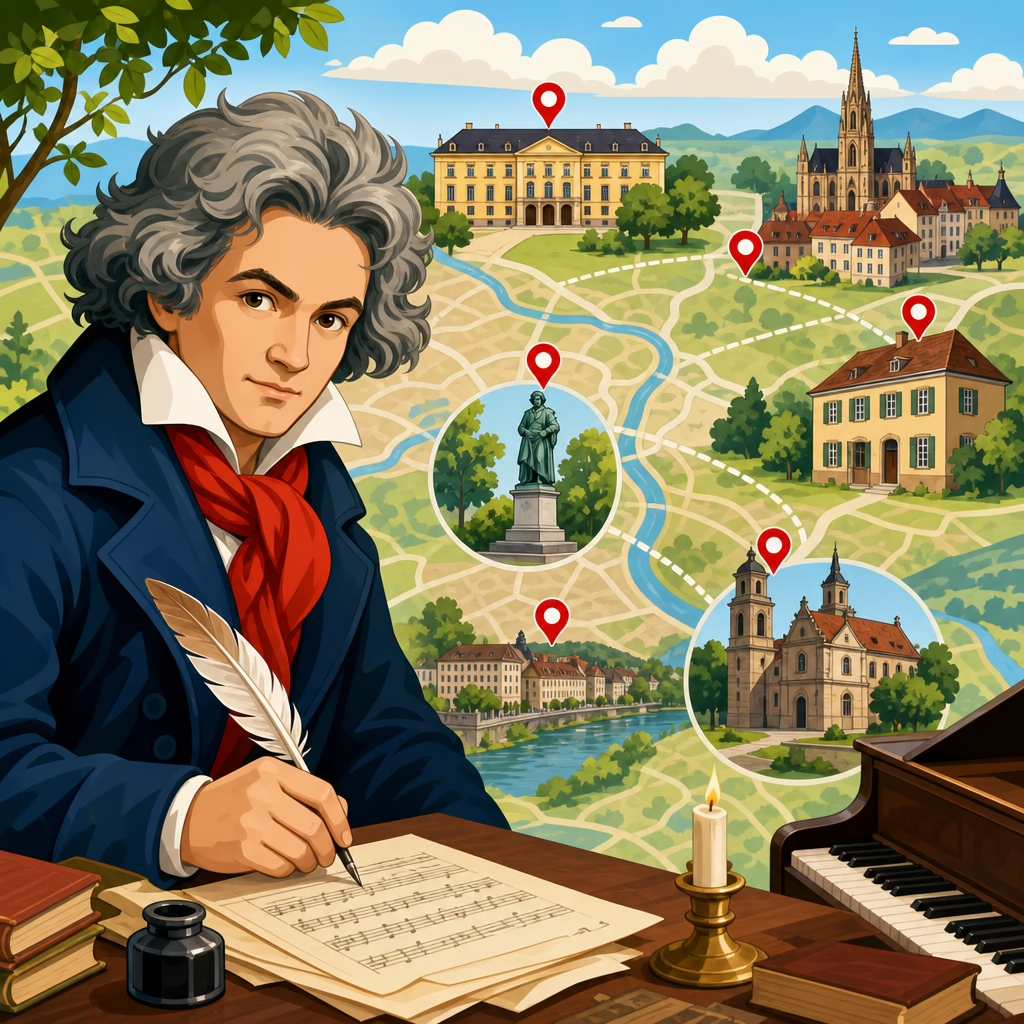
Explore Beethoven’s World Through Interactive Maps
Explore Beethoven’s world through interactive maps and a familiar composer becomes a living presence moving across streets, courts, theaters, churches, and salons. For a multimedia gallery, maps do more than decorate a page: they organize biography, music history, and place into one navigable experience that helps readers see how Ludwig van Beethoven’s life unfolded in Bonn, Vienna, and across the wider Habsburg world. In practical terms, an interactive map is a digital layer built from geolocated points, archival images, timelines, audio excerpts, and explanatory notes. Instead of reading a list of addresses, visitors can click a palace, apartment, or concert hall and immediately understand what happened there, when it mattered, and why it changed Beethoven’s career. That combination is especially valuable for a miscellaneous hub page, because Beethoven’s story cuts across travel, education, patronage, performance, publishing, health, and memory.
I have worked on cultural heritage content where a single well-designed map solved a basic problem: readers knew the famous works but could not connect them to actual places. With Beethoven, that gap is even larger because the mythology often overwhelms the geography. People know the image of the stormy genius, yet fewer can identify the Bonn court environment that shaped his early training, the Viennese neighborhoods where he rented rooms, or the spa towns and country retreats associated with the “Heiligenstadt Testament” and later composition. Interactive maps correct that by grounding abstract history in physical context. They also serve different kinds of users at once: students need orientation, travelers want routes, teachers need visual aids, and researchers benefit from linked sources and standardized place names.
This hub article covers the miscellaneous side of Beethoven mapping comprehensively by showing what to include, how to interpret locations, and how maps connect to the broader multimedia gallery. It explains the core places in Beethoven’s life, the kinds of archival materials that enrich a map, the best digital features for usability, and the limitations that responsible editors should acknowledge. If you want one page that points to every related article in this subtopic, start here. A strong Beethoven interactive map does not merely answer where he lived. It reveals how mobility, patronage networks, performance venues, and urban change shaped the music itself.
Why Interactive Maps Transform Beethoven Biography
A static biography usually moves year by year, but an interactive map lets readers understand Beethoven spatially. That matters because place was not incidental to his development. Born in Bonn in 1770, Beethoven grew up within the orbit of the Elector of Cologne’s court, where church music, theater, and aristocratic patronage created professional pathways for gifted musicians. When readers can see the compact relationship among the court chapel, rehearsal spaces, residences, and teaching sites, they understand that his early career was built within an institutional ecosystem, not in isolation. The move to Vienna in the early 1790s then appears not as a romantic leap, but as a calculated shift into Europe’s most competitive musical capital.
Maps also clarify chronology. Beethoven occupied multiple lodgings in Vienna and its suburbs, sometimes changing residences frequently because of finances, landlords, health concerns, or seasonal habits. Without a map, those addresses blur together. With a map, patterns emerge: proximity to patrons, distance from publishers, movement toward quieter districts as his hearing deteriorated, and regular retreat to semi-rural areas for recovery and work. Readers can link a point on the map to a date, manuscript image, or work list and quickly understand context. That is the difference between memorizing facts and recognizing historical structure.
Another advantage is that maps support layered interpretation. A basic user may only need “Where was Beethoven born?” A more advanced visitor may ask, “Which residences overlap with the composition of the Eroica Symphony, Fidelio revisions, or late string quartets?” A strong map answers both by stacking simple and advanced information in the same interface. In my experience, this layered design lowers the barrier for newcomers without flattening nuance for serious readers.
Core Locations Every Beethoven Map Should Include
The foundation of any Beethoven hub is a carefully chosen set of locations tied to verifiable events. Bonn comes first. Beethoven-Haus marks the birthplace tradition and anchors discussion of his family background, though editors should distinguish clearly between commemorative presentation and strictly documentary claims. The Bonn court environment, including sites associated with Christian Gottlob Neefe, the court organ, and theatrical life, explains how the young Beethoven learned keyboard playing, composition, continuo practice, and professional discipline. These are not side notes; they are the infrastructure of his early identity.
Vienna is the indispensable second center. Any serious map should include the Theater an der Wien, where Beethoven was connected to important performances and to the long history of Fidelio. It should also identify residences linked to major creative periods, even when certainty varies. The Pasqualati House is among the most famous because of its association with several works and because later memory culture fixed it firmly in Beethoven tourism. Heiligenstadt belongs on every map because the 1802 testament written there illuminates the crisis around his hearing loss and the resolve that followed. Döbling and Baden matter for similar reasons: they show Beethoven’s pattern of seeking healthier air and quieter working conditions outside the urban core.
Performance and patronage sites are equally important. Palaces associated with patrons such as Prince Lichnowsky and Archduke Rudolph help explain how Beethoven financed his career outside stable court employment. Churches and concert venues reveal the public side of his work, from sacred music to benefit academies. Cemeteries and memorial sites, including central places tied to his funeral and later remembrance, complete the story by showing how rapidly his reputation entered public culture. A map that ignores memorial geography misses how Beethoven became Beethoven.
| Location | Why It Matters | Best Map Layer |
|---|---|---|
| Bonn | Birthplace tradition, court training, early network | Family, education, court music |
| Vienna city center | Publishing, patrons, concerts, residences | Timeline of lodgings and premieres |
| Heiligenstadt | Hearing crisis and 1802 testament | Health, letters, turning points |
| Theater an der Wien | Opera history and major performances | Performance venues |
| Baden | Seasonal retreat and late-period work | Summer residences, sketches, wellness |
What to Attach to Each Map Point
An interactive point should never be just a pin and an address. It should answer the user’s next question immediately. The minimum useful payload includes date range, place name variants, event summary, significance, and source basis. For example, a marker for Heiligenstadt should state that Beethoven stayed there in 1802, that the village then lay outside Vienna’s dense center, that the location is tied to the “Heiligenstadt Testament,” and that this document is central evidence for his confrontation with progressive hearing loss. In one click, the user learns not only where the place is, but why music historians treat it as decisive.
Rich media then deepens the experience. Archival portraits, manuscript facsimiles, period city maps, building engravings, and short audio clips can all be attached to a single location. If the point is the Theater an der Wien, the media package might include a theater image, a concise history of the venue, a note on Fidelio revisions, and a short excerpt from the overture tradition associated with the opera. If the point is a suburban summer lodging, editors can attach sketches, letters about health, and a landscape image showing the quieter environment Beethoven sought. This multimedia structure makes the map part gallery, part research guide, and part narrative engine.
Good editorial practice requires careful labeling of certainty. Some Beethoven addresses are firmly documented; others are probable or debated because house numbering systems changed, streets were renamed, and buildings were rebuilt. I have seen the best maps solve this with evidence labels such as documented, probable, commemorative, or approximate. That small distinction builds trust and prevents misleading precision.
Design Features That Make a Map Useful
The best Beethoven maps are not the ones with the most pins; they are the ones that help users find patterns quickly. Clear filters are essential. Visitors should be able to sort locations by childhood, Vienna residences, performance venues, patrons, health-related retreats, memorial sites, and works composed nearby. A timeline slider is equally valuable because Beethoven’s geography changed significantly between the Bonn years, the early Viennese ascent, the middle heroic period, and the late years. When a user moves the slider from 1792 to 1827 and sees places appear and disappear, biography becomes intelligible at a glance.
Basemap choice also matters. A contemporary street map is useful for travelers, but a historical map layer can reveal vanished walls, suburban boundaries, and old routes that modern geography conceals. Side-by-side comparison is ideal. If that is too resource intensive, include a toggle between modern and period context. Accessibility should be treated as core functionality, not polish. Every map marker needs readable text alternatives, keyboard navigation, high-contrast colors, and captions for audio. Cultural sites often overlook this, yet accessibility directly affects whether a map serves classrooms and public audiences.
Performance is another decisive factor. Large media files, autoplay audio, and crowded marker clusters can make a map frustrating on mobile devices. Use compressed images, lazy loading, concise summaries, and clustered markers that expand cleanly. Platforms such as Leaflet, Mapbox, StoryMapJS, and ArcGIS StoryMaps are commonly used because they balance visual storytelling with manageable technical overhead. The right tool depends on the collection, but the principle is fixed: the interface should disappear behind the historical insight.
How Maps Connect Beethoven’s Places to His Music
The strongest reason to explore Beethoven through interactive maps is that geography can illuminate the music without reducing it to simple biography. Place did not mechanically produce masterpieces, but it shaped working conditions, social opportunity, and emotional pressure. The map point for Heiligenstadt, for instance, should not claim that one village caused a stylistic transformation. It should state something more accurate: the 1802 crisis documented there reveals Beethoven’s awareness of his hearing loss and helps explain the determination and enlarged ambition evident in works from the following years. That is historically responsible and still meaningful.
Similar connections can be drawn across Vienna. Residences near patrons remind users that Beethoven’s independence was always negotiated, financed by subscriptions, dedications, commissions, and aristocratic support. Performance venues show the practical demands of public music making: rehearsal logistics, orchestral resources, audience expectations, and benefit concert economics. Rural retreats such as Baden help explain why late Beethoven often sought spaces where he could walk, think, and work with fewer interruptions. Even if no single address “explains” a sonata or quartet, mapped environments reveal the material conditions under which those works came into being.
This hub should therefore link outward to related articles on Beethoven’s Vienna, Bonn origins, hearing loss, patrons, concert life, manuscript culture, and memorial sites. In a multimedia gallery, the map becomes the central navigation device tying these topics together. A user can start with a single marker and move naturally into deeper essays, image collections, or audio pages. That internal structure improves discoverability and creates a coherent learning journey.
Limits, Verification, and Best Practices for a Reliable Hub
Interactive maps are powerful, but they can also create false confidence. Beethoven’s life is well documented compared with many historical figures, yet the evidence is still uneven. Letters survive selectively. Property records can be ambiguous. Modern commemorative sites sometimes sit near, rather than exactly on, original locations. Buildings were demolished, renumbered, or rebuilt after wars and redevelopment. A trustworthy hub should say this plainly. Precision should reflect sources, not design ambition.
Verification works best when editors rely on multiple source types: critical biographies, catalogues, manuscript studies, local archives, museum records, and historical cartography. For music history, the New Grove tradition, scholarly Beethoven biographies, municipal archives in Bonn and Vienna, and museum documentation offer strong foundations. Where disputes remain, note them in concise language rather than hiding them. Readers respect transparency, especially when a site carries heavy symbolic meaning.
The practical takeaway is simple. If you are building or using a Beethoven interactive map, look for documented locations, layered media, date controls, historical context, and visible sourcing. Those features turn a map from a novelty into an educational tool. Explore the linked articles in this miscellaneous hub, compare places across Beethoven’s career, and use the map as your guide to the wider multimedia gallery. When geography, documents, and music are presented together, Beethoven’s world stops feeling distant and starts feeling navigable, human, and vividly real.
Frequently Asked Questions
What can interactive maps reveal about Beethoven’s life that a traditional biography cannot?
Interactive maps make Beethoven’s biography spatial, which changes how readers understand his life and work. A conventional biography usually presents events in chronological order, guiding readers from Bonn to Vienna and through major milestones such as his early education, aristocratic patronage, public performances, and late creative achievements. An interactive map adds another dimension by showing where those events happened in relation to one another. Instead of simply reading that Beethoven studied, performed, worshipped, socialized, and negotiated patronage in different parts of a city, readers can see those places positioned across actual streets, districts, and cultural centers.
This matters because Beethoven’s world was deeply shaped by movement through urban space. Courts, theaters, churches, salons, publishers, and private residences were not abstract categories; they were physical destinations embedded in the social geography of Bonn and Vienna. Mapping them helps readers grasp patterns that prose alone may hide, such as how close certain collaborators lived, how often Beethoven’s work intersected with elite neighborhoods, or how performance venues related to political and cultural institutions. It also helps users connect music history to daily life, showing that a composer’s career unfolded through repeated encounters with real places and local networks.
For a multimedia gallery, this approach is especially powerful because it turns Beethoven from a distant historical figure into a lived presence within a navigable environment. Readers do not just learn what happened; they explore where it happened and how places relate to one another. That spatial understanding can deepen appreciation for the social, political, and artistic contexts behind the music, making the story more immersive, memorable, and historically grounded.
Why are Bonn and Vienna so central to an interactive map of Beethoven’s world?
Bonn and Vienna are essential because they anchor the two most formative phases of Beethoven’s life. Bonn was his birthplace and the setting of his early musical and intellectual development. It was there that he encountered court culture, local religious institutions, early performance opportunities, and the educational influences that shaped him before international fame. An interactive map of Bonn can help readers trace the compact but important network of places connected to his youth, including family residences, court-related sites, churches, and spaces tied to his first public and professional experiences.
Vienna, by contrast, represents the larger and more complex environment in which Beethoven matured as a composer and became a major force in European music. In Vienna, he navigated a dense world of patrons, publishers, performers, private salons, aristocratic households, concert venues, and shifting residences. An interactive map can reveal how extensively he moved through the city and how central place was to his working life. It also helps readers understand Vienna not just as a backdrop, but as a cultural system that supported, constrained, and amplified his career.
Together, these two cities tell a story of transformation. Bonn shows Beethoven’s roots, while Vienna shows the expansion of his artistic identity. For readers, mapping both cities creates continuity between his early formation and later achievement. It becomes easier to see how local beginnings connected to imperial cultural life and how a young musician from the Rhineland entered the wider Habsburg world. That transition is one of the most compelling aspects of Beethoven’s story, and interactive maps make it visible at a glance.
How do interactive maps help explain the relationship between Beethoven’s music and the places where he lived and worked?
Interactive maps help readers understand that music history is not separate from place. Beethoven’s compositions did not emerge in a vacuum; they were shaped by the environments in which he lived, the institutions he depended on, and the people he encountered in specific locations. By linking musical works, dates, and biographical events to mapped places, a digital gallery can show how geography intersects with creativity. A residence might connect to a productive period, a theater to a premiere, a church to liturgical traditions, or an aristocratic home to patronage that enabled composition and performance.
This geographic framing is useful because it reveals the networks behind the music. Readers can see that Beethoven’s career involved constant interaction with publishers, students, noble supporters, fellow musicians, and audiences. These interactions happened across a city and sometimes across a broader political landscape. Mapping those connections helps explain how works circulated, where opportunities emerged, and how Beethoven’s professional world functioned on the ground. It also makes clear that artistic production was often tied to mobility, access, reputation, and proximity to influential institutions.
In a multimedia setting, the map can do even more by connecting places to audio excerpts, manuscript images, timelines, and historical notes. That layered approach allows readers to move seamlessly from geography to biography to music. Instead of reading about a composition in isolation, they can encounter it as part of a web of relationships anchored in real places. This creates a richer understanding of Beethoven’s world and gives audiences a more concrete sense of how artistic life unfolded in his era.
What features make an interactive Beethoven map useful for readers in a multimedia gallery?
A strong interactive Beethoven map should do more than display pins on a city plan. Its real value comes from how effectively it organizes complex historical material into a clear, engaging experience. Readers benefit most when the map allows them to filter locations by theme, such as residences, performance venues, churches, patron households, publishing sites, or places linked to specific compositions. This kind of structure turns the map into a research and storytelling tool rather than a decorative add-on.
Clickable location entries are also important. Each mapped point should ideally open to concise but informative content that explains why the place matters in Beethoven’s life. The best galleries enrich these entries with historical images, dates, short narratives, and links to related media such as letters, score excerpts, portraits, or recordings. A timeline layer can be especially helpful because it allows users to see not only where Beethoven was connected to a place, but also when that connection mattered. This reinforces the relationship between movement, chronology, and creative development.
Usability matters just as much as content depth. A useful map should be intuitive on both desktop and mobile devices, load efficiently, and present historical information in a way that is easy to scan without oversimplifying. Search functions, zoom controls, highlighted routes, and contextual captions all improve the experience. For a multimedia gallery focused on Beethoven, the best interactive maps balance scholarly authority with accessibility, helping casual readers and serious enthusiasts alike navigate biography, place, and music history in one coherent interface.
How does mapping Beethoven’s world across the wider Habsburg sphere deepen historical understanding?
Looking beyond Bonn and Vienna broadens the story from personal biography to regional and imperial history. Beethoven lived and worked within a world shaped by the Habsburg monarchy, aristocratic patronage, religious institutions, diplomatic networks, and cultural exchange across Central Europe. Mapping that wider sphere helps readers understand that his career was connected to more than a single city. Ideas, musicians, manuscripts, and influence moved across borders, and Beethoven’s reputation developed within that larger circulation of people and institutions.
This wider perspective is historically valuable because it situates Beethoven inside the structures that made his success possible. Patron families often had connections beyond one city. Performance culture was linked to court life, public taste, and changing political conditions. Travel routes, communication networks, and regional centers all played a role in how music spread and how composers built lasting reputations. When readers see Beethoven’s world mapped at multiple scales, they begin to understand that his life was part of a broader European cultural geography rather than an isolated sequence of local episodes.
For a digital article or gallery, this scaled approach also creates a more dynamic reading experience. Users can move from intimate city-level detail to a wider historical frame, seeing how neighborhood locations connect to imperial systems and transregional culture. That shift in perspective is one of the great strengths of interactive mapping. It allows the article to present Beethoven not only as an individual genius, but also as a figure embedded in the social, political, and geographic realities of his time.