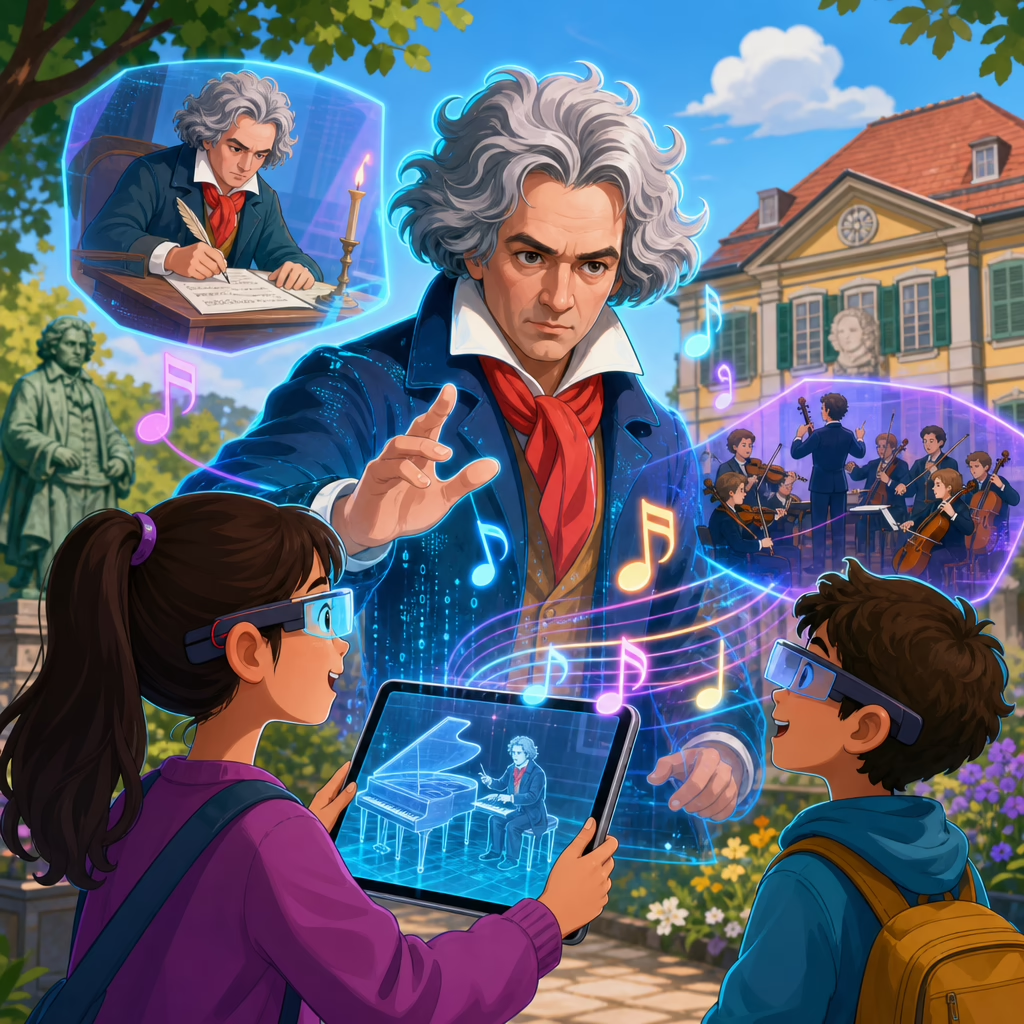
Augmented Reality Experiences Featuring Beethoven
Augmented reality experiences featuring Beethoven bring a canonical composer into contemporary media by layering digital sound, animation, text, and interaction onto real spaces, devices, and museum objects. In practice, that can mean pointing a phone at a score to see a conducting overlay, wearing smart glasses to watch a virtual Beethoven perform in a gallery, or entering a location-aware installation where fragments of the Ninth Symphony react to movement. Augmented reality, usually shortened to AR, differs from virtual reality because it does not replace the physical world; it adds context and media to it. For cultural institutions, educators, app developers, and music audiences, that difference matters. Beethoven’s life and works are already heavily interpreted through concerts, documentaries, and textbooks. AR creates a new layer of interpretation that can sit directly on top of manuscripts, statues, concert halls, classrooms, and city streets.
I have worked on multimedia interpretation projects where the hardest problem was not visual rendering but translation: how to turn dense musical history into an experience that feels immediate without becoming trivial. Beethoven is a strong subject because his music is widely recognized, his biography is dramatic, and his historical footprint is unusually well documented. He also presents a useful design challenge. Any AR experience featuring Beethoven must balance authenticity with accessibility, respect for archival sources with audience expectations, and technical novelty with musical substance. When that balance is handled well, AR can help users understand form, instrumentation, hearing loss, sketchbook development, and performance practice in ways that static labels rarely achieve.
This hub article maps the miscellaneous landscape of Beethoven AR experiences, from museum activations and education tools to tourism, performance enhancement, retail tie-ins, and experimental installations. It matters because audiences increasingly discover classical music through multimedia pathways rather than through formal concert training. Institutions also need digital formats that support both in-person and remote engagement. A strong Beethoven AR strategy can extend dwell time in exhibitions, deepen learning outcomes, create social sharing moments, and connect related content across a multimedia gallery. The most successful examples answer practical questions clearly: what users see, what they hear, what device they need, what problem the experience solves, and why Beethoven is central rather than decorative.
What counts as a Beethoven AR experience
A Beethoven AR experience is any digital layer anchored to the physical world that uses Beethoven’s music, likeness, manuscripts, places, instruments, or historical narrative as the primary content. The anchor can be marker-based, such as an image target on a program booklet, or markerless, using spatial mapping and geolocation. The interaction may be simple, like opening a 3D bust with synchronized audio commentary, or sophisticated, like real-time score following that changes overlays as an orchestra performs. In production terms, these projects are commonly built with Unity and AR Foundation, Unreal Engine, Apple ARKit, Google ARCore, WebAR platforms such as 8th Wall, or museum-specific interpretive systems integrated into native apps.
The category is broader than many people assume. It includes educational overlays on piano keyboards that teach motifs from the Fifth Symphony, urban walking tours in Bonn or Vienna that reconstruct historical sites connected to Beethoven, packaging activations for recordings and books, and concert lobby installations where visitors trigger instrument stems by approaching physical objects. It also includes accessibility-focused concepts. For example, vibration-linked visualizers can represent rhythmic structure for deaf and hard-of-hearing users, while text and gesture cues can explain how Beethoven composed after severe hearing loss. The common thread is that AR is not just decoration. It ties Beethoven content to a user’s immediate environment so the history feels situated and explorable.
Museum and exhibition uses
Museums are the most natural home for augmented reality experiences featuring Beethoven because they already manage authentic objects, contextual interpretation, and timed visitor journeys. In a Beethoven exhibition, AR can animate fragile materials that cannot be touched: sketchbooks, first editions, ear trumpets, letters, metronome markings, and portraits. A visitor scans a manuscript page and sees melodic fragments highlighted while an audio layer isolates the same passage in performance. That single interaction does three jobs at once. It preserves the object, explains compositional process, and makes notation legible to non-musicians. Curators value this because it converts specialist knowledge into direct perception.
Location-based storytelling is especially effective in gallery design. A room focused on the Eroica Symphony might place a virtual conductor beside a physical display of political documents from the Napoleonic era, showing how Beethoven’s dedication changed and why. Another room could use spatial audio to separate choir, strings, and brass in the final movement of the Ninth, allowing visitors to walk closer to each section and understand orchestration physically. Institutions such as the Beethoven-Haus Bonn, the House of Music in Vienna, and major temporary exhibitions have set a precedent for combining archival authority with digital interpretation, even when the exact interface differs from project to project.
From experience, the strongest museum executions avoid gimmicks. They load quickly, work under uneven lighting, provide captions, and keep interactions under thirty to sixty seconds unless seating is available. They also account for conservation limits and visitor flow. A magnificent AR reconstruction is pointless if ten people can use it per hour. Successful teams prototype in the gallery, test sightlines, and tune audio carefully so headphones or directional speakers preserve the surrounding exhibit atmosphere. Beethoven’s material rewards that rigor because visitors respond strongly when they can connect a real artifact to a clearly explained musical result.
Education, classrooms, and informal learning
In education, Beethoven AR works best when it clarifies concepts that students usually struggle to imagine. Form is one example. Sonata form, thematic development, and variation techniques are often taught through diagrams detached from listening. AR can place those diagrams over a classroom piano, a worksheet, or a tablet view of an orchestra and sync them to sound. Students then see where a theme returns, how a motif is transformed, and which instruments carry the argument. For younger learners, character-based narration can introduce Beethoven’s life without flattening complexity. For advanced students, overlays can compare autograph sources, editions, and tempo debates.
Informal learning environments benefit as much as formal classrooms. Libraries, family festivals, and community music programs can use lightweight WebAR so participants need only a browser and a phone. A printed poster about Beethoven’s Fifth can unlock an animation that breaks the opening motif into rhythm, contour, orchestration, and cultural afterlife in film and advertising. In piano pedagogy, keyboard overlays can guide fingering, phrase shaping, and harmonic function for beginner arrangements. Teachers appreciate AR when it supports active listening instead of replacing it. The device should direct attention back to the music, not trap students inside menus.
| Use case | Typical AR method | Main benefit | Practical limitation |
|---|---|---|---|
| Museum manuscript display | Image target recognition with synchronized audio | Makes notation and revisions understandable | Lighting and crowding can reduce scan reliability |
| Classroom music theory lesson | Tablet overlay on score or keyboard | Visualizes form, motif, and harmony in real time | Requires teacher guidance to avoid distraction |
| City walking tour | Geolocation and spatial audio | Connects Beethoven biography to place | GPS drift affects precision in dense urban areas |
| Concert companion app | Program scan and timed content triggers | Improves audience understanding before performance | Must not compete with the live event |
| Retail or publishing activation | Packaging scan with 3D animation | Creates discoverable, shareable entry points | Often shallow unless tied to substantive content |
Concerts, performances, and audience engagement
Live performance presents the most exciting and the riskiest category. A Beethoven AR layer in a concert setting can enrich understanding before the downbeat, during intermission, or in ancillary spaces without interfering with listening. For example, patrons might scan their program to view a conductor explaining the architecture of the Seventh Symphony, or use a lobby installation to hear the scherzo theme passed among sections. Some producers experiment with headset-based overlays in the hall, but this is a delicate choice. In my experience, the threshold for visual intrusion is low in classical settings, and anything that competes with eye contact, ensemble awareness, or acoustic concentration can alienate core audiences.
The more reliable model is the concert companion. An app can unlock rehearsal clips, annotated listening guides, and instrument maps tied to Beethoven’s score. During family concerts or outdoor screenings, AR can go further, adding subtitles, historical portraits, and animated thematic cues that support first-time listeners. Real-time score following is technically possible using audio fingerprinting or conductor cue systems, but it requires robust latency management and extensive rehearsal. When it works, it can show exactly where the orchestra is in the movement and identify motifs as they recur. When it fails, trust collapses immediately, so production discipline is essential.
There is also a strong case for backstage and pre-concert education. Musicians can use AR rehearsal aids to review seating plans, historical instrument differences, or articulation notes in Beethoven symphonies. Audience members can compare modern and period instrument sound through object-based audio stations. These applications may seem niche, but they solve a common problem: many people know Beethoven is important without knowing why specific performance choices change the result. AR can make those choices visible and audible in plain terms.
Tourism, public history, and city storytelling
Beethoven’s biography is tied to places, and that makes tourism a natural miscellaneous hub for augmented reality experiences featuring Beethoven. In Bonn, Vienna, Heiligenstadt, and other associated sites, AR walking tours can restore demolished buildings, label former residences, and place diary extracts or letters in context. A user standing in a square can raise a phone and see a historical reconstruction aligned with present streetscape, while spatial audio introduces excerpts connected to that period of Beethoven’s life. Done properly, this turns a passive plaque into a guided encounter with time, geography, and music.
Public history projects gain credibility when they cite source material directly. If an AR stop references the Heiligenstadt Testament, it should specify date, document context, and interpretive limits. If it recreates a first performance venue, it should distinguish between measured architectural evidence and artistic reconstruction. Those distinctions are not academic niceties; they determine whether the experience teaches users to trust the institution. City tourism boards often want shareable spectacle, but the most durable experiences combine visual appeal with precise historical framing, multilingual support, offline caching, and accessibility options for walking speed, subtitles, and route length.
Commercial partnerships can extend these tours into hotels, transit hubs, and retail. A station poster might launch a route focused on Beethoven’s final years, while a café near a heritage site could host a tabletop AR vignette about conversation books or daily routines. These small activations work when they point users toward richer content rather than trying to do everything in one interaction.
Design standards, challenges, and future opportunities
Building good Beethoven AR requires clear editorial goals and realistic technical choices. Start with the user question. Do you want to explain the opening of the Fifth, demonstrate deafness and vibration, reconstruct a salon performance, or guide visitors through a museum? That answer determines everything else: platform, fidelity, interaction length, accessibility, and asset budget. For mobile delivery, WebAR lowers friction but offers less power than native apps. For high-fidelity spatial experiences, headsets can be impressive, but hygiene, staffing, and throughput costs rise. Audio is the decisive layer. Poorly mixed or compressed Beethoven excerpts undermine the whole experience faster than imperfect visuals.
Rights and sources also matter. Beethoven’s compositions are public domain, but recordings, editions, translations, and images may not be. Manuscript photography usually involves institutional permissions. Historical claims should be checked against catalog records, critical editions, and reputable scholarship. Teams should align with museum interpretation standards, WCAG accessibility principles for digital content, and basic usability testing practices. In every project I have seen succeed, prototype testing happened early with real users: school groups, older visitors, musicians, tourists, and people with varying familiarity with classical music. Their feedback usually improves navigation, pacing, and language far more than internal debate does.
The future of this subtopic is promising because AR hardware is becoming lighter, computer vision more reliable, and spatial audio more expressive. Expect stronger mixed-reality conducting lessons, AI-assisted but curator-reviewed manuscript interpretation, and city-scale heritage layers that connect Beethoven with broader nineteenth-century networks. The opportunity is not to make Beethoven trendy for a moment. It is to use augmented reality to reveal structure, place, and human experience with greater clarity than labels alone can provide. If you manage a multimedia gallery, treat Beethoven AR as a hub topic: link exhibitions, education resources, tours, recordings, and companion guides into one discoverable ecosystem. Audit your current assets, identify the strongest story, and build the next experience around what audiences genuinely need to understand.
Frequently Asked Questions
What are augmented reality experiences featuring Beethoven?
Augmented reality experiences featuring Beethoven are digital layers added to the physical world that help audiences encounter the composer, his music, and his historical legacy in a more immersive way. Instead of only reading about Beethoven or listening to a traditional recording, users can point a smartphone or tablet at a printed score, a museum label, a sculpture, or even a concert hall seat and trigger animated visuals, synchronized sound, historical commentary, or interactive musical demonstrations. In some cases, smart glasses or headsets place a virtual Beethoven into the room, allowing visitors to see a life-sized conducting sequence, a reconstructed rehearsal scene, or a guided narrative tied to specific works such as the Fifth Symphony or the Ninth Symphony.
What makes these experiences distinctive is that they connect real environments with responsive media. A gallery installation might align a digital animation with an original manuscript, showing how a passage develops across revisions. A location-aware exhibit could react to where a visitor stands, changing orchestral balance or visual perspective as they move. Educational apps may let users isolate instrumental lines, follow thematic motifs, or visualize harmonic tension while standing in front of a historical object. In short, augmented reality transforms Beethoven from a fixed subject of study into an active, explorable presence that combines music history, performance, interpretation, and technology in a single experience.
How does augmented reality help people understand Beethoven’s music and life more clearly?
Augmented reality can make Beethoven more understandable by turning abstract musical and historical ideas into visible, interactive experiences. Many listeners know Beethoven as a towering classical composer, but they may find forms, motifs, orchestration, and historical context difficult to grasp through text alone. AR addresses that gap by showing information exactly where and when it matters. For example, an app can overlay color-coded themes onto a score as the music plays, helping users recognize recurring motives. It can animate orchestral sections in real time so viewers hear and see how strings, winds, brass, and percussion contribute to a dramatic climax. This kind of guided visualization is especially effective for newcomers who want a clear entry point into complex works.
AR also helps contextualize Beethoven’s biography and cultural importance. Instead of reading a timeline on a wall panel, visitors might see key events unfold spatially around them: Vienna’s musical world, the evolution of Beethoven’s style, his hearing loss, and the reception of landmark compositions. A museum object, such as a manuscript page or period instrument, can become the anchor for a deeper story that includes narration, archival imagery, and performance excerpts. That layering of media supports different learning styles at once. It allows users to connect music, history, place, and emotion, making Beethoven feel less distant and more human without sacrificing accuracy or scholarly depth.
What kinds of Beethoven AR experiences are available in museums, classrooms, and public spaces?
Beethoven-themed AR can appear in several formats depending on the setting and audience. In museums, the most common experiences include mobile app overlays on manuscripts, portraits, instruments, and exhibition cases. A visitor might point a device at an autograph score and watch annotations appear that explain compositional changes, performance practice, or the significance of a particular passage. Some institutions use smart-glasses-based experiences to place a virtual performer or narrator in the exhibition space, creating the impression that Beethoven’s world is being reconstructed around the viewer. These installations often combine spatial audio, archival interpretation, and animation to deepen engagement while preserving the integrity of the physical collection.
In classrooms, AR experiences often focus on music education. Students can scan handouts, textbook pages, or classroom posters to trigger demonstrations of sonata form, motif development, conducting patterns, or orchestral seating related to Beethoven’s works. Teachers may use these tools to show how a theme changes across movements or how a famous opening gesture gains meaning through repetition and variation. In public spaces, the format can be even more interactive. A location-based installation in a plaza, concert venue, or cultural district might respond to walking paths, gestures, or group movement, allowing fragments of Beethoven’s music to shift dynamically. These projects are especially effective for festivals, citywide arts events, and heritage programming because they invite participation from both dedicated classical music audiences and casual passersby.
Do augmented reality Beethoven experiences require special equipment?
Most augmented reality experiences featuring Beethoven are designed to work on devices many people already own, especially smartphones and tablets. In these cases, users simply open an app or web-based AR tool, point the camera at a recognized object or location, and view the digital content on the screen. This approach keeps the experience accessible and scalable for museums, educators, and event organizers because it reduces the need for expensive hardware. It also makes it easier to distribute Beethoven AR content beyond a single venue, allowing users to engage with printed scores, books, posters, and educational materials from home or in the classroom.
Some higher-end experiences do use specialized equipment such as smart glasses, mixed reality headsets, motion sensors, or spatial audio systems. These setups can create a more seamless and dramatic sense of presence, such as placing a virtual Beethoven in a room at true scale or enabling sound to shift naturally as the user moves. However, they are not required for the core concept to work well. The most important technical ingredients are accurate visual tracking, strong audio design, and well-structured historical or musical content. A thoughtfully designed phone-based experience can be just as meaningful as a headset installation if it presents Beethoven’s music and story clearly, responsively, and in a way that supports exploration rather than distraction.
Why are augmented reality experiences featuring Beethoven important for contemporary audiences?
These experiences matter because they help bridge the gap between canonical culture and current media habits. Beethoven remains one of the most recognized figures in Western music, but modern audiences often encounter information through interactive, visual, and mobile platforms rather than through traditional concert programs or academic essays alone. Augmented reality does not replace live performance, historical scholarship, or careful listening; instead, it creates a contemporary pathway into them. By meeting audiences on devices and in formats they already use, AR can lower barriers to entry and make Beethoven’s music feel relevant, approachable, and alive in the present.
They are also important because they expand interpretation and access. AR can support multilingual content, layered levels of explanation, adaptive navigation, and visually guided listening, making Beethoven more available to audiences with different backgrounds and levels of expertise. For institutions, this means a single exhibit or educational program can speak to children, tourists, students, scholars, and first-time classical listeners in distinct but connected ways. For the broader cultural landscape, Beethoven AR projects demonstrate how historical art can thrive in digital environments without losing depth or seriousness. When done well, they show that innovation and tradition are not opposites. They can work together to generate curiosity, emotional connection, and a richer understanding of one of music history’s most influential composers.