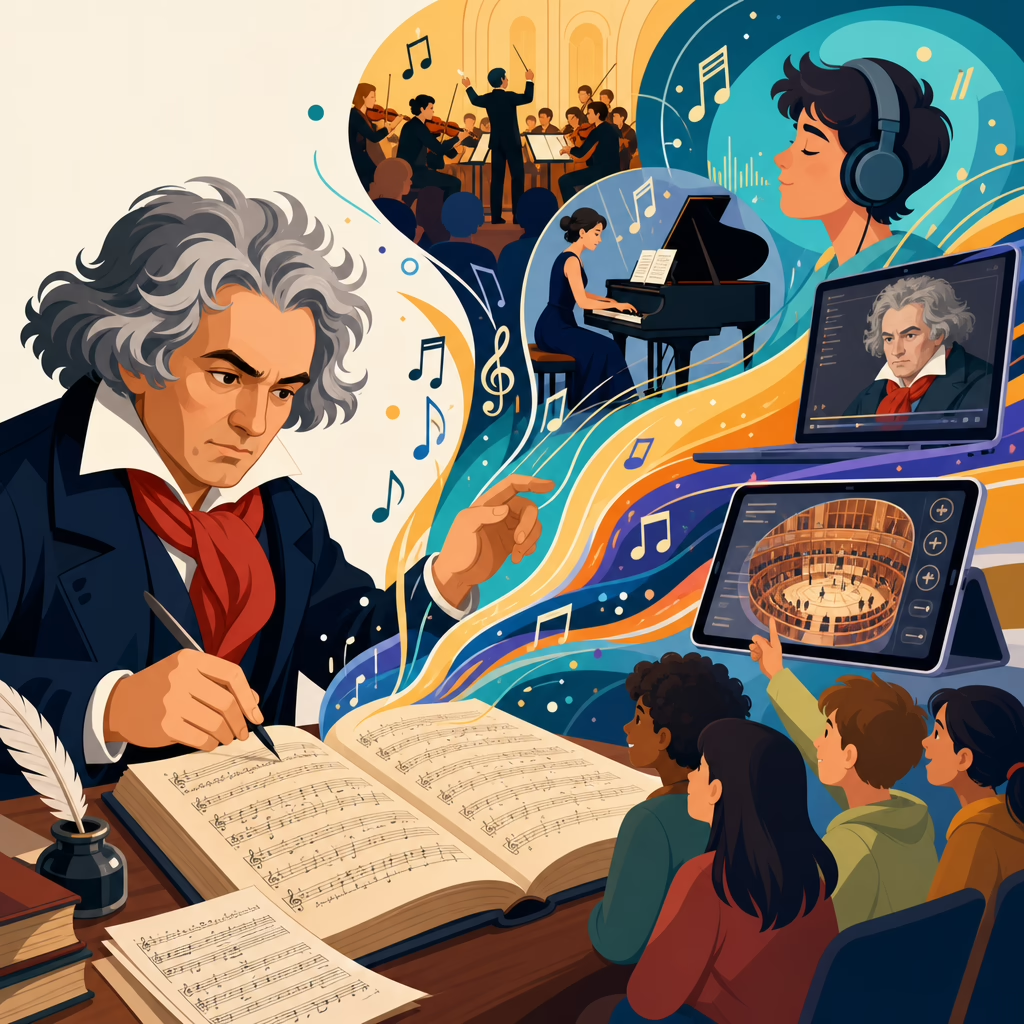
Digital Projects Bringing Beethoven’s Scores to Life
Digital projects bringing Beethoven’s scores to life are changing how musicians, students, curators, and everyday listeners encounter one of the most documented bodies of music in history. A Beethoven score is not just a set of notes on staff paper; it can include autograph manuscripts, copyists’ parts, early printed editions, sketchbooks, correspondence, premiere materials, and later scholarly corrections that explain how a work moved from idea to performance. When those materials are digitized, encoded, linked, and presented through multimedia platforms, they become searchable, playable, comparable, and teachable in ways that paper archives alone never allowed. I have worked with digital music collections and score-based exhibition pages, and the practical difference is unmistakable: a static facsimile becomes a navigable research object, and a difficult manuscript becomes a guided listening experience. That matters because Beethoven sits at the center of music education, concert programming, copyright-free publishing, and public humanities work. Digital access expands preservation, supports analysis, improves performance preparation, and gives galleries within a multimedia hub a natural bridge between image, sound, text, and interactive interpretation. For readers exploring miscellaneous resources under a multimedia gallery, Beethoven is an ideal hub subject because the field touches archives, notation software, metadata standards, IIIF image delivery, digital editions, synchronized audio, machine-readable encoding, and online pedagogy all at once.
Why Beethoven’s scores are especially suited to digital interpretation
Beethoven’s music invites digital treatment because the surviving source base is rich, layered, and often complex. Researchers regularly work across autograph pages full of revisions, sketch leaves showing motivic development, first editions containing engravers’ compromises, and later critical editions that reconcile conflicting readings. In print, comparing these materials can take days in a reading room. In a digital environment, side-by-side viewing, synchronized zoom, annotation layers, and linked commentary collapse that effort into minutes. This is particularly valuable for works with famous textual questions, such as tempo indications, articulation inconsistencies, missing dynamics, and variant endings.
The music itself also benefits from multimedia presentation. Beethoven’s scores are structurally clear enough for non-specialists to follow when guided well, yet sophisticated enough to reward expert analysis. A platform can highlight a rhythmic cell in the Fifth Symphony, then let users hear it recur across movements. It can trace thematic transformation in the Eroica, compare pedal markings in late piano sonatas, or show how the Grosse Fuge pushes notation and performance technique to their limits. That combination of accessibility and depth is rare.
Institutions have recognized this for years. The Beethoven-Haus Bonn digital collections, major library repositories, university projects, and scholarly editions all use digitization to widen access while protecting fragile originals. Their work demonstrates a simple truth: for canonical repertory with dense source traditions, digital projects do not replace live performance or print scholarship. They extend both, often making each more useful.
What kinds of digital Beethoven projects exist today
Digital Beethoven work falls into several practical categories, each serving a different audience. Archive portals focus on high-resolution facsimiles and metadata. Digital editions present edited notation with commentary, source descriptions, and variant readings. Performance-oriented tools add page turning, transposition support where relevant, rehearsal marks, and synchronized recordings. Educational exhibits combine narration, timelines, manuscript images, and listening guides for general visitors. Data-driven projects encode scores in formats such as MusicXML or MEI so that computers can compare passages, search motifs, or render notation dynamically.
In real production work, these categories often overlap. A gallery page may begin with a manuscript image, add a clean score transcription, attach an audio excerpt, and then link outward to an essay on historical context. That layered model works well in a miscellaneous multimedia hub because users enter with different intentions. A pianist may want urtext comparison. A teacher may need a classroom-friendly excerpt. A casual visitor may simply ask, “What am I looking at in Beethoven’s handwriting?” Good projects answer all three.
| Project type | Main purpose | Typical tools or standards | Example user benefit |
|---|---|---|---|
| Digital archive | Preserve and display original sources | IIIF, Dublin Core, high-resolution imaging | Zoom into revisions without handling fragile paper |
| Scholarly digital edition | Establish reliable musical text | MEI, critical apparatus, source comparison | See variant readings and editorial decisions clearly |
| Interactive score player | Connect notation with sound | MusicXML, Verovio, synchronized audio | Follow the score while listening measure by measure |
| Educational exhibit | Explain context for broad audiences | Story maps, timelines, captioned media | Understand why a manuscript page matters historically |
| Analytical dataset | Enable computational research | Encoded corpora, metadata schemas, APIs | Search recurring motifs across multiple works |
How archives, imaging, and metadata make scores usable online
The foundation of any serious Beethoven project is imaging quality and metadata discipline. A beautiful scan without reliable description is hard to discover, cite, or reuse. The strongest repositories capture color-calibrated images at preservation standards, document physical details such as paper type and watermark evidence when available, and assign stable identifiers so scholars can reference exact items. IIIF has become especially useful because it allows tiled zooming, interoperability across viewers, and image comparison between institutions. When a user can place two sonata sources side by side in a browser, digital access becomes analytical access.
Metadata is equally important. At minimum, projects need consistent fields for work title, opus or catalog number, source type, date, repository, provenance, and rights status. Better projects go further by identifying scribal hands, movement divisions, pagination irregularities, and relationships between sources. In practice, this reduces confusion around Beethoven’s notoriously complicated source history. One manuscript leaf might belong to a sketchbook, another to a later fair copy, and a third to an early printed issue. Clear metadata stops visitors from treating every image as equivalent evidence.
I have seen engagement rise sharply when repositories add plain-language descriptions beside formal catalog records. A sentence such as “This page shows Beethoven revising the opening theme repeatedly before settling on the final version” helps a newcomer orient instantly. That is not simplification; it is good interpretation built on sound archival description.
Digital editions, encoding, and the move from image to insight
Once a score is digitized, the next major step is encoding and editorial modeling. A scan shows what is on the page. An encoded edition explains musical structure in machine-readable form. Standards such as MEI and MusicXML let projects represent notes, rests, slurs, dynamics, lyrics, and layout with enough precision to support rendering, searching, and comparison. For Beethoven, that matters because many scholarly questions involve not only what appears in one source but how readings differ across sources and editions.
Digital critical editions can expose editorial judgment rather than hiding it. A printed score may compress years of source evaluation into a few symbols and a back-of-book report. A digital edition can link every disputed accent or phrase mark to source images, commentary, and rationale. That transparency is valuable for performers deciding between readings and for students learning how editing works. It also improves trust. Users can see whether an editorial intervention is based on an autograph correction, a copyist’s habit, or a later conjecture.
Encoding also enables reuse. Verovio can render MEI in the browser, allowing responsive notation that scales cleanly on phones and large screens. Music21 and similar frameworks can support analysis, motif searching, and teaching demonstrations. In other words, a Beethoven score becomes not only visible but computable. That is the point where a multimedia gallery moves beyond reproduction and starts delivering new knowledge.
Audio, video, and synchronized playback that clarify the score
Many visitors do not read notation fluently, so sound synchronization is one of the most effective ways to bring Beethoven’s scores to life. When playback tracks the cursor through each system, users begin to connect visual signs with audible results. This is useful for every level of expertise. A listener new to the Moonlight Sonata can follow the triplet accompaniment and melody placement. A conductor studying the Seventh Symphony can check how a phrase is balanced against articulation choices in performance. A student can replay a transition until the harmonic shift becomes obvious.
Well-designed projects make careful choices here. MIDI playback is acceptable for orientation, but expressive recorded audio usually serves Beethoven better because timing, articulation, and dynamic contour are central to interpretation. The strongest platforms therefore pair a reliable notated text with human performance and precise time alignment. Some use segmented clips linked to commentary, allowing a page to explain, for example, how sforzando markings differ in character from a broad crescendo or why a late quartet rhythm can sound unstable before resolving structurally.
Video adds another layer when used selectively. A pianist discussing pedaling in Op. 111, a string quartet demonstrating bowing implications, or a conservator explaining manuscript damage can turn an abstract score issue into an understandable physical and musical problem. In a miscellaneous hub, these formats broaden reach without diluting rigor.
Educational exhibits, public history, and gallery storytelling
Not every digital Beethoven project is built for specialists, and that is a strength rather than a compromise. Public-facing exhibits can frame scores as cultural objects shaped by politics, patronage, technology, and reception history. A manuscript page from the Ninth Symphony means more when viewers learn about the commission, the choral finale’s ambitions, nineteenth-century copying practices, and the modern afterlife of the “Ode to Joy.” Multimedia storytelling gives these layers room to breathe.
The most effective exhibit design follows a simple pattern: show the object, explain what to notice, connect it to sound, and place it in context. For Beethoven, this might mean presenting a sketch leaf beside a polished printed page to show how composition evolved. It might mean mapping the circulation of editions across European cities, or pairing a hearing-related letter with late-period manuscripts to address, carefully and without mythmaking, how disability intersected with creative work. These choices turn a score gallery into a narrative experience.
For a sub-pillar hub under multimedia gallery, miscellaneous coverage should include these exhibit models because they often connect users to related articles on archives, manuscript studies, digital curation, accessibility, and interactive learning. They are the connective tissue of the topic.
Challenges, limitations, and what good projects still need to improve
Digital access does not solve every Beethoven problem. Copyright may be less restrictive for the music itself, but scans, editions, commentary, and recordings can still carry rights limitations. Metadata remains inconsistent across institutions. Optical music recognition is improving, yet handwritten Beethoven manuscripts remain difficult for automated systems because of dense corrections, irregular spacing, and source damage. Even high-quality images cannot always capture paper texture, ink layering, or other physical clues as reliably as in-person examination.
There are also interpretive risks. Users may confuse a diplomatic transcription with a performance score, or assume that a polished digital rendering reflects Beethoven’s final intentions rather than one editorial pathway through conflicting evidence. Platforms need clear labeling, source notes, and version control. Accessibility deserves more attention as well. Alt text for images, keyboard navigation, captioned video, and readable contrast are not optional extras; they determine whether a gallery truly serves the public.
From experience, sustainability is the hardest issue. Grant-funded prototypes often launch impressively and then stagnate when software dependencies break or editorial maintenance ends. The strongest Beethoven projects plan for preservation from the start: open standards, documented workflows, exportable data, and institutional commitment. Without that, multimedia richness can become digital decay.
Digital projects bringing Beethoven’s scores to life succeed when they combine preservation, scholarship, usability, and storytelling in one coherent experience. High-resolution archives protect fragile sources while opening them to the world. Metadata and stable identifiers make collections discoverable and citable. Encoded editions turn manuscript evidence into searchable, transparent musical texts. Synchronized audio and video help readers hear what the notation means. Public exhibits connect the page to history, performance, and human context. Together, these approaches make Beethoven more legible without making him smaller.
For a multimedia gallery hub covering miscellaneous resources, this subject offers unusual breadth. It links manuscripts, digital libraries, music encoding, performance media, accessibility design, and educational interpretation. It also provides a practical map for further reading: users interested in archive platforms can continue into digitization and metadata articles, while performers can move into edition comparison, listening guides, or interactive score tools. That hub function is valuable because no single format explains Beethoven completely; the music lives across images, sounds, texts, and systems.
If you are building, curating, teaching with, or simply exploring digital music collections, start with one Beethoven project and test it against four questions: Can you trust the source, understand the context, hear the result, and follow the editorial reasoning? The best digital work answers yes to all four. Use that standard as your guide, and this corner of the multimedia gallery will reward close attention.
Frequently Asked Questions
What does it mean to bring Beethoven’s scores to life through digital projects?
Bringing Beethoven’s scores to life digitally means much more than scanning old pages and placing them online. It involves turning a complex historical record into something searchable, viewable, comparable, and meaningful for modern audiences. A Beethoven score can exist in many forms at once: autograph manuscripts written in his own hand, sketchbooks showing the early evolution of an idea, copyists’ parts used in rehearsal, first editions prepared for publication, annotated performance materials, and later scholarly revisions that attempt to resolve contradictions between sources. Digital projects gather these layers and present them in ways that help users understand not only what Beethoven wrote, but how a piece developed over time.
For musicians, this can mean zooming into a manuscript to examine a dynamic marking or articulation that may look different from a later printed version. For students, it can mean seeing that a famous work was not born fully formed, but emerged through experiments, revisions, and practical decisions. For curators and researchers, digital tools can connect separate documents from different archives and show relationships that were once difficult to trace. For general listeners, these projects make Beethoven more accessible by revealing the human process behind the masterpieces. In that sense, digital interpretation does not replace the original score; it expands its life by allowing more people to interact with it in historically informed and visually rich ways.
Why are Beethoven’s scores especially valuable for digitization and online access?
Beethoven’s music is among the best documented in Western classical history, which makes it uniquely suited to digital presentation. Many of his works survive in multiple source types, including drafts, autograph manuscripts, corrected proofs, first editions, correspondence with publishers, and performance-related documents. That abundance of material gives scholars and performers a rare opportunity to reconstruct how pieces changed from conception to circulation. In print-only environments, comparing those sources often requires travel, institutional access, and extensive specialist knowledge. Digitization removes many of those barriers by placing high-resolution materials and scholarly metadata into one connected environment.
Online access is valuable because Beethoven’s sources are dispersed across libraries, museums, archives, and private collections in different countries. A digital project can reunite these scattered materials virtually, allowing users to compare sources side by side without needing to physically assemble them. This is especially important when trying to understand disputed readings, performance practice questions, or editorial choices in modern editions. Digitization also helps protect fragile originals by reducing handling while still widening public access. Instead of limiting Beethoven’s documentary legacy to a small group of specialists, digital access opens it to performers preparing repertoire, teachers building lessons, students learning source criticism, and listeners who want to understand why one version of a famous passage may differ from another.
How do digital Beethoven archives help musicians, students, and researchers interpret the music more accurately?
Digital Beethoven archives improve interpretation by making the underlying evidence visible. In many cases, the score a performer buys today is the product of editorial decisions shaped by conflicting historical sources. A digital archive can show where those decisions come from. If an autograph manuscript has one articulation, a first edition shows another, and a later corrected printing introduces a third reading, users can study the chain of transmission and decide how much weight to assign each version. This kind of transparency is invaluable for performers who want to go beyond a single modern edition and engage directly with the historical record.
Students benefit because these projects teach critical reading rather than passive acceptance. Instead of seeing notation as fixed, they learn that musical texts can be unstable and historically layered. They can trace Beethoven’s revisions, observe where copyists may have introduced errors, and understand how publishers influenced what audiences eventually heard. Researchers gain even more from searchable metadata, source descriptions, provenance records, and linked correspondence that provide context for when and why changes occurred. Some digital platforms also include encoding tools, critical commentary, synchronized audio, or comparison viewers that allow users to align multiple versions of the same passage. Together, these features support a more accurate and nuanced understanding of Beethoven’s music by grounding interpretation in evidence rather than assumption.
What kinds of materials might be included in a digital project focused on Beethoven’s scores?
A strong digital Beethoven project usually includes far more than a clean score image. It may feature autograph manuscripts that preserve Beethoven’s own handwriting, sketchbooks documenting the earliest stages of composition, copyists’ manuscripts prepared for rehearsal or publication, early printed editions, publishers’ proofs with corrections, and parts used in premieres or later performances. In some cases, projects also include letters between Beethoven and publishers, notes from editors, ownership marks, catalog entries, watermarks, paper studies, and provenance documentation showing how an item moved from one collection to another. Each of these materials contributes to a fuller story of how a composition came into being and how it circulated in the musical world.
The best projects also provide interpretive infrastructure around the documents. That can include scholarly essays, source descriptions, critical reports, timelines, work histories, encoded musical text, and tools for side-by-side comparison. Some platforms integrate translations, transcriptions, thematic catalogs, and audio examples so users can connect what they see on the page to what they hear in performance. Others use high-resolution imaging so viewers can inspect erased measures, overwritten notes, or changes in ink that point to revision stages. When these components are combined, the project becomes not just a digital archive, but a research and learning environment. It helps users see Beethoven’s scores as living documents shaped by creativity, collaboration, correction, and historical transmission.
How are digital projects changing public engagement with Beethoven’s music and legacy?
Digital projects are changing public engagement by making Beethoven’s creative world less distant and more participatory. Traditionally, access to primary materials was limited to scholars and archivists working in specialized reading rooms. Now, a student, teacher, performer, or curious listener can explore manuscripts online from anywhere. That shift matters because it changes Beethoven from a remote monument of music history into a working artist whose process can be observed. Seeing crossings-out, rewritten themes, alternative passages, and practical notational adjustments reminds audiences that great works were made through effort, revision, and decision-making, not just inspiration.
These projects also support new forms of storytelling and education. Museums and libraries can build digital exhibitions around a symphony, sonata, or string quartet, showing how a piece moved from sketch to premiere to later edition. Educators can use digitized sources to teach not only music history, but also archival literacy, editing, and cultural context. Performers can share historically informed interpretations linked directly to source materials, helping audiences hear why a tempo, phrase, or articulation might differ from familiar recordings. Even casual listeners benefit from interactive access that turns Beethoven’s legacy into something visually engaging and intellectually approachable. In this way, digital initiatives do more than preserve documents; they deepen cultural understanding and invite broader audiences into the ongoing conversation about how Beethoven’s music is read, performed, and valued today.