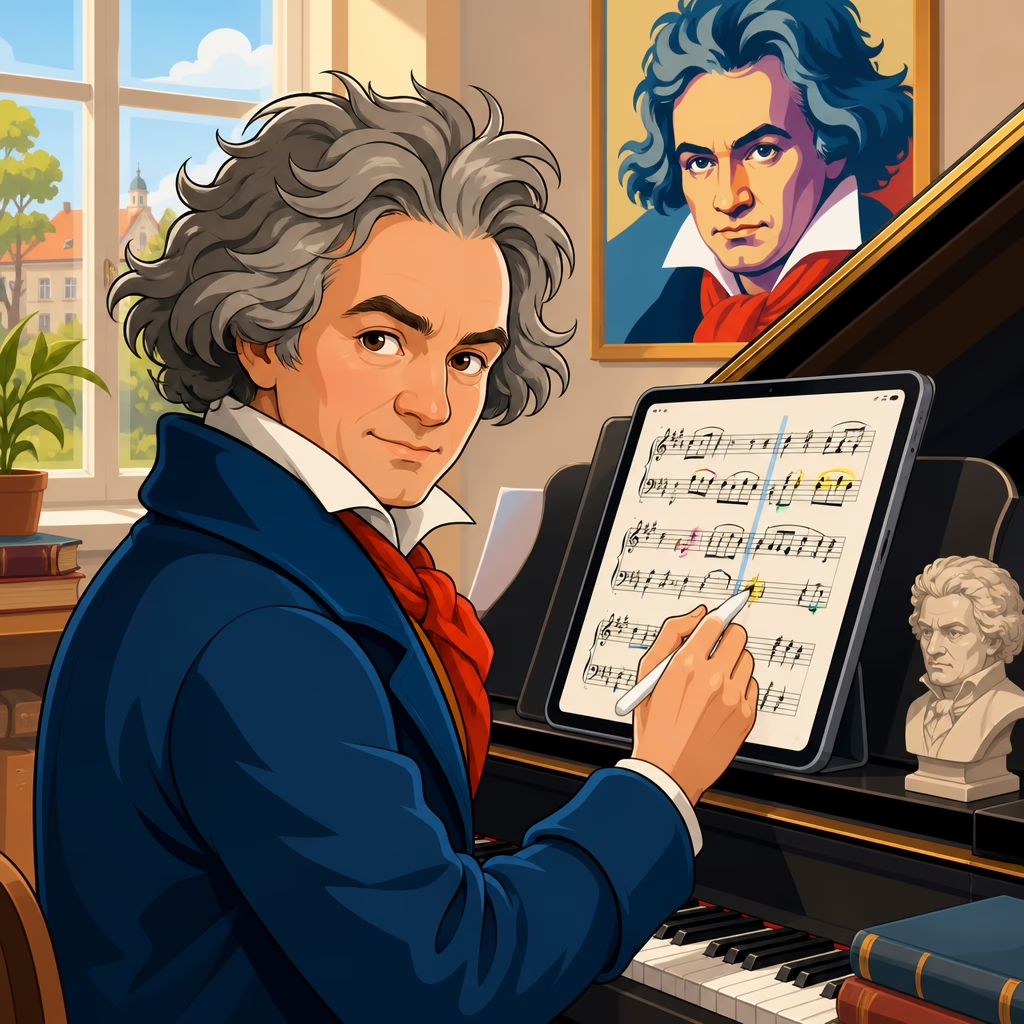
Digital Score Reading for Beethoven Performers
Digital score reading has changed how Beethoven performers prepare, annotate, compare editions, and solve technical problems, but its value depends on using the technology with a musician’s discipline rather than treating the screen as a shortcut. For pianists, string players, conductors, coaches, and scholars who work regularly with Beethoven, digital score reading means viewing, marking, organizing, and sometimes synchronizing notated music on tablets, laptops, or large displays instead of relying only on printed parts. In practice, that includes reading urtext editions in PDF form, switching between autograph facsimiles and modern editorial texts, adding layered annotations with a stylus, linking fingerings to audio references, and carrying a searchable performance library into rehearsal. I have used digital scores in chamber rehearsals, orchestral preparation, lesson studios, and archive-heavy Beethoven projects, and the central lesson is consistent: the device matters less than the reading method. Beethoven’s notation is dense with structural signals, articulation subtleties, and revision history. If a player uses a tablet merely to turn pages silently, the benefit is modest. If the player uses it to compare sources, track recurring motives, standardize bowings, and revisit difficult passages efficiently, digital score reading becomes a serious interpretive tool. That matters because Beethoven performance sits at the intersection of text, history, and physical execution, and small reading decisions shape tempo, phrasing, voicing, and character.
Unlike some repertory that tolerates loose textual habits, Beethoven exposes every weakness in score reading. A missed sf, an inconsistent slur grouping, or an overlooked rest can distort form and rhetoric. Digital reading helps because it can reduce friction around access and comparison. A performer can keep a Henle edition, a Bärenreiter edition, an old Breitkopf part, and a manuscript image in one folder, then move between them within seconds. That speed supports better questions: Is this accent editorial or original? Does the staccato appear in parallel passages? Is the dynamic really identical at the recapitulation? The answer is often in the page history. Digital reading also matters for logistics. Beethoven performers increasingly play from tablets in recital, memorize from annotated PDFs, and rehearse in mixed settings where one person uses paper and another uses forScore, Newzik, MobileSheets, or a desktop annotation setup. Used well, digital score reading improves consistency, saves time, and deepens textual awareness. Used poorly, it encourages shallow scrolling, overannotation, and dependence on zoom instead of full-page structural vision. The goal is not to replace musicianship with software. The goal is to read Beethoven more accurately, more comparatively, and more intentionally.
Why Beethoven scores benefit from digital reading
Beethoven’s works reward close comparative reading because the notation often carries interpretive instruction beyond obvious dynamics and tempo words. In the piano sonatas, for example, slur length can influence whether a gesture speaks as speech-like rhetoric or as a legato span. In the string quartets, accent placement may reveal metric tension that is easy to flatten in ensemble rehearsal. In the symphonies and overtures, parallel figures in winds and strings frequently need coordinated articulation decisions that are easier to spot when marked consistently across parts. Digital reading helps by making those relationships easier to search, layer, and revisit. A performer can duplicate a score, create one version for pure text study, another for fingerings or bowings, and a third for rehearsal notes. That separation prevents the common paper problem of one overcrowded part serving conflicting purposes.
The second advantage is source agility. Beethoven performers routinely confront multiple editions because no single publication answers every question. Urtext editions aim to present a critically informed text, but performers still benefit from checking editorial notes, early editions, and manuscript facsimiles when available. With digital files, that process is practical during daily work rather than reserved for library visits. I often compare a clean performing edition with a facsimile only for passages where articulation, beaming, or spacing appears ambiguous. That takes minutes on a tablet and often clarifies whether a phrase should be grouped by bar, by gesture, or by harmonic arrival. For players working within the broader question of analytical technology, the main pillar guide at https://lvbeethoven.com/how-ai-tools-can-help-analyze-beethoven-scores/ offers useful context, but digital score reading remains its own practical discipline centered on seeing the page better and acting on what is seen.
Choosing devices, apps, and file setups that serve performance
The best digital setup for Beethoven performance balances screen size, stylus precision, page-turn reliability, and file organization. In my experience, a 12.9-inch tablet is the minimum comfortable size for dense piano textures, quartet full scores, and orchestral reductions. Smaller screens work for single-line parts, but Beethoven’s thick notation, long systems, and frequent expressive markings reward more visible real estate. Among apps, forScore is strong for iPad-based solo and chamber use because of stable annotation, set lists, and Bluetooth pedal integration. Newzik is effective when sharing marked parts among ensembles. MobileSheets is a practical option for Android and Windows users. Desktop PDF editors such as PDF Expert, GoodNotes, or even Adobe Acrobat become useful during preparation, especially when building layered master files.
File discipline matters more than brand loyalty. Use a naming system that identifies composer, opus, movement, instrumentation, edition, and version status. A filename such as Beethoven_Op59No1_Vn1_Mvt4_Henle_Bowed_v3.pdf is far more useful than QuartetFinalNew.pdf. Keep original scans untouched, then create working copies for annotations. Back up everything in at least two locations, typically cloud plus local storage. When using Bluetooth page-turn pedals, test battery life and latency before any rehearsal. Beethoven’s transitions can be too exposed to gamble on a device handshake. I have seen players lose continuity in the slow movement of Op. 132 because a pedal slept between turns. The technology did not fail mysteriously; the setup was not stress-tested.
| Need | Best practical choice | Why it matters for Beethoven |
|---|---|---|
| Dense notation visibility | Large tablet, 12.9 inches or bigger | Reduces zooming and preserves phrase-level overview |
| Precise annotation | Active stylus with palm rejection | Supports clean fingerings, bowings, and source notes |
| Reliable page turns | Bluetooth pedal plus rehearsal testing | Avoids breaks in exposed transitions and repeats |
| Edition comparison | Layered PDFs or split-screen viewing | Makes articulation and dynamic discrepancies visible fast |
| Ensemble coordination | Shared cloud folders with version labels | Prevents conflicting markings across players |
Reading methods that improve interpretation instead of distracting from it
Effective digital score reading for Beethoven starts with a full-page pass before detailed marking. On paper, performers naturally absorb layout, system breaks, and page architecture. Screens can encourage the opposite: zoom in, chase detail, lose form. Resist that. First read each movement at a scale that shows the whole page, identifying formal pillars, harmonic arrivals, recurring motives, and unusual notation. Then create annotation layers with distinct purposes. I use one color for structure, one for articulation conflicts across sources, one for technical reminders, and one for rehearsal issues. That prevents interpretive ideas from merging with emergency fingering fixes. In Beethoven, where repeated motives evolve across a movement, this clarity is essential. If every mark looks the same, the page becomes visually noisy and less informative than print.
Another best practice is to mark only what you would be willing to defend aloud in rehearsal. Digital tools make endless annotation easy, but quantity does not equal insight. In the first movement of the “Waldstein” Sonata, for instance, it is worth marking where repeated chord patterns change registral emphasis or where pedal strategy must protect harmonic rhythm. It is usually not worth circling every obvious crescendo already visible in the score. Similarly, string players in Op. 18 or Op. 59 can benefit from highlighting slur inconsistencies between parts, because those affect ensemble speech. Marking every dynamic twice only clutters the display. Digital reading is strongest when it sharpens attention, not when it replaces the eye with colored decoration.
Comparing editions, facsimiles, and parts without losing practical focus
One of the most powerful uses of digital score reading is rapid edition comparison. Beethoven’s notational transmission can be messy because of revisions, copyist involvement, first-edition inconsistencies, and later editorial intervention. Performers do not need to become full-time textual critics, but they do need a method for deciding when a discrepancy matters. Start by identifying passages that influence execution: articulation, ties, rests, accents, dynamics, and note values in structurally exposed places. Compare those spots across two reliable modern editions, then consult editorial notes or facsimiles when the difference affects phrasing or coordination. This is especially valuable in chamber music, where one player’s editorial slur can create a false sense of unanimity if other parts derive from a different source tradition.
The practical limit is important. Not every variant deserves rehearsal time. If one edition places a cautionary accidental differently but pitch meaning is unchanged, move on. If a slur changes whether a violin line speaks in two-bar units or one continuous sweep, that is performative and should be discussed. Digital reading supports this triage because screenshots, bookmarks, and side-by-side views reduce the cost of checking. In my own Beethoven work, this has prevented several avoidable errors, especially where old parts retained legacy bowings that contradicted the text under discussion. The point is not fetishizing sources. The point is making better performance decisions with documented evidence.
Using digital scores in rehearsal, teaching, and the practice room
In rehearsal, digital score reading is most effective when it supports shared language. A quartet can agree on annotation symbols for bow distribution, subdivision warnings, and balance priorities. A pianist coaching a sonata duo can bookmark transitions where tempo relationships tend to drift. A conductor can carry a full score, critical notes, and marked rehearsal reductions in one device. These conveniences become musical advantages only when everyone can act on them quickly. Before the first rehearsal, confirm page numbers, rehearsal letters, and version dates. Nothing wastes time faster than discussing measure 143 while half the group reads a different pagination. Shared folders and version labels solve that problem better than late verbal corrections.
In teaching, digital scores make Beethoven easier to demonstrate because teachers can project enlarged passages, compare parallel phrases instantly, and save progressive annotation states. Students often understand articulation better when they see three versions of the same passage: unmarked urtext, technical markup, and stylistic markup. In the practice room, tablets are especially useful for loop-based work on coordination challenges. A pianist can isolate a difficult page, attach a short audio memo about voicing goals, and return later without recreating the problem from memory. That said, I still advise advanced students to alternate between digital and printed reading. Paper remains excellent for deep immersion away from notifications and battery concerns, while digital tools excel at revision, comparison, and organized recall.
Common mistakes and the standards that prevent them
The biggest mistake Beethoven performers make with digital scores is mistaking access for understanding. Having ten editions on a tablet does not mean the player has studied any of them carefully. The second mistake is overreliance on zoom. If you constantly enlarge details, you may solve fingering while missing phrase proportion and page-level structure. The third is annotation inflation: too many colors, arrows, and text boxes masking the notation itself. Good digital reading should leave the score more legible, not less. I recommend a fixed annotation legend, monthly file cleanup, and rehearsal copies that strip away outdated experiments. Another common failure is weak backup procedure. Devices crack, apps crash, and operating system updates create surprises. Keep offline copies and export flat PDFs after major marking sessions.
Standards from professional music libraries and edition publishers offer a useful benchmark even for private performers: preserve originals, document changes, and separate source evidence from performance decisions. That discipline protects judgment. Beethoven interpretation is rarely improved by technological novelty alone. It improves when the performer reads more carefully, compares more intelligently, and enters rehearsal with a tested, transparent system. Digital score reading can absolutely do that. It can make a performer faster, more accurate, and more responsive to the text. But the screen must remain subordinate to the score, and the score subordinate to the musical argument. Build a workflow that respects those priorities, and Beethoven’s pages become clearer, not flatter. If you perform Beethoven regularly, audit your current score-reading process this week and improve one concrete element: device setup, annotation method, or edition comparison. Small upgrades produce real musical gains.
Frequently Asked Questions
1. How does digital score reading actually help Beethoven performers in daily practice?
Digital score reading helps Beethoven performers by making the practical side of preparation faster, more flexible, and easier to organize without changing the essential musical work that still has to be done. A pianist can keep several sonata editions on one tablet and switch quickly between them when checking articulation, slurs, pedal suggestions, or editorial dynamics. A violinist or cellist can mark bowings, fingerings, cue entries, and rehearsal solutions in layers that can be revised as interpretation develops. A conductor can move between full score, reduced score, and marked rehearsal copy without carrying multiple volumes, while a coach or scholar can compare sources, annotate formal structure, and collect interpretive notes in one searchable place.
For Beethoven specifically, this is useful because his music often demands close attention to detail, revision, and structural awareness. Performers regularly need to compare urtext editions, examine phrasing across parallel passages, locate recurring rhythmic cells, and track dynamic contrasts that shape larger spans. Digital tools make that process more efficient. You can bookmark difficult transitions, color-code motivic relationships, zoom in on dense textures, and instantly return to places that need repeated technical work. In ensemble settings, digital page management can also reduce interruptions, especially when page turns in Beethoven come at awkward moments of rhythmic or expressive intensity.
That said, the real benefit is not convenience alone. Digital score reading is most valuable when it supports disciplined listening, structural analysis, and deliberate repetition. If the performer uses the device simply to scroll and glance, it becomes a distraction. If it is used to examine voice leading, compare notation choices, test fingering plans, and preserve evolving interpretive decisions, it becomes a serious professional tool. Beethoven performers gain the most when the screen serves the same depth of study that earlier generations brought to paper scores.
2. Is reading Beethoven on a screen as musically reliable as reading from a printed score?
Yes, it can be musically reliable, but only when the performer approaches the digital score with the same rigor used for printed materials. A screen does not automatically make a score better or worse. Reliability depends on edition quality, display clarity, annotation habits, and the player’s concentration. If the file is a trustworthy edition, the screen is large enough to show details comfortably, and the device is used in a stable, distraction-free way, digital reading can be every bit as serious as printed reading.
For Beethoven performers, the main concern is not the medium itself but what the medium can encourage. Screens make it easy to jump around quickly, rely on search functions, and treat notation as something to be skimmed rather than absorbed. Beethoven’s music does not reward superficial reading. His accents, rests, phrase lengths, sforzandi, registral shifts, and motivic recurrences often carry interpretive consequences far beyond the measure in which they appear. If the performer allows the speed of technology to replace close score study, important musical relationships can be missed. On the other hand, digital reading can improve reliability when it allows side-by-side edition comparison, magnification of complex passages, and carefully organized annotations that remain legible over long rehearsal periods.
Many experienced players find that the best solution is not ideological loyalty to either paper or screen, but a thoughtful combination of both. Some prefer to do first-pass structural study on paper and then move to digital materials for rehearsal efficiency. Others learn entirely on tablets but still print selected pages for intensive harmonic or formal analysis. The key point is that Beethoven interpretation depends on precision, memory, and long-range thinking. If digital reading supports those things, it is reliable. If it encourages passive consumption, it is not. The musician’s habits, not the device, determine the artistic result.
3. What should performers look for when choosing digital scores and editions of Beethoven’s music?
Performers should begin with the same standard they would use for print: source credibility comes first. Beethoven’s notation exists within a complex editorial history, and many works appear in multiple editions with meaningful differences in articulation, phrasing, dynamics, slurring, pedaling, accidentals, and even layout. A digital score is only as good as the edition behind it. For serious performance work, players should prioritize respected urtext or scholarly editions, confirm publication details, and know whether they are reading an editor’s interpretive version, a facsimile-based reproduction, or a pedagogical edition with added suggestions.
After edition quality, display usability matters a great deal. Beethoven’s music often places heavy visual demands on the reader: thick chordal writing in the piano sonatas, contrapuntal textures in late works, densely cued orchestral passages, and ensemble scores where alignment must be tracked quickly. A good digital score should remain clear at performance size, allow smooth zooming without losing orientation, and support markings that do not obscure notation. Searchable navigation, bookmarks, hyperlinking between movements or recurring passages, and the ability to duplicate a page for different annotation purposes can all be extremely useful in practice and rehearsal.
It is also wise to compare editions deliberately rather than assume that one digital file answers every question. Beethoven performers often need to inspect parallel passages across editions, check editorial footnotes, and consider whether a phrasing mark reflects source evidence or later tradition. For pianists, pedaling and articulation discrepancies can significantly affect touch and sonority. For string players, slurs and accent patterns may influence bow distribution and character. For conductors and scholars, source comparison may shape tempo relationships, rehearsal planning, and larger interpretive argument. In other words, choosing a digital score is not merely about downloading a convenient PDF. It is about building a dependable working library that supports informed artistic decisions.
4. How can digital annotation improve Beethoven interpretation without becoming cluttered or distracting?
Digital annotation improves Beethoven interpretation when it is selective, consistent, and tied to musical purpose rather than visual habit. One of the great advantages of digital score reading is that performers can create annotation layers: one for fingering, one for structural analysis, one for rehearsal notes, one for ensemble cues, and one for performance-only reminders. This allows a musician to think more clearly about what each type of marking is meant to solve. In Beethoven, that separation can be especially helpful because technical solutions, formal understanding, and expressive pacing are often closely related but not identical. A player may need one kind of note for a difficult left-hand leap, another for the return of a motive in inversion, and another for a conductor cue or breathing point.
The danger is overmarking. Because digital tools make color, symbols, and note boxes so easy to apply, some performers end up creating a page that is visually louder than the music itself. That can damage real-time reading, especially in Beethoven where clarity of rhythm, articulation, and dynamic profile must remain immediately visible. A better approach is to adopt a limited system. For example, one color might indicate structural pillars, another recurring technical problems, and another rehearsal coordination points. Short labels such as “sequence,” “dominant prep,” “watch cello,” or “save bow” are usually more useful than long written commentary. If a note does not help a concrete musical or technical decision, it probably does not belong on the page.
Digital annotation is especially powerful over time because it records the evolution of interpretation. A performer can preserve an early practice layer, then compare it with later revisions after lessons, rehearsals, historical research, or live performance experience. This is valuable in Beethoven, where understanding often deepens as one hears broader architecture, sharper contrasts, and more exact rhythmic character. Used well, digital annotation does not replace memory or musicianship. It externalizes thought, tracks decisions, and keeps the score responsive to growing artistic insight.
5. Are there risks to relying too much on digital score reading when preparing Beethoven?
Yes. The biggest risk is mistaking access for understanding. Digital tools make it easy to collect editions, store markings, and navigate quickly, but none of that guarantees that the performer has truly internalized the music. Beethoven preparation still requires slow work: hearing harmony inwardly, understanding phrase direction, feeling pulse beneath surface complexity, memorizing structural landmarks, and solving technique through repetition and awareness. If the performer starts treating the tablet as an all-purpose support system, there is a danger of weakening memory, reducing visual independence, and losing the habit of mentally carrying the score away from the screen.
Another risk is fragmentation of attention. Tablets and laptops can encourage constant switching between apps, recordings, notes, source comparisons, and unrelated distractions. Beethoven’s music often demands the opposite mindset: sustained concentration over long spans, especially in late sonatas, quartets, variation sets, and symphonic movements where local details only make full sense within broader structure. If the device interrupts focus, the performer may become efficient in small tasks but weaker in large-scale interpretation. Physical fatigue is also a consideration. Glare, poor screen angle, dim contrast, and small notation can create strain that affects rehearsal quality and even body use.
The solution is not to reject digital reading, but to place it inside a disciplined artistic routine. Serious Beethoven performers should still sing lines away from the instrument, analyze form, mark harmonic goals, practice from memory where appropriate, and test whether they can imagine the score without looking at it. They should also have practical backups for rehearsals and performances, including battery management, offline file access, and a contingency