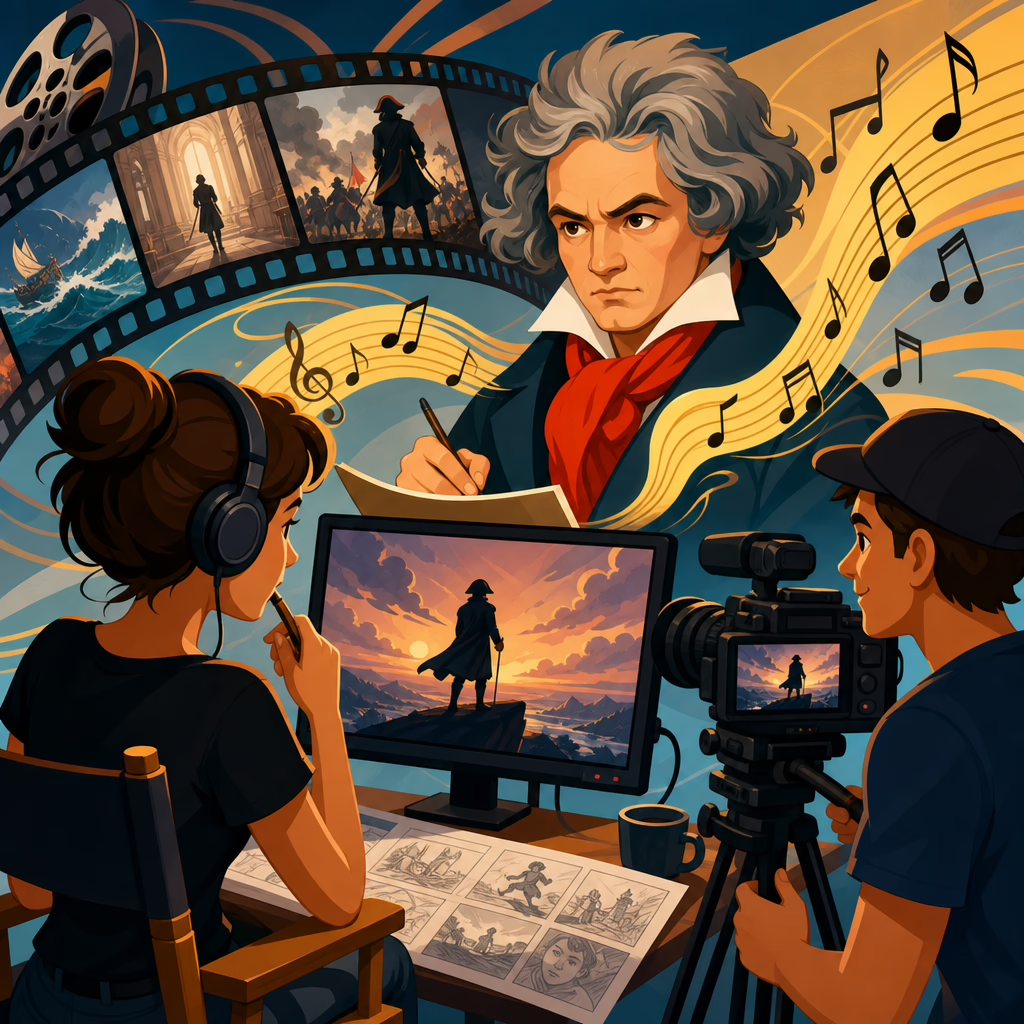
How Filmmakers Use Beethoven’s Music to Tell Stories
Beethoven’s music remains one of cinema’s most reliable storytelling tools because it carries conflict, momentum, tenderness, and moral weight without needing translation. For filmmakers, the value is not simply that Ludwig van Beethoven wrote famous symphonies and sonatas; it is that his work is structurally dramatic. Themes collide, return changed, and push toward resolution in ways that mirror what screen stories do. When directors, editors, music supervisors, and composers place Beethoven into a film, they are not adding generic classical prestige. They are choosing musical architecture that can define character, sharpen a scene’s emotional logic, or create irony by setting elevated music against chaos, violence, comedy, or everyday life.
In practical terms, filmmakers use Beethoven’s music in two main ways. First, they license or perform an existing piece such as the Fifth Symphony, the Ninth Symphony, the “Moonlight” Sonata, the Seventh Symphony, or “Für Elise” as source music or score. Second, they borrow Beethoven-like ideas: rhythmic insistence, abrupt dynamic contrast, motivic development, and the journey from tension to release. I have seen in editing rooms how quickly a Beethoven cue can clarify a cut. A scene that felt merely sad can become tragic, defiant, or transcendent depending on whether the chosen passage emphasizes harmonic instability, pulse, or melodic inevitability. That flexibility explains why Beethoven appears across war films, dramas, thrillers, animation, documentaries, prestige television, and even satire.
This hub article surveys how filmmakers use Beethoven’s music to tell stories across the broad miscellaneous landscape of the Multimedia Gallery topic. It covers why certain pieces recur, what narrative functions they serve, how famous film examples work, where the creative opportunities and limits lie, and what viewers should listen for. Understanding these patterns matters because music often does narrative labor that dialogue never states outright. If you can hear why a director picked Beethoven, you can read the scene more accurately. You also gain a map for exploring related articles on scoring, editing, historical context, music rights, sound design, and adaptation throughout this subtopic.
Why Beethoven Fits Film Narrative So Well
Beethoven fits screen storytelling because his music is built on clear motives that develop under pressure. A small cell, sometimes only four notes, can generate an entire movement. That economy resembles screenwriting, where a single conflict expands into plot. The opening of Symphony No. 5 is the obvious case: short-short-short-long. In film terms, it behaves like a narrative engine. It announces urgency, repeats with variation, and refuses to let the audience relax. Directors use such material when they need inevitability. Even viewers with no formal music training recognize the sense of drive.
Another reason is contrast. Beethoven was a master of sudden shifts in volume, texture, tempo emphasis, and emotional register. Those changes translate beautifully to montage, reversals, and scene transitions. Editors often need music that can support a cut from intimate close-up to wide-scale action without feeling arbitrary. Beethoven supplies that naturally. He can move from solitary introspection in a piano sonata to public triumph in an orchestral finale, giving filmmakers a wide expressive range within one recognizable authorial voice.
Beethoven also carries cultural meaning. His name signals seriousness, artistic ambition, European concert tradition, and the idea of genius forged through struggle. Films use that cultural baggage deliberately. Sometimes the association is sincere, as in biographical or historical dramas. Sometimes it is ironic, as when refined music accompanies brutality or absurdity. Stanley Kubrick understood this in A Clockwork Orange, where Beethoven becomes part of Alex’s ecstatic inner life, binding beauty to menace. The audience is forced to confront an uncomfortable truth: great art does not automatically produce good behavior.
Because much of Beethoven’s output is in the public domain, filmmakers can access the compositions without paying publishing fees, though they still must license specific recordings or create new ones. That practical advantage matters. Independent films with limited budgets can record a chamber arrangement of a Beethoven work more easily than they can commission a full bespoke score. At the same time, the familiarity of the material means directors must use it with care. A famous cue brings instant recognition, but it can also feel overdetermined if placed lazily. Effective films either align the expected meaning with the scene very precisely or subvert it in a way that adds new insight.
What Specific Beethoven Pieces Usually Communicate
Not every Beethoven piece says the same thing on screen. Filmmakers choose works based on narrative function, instrumentation, and audience association. The Fifth Symphony often signals fate, conflict, war, determination, or looming consequence. The slow movement of the Seventh Symphony is frequently used for grief, solemn procession, historical gravity, and collective suffering; its repeating rhythm can feel like both mourning and endurance. The Ninth Symphony carries ideals of transcendence, human unity, public ceremony, and overwhelming scale, though after many modern uses it can also suggest grandiosity or ideological tension.
The piano sonatas serve different purposes. The “Moonlight” Sonata, especially the first movement, is a favorite for solitude, suppressed emotion, late-night reflection, and melancholy elegance. “Für Elise” often appears when filmmakers want instant recognizability, childhood piano lessons, domestic space, or a lightly ironic touch because it is so familiar outside concert halls. The “Pathétique” Sonata can underline emotional intensity with more rhetorical force than the “Moonlight,” making it useful for melodrama or psychological conflict. Even the “Ode to Joy” theme from the Ninth can shift meaning scene by scene: sincere celebration in one film, chilling indoctrination in another.
| Beethoven work | Common story function | Typical screen effect |
|---|---|---|
| Symphony No. 5, first movement | Conflict, pursuit, inevitability | Creates propulsion and high-stakes momentum |
| Symphony No. 7, second movement | Grief, endurance, historical weight | Turns scenes solemn and processional |
| Symphony No. 9, “Ode to Joy” | Triumph, mass feeling, irony | Expands scale or exposes ideological tension |
| “Moonlight” Sonata, first movement | Introspection, loss, secrecy | Adds intimate melancholy and suspended time |
| “Für Elise” | Recognition, domesticity, ironic refinement | Signals familiarity quickly, sometimes with humor |
These meanings are not fixed rules. Context changes everything. A slow, mournful cue can play over a peaceful landscape and imply memory rather than tragedy. A triumphant chorus can be framed as oppressive if the camera shows coercion or fanaticism. The best filmmakers understand that Beethoven works because audiences bring expectations to it. Storytelling power lies in meeting, delaying, or overturning those expectations with intention.
How Directors Use Beethoven for Character, Irony, and Point of View
One of the most effective uses of Beethoven in film is characterization. Music can reveal taste, aspiration, class, vulnerability, or hidden contradiction before a character explains anything. In The King’s Speech, Beethoven’s Seventh Symphony, second movement, supports the climactic radio address with dignity and mounting control. The cue does not merely decorate the scene. It dramatizes King George VI’s effort to master fear and inhabit public responsibility. The repeated rhythmic pulse works almost like a breathing guide, turning speech itself into a heroic action.
In A Clockwork Orange, Beethoven is inseparable from Alex’s psychology. Kubrick uses the music not to civilize him but to expose the intensity of his appetite. That choice creates one of cinema’s sharpest examples of ironic counterpoint. The audience hears exalted music while watching cruelty, which blocks any easy equation between aesthetic sensitivity and moral goodness. It also makes the later aversion-conditioning sequences more disturbing because Beethoven, once tied to Alex’s ecstatic freedom, becomes bound to nausea and state control. The story is not only about violence; it is about who gets to own culture and how coercion can corrupt pleasure.
Filmmakers also use Beethoven to establish point of view. If a piece is source music, coming from a radio, concert hall, piano lesson, or headphones, it belongs to the world of the character. If it shifts into non-diegetic score, the film may be inviting us deeper into that character’s subjective experience. I have watched directors exploit this transition very carefully. A rehearsal scene might begin with realistic room acoustics, then the sound opens up as the camera moves into memory, imagination, or emotional identification. Beethoven’s recognizability helps the audience track that shift instantly.
Comedy can benefit too. Because Beethoven carries prestige, placing his music against banality or clumsiness can be funny without words. The joke works when the contrast reveals something true: a character’s inflated self-image, a social mismatch, or the absurd grandeur of ordinary problems. Used lazily, this becomes cliché. Used well, it deepens tone by letting humor and admiration coexist.
Editing, Pacing, and the Mechanics of Scene Construction
Beyond symbolism, Beethoven is useful because his phrasing gives editors strong structural markers. Musical cadences suggest where to cut, hold, or transition. Crescendos can support a push-in shot or the escalation of a confrontation. A sudden orchestral accent can punctuate a reveal more cleanly than dialogue ever could. This is especially true in montage. Training sequences, historical summaries, travel sequences, and memory collages often need music with internal development. Beethoven provides beginning, complication, expansion, and arrival inside a single movement.
Tempo matters as much as melody. The pulse of the music affects how long shots feel. A measured adagio can stretch time, making the audience inspect faces and spaces more closely. A driven allegro compresses perception and heightens urgency. When editors cut against Beethoven instead of simply on the beat, they can create productive tension. A delayed cut after an expected cadence can make a character seem trapped in thought. A cut just before resolution can preserve anxiety. These are technical decisions, but they are also storytelling choices.
Sound mix shapes the result. A Beethoven cue can dominate, blend, or sit behind dialogue depending on equalization, reverb, and dynamic control. In historical dramas, mixers often preserve more natural orchestral depth to maintain period texture. In thrillers, they may emphasize lower strings or brass impact to make the cue feel more dangerous. The same composition can play as noble or ominous depending on performance style and mix. That is why film use of Beethoven is never just about the notes on the page. Recording, tempo selection, instrumentation, and acoustic space all participate in meaning.
Documentary filmmakers use Beethoven differently but with equal precision. In nonfiction, a Beethoven cue can lend historical continuity or frame an issue as part of a larger human struggle. Yet documentary editors must be careful. Strong canonical music can overstate significance or impose emotional interpretation too aggressively. The most disciplined documentaries earn the cue by aligning it with evidence, testimony, and visual argument rather than using it as borrowed importance.
Historical Context, Licensing Realities, and Common Mistakes
Beethoven’s compositions are free to use, but film rights are not automatically free. Producers must distinguish between the composition and the sound recording. A new recording avoids master recording fees, but it still requires musicians, studio time, and post-production. For a low-budget film, a solo piano sonata may be realistic where a symphonic movement is not. Some projects use high-quality library recordings, though exclusivity and emotional fit can become issues. In my experience, the right performance matters more than filmmakers first assume. A slightly wrong tempo or overly glossy interpretation can flatten the scene.
Historical authenticity also deserves attention. A film set before a work’s premiere should not include it casually if period accuracy matters. Likewise, performance style can shape credibility. Full modern vibrato and lush late-romantic phrasing may be expressive, but they create a different historical impression than a leaner, more classically informed approach. Not every film needs strict musicological purity, yet inconsistency is noticeable in otherwise meticulous productions.
The biggest mistake is using Beethoven as shorthand for importance. Audiences can feel when a cue is doing all the emotional labor. Another mistake is choosing the most famous excerpt without considering whether viewers’ prior associations will overpower the scene. The “Ode to Joy” can be magnificent, but it is so culturally loaded that it may bring memories of other films, ceremonies, advertisements, or political events. Smart filmmakers either embrace that baggage knowingly or select less familiar Beethoven that serves the story more cleanly.
Finally, Beethoven works best when connected to the film’s broader sound world. A cue should relate to themes, motifs, production design, and character arcs. When that integration happens, the music feels inevitable rather than imported. That is the standard viewers should listen for across this Multimedia Gallery hub and the related miscellaneous articles linked from it. Revisit a favorite film, isolate the Beethoven cue, and ask what story information the music provides that the image alone does not. That single habit will make you a sharper viewer and a more perceptive listener.
Beethoven’s music helps filmmakers tell stories because it combines dramatic structure, emotional intensity, and deep cultural recognition. Directors use symphonies, sonatas, and familiar themes to shape pace, define character, create irony, support montage, and enlarge a scene’s meaning beyond dialogue. Specific works carry recurring associations, but their real power comes from context. A cue can signal fate, grief, unity, vanity, menace, introspection, or resilience depending on performance, placement, and image. That flexibility explains why Beethoven remains central across drama, satire, documentary, historical film, and psychological cinema.
For viewers, the main benefit of understanding these choices is simple: you stop hearing classical music as background and start hearing it as narrative evidence. When a film uses the Fifth Symphony, the Seventh’s funeral-like pulse, or the fragile stillness of the “Moonlight” Sonata, it is making an argument about what the moment means. Follow that argument and the story becomes clearer. Explore the related Multimedia Gallery articles on film scoring, editing rhythms, music supervision, adaptation, and sound design, then watch a scene with Beethoven again and listen for the story inside the music.
Frequently Asked Questions
Why do filmmakers so often choose Beethoven’s music for storytelling?
Filmmakers return to Beethoven because his music already behaves like drama. It does not simply create a pretty background or signal a general mood; it moves with intention. His themes often begin with a clear emotional or rhythmic idea, encounter resistance, develop tension, and return transformed. That arc mirrors the way scenes, character relationships, and entire films are built. In practical terms, this makes Beethoven especially useful for directors and editors who need music that can support conflict, momentum, revelation, or emotional release without feeling arbitrary.
Another reason is emotional clarity. Beethoven’s music can communicate urgency, struggle, triumph, vulnerability, grief, and moral seriousness in a way that audiences recognize immediately, even if they do not know the title of the piece. A few measures can suggest inner turmoil, a hard-won decision, or a sense that something important is at stake. That kind of instant readability is valuable in film, where music often has to deepen what the image is doing in a matter of seconds.
There is also cultural memory attached to Beethoven. Because his work is so widely known, it can bring additional layers to a scene. It may evoke sophistication, discipline, rebellion, genius, or historical weight depending on how it is used. A filmmaker can use that familiarity sincerely, ironically, or even subversively. In all cases, Beethoven offers more than prestige. He offers structure, emotional force, and thematic depth, which is why his music remains one of cinema’s most reliable storytelling tools.
How does Beethoven’s music help shape the emotional arc of a scene?
Beethoven’s music shapes a scene by giving it directional energy. Many pieces feel as though they are going somewhere, which is essential in film storytelling. Rather than sitting still emotionally, the music often pushes forward through repetition, variation, contrast, and escalation. That means a scene can begin in uncertainty, gather pressure, and arrive at a breakthrough while the music reinforces each stage. Editors especially value this quality because the music can help determine pacing, shot length, and the timing of key visual beats.
His work is also powerful because it contains emotional complexity rather than a single fixed mood. A Beethoven movement may hold tenderness and tension at the same time, or nobility mixed with pain. That allows filmmakers to avoid blunt emotional instruction. Instead of telling the audience exactly what to feel in a simplistic way, the music can suggest layered inner states. This is particularly useful in scenes involving moral conflict, character hesitation, or bittersweet change, where a more one-dimensional score would flatten the drama.
Beethoven can also enlarge the meaning of a moment. A private action, such as a character making a difficult choice, can feel larger and more consequential when paired with music that carries historical and emotional weight. The scene gains scale without necessarily becoming louder or more obvious. In that sense, Beethoven helps filmmakers connect the intimate and the monumental. He can make one look, one cut, or one gesture feel like part of a larger human struggle, which is one reason his music remains so effective on screen.
What makes Beethoven’s compositions especially effective for film editing and pacing?
From an editing perspective, Beethoven is useful because his music is highly organized yet dramatically flexible. His pieces often contain clearly defined motifs, shifts in intensity, and strong rhythmic profiles that can guide visual structure. Editors can cut to recurring phrases, rising momentum, sudden pauses, and major transitions with unusual precision. When a scene needs to build toward a reveal, confrontation, chase, realization, or emotional release, Beethoven often provides ready-made musical architecture that supports those turns naturally.
His sense of development is especially important. Beethoven rarely leaves an idea untouched. He introduces a musical thought, presses on it, disrupts it, reworks it, and brings it back altered. That process resembles the way film scenes evolve through action and reaction. Because of this, his music can help a sequence feel as if it is actively unfolding rather than merely being accompanied. It gives editors a framework for acceleration and contrast, helping them decide when to linger, when to cut sharply, and when to let a moment land.
Beethoven also offers dynamic range. His music can move from intimacy to force, from stillness to eruption, often within a single movement. That variability makes it highly adaptable across different kinds of scenes. A director may use one passage to underscore internal reflection and another to drive external action, while maintaining a coherent tonal world. This ability to support both pacing and narrative progression is a major reason filmmakers continue to use Beethoven when they want music that does more than decorate the image.
Do filmmakers use Beethoven mainly for grandeur, or can his music support subtle storytelling too?
Beethoven is often associated with scale, intensity, and grandeur, but limiting him to those qualities misses a great deal of what makes his music so valuable in film. Yes, his symphonic writing can bring power and sweep to major scenes, but many of his works also contain remarkable intimacy, delicacy, and emotional nuance. Filmmakers can use those quieter qualities to reveal vulnerability, longing, doubt, or tenderness without losing a sense of seriousness. In fact, some of the most effective uses of Beethoven in cinema are not the biggest moments but the most psychologically revealing ones.
Subtle storytelling benefits from Beethoven because his music often suggests inner movement even at low intensity. A soft piano passage or restrained orchestral phrase can imply thought, memory, hesitation, or unresolved feeling. That makes his work especially useful when a filmmaker wants to support subtext rather than announce emotion. Instead of overpowering a performance, the music can sit just beneath it, giving shape to what the character cannot say directly. This is one of the reasons Beethoven works so well in scenes of introspection, emotional distance, or quiet transformation.
He is also effective when filmmakers want contrast. A restrained use of Beethoven in a modest scene can create depth by implying that more is happening internally than the surface action suggests. Conversely, placing highly charged Beethoven against calm or controlled imagery can create irony, tension, or emotional friction. So while grandeur is certainly part of his cinematic appeal, his true storytelling strength lies in range. He can elevate spectacle, but he can also illuminate silence, ambiguity, and the smallest shifts in human feeling.
How do directors and music supervisors decide where Beethoven’s music belongs in a film?
Choosing where to place Beethoven begins with story function, not reputation. Directors and music supervisors ask what the scene needs the music to do. Should it reveal a character’s inner life, intensify conflict, connect separate moments, add irony, establish period or cultural tone, or carry a sequence toward resolution? Beethoven is selected when his music can perform one of those jobs with unusual clarity. Because his compositions are structurally dramatic, they are often best placed at turning points, moments of realization, morally charged decisions, or sequences that need strong forward motion.
They also consider point of view. In some films, Beethoven is used as source music, meaning it exists within the world of the story and may tell us something about a character’s taste, education, obsession, or emotional state. In others, it functions as score, shaping how the audience interprets the scene from outside the characters’ awareness. That distinction matters because it changes the meaning of the same piece. A sonata heard on a record player can define a room or a personality, while the same music used non-diegetically can frame the entire scene as tragic, noble, or conflicted.
Finally, placement depends on balance. Because Beethoven carries such strong identity and emotional force, filmmakers have to use him carefully. Too much can overwhelm dialogue, performance, or the film’s own musical language. The best placements feel earned. They arrive at moments where the music’s tension, momentum, or tenderness deepens the narrative rather than competing with it. When directors and music supervisors choose well, Beethoven does not feel pasted onto the film. It feels as though the story has found a musical voice equal to its emotional and dramatic stakes.